


(Texte français disponible ici)
The campaign is winding down. There was some more nonsense on Friday, but let’s get a bit more serious.
But first, this. Christine Fréchette has indicated that she wants to remain CAQ leader even if she isn’t elected.
How do I put this…
Christine, the only way that happens is if not a single CAQ candidate is elected, and even then. But if even one other CAQ candidate is elected, that person will be leader.
That’s how it works. Someone will explain it to you Tuesday morning.
Don’t worry, you’ll get at least $230,000 as a transition allowance. Things could be worse.
For a coalition government
On Monday, the Parti Québécois will win Quebec’s 44th general election.
At best, it will get a little over 30% of the vote. Under normal circumstances, that wouldn’t be enough to govern.
In Quebec’s 43 general elections since Confederation, only three majority governments have been formed with less than 40% of the vote: Honoré Mercier in 1886 (39.6%), Maurice Duplessis in 1944 (38%), and François Legault in 2018 (37%). Aberrations.
Two other governments were formed with less than 35% of the vote. As you would expect, both were minority governments: Jean Charest in 2007 (33%) and Pauline Marois in 2012 (32%).
Paul St-Pierre Plamondon, by contrast, could see his party win a majority of seats in the National Assembly with barely 30% of the vote, thanks to an unprecedented five-way split.
That would be a first. And it’s not just possible. It’s likely.
Over the past few days, the PQ leader has repeatedly asked Quebecers to give him a majority. He hasn’t been particularly subtle.
In Quebec City, PSPP has promised to build a $350-million football stadium on the site of the former Quebec Colisée, in a region where the QCP is ahead but a few ridings are within reach.
In Arthabaska-L’Érable, PSPP has hinted that he could appoint his MNA, Alex Boissonneault, to cabinet. Boissonneault is currently facing a strong challenge from the QCP.
In Charlevoix, PSPP has offered a credit for gas purchases. Just because.
That’s one way to win a “majority.” But it would miss the point.
Because that majority would still be hollow, surreal, absurd, unrepresentative, and hardly democratic.
For a long time in Quebec, getting less than 50% of the vote meant your party ended up in opposition. That was the rule from 1867 to 1962.
Then something broke. Parties started winning elections with around 45%. Then around 40%. Then below 40%.
Today, a political party can hope to form a “majority” government with 30% of the vote.
Some will argue that the same rule applies to every party. True, but that doesn’t make the rule any more sensible.
Quebecers who support other parties outnumber those backing the party likely to form government by 2.3 to 1. Yet that party will probably have a majority of seats. That’s completely nuts, mathematically and democratically.
As a reminder, this is what it looks like:
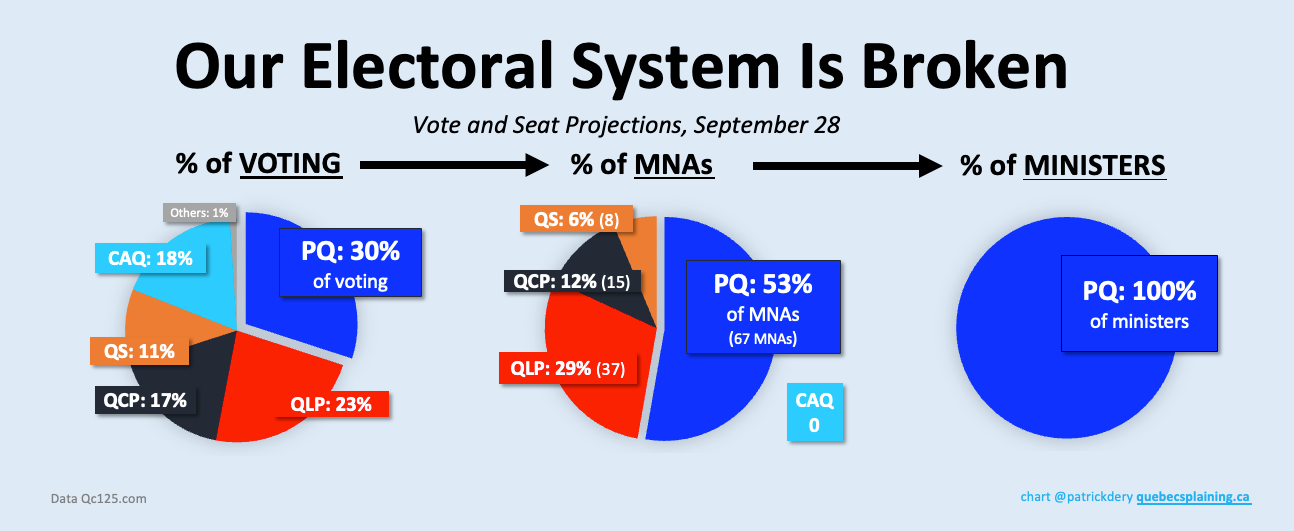
It’s not Mr. St-Pierre Plamondon’s fault that Quebecers have a broader range of political options (a good thing) and are dividing their support among five main political camps.
Nor is it Mr. St-Pierre Plamondon’s fault that François Legault failed to keep his promise to reform the electoral system, a solemn promise made in front of the cameras in the spring of 2018.
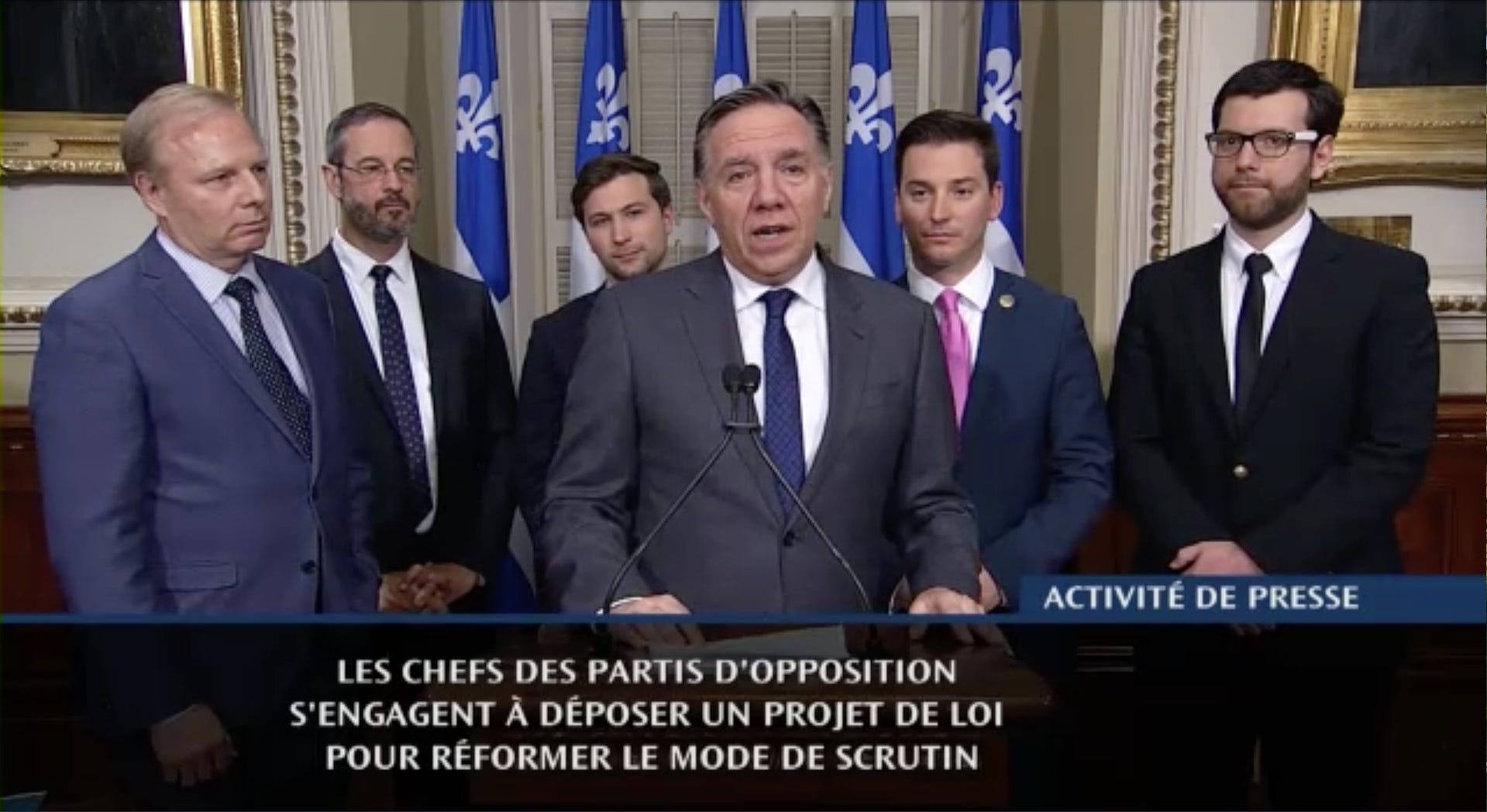
François Legault lying to more than 8 million people, circa 2018.
But that’s the situation Mr. St-Pierre Plamondon faces today. He can follow the example of some of his predecessors, exploit the circumstances, and cling to power for the next four years.
That would be legal. It would be constitutional. Would it be legitimate?
Several of you say others did it before PSPP. Did you think it was honest?
There is another way.
PSPP could also acknowledge that a “majority” with 30% of the vote is nothing more than a democratic accident, the unintended consequence of a fragmented vote that our electoral system can’t digest. What it spits back out is a mess.
He could also acknowledge that the choices of Quebecers who didn’t vote for his party are just as legitimate, and that those Quebecers far outnumber his supporters.
It’s probably not what he hoped for. But it’s the reality.
In 2022, the Coalition avenir Québec won 90 of the National Assembly’s then 125 seats with just 41% of the vote.
The disparity between votes and seats, from one party to another, was grotesque.
The CAQ got 41% and 90 MNAs. The PQ, QS, and the QCP together got 14 MNAs with slightly more votes.
Here’s what I wrote at the time.

I wasn’t the only one who thought it didn’t make any damn sense.
Representing the will of the people isn’t a partisan issue. It follows logically from the exercise of fundamental political rights, which the electoral system must strive to reflect.
That’s the foundation of political power and trust in our institutions, whichever party governs. It’s what lets us believe the electoral process is fair and accept it, even when the election doesn’t turn out the way we wanted.
Ultimately, it’s what lets us spend four years putting up with the government we didn’t vote for, because we know it came to power the right way.
Hence two dangers: slipping into power by accident, and abusing it.
+++++++
The PQ’s MNAs, like others, had identified the same danger.
Here’s what Pascal Bérubé said on the evening of October 3, 2022, after the CAQ swept Quebec with less than half the vote.
“Democracy is being shortchanged. With five political parties, the vote is fragmented. It’s obvious we need an electoral system with a proportional component […] the results don’t reflect the popular vote.”
Here’s what his leader added the next day:
“The disparity between the popular vote and the number of seats is historic, and it poses a serious problem for democracy in Quebec.”
Then, in a news release on November 28, 2022:
“(…) the current electoral system has produced an unprecedented distortion in the composition of the National Assembly, and we must do everything in our power to restore some democratic balance.”
On December 9, 2022, Pascal Bérubé rightly noted that the National Assembly’s two-thirds requirement for certain appointments could no longer serve its purpose when a party with 41% of the vote could win 72% of the seats.
Finally, in September 2023, the PQ pointed to “an abandoned commitment that causes a historic democratic distortion, giving the government 72% of the MNAs with only 41% of the vote.”
That promise was indeed abandoned. A new government could still be a little more principled and honour it. It could act as though electoral reform had been adopted. That’s what the PQ itself wanted at the time, and what a majority of Quebecers still hope for.
Actions > words.
Whether or not it wins a majority, the PQ should seek to govern in a way that represents a real majority.
That would mean governing as though it didn’t have a majority.
In practice, the PQ would secure the support of at least one, if not two, other parties whenever it wanted to pass a bill, so it has the backing of MNAs representing a majority of us.
A bolder step would be to seek a formal, lasting coalition with one or two other parties. To share power. To bring MNAs from other parties into cabinet.
That would mean PQ ministers serving alongside ministers from QS, the QCP, the CAQ, or even the QLP.
I know that would mean giving some things up, including the referendum. But the choice is that or basing political decisions on a lie about the government’s democratic mandate.
I know, no one has ever done this, because in Quebec we do politics like bickering children.
In most European democracies, it happens all the time, and no one is surprised anymore.
Maybe it’s time we started acting like adults.
+++++++
I have no doubt this appeal won’t get much traction. Political commentators tend to treat elections like hockey games: keep score, and let the strongest win.
Ideals? Come on!
Politics isn’t a sport. It’s how democracy ultimately gives expression to the will of the people.
A large majority of Quebecers won’t support the PQ. They deserve to be heard too.
Quebec’s next premier should show some humility and govern for all Quebecers. He should form a coalition government and govern accordingly, whether or not he has a majority of seats.
Of course, we’re all vulnerable to temptation, so it wouldn’t hurt if voters nudged the winning party toward cooperation by denying it a majority.
But even if the PQ should get a majority, that shouldn’t stop it from trying to govern differently. Le choix de la confiance (choosing trust), as its slogan puts it.
To borrow the words of a great man, it would be a beautiful risk, a beautiful dream.
-30-
My name is Patrick Déry. I’m a French-speaking Québécois who writes for a living, and I’m trying something different here. If you enjoyed reading this article, you can support me by buying me a coffee. You can also subscribe to this publication (free or paid, your choice).
Comments, shares, and “likes” are always appreciated. They also help the Substack algorithm notice me, so don’t be shy!

Yes, the CAQ is out of the equation. What did you expect? ;-)