In Montreal, service is provided in French. No one seems to notice.
This article is 97.4% good news.
(Texte français disponible ici.)
I’ll put the candy here, but only if you promise to read all the way to the end. Deal?
Okay, let’s get started.
+++++++
When the French language is in danger, you can count on Jean-François Roberge to come to the rescue.
Nothing escapes the watchful eye of the Minister of (take a deep breath) the French Language, the Canadian Francophonie, Laicity [i.e., secularism], Democratic Institutions, Access to Information, and the Protection of Personal Information. Phew!
From now on, as a result of an initiative by one of the many ministries headed by Mr. Roberge, every municipal employee must ensure that the business with which they deal on behalf of their employer complies with the Charter of the French Language, better known as Bill 101, along with its recent amendments, such as Bill 96.
Previously, only transactions of $5,000 or more fell under the scope of the law. From now on, before buying a drain auger or a sandwich at a local store, municipal employees will have to verify whether said business complies with the rules of the Office québécois de la langue française (OQLF).
Minister Roberge seems to be truly proud of this.
(Side note. I did not come up with the example of a clogged drain. The government did. I don’t know enough about the condition of the public service’s restrooms or Minister Roberge’s bowels to understand why this is a concern for his staff. I also didn’t know this was an issue in municipalities. Since a drain auger sells for $43 at Canadian Tire, it might be more practical for each city to buy its own tools rather than sending an employee to the hardware store every time a toilet gets clogged. Perhaps the Minister of Municipal Affairs should look into this.)
At hearing about the new manoeuvre from Mr. Roberge, one can’t help but think that the French language situation must be really bad in Quebec’s retail sector. Just think about it: every single employee in every single municipality in the province, from Gatineau to Gaspé, has just been turned into an OQLF inspector. From a Machiavellian-bureaucratic standpoint, it’s actually brilliant, and kudos to the twisted mind that came up with that.
On the other hand, it might not do much for municipal employees’ productivity, but that’s clearly not a preoccupation for Mr. Roberge. Our unmasked vigilante’s only concern is our common language.
By the way, how is French faring in Quebec’s businesses?
As luck would have it, the OQLF published a study on businesses’ compliance with Bill 101in early May. The study examined signage, language of service, invoices, and payment terminals in Greater Montreal stores.
More specifically, between January and May 2025, OQLF inspectors surveyed the Quartier Latin—that is, part of downtown—Taschereau Boulevard on the South Shore, and Laurentides Boulevard in Laval. In total, they visited nearly 1,000 stores.
What were the results?
The “overall compliance rate”—that is, the percentage of merchants fully compliant with the OQLF’s criteria—was 77%, as shown in this graph from the OQLF’s website:
So, 23% of merchants are non-compliant. That may seem like a lot—even alarming. Are merchants in Montreal and its suburbs rebelling against Bill 101?
The picture changes somewhat when we look at each criterion separately. The highest non-compliance rate is then 13%. The violations are not the same across all stores, and a very large proportion were compliant with several of the aspects.
What are the problems?
Language displayed on payment terminals: this is the most common issue. The display is in English in 13% of cases (and therefore in French in the remaining 87%). In its report, the OQLF notes that its inspectors helped merchants—who seemed cooperative—to change the default setting to French.
Receipts: 11% were issued in English. This is not insignificant, but it is once again more of a technical issue related to software or its configuration than explicit disobedience. It is also possible that convenience stores or fast-food owners did not attach much importance to a receipt that customers do not look at. Still, 89% of stores were compliant.
Outdoor public signage: non-compliant in 8% of cases. So, 92% were compliant. Here, the rules are well known, but things get complicated in practice. Sometimes, the company name is English and translates poorly. Personally, I hope I never see Canadian Tire become Le Pneu canadien.
Sometimes, businesses simply lack imagination. Staples, which became “Bureau en gros” in Quebec, showed that it is possible to both be effective from a marketing standpoint and respect our linguistic difference, which is unique in North America.
Sometimes, too, business owners are simply reluctant to follow the rules, and they aren’t necessarily English speakers. I struggle to understand why a French-speaking Quebecer would insist on naming their bar Le Red Room rather than La Chambre rouge, especially since it generally refers to the same thing in literature and popular culture, but some people do it anyway.
Language of service: the fourth and final criterion is the one that receives the most media attention, and also the one that generates the most dissatisfaction. According to the OQLF, more than 10,000 complaints were filed over the past year. This is also the main reason that prompted the OQLF to conduct the inspections.
So what is the percentage of stores that were unable to provide service in French during the OQLF’s inspections? Two percent.
You read that right: in Montreal, on the South Shore, and in Laval—these bastions of rampant anglicization—an employee was able to service OQLF inspectors who spoke to them in French 98% of the time.
Here is the overall picture, once again taken from the OQLF website:
Of course, it’s not perfect. Of course, there’s still work to be done, but even in Montreal, where a third of the population doesn’t speak French as a first language, at least 87% of merchants comply with one or more of the OQLF’s criteria, and 98% meet the most important one: being able to serve their customers in French. We’re a long way from a linguistic apocalypse.
These generally positive findings regarding the languages used in retail stores are little known, but not new.
In 2022 and 2023, the OQLF conducted a larger-scale study, visiting 10,000 stores to assess the language of greeting, the language of service used spontaneously, and the language of service upon request—that is, when service in French was requested after initial contact in English. It wasn’t just the Quartier Latin that was surveyed, but the entire island of Montreal, from east to west.
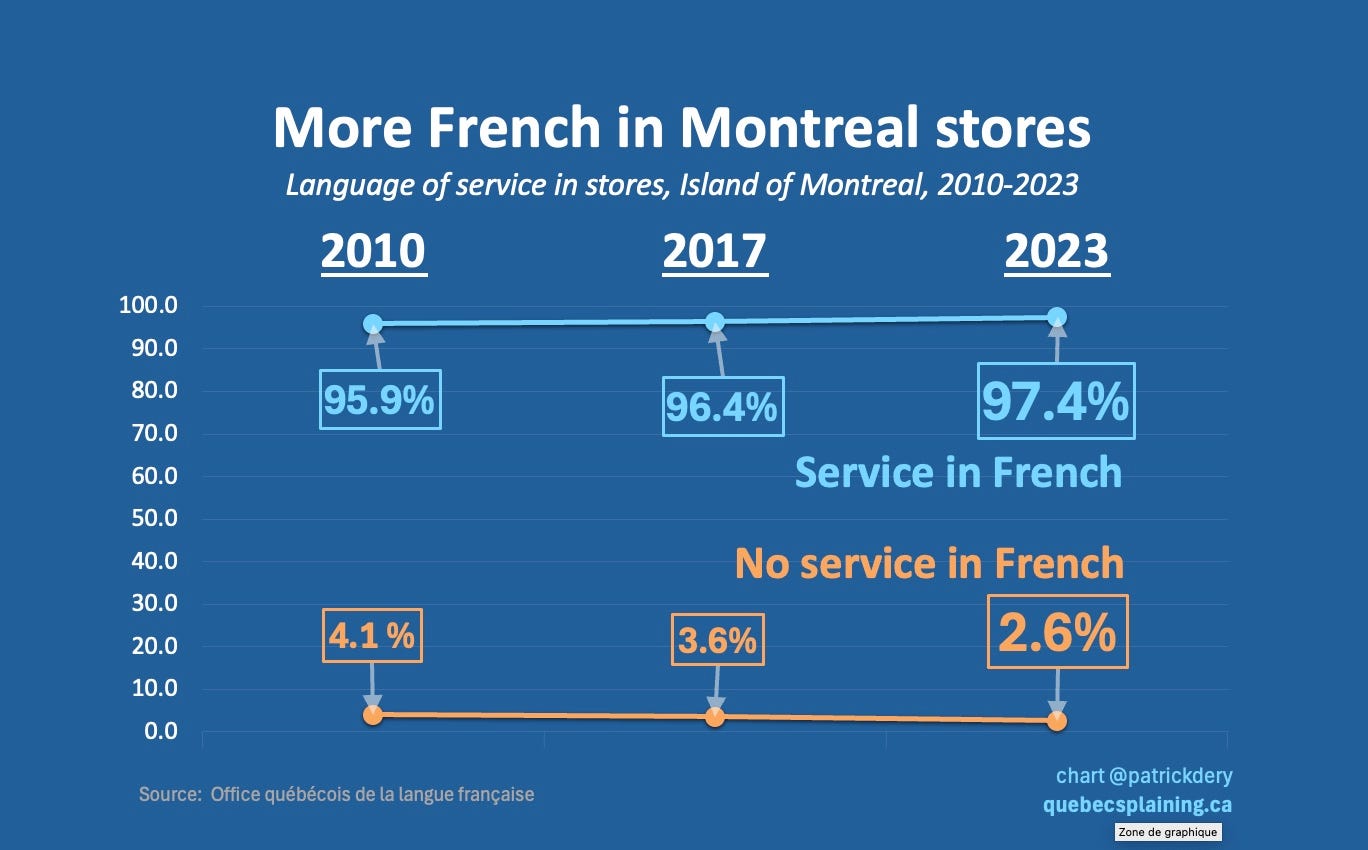
Across the island, 97.4% of merchants were able to service customers in French. In 90% of cases, service was spontaneously offered in French. Even when it wasn’t (which is understandable in English-speaking neighbourhoods), nearly all employees were able to provide it upon request, hence the overall result of 97.4%.
Better yet, this figure was on the rise, as the same rate was 95.9% in 2010 and 96.4% in 2017.
You have to go all the way to page 32 of the report, just before the conclusion, to discover what I believe is the most important chart.
During this period, when we were bombarded with articles about the “decline” of the French language and our former prime minister was raising the spectre of Quebec’s “Louisianization,” the lack of service in French became even rarer, dropping from 4.1% to 2.6%.
Let’s just say that puts alarmist headlines like “Unable to be served in French” into perspective.
That’s not all. Hold on to your poutine.
In the western part of the Island of Montreal—its most English-speaking area—95% of merchants were able to serve customers in French. Ninety-five percent! (It’s listed at the top of page 35 of the OQLF report if you’re curious.)
Even if the greeting was more often a “Bonjour-Hi,” or even just a “Hi,” the fact remains that almost everyone in the western part of the island is willing and able to serve those who ask for it in French.
Admit it, you wouldn’t have expected that.
To those who doubt the figures, may I remind that the OQLF recently sought to “Frenchify” the slogan “Go Habs Go”, and it’s hard to suspect the organization of linguistic complacency.
+++++++
Even media outlets that generally rely less on sensationalism struggle to report the good news.
In early May of this year, when the OQLF published its report on inspections conducted in 2025 at stores on the South Shore, in the Latin Quarter, and in Laval, Radio-Canada limited itself to discussing the overall compliance rate, without distinguishing between the language of the payment terminal and customer service. One in four stores does not comply with Bill 101. Ouch!
That’s the kind of headline that puts a lot of people in a bad mood. It was also rather simplistic for a topic we know to be so explosive.
The article mentions the 10,000 complaints that we talked about earlier, but fails to note that they rarely lead to court convictions. Generally, merchants cooperate. And not all complaints are valid. In 2012, out of a total of 4,000 complaints, 47 led to convictions and fines.
La Presse went a step further, choosing the angle of language in signage and running a headline about “delinquent merchants.” The article provides more information; it is balanced and, as a good on-the-ground report, gauges the sentiment of business owners. However, it does not mention the surprising and very positive results concerning the language of customer service. If one only reads the headline—which is what between half and as many as three quarters of us do—they’re left with a generally negative impression.
The most positive coverage came (surprisingly) from the Le Journal de Montréal, whose reporter decided to provide an overview of the Office’s findings. But watchout, the OQLF didn’t venture into the English jungle in the western part of the island! Yet, the findings likely wouldn’t have been that different when it comes to the language used to welcome customers.
(Note: I couldn’t find an article in Le Devoir on this topic.)
++++
Journalists both report on the society we live in and reflect on it with their own preferences and blind spots. I’m no exception.
When it comes to French, I can’t help but feel that we’ve lost sight of the bigger picture and that we’ve become somewhat pessimistic by reflex, even though the overall data on the evolution of French in Quebec is generally reassuring, as I’ve detailed here with numerous charts you won’t find anywhere else.
Can Quebec one day become French enough to put our fears to rest?
For now, the answer seems to be no. And we remain vulnerable to the diversionary tactics of Jean-François Roberge and other politicians who raise scarecrows and distract us from what really matters.
-30-
This text is about 2,000 words long, or eight pages of a book. The research, writing, and teasing of the inimitable Minister Roberge took me about two days.
My name is Patrick Déry. I write for a living, and I’m trying something different here. If you enjoyed reading this text, you can support me by buying me a coffee. Comments, shares, and “likes” are always appreciated.
You can also subscribe to this publication (free or paid, your choice).


