Is Quebec independence making a “comeback”?
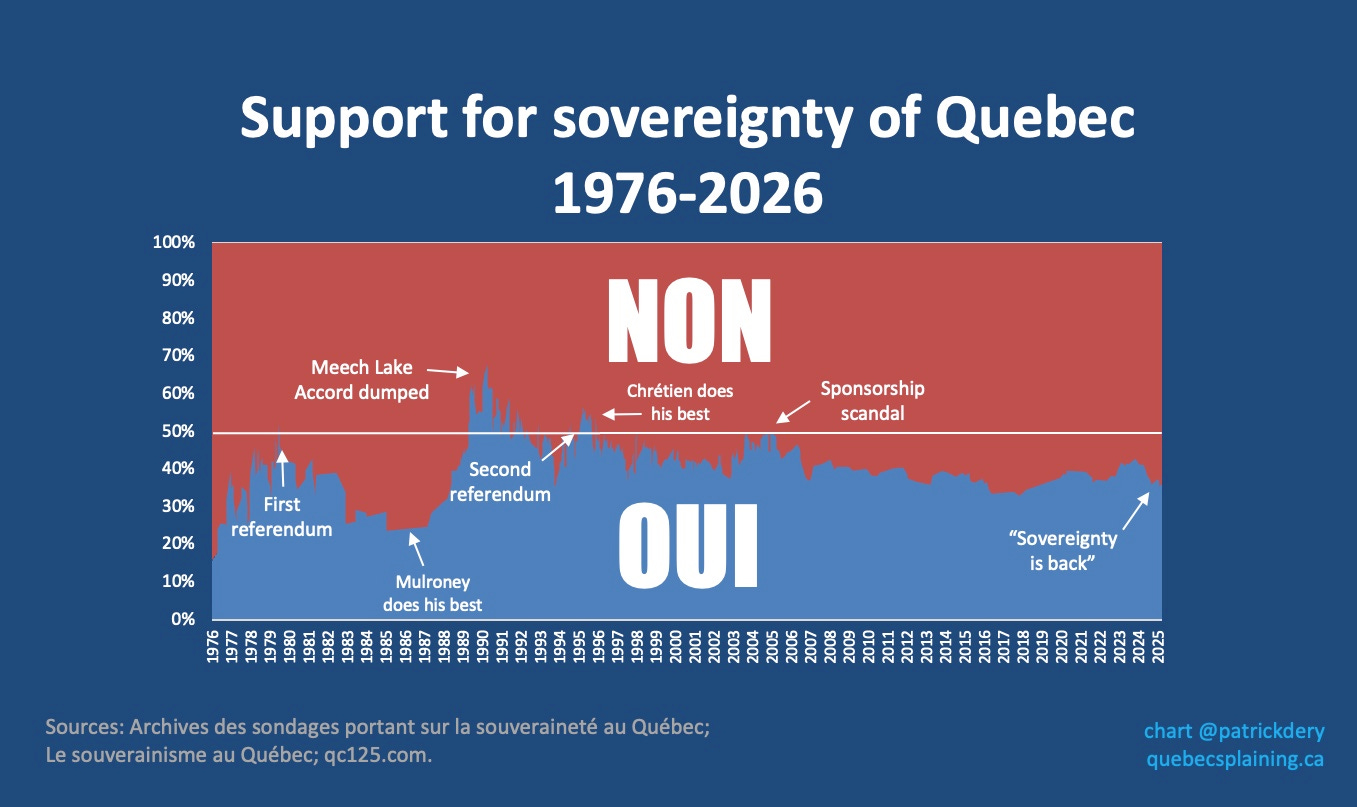
The answer in a chart you won’t see anywhere else, including 943 responses to surveys conducted over 50 years.
(I am placing the chart here, but I suggest you read the text first. I will place it back again below, with localized zooms. Patrick)
Quebec could see another referendum by 2030. At least, that is what the Parti Québécois is promising, and it has a good chance of forming the next government.
So far, the PQ is the only contender. The CAQ is on its knees and clinging to the time it has left; Quebec solidaire and the Conservative Party each represent legitimate but mostly marginal political currents, and they are not a credible option in the eyes of the majority of Quebecers. The Liberal Party, once it has a new leader, will have barely six months to make people forget the Pablo Rodriguez disaster and rebuild its political health. Good luck.
That leaves the Parti Québécois, which is currently winning by default by demonstrating less incompetence than its opponents.
It is therefore more up to the Parti Québécois to lose the next election than it is up to the others to win it. Paul St-Pierre Plamondon (or PSPP), the leader of the PQ, swears that he will hold a referendum during the next term. His political base seems to believe him.
Buoyed by their electoral fortunes, sovereigntist politicians and commentators seem convinced that this time will be the right one. Some are particularly optimistic.
This is the case for Gabriel Coulombe, the PQ’s co-spokesperson on economic issues. In a recent article, Mr. Coulombe argued that we are currently witnessing a “strong comeback for the independence movement in Quebec.” PSPP made the same analysis this week, arguing that “the independence movement is gaining strength.”
What do the numbers say? Almost every month, and sometimes several times in a single month, a new poll measures Quebecers’ support for the sovereignty of the territory they inhabit. I counted 16 polls in 2025 alone, 14 in 2024, and 7 in 2023, thanks to Philippe J. Fournier’s website qc125.com.
The increase in the frequency of polls seems to match the rise of the PQ in voting intentions during the second half of 2023. Each new poll thus fuels the speculations of political commentators, who can then debate the next referendum ad nauseam, just as others debate the Canadiens’ next Stanley Cup on talk radio in the middle of the summer.
Repeated polls keep the media machine running, but they do not increase support for Quebec becoming a country: if a referendum were held today, 38% of Quebecers would vote OUI.
I wanted to go further. The result of a poll is a fluctuating snapshot of the moment. It can be affected by current events, the wording of the question, the preceding questions, the size of the sample, our sympathy or antipathy towards a standard-bearer for the OUI or for the NON, or even chance: most political polls published in Quebec have a margin of error of about 3%, 19 times out of 20. In concrete terms, this means that 32%, 35% and 38% can be the same thing. The OUI side could also achieve a one-time result of 42% or 45% for a while, depending on the latest news and momentary shifts in public opinion.
Since methodology can vary from one firm to another, the variability is even greater when we consider only individual polls. We saw this last summer with the “spectacular rise” of sovereignty among young people. Two months later, 18-34-year-olds were not more sovereigntist than their parents. Was this a fad due to social media or limited sampling? We will never know, but we should not be surprised that the results of small groups are subject to greater variation.
On the other hand, over time, the aggregate results of polls end up showing a broader trend. I find this more relevant, and also more representative of the opinion of a society, if such a thing exists.
50 years of “Quebexit”
Polls have been measuring Quebecers’ support for sovereignty—or independence—for more than 50 years. I wanted to regroup them visually to see what it looked like. To this end, I gathered the survey data available on Claire Durand’s archives of sovereignty polls website at the University of Montreal, the Wikipedia page Le souverainisme au Québec and the website qc125.com.
I counted a total of 943 occasions when Quebecers were asked their opinion on the national question. Placed one after the other on a timeline, this is what it looks like. (Please click on the image to enlarge it.)
What should we take away from this?
On 30 October 1995, some 49.5% of Quebecers voted for their province to become a country. Such a high level of support for independence has only been measured by pollsters a few times since the 1960s. I have noted four occasions, some very brief, others fairly longer in duration.
1- A very brief spike just before the 1980 referendum. Perhaps the OUI would have passed, had it not been for Lise Payette and the “l’affaire des Yvette.”
2- The year before the failure of the Meech lake Accord and a few years after that.
Meech’s failure was a slap in the face. Among French speakers, apart from the older generation, it was difficult to find people who were willing to identify themselves as federalists. In the Parlement étudiant du Quebec, the Federalist Party even changed its name. It simply became “Les Rouges” (The Reds”) and included several sovereigntists in their ranks (I was one of them).
3- A brief fluctuation just before the 1995 referendum, then in the months that followed. This was in the aftermath of Meech. The failure of the Charlottetown Accord had shown that what was insufficient for Quebecers was still too much for the rest of the country. The Constitution had the blues. This is the only other period during which support for the OUI lasted more than a few weeks.
4- A small blip during the media coverage of the sponsorship scandal, which saw Jean Chrétien’s government demonstrate both its pettiness and its incompetence.
Only two periods have seen a majority of Quebecers support the OUI side: the failure of the Meech Lake Accord and the months following the 1995 referendum. At other times, the sovereigntist option has briefly plateaued at around 50%.
Basically, Quebecers have had a taste for independence for less than five years in the last half-century.
And no matter what certain politicians say, wish or claim, there is no way to interpret recent polls as showing a “strong comeback” for independence. At least not in the last 20 years.
***
The questions have varied over time. Sometimes it was about sovereignty, sometimes about independence, with or without a partnership with the rest of the country.
Over time, the way the question was framed has become more consistent. Most polls will generally ask whether you are “for” or “against” sovereignty, as in the Léger or Pallas polls. CROP tends to ask whether you would vote OUI or NON, which places more emphasis on the answer than on the question (which makes sense when everyone knows what the answer means!). Finally, other firms, such as Mainstreet, tend to ask whether you agree that Quebec should “separate” from Canada.
Most of the time, the response of the majority has almost always been the same: NON. This includes the last 20 years, which have seen support for the OUI support garner between 35 and 40 per cent, as shown in the graph.
At best, sovereignty seems like something that could only happen on a whim, with a nasty hangover the next day.
In short, when sovereignty receives the support of the majority, it is more by reaction than by conviction.
Those who promote independence should take note of this. The foundations of a country cannot be built on a whim or a passing mood, within the margin of error. The bar to be cleared should be an irresistible momentum, a lasting groundswell.
In Quebec, such a movement has never really existed.
Up next: PSPP’s speech in answer to Mark Carney. It’s 1759 all over again. Stay tuned.
-30-
This text is 1,347 words long, or about six pages of a book. The research, writing, tinkering with data and design of the chart (viva Excel!) took me about three days.
My name is Patrick Déry. I write for a living, mostly in French, but I dabble in English here. I also enjoy making numbers talk and putting together charts that you won’t see anywhere else. If you enjoyed reading this text, you can encourage me by buying me a coffee. Commenting, sharing and “liking” are always appreciated.
You can also subscribe to this media by clicking on the button below.


