


(Texte français disponible ici)
Before we begin, a public service announcement:
Dear PQ supporters,
When we say the Parti Québécois is “flirting” with the far right, we aren’t saying the PQ has become France’s National Rally or that PSPP is Donald Trump.
We’re pointing out that some of their tactics are similar.
For example:
Blaming “mass immigration” for problems that have existed for years;
Calling everything left of centre “the radical left,” including former PQ ministers;
Denouncing “wokism” as an existential threat when it is fairly marginal and declining;
Agreeing with Donald Trump when he says drugs and illegal immigrants are pouring into the United States from Canada;
Giving Rebel News an interview and using it to make up figures about asylum seekers in hospitals;
Always blaming Ottawa, never Trump, for the tariff war;
Refusing to use the word “war” to describe the trade conflict between Canada and the United States, even though media around the world use it;
Losing his temper whenever anyone criticizes him, including journalists and artists;
Constantly playing up the “decline” of the nation and its culture.
Among other things.
This is factual and easy to see. Many of us have documented it, from across the political spectrum, including people sympathetic to the PQ.
If you think the comparison goes too far, tell your leader to stop.
Now, let’s get into it!
The debate by the numbers
You know me: I like data. So I’m going to take two minutes of your time and five of mine (writing takes longer) to revisit Wednesday’s debate.
Who spoke the most?
Paul St-Pierre Plamondon: 24 minutes
Christine Fréchette: 21 minutes
Ruba Ghazal: 20 minutes
Charles Milliard and Éric Duhaime: 18 minutes each
I would have put money on PSPP coming first. I also would have put money on Christine Fréchette coming last.
Éric Duhaime came last, but I remember several of his interventions.
That’s what an effective communicator does.
Via InfoNews and The Canadian Press.
The words of the debate
· Christine Fréchette: “also,” 23 times
· Paul St-Pierre Plamondon: “young,” 20 times
· Ruba Ghazal: “culture,” 14 times
· Éric Duhaime: “think,” as in “I think,” 18 times
· Charles Milliard thinks too: 14 times
PSPP and Ruba stayed on message, as they say.
The word “referendum” came up 53 times. Every leader said it at least once… except the one promising to hold one.
Via Jean-Simon Bui.
Debate fact-check: The lifespan of a minority government
“Because a minority government, in principle, has a shorter lifespan, and its promises depend on the other parties.”
— Paul St-Pierre Plamondon, during Wednesday’s debate
Ah, minority governments! So complicated! So unstable! So troublesome that they’re common in nearly every democracy on the planet! (Elsewhere, they call them “coalitions.” Real ones.)
I understand why a politician would want both hands on the wheel, or whichever political metaphor you prefer. But it’s worth checking whether what Mr. St-Pierre Plamondon said is true.
(You can probably guess, given how late it is as I write this, that I wouldn’t bother bringing it up if it were.)
1. Minority governments have “a shorter lifespan”
That’s true. But not for the reasons PSPP implies.
Quebec has had three minority governments: in 2007 (Charest), 2012 (Marois), and 1878.
In both recent cases, the opposition parties didn’t want an election and the legislature was functioning. But the governing parties brought about their own downfall in the hope of winning a majority. It worked for Charest. It didn’t work for Marois.
Federally, there is a fairly recent history of opposition parties bringing down minority governments, including those of Pierre Trudeau (1974), Joe Clark (1980), Paul Martin (2006), and Stephen Harper (2011).
In 2008, though, Stephen Harper dissolved Parliament himself and called an election in the hope of winning a majority. Justin Trudeau did the same in 2021. We could add the 2025 election, which Mark Carney called six months early to capitalize on his popularity and catch his opponents off guard.
Put Ottawa and Quebec together, and five of the last six minority governments slipped on banana peels they’d put in their own path.
It would be more accurate to say that when a minority government doesn’t last long, it’s because it has brought itself down in the hope of winning a majority.
Which brings us to the real reason PSPP and every other politician dreams of one.
2. Under a minority government, “promises depend on the other parties”
Absolutely. You have to work things out with other people, as you do in a relationship, with friends, or on any team project. That inevitably means compromise.
That’s life. Grow up.
Christine Fréchette and message control
In a crisis, there are generally two ways to respond. One is to trust people’s intelligence: acknowledge the problem, then explain what you’ll do about it.
That’s what Maple Leaf did during the listeriosis crisis, when about 20 Canadians died after eating contaminated deli meat.
“I believe if we had known then what we know now, had we done then what we do now, we might have saved 21 lives,” Michael McCain said. “We are determined to make a terrible wrong right. That is our obligation to those who died and to their families.”
That approach takes more skill, but it’s also more honest and pays off in the long run because it helps preserve credibility. Listeriosis could have brought Maple Leaf down. The company is still around today.
Speaking of ham and baloney, someone asked Christine Fréchette whether she thought her party was getting its money’s worth from influencer Olivier Primeau. The CAQ paid him $20,000 to benefit from his reach.
This gentleman:

Here’s the word salad Ms. Fréchette served up to reporters:
“I think it’s money well spent to connect with Quebec’s small and medium-sized businesses. And I respect freedom of thought. Mr. Primeau, I think he has substance, expertise, and interesting experience that can help start a dialogue with Quebec’s small and medium-sized businesses.”
(I’m trying to make a joke about salad, ham, and baloney, but I can’t quite pull it off. The poutine must be distracting me.)
Earlier this week, we learned that Mr. Primeau was, in fact, a longtime Conservative who still prefers the QCP but plans to vote strategically in his riding.
Mr. Primeau had also said he wouldn’t use his platforms to promote the CAQ, which was pretty much what CAQ strategists had hoped he would do.
(Let’s be honest: when you pay an influencer, you expect him to influence.)
If Ms. Fréchette still genuinely considers this “money well spent,” it’s easier to understand why she poured another $675 million into Nemaska Lithium when everyone could see where things were headed.
The PQ turns right in its ads

Ok, I’m just teasing the overly partisan PQ supporters. Everybody turns right on the highway. It’s fine.
The ad has already inspired parodies, including this one.
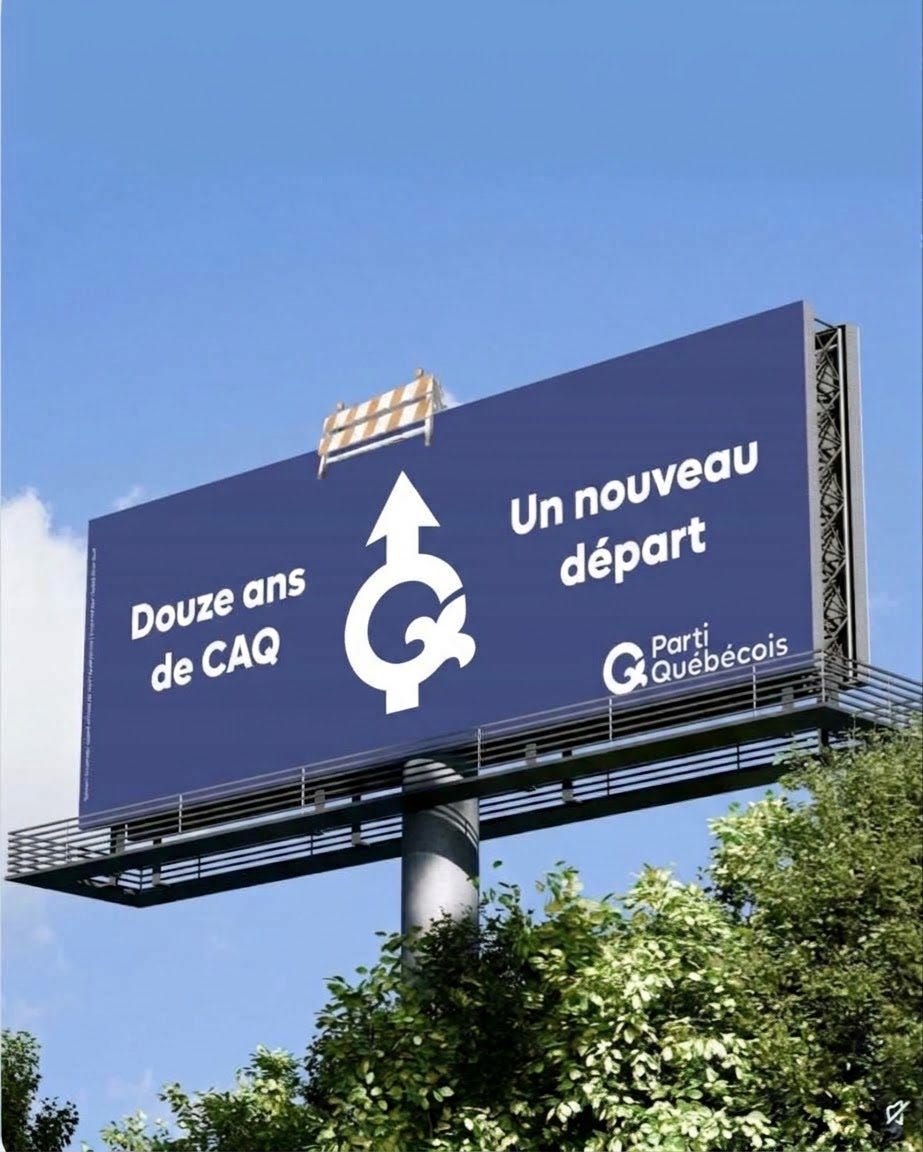
And an official CAQ response.

The CAQ’s liability
I need to tell you about Louis-Charles Taouin Thouin again. It’s not that I want to. He keeps giving me reasons.
As a reminder, he’s the CAQ MNA who recently gave away CAQ hats and T-shirts as bingo door prizes, with $10 and $20 bills tucked into the promotional items.
Subtle.
Mr. Thouin has also:
Been investigated for inviting mayors to meet the deputy premier in exchange for a $100 donation to the CAQ;
Been the subject of another investigation over an apparent conflict of interest;
Awarded grants to businesses run by his stepdaughter;
Given an animal control contract to an organization he co-founded…
… and his spouse later became its director…
… after ending a contract with a competing company…
… while he was mayor of Saint-Calixte.
Among other things. His leader, Christine Fréchette, had nevertheless reaffirmed her confidence in him.
That’s him.
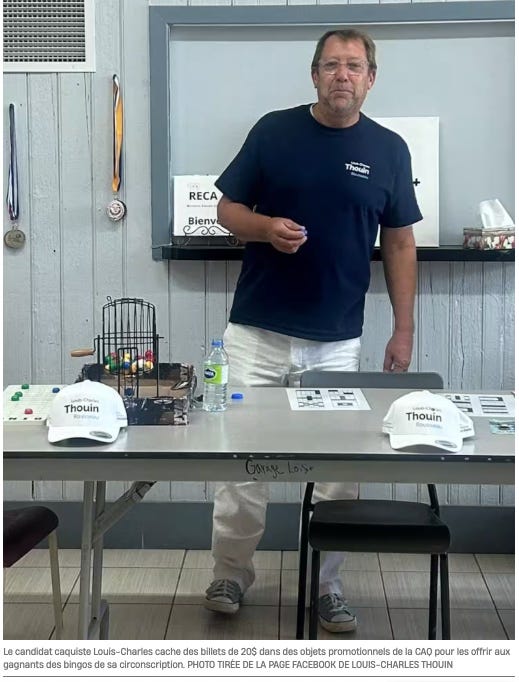
A CAQ MNA in his natural habitat.
On Thursday, we learned that Mr. Thouin hadn’t paid the municipal property taxes on his work apartment in Quebec City and that the city was preparing to auction off his condo. Over $600.
It wasn’t the first time. Last year, Mr. Thouin was also $5,141 behind on his property taxes. He paid that debt just before his house was to be auctioned.
Mr. Taouin Thouin is the premier’s parliamentary assistant, a position that pays him about $175,000 a year. He also receives a housing allowance of up to $20,000.
I imagine he was so busy reading and rereading the bills he had to vote on that his property taxes slipped his mind.
The sacrifices people make for public service.
One question for Ms. Fréchette before we move on: What does it take to be disqualified from running for the CAQ?
I don’t have a measuring tape handy, but the bar looks awfully low.
The sovereigntist quote of the day
“Independence should be the most unifying vision for our society.”
— Ruba Ghazal, stating the obvious
With 30% support and the two sovereigntist parties at each other’s throats, we’re not exactly off to a great start, to borrow a line from a sovereigntist singer.
Going after English
Election workers will not be allowed to speak English to voters, except voters eligible to attend English-language schools and Indigenous voters.
Élections Québec sent the directive to its staff. In the past, election workers spoke to voters in the language of their choice. This year, if a voter doesn’t understand what an Élections Québec employee says, the employee will have to repeat it in French until the voter does.
That could take a while.
The headline might make it sound like Élections Québec made this decision. In fact, the government is forcing Élections Québec to follow Bill 96, which requires government communications to be in French.
A few weeks ago, we learned that election materials had been sent out in French only, instead of in both languages as in every previous election. Since then, the Superior Court has ordered Élections Québec to send voters their reminder cards in both languages.
Other jurisdictions send voter cards in more than one language as a courtesy to their linguistic minorities. Ontario, Manitoba, New Brunswick, the federal government, and several American states do it.
Why suddenly forbid something we’ve always done, something that has never caused a problem? This has nothing to do with promoting French anymore. It’s simply going after English.
The justification gives it away.
On social media, defenders of the hard line always make the same argument: Francophone minorities haven’t always been treated well in other provinces.
So this is payback?
-30-
My name is Patrick Déry. I’m a French-speaking Québécois writing for a living, and trying something different here. If you enjoyed reading this text, you can support me by buying me a coffee. You can also subscribe to this media (free or paid, your choice).
Comments, shares, and “likes” are always appreciated. It also helps the Substack algorithm notice me, so don’t be shy!