


It’s Day 1, and time for the second instalment of my campaign journal. You can find the first edition here.
This one turned out longer than expected, but I didn’t have the heart to cut it down and deprive you of the good bits. So here it is.
A Bombshell Poll
The big news of the day is this poll, which puts the PQ and the CAQ in a statistical tie, with 28% for the former and 27% for the latter, and with the QLP trailing well behind at 20%.
Enter those numbers into Qc125’s election simulator, and here’s what you get:
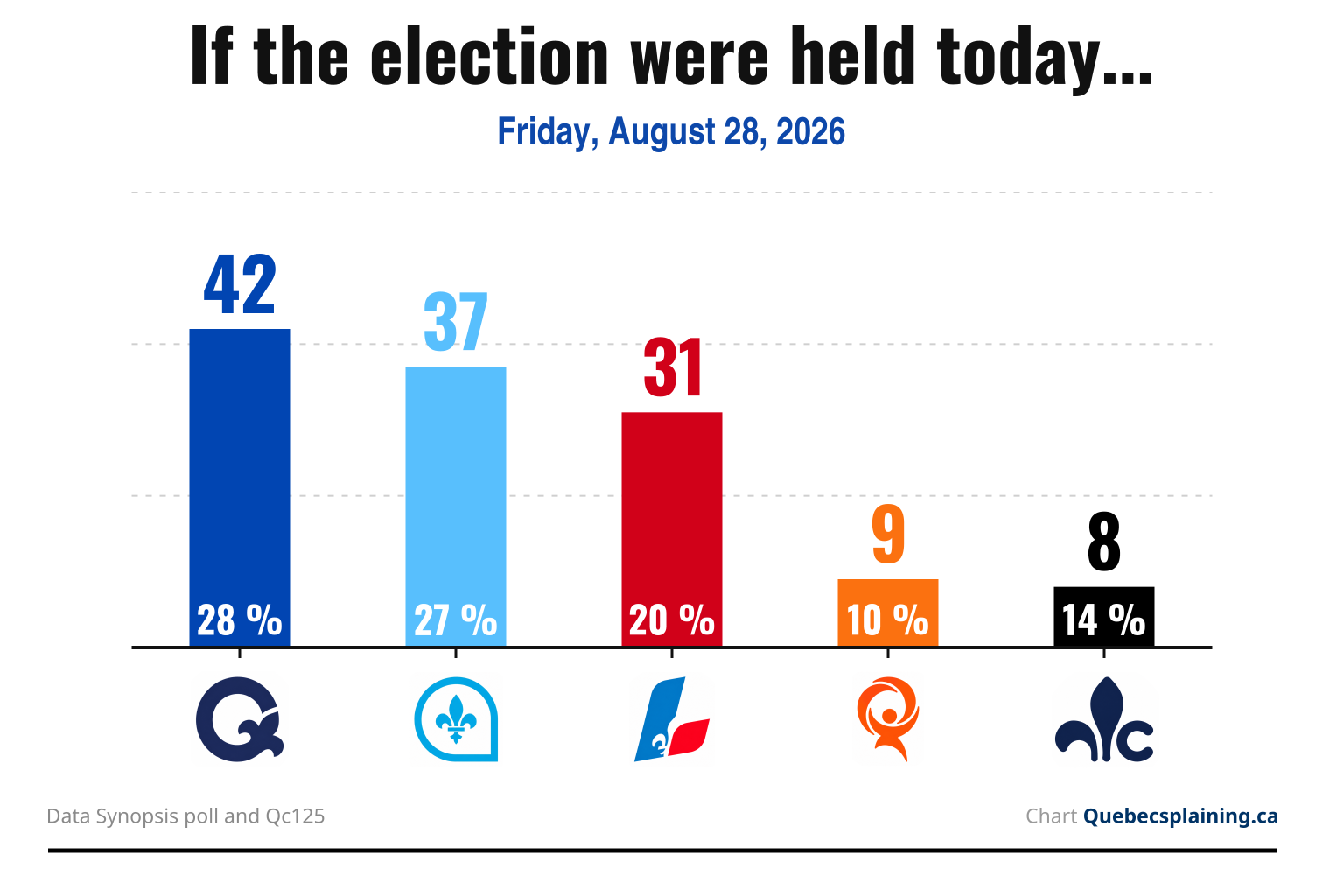
Suddenly, the PQ is more than 20 seats short of a majority, the CAQ is just five seats away from forming a government, and the QLP loses its official opposition status.
This scenario would have been unimaginable only a few weeks ago. It would also produce an unprecedented configuration in Quebec political history: for the past 160 years, the QLP has always either formed the government or served as the official opposition.
Questions have been raised about the credibility of the Synopsis poll, but its sample size provides no obvious reason to dismiss it. Just over 1,000 people were surveyed, a standard sample for a province-wide poll.
A Léger poll released a few days earlier put the CAQ at only 23% and the PQ at 30%.
The Léger poll was conducted from August 21 to 24, while the Synopsis poll was conducted from August 24 to 26. News travels fast. There may have been a rapid three- or four-point shift over those few days. The rest of the discrepancy may simply reflect ordinary sampling variation.
Personally, though, I suspect there’s more to it, and that a structural problem is beginning to catch up with PSPP.
Which brings me to my next point.
PSPP: When Karma Bites Back
On January 20, 2025, the White House issued the executive order establishing the America First Trade Policy. That same day, Donald Trump threatened Canada with 25% tariffs.
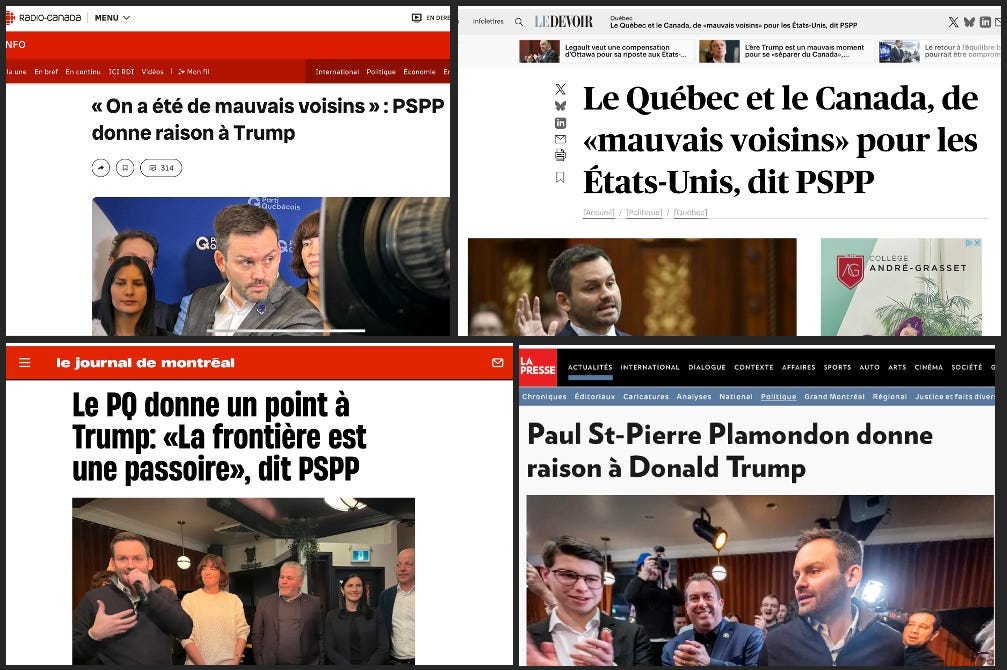
Two days later, Paul St-Pierre Plamondon, the leader of the Parti Québécois and front-runner to become Quebec’s next premier, agreed with Donald Trump.
“We’ve been bad neighbours,” he said. “We must start by acknowledging that what’s in [the executive order] is true.”
It wasn’t.
The U.S. government needed a pretext—an exceedingly crude and obvious one—to impose tariffs on us. It settled on migrants and fentanyl.
In reality, migrants and drugs enter the United States overwhelmingly through Mexico. What comes from Canada amounts to a homeopathic dose. I wrote about this here.
But PSPP seemed more interested in shifting the blame to Canada and making Ottawa look bad than in acknowledging the obvious: the United States was simply looking for an excuse to impose tariffs.
The anti-Ottawa—and subtly pro-Trump—rhetoric continued.
In November 2025, PSPP argued that an independent Quebec’s military interests would be aligned with those of the United States.
Oh, really? Would we abandon our longtime allies, cozy up to dictators, and flout international law?
Last January, at his party’s national convention, the PQ leader compared the Canadian federation to colonial India, apartheid-era South Africa, and the former Soviet Union. Seriously.
In June, PSPP went off the rails again, referring to the high-speed rail project as the “Canadian unity train.”
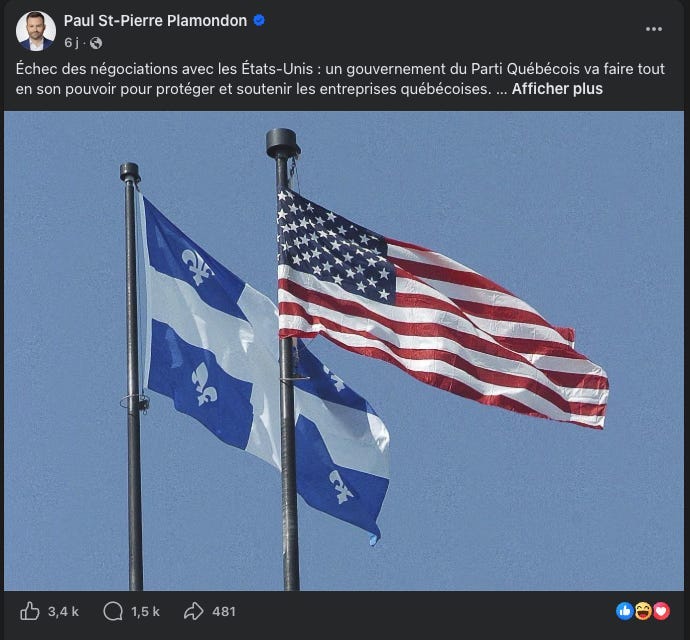
And a few days ago, the PQ leader launched into yet another lengthy tirade against Christine Fréchette’s government, as though the CAQ were somehow responsible for the raving madman in the White House and the other raving madmen surrounding him.
There are plenty of reasons to criticize the CAQ. That isn’t one of them.
The Facebook post was adorned with the flags of Quebec and the United States, as though Canada were the only obstacle to good relations, and as though an independent Quebec would fare better without Ottawa.
Let’s be honest: Quebec would be eaten alive.
In short, it is always Ottawa’s fault or Quebec’s fault, never the United States’. Over time, this hostile, bitter, hyperpartisan rhetoric begins to create the impression that the PQ wants things to go wrong above all else.
It is easy to imagine Jacques Parizeau—a statesman—crossing the aisle to offer Christine Fréchette his support. He did something similar after the Meech Lake Accord failed, walking over to shake Robert Bourassa’s hand.
“My premier,” Mr. Parizeau said, visibly moved. PSPP is clearly not cut from the same cloth, and sovereignists are beginning to notice.
When Duhaime Thinks He’s Obama
In 2014, during a rather racist tirade, Éric Duhaime, the leader of the Quebec Conservative Party, then a radio host, claimed that “Black people have few heroes” and that “they often end up being nobodies.” Open a book, for heaven’s sake…
Duhaime also called Barack Obama the “worst president in U.S. history” and said that was how Obama would be remembered.
Today, Duhaime has no problem appropriating the imagery of Obama’s 2008 presidential campaign.
It takes a lot of nerve, but Éric Duhaime has never lacked nerve. It also helps not to have any principles.
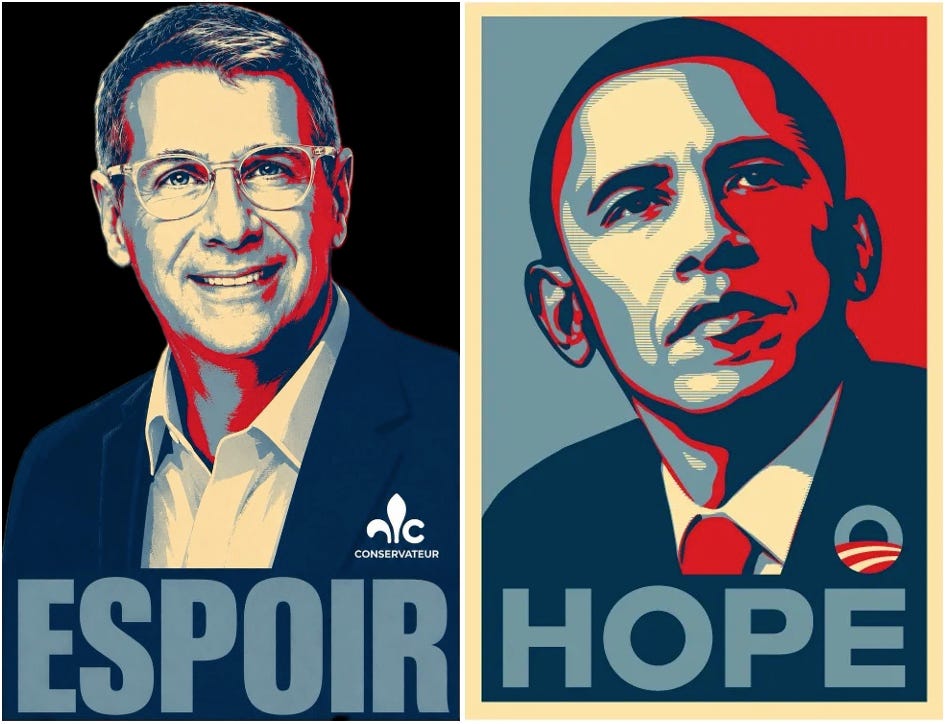
(Note : In French, “espoir” means hope.)
The Facebook post has gone viral among conservative supporters, who do not seem to have noticed the supreme irony.
Today’s Number: $11,166
That is the average tax cut the Quebec Conservative Party is promising each household, at a total cost of roughly $6 billion a year.
It’s possible. It’s also possible that we’ll have trouble funding schools and hospitals while trying to make up a $100-billion infrastructure deficit.
Words of the Day: “défréchettiser” and “défitzgibonniser”
These are the terms PSPP used to justify cutting the corporate tax rate by nearly 20% over the next four years. The measure would be financed in part by abolishing the Economic Development Fund, the very fund through which Quebec lost hundreds of millions of dollars on the Northvolt project.
Former minister Pierre Fitzgibbon had a hand in that kind of policy, as did Premier Fréchette. Hence the coinages.
I agree with the underlying idea. If direct subsidies to businesses worked, Quebec would be the country’s economic engine.
Let’s invest in human capital instead. Quebec still has the highest high-school dropout rate in the country. Who’s talking about that?
Quote of the Day
—Christine Fréchette, who still hasn’t gotten the message
A Small Step for the QPIP
The CAQ announced several improvements to the Québec Parental Insurance Plan. Among other changes, it would extend leave reserved exclusively for fathers from five to seven weeks; increase from 18 months to five years the period during which benefits may be claimed, without increasing the total benefits available; and allow parents to transfer up to four weeks of benefits to relatives, including grandparents.
In short, the changes would make the program more flexible, and it is difficult to argue against that.
From my perspective as a public-policy nerd, this is precisely the kind of reform that has been advocated for years. We know similar provisions exist elsewhere, but ideas like these move at a snail’s pace through government departments and political offices.
Ultimately, we shouldn’t have to wait for an election campaign to hear this kind of announcement. It is a matter of continuous improvement and basic stewardship. Because it’s 2026.
In Sweden, each parent is entitled to 240 days of leave, for a combined total of 480 days. Thirteen weeks are reserved for each parent, and up to 300 days of parental leave may be transferred to other family members. Now that’s flexibility.
Sweden also has resources Quebec lacks: its GDP per capita, adjusted for purchasing power, is approximately 35% higher than ours.
It’s easier to be a social democrat when you’re rich.
Pete, Repeat, and the QLP
The QLP is promising substantial aid for businesses affected by U.S. tariffs.
That goes without saying. The problem for the QLP is that the CAQ—the party currently in government—had already created an assistance program and has just made it more accessible.
In other words, the QLP is not offering anything fundamentally new.
Perhaps its plan is marginally better. Perhaps it isn’t. It is difficult to tell, because the QLP has not provided a detailed breakdown of its proposal, while the total amount of assistance available under the CAQ program remains unknown.
In the context of a campaign announcement, however, that hardly matters. Most people are not comparing the fine print. They are looking for what distinguishes one party’s platform from another’s.
From that perspective, this is a complete failure for the QLP, a party that recently proclaimed itself “Regionalist. Nationalist. Federalist.” on its homepage, and whose leader seizes every opportunity to declare his support for Quebec City’s third-link highway project.
A regionalist, nationalist, federalist, pro-highway party already exists. It’s called the CAQ.
The QLP’s real problem is not its image. It’s its lack of imagination.
The Campaign as Seen from the United States
“My opponent is named Donald Trump,” Coalition Avenir Québec Leader Christine Fréchette said as campaigning began for the October 5 election to Quebec’s National Assembly, the provincial legislature. “He’s the real adversary.”
(…)
“I’m asking for a mandate to move forward through a storm,” she said.
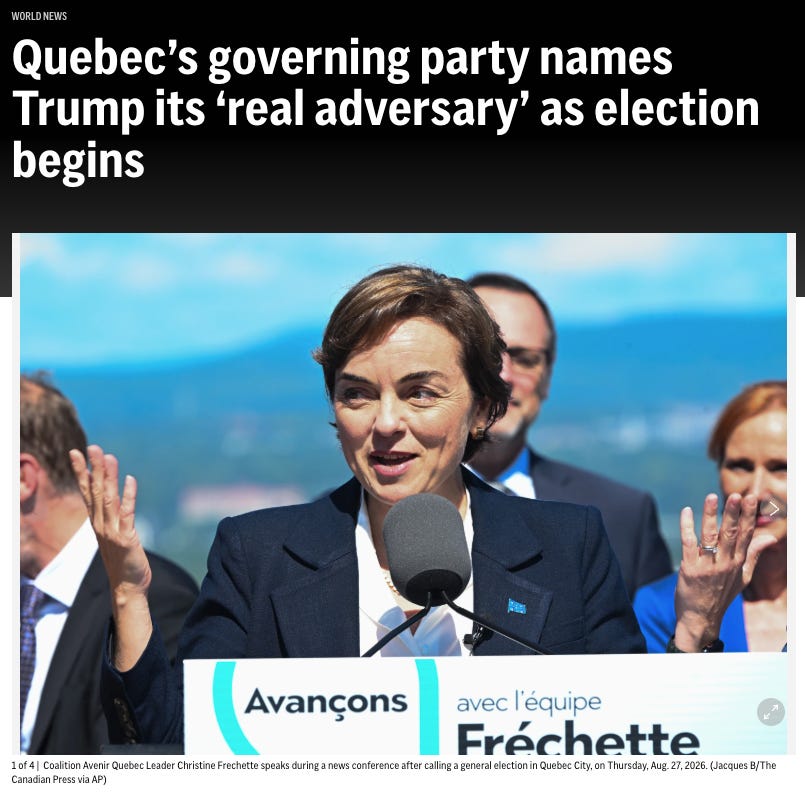
- Via Associated Press.
-30-
My name is Patrick Déry. I’m a French-speaking Québécois writing for a living, and trying something different here. If you enjoyed reading this text, you can support me by buying me a coffee. You can also subscribe to this media (free or paid, your choice).
Comments, shares, and “likes” are always appreciated.