


My son’s hockey season started up again today, which meant I got a late start and ended up posting this a little later than I should have. I’ll catch my breath on Sunday. :-)
Here’s what caught my attention, in four parts. Enjoy the read!
Pollsters’ (Misplaced) Priorities
What are your favourite campaign promises? On Saturday, a poll in my favourite newspaper (I have a favourite newspaper, a top newspaper, and a cherished newspaper, just to avoid any arguments) measured Quebecers’ support for “29 campaign pledge ideas, some of which have already been put forward by political parties, others not yet [sic].”
It goes like this :
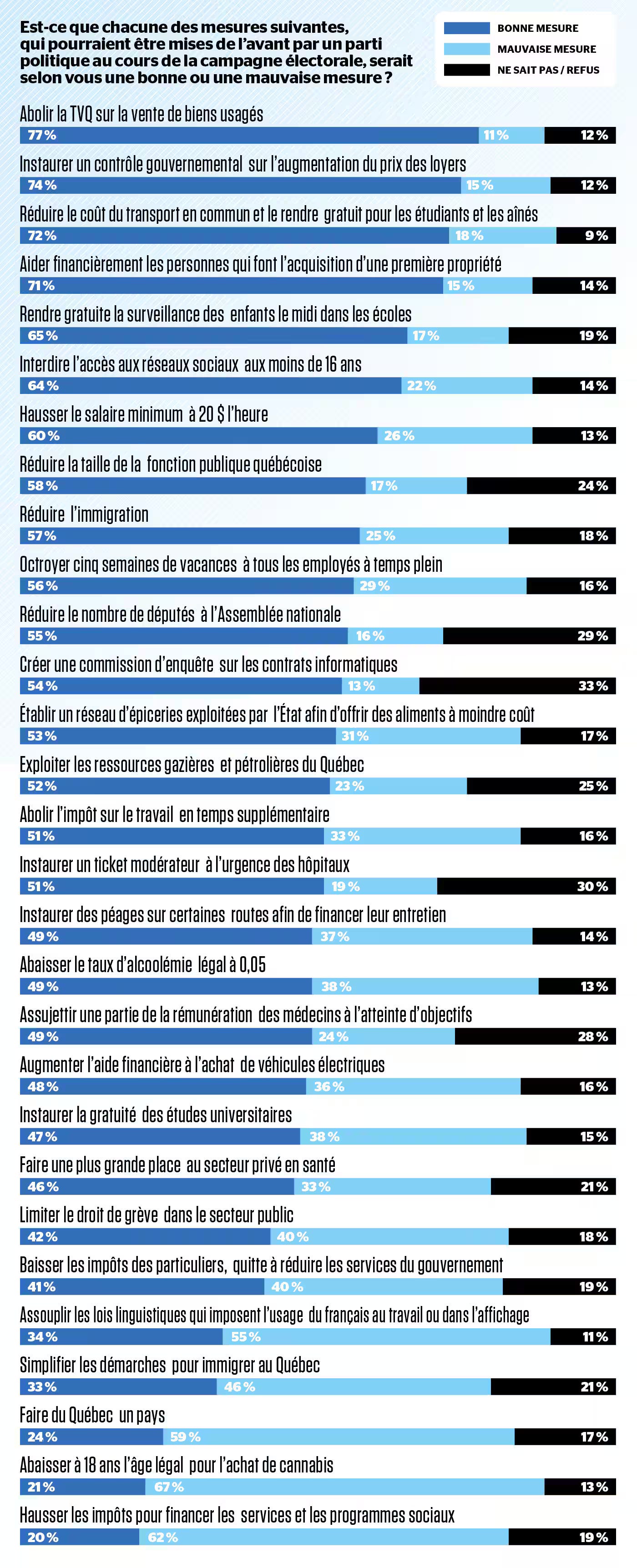
Aside from the fact that some of these items aren’t actually campaign promises (which the media outlet publishing the poll itself acknowledges), I see three problems.
The first problem is that we don’t need a poll to know that paying less in taxes will always be popular and that asking people to make an effort or a sacrifice will always be unpopular.
Unsurprisingly, then, 77% of Quebecers support eliminating the QST on used goods.

But the pollster doesn’t ask how the lost revenue would be made up or what cuts would be required to compensate. (A quick reminder: demand for public services is growing, so public spending will continue to rise.)
The second problem is that just because a policy is desired doesn’t mean it’s desirable.
For example, 74% of us want the government to control rent increases.

First, it already does, except for housing units less than five years old. That means the vast majority of rents are regulated. Second, economists never tire of pointing out that rent control creates all sorts of unintended consequences that ultimately reduce the supply and quality of housing, which is something we’ve been witnessing for years in Quebec.
It would be more effective to increase the housing supply (by lowering construction costs and streamlining regulations) and to build more social housing, as Vienna does. There, 60% of the population lives in non-market housing. But that’s too complex to fit into a poll question.
Since housing is in the news, the poll asks whether people support giving money to first-time homebuyers. Seventy-one percent say yes.

That’s what we’ve been doing in recent years, and at the margin, all it has done is drive prices higher—which is exactly what you would expect when demand increases but supply does not. But the pollster isn’t there to teach economics. Nor does the pollster ask where the money would come from or whether those who answer “yes” would be willing to pay higher taxes to expand the FHSA, the Home Buyers’ Plan, or other programs that generally benefit those who already have the means to buy a home.
The poll also shows that two-thirds of Quebecers (67%) oppose lowering the legal age for purchasing cannabis to 18.

This is a knee-jerk reaction typical of an aging population, but it is misguided. Quebec is the only province where the legal age is 21. Everywhere else, it’s 19, except in Alberta, where it’s 18. By keeping the age at 21, we’re driving young adults to buy online from the grey market—or straight from organized crime. They’ll use cannabis anyway, but they’ll get it from less safe sources. It’s foolish, and we have François Legault to thank for it. That explanation, too, is too long to fit into a poll question.
In short, the poll tells us that an ineffective policy and a harmful one are popular, while a beneficial policy is not. That doesn’t get us very far.
The third problem is that the pollster decides which issues matter and which don’t.
This turns politics into a populist contest in which politicians must, above all, say what will please the public—and woe to anyone clear-eyed enough to point out that we’re heading in the wrong direction in several areas, among them health care, elder care, infrastructure, demographics, and I’ll stop there so as not to ruin your weekend.
For example, Quebec has had the highest high school dropout rate in the country for years. Yet I see no questions in the survey about the importance of increasing high school graduation rates.
The number of Quebecers aged 75 and older will rise by about 40% by 2034. Yet I see no questions about the urgent need to expand home care and health care services in general.
The combined asset-maintenance deficit for public infrastructure (roads, bridges, schools, and hospitals) and water infrastructure is approaching $100 billion and growing every year. Yet I don’t see a single question asking whether we agree that this needs to be dealt with immediately, before Quebec starts falling apart at the seams.
Politics shouldn’t boil down to governing by poll. Leading sometimes means saying difficult things, setting a direction, and spelling out the tough but sometimes necessary sacrifices required to get there.
Pollsters don’t care about that.
Better to Have Bad Numbers Than No Numbers at All
The Quebec Conservative Party promises to pull Quebec out of the carbon market, which would lower the price of a litre of gas by about 10.7 cents.
According to the PCQ, the measure would save the average household about $1,350 over five years. Or $270 a year, which already sounds far less impressive. (A basic principle of journalism bears repeating: never simply repeat a number fed to you by a politician. That is exactly what politicians want.)
The average car in Quebec consumes 1,007 litres of gasoline a year, which is the amount required to travel 12,435 km at a rate of 8.1 litres per 100 km. I explain the calculation here.
There are approximately 4 million households in Quebec and 5 million cars and light trucks. That works out to roughly 1.25 vehicles per household, give or take, and therefore about 1,250 litres of gasoline per household each year.
If the saving is 10 cents per litre, what does that amount to? About $125 a year for the average household.
(I don’t know where the Conservatives get their numbers, but I’ll bet it’s the same place their conspiracy-minded candidates get their information about vaccines.)
There’s a lot to be said about how the Quebec government has used the revenue collected through the carbon market. It has financed all sorts of projects that delivered little in the way of climate benefits or were extremely costly relative to the results achieved.
But, for heaven’s sake, when a party leader who has already explained that it’s better to have “bad information than no information at all” throws numbers at us, can we at least verify what he’s saying before repeating it?
This probably isn’t over yet. Before the campaign, the Parti Québécois had also promised to lower gas prices using “fiscal levers.”
That kind of promise is politically attractive because people tend to lose all sense of proportion when it comes to prices at the pump.
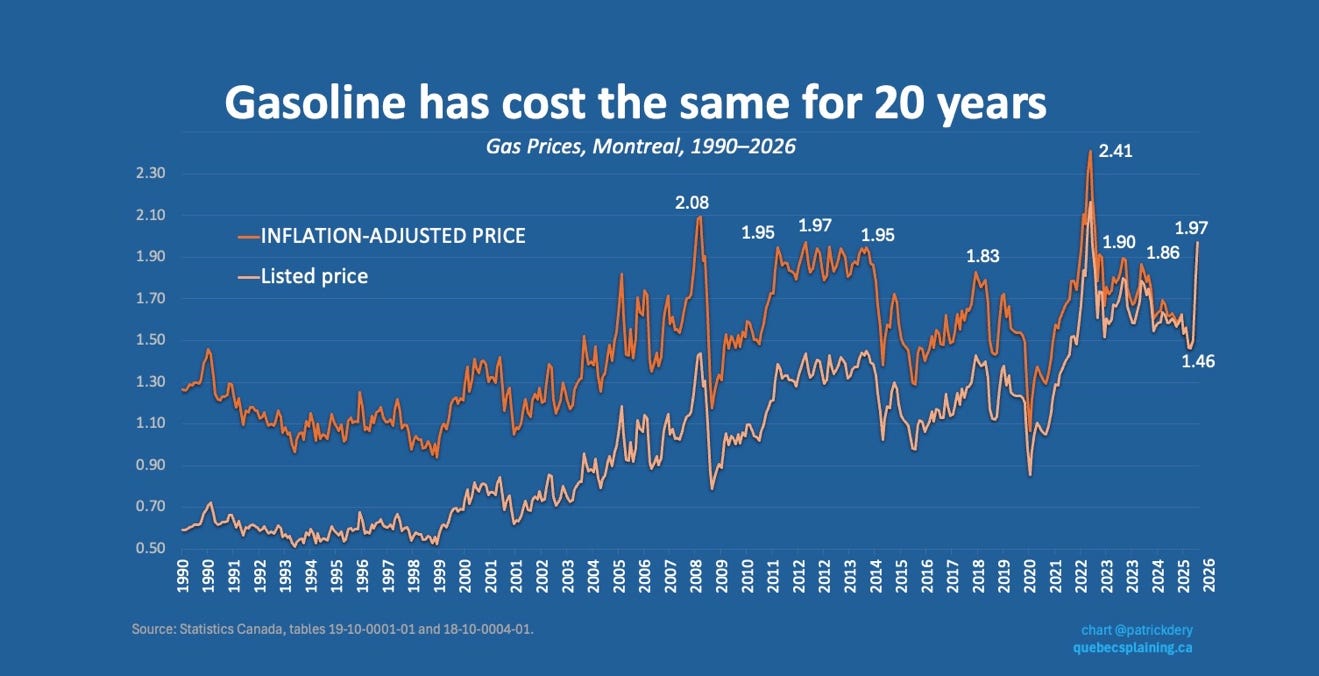
Yet, in real terms, gas costs about the same as it did 20 years ago.
Shifting Allegiances
Caroline Simard, a former Liberal member of the National Assembly under Philippe Couillard, has decided to run under the banner of Éric Duhaime’s Conservative Party. Others, such as Ange Claude Bigilimana, have moved in the opposite direction. In Vimont, Liberal candidate Louis Ialenti previously ran for the federal Conservatives.
I’m convinced that Ms. Simard’s decision to make the move to the conspiracy-adjacent Conservatives has nothing to do with the projections in Charlevoix, which put the PLQ at 8% and the PCQ at 24%—and give her a reasonable chance of winning.
Things look even better for the Liberal candidate in Vimont, a former Liberal stronghold, where projections put the QLP in first place. In Terrebonne, the QLP and Mr. Bigilimana don’t stand a chance, but that doesn’t seem to bother him. I imagine the PLQ wasn’t exactly flooded with prospective candidates…
Returning to Ms. Simard, she explained her change of heart by saying, “As they say, only fools never change their minds, so that reassures me!”
At the risk of worrying Ms. Simard, I know some fools who change their minds all the time. One of them is even the president of the United States.
PSPP Brings Back the Immigration Scare
The Parti Québécois is promising a “significant” reduction in immigration, citing a “total loss of control over our immigration system.”
That may have been true a few years ago, but it is no longer the case. Both the CAQ government and Ottawa have tightened immigration criteria, sometimes in ways that are both foolish and cruel, and contrary to Quebec’s interests, for example by moving to deport fully integrated, French-speaking families, some of them even from France, as well as workers in fields where our needs are dire.
The numbers are unequivocal. After peaking at 569,000 in late 2024, the number of temporary immigrants in Quebec had fallen to 492,000 by the summer of 2026—a decrease of approximately 77,000.
To say there is still a “loss of control” is objectively false. But it still pays politically to claim otherwise.
PSPP is therefore promising that, if his party is elected, it will reduce the number of temporary workers and international students to between 200,000 and 250,000 within four years, “while protecting sectors such as agriculture and manufacturing, certain regional industries, and direct public services, especially health care.”
In other words, we’re going to reduce immigration, except where we need immigrants. Good luck with that!
The Parti Québécois leader also promises to reduce permanent immigration to 35,000 per year. (The current target is 45,000.)
First, whether it’s 35,000, 45,000, or 55,000 won’t make much difference, since most permanent immigrants are already living here by the time they receive permanent status.
Second, PSPP bases his proposal on the recommendations of the distinguished economist Pierre Fortin, who has indeed warned against immigration levels that are too high or that rise too quickly.
The catch is that Pierre Fortin himself recommends keeping permanent immigration thresholds between 50,000 and 60,000.
++++++
That’s it for today, see you Monday!
-30-
My name is Patrick Déry. I’m a French-speaking Québécois writing for a living, and trying something different here. If you enjoyed reading this text, you can support me by buying me a coffee. You can also subscribe to this media (free or paid, your choice).
Comments, shares, and “likes” are always appreciated.
Thanks for the explanation of your day numbering. However, the English version has the numbering completely messed up. Monday, August 31st is headlined "Day 2" and tagged "Day 5". The French version doesn't suffer from this