


New polls, new ads, new factual errors, and a candidate who keeps delighting us with his past remarks!
But first, a word about the election calendar.
The Media, Élections Québec, and the Election Calendar
Eagle-eyed readers will have noticed a difference between how the major media outlets number the days of the campaign and how I do it.
For my part, I’ve stuck to the definition in the Election Act, which specifies that the election period begins the day after the order calling the election is issued. This is also what the Chief Electoral Officer (or Élections Québec) states on its website.
Thursday, August 27, the day the election order was issued, was therefore Day 0. Friday was Day 1, Saturday was Day 2, and Sunday was Day 3.
But the media all treated Thursday as the first day of the campaign. As a result, Sunday was Day 4 for them, not Day 3.
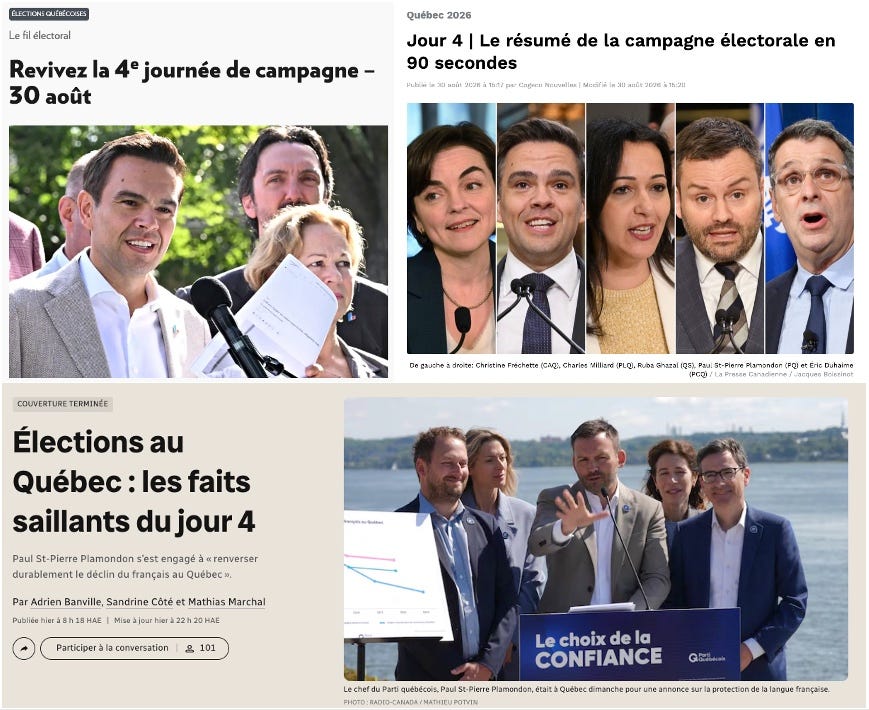
This detail may seem trivial, but the Election Act also stipulates that the election period, which ends on Election Day, can last no more than 39 days, as most media outlets correctly noted. Yet if the campaign is considered to have begun on August 27, October 5 becomes its 40th day, exceeding the limit set by law.
To complicate matters further, the Chief Electoral Officer itself stated in an August 27 news release that “the election period begins today,” contradicting the legislation it administers.
But sometimes you can be wrong even when you’re right.
So even though the campaign cannot last more than 39 days, I’ve changed my numbering. Don’t look for Day 4 on my calendar, it never happened. We’re skipping straight to Day 5 so I can fall in line with everyone else.
Here’s to a great 40-day campaign!
Sunday’s Announcements
On Sunday, Day 3, now officially Day 4, I took the day off. There were nevertheless a few important announcements, which I’ll summarize briefly:
· The CAQ wants to balance the budget and will not cut taxes
· The Parti Québécois has pledged to “reverse the decline of French”
· The Quebec Liberal Party wants to cap rent increases in private seniors’ residences
· The Quebec Conservative Party wants to abolish the QST on used goods
· Québec Solidaire wants the government to co-invest with first-time homebuyers (what!!?!)
(I don’t have time to discuss all this tonight, but make a note to read this piece on the “decline” of French—I promise it’s worth your time.)
Monday’s Announcements
· The CAQ promises more privately delivered healthcare, paid for by the government
· The Parti Québécois wants to cut the size of the civil service
· The QLP plans to build 100,000 additional housing units a year
· The Quebec Conservative Party wants to develop shale gas
· Québec Solidaire promises $340 million to tackle high school dropout rates
I can’t cover all of that, we’d still be here tomorrow morning.
But I’d like to talk about untaxing used goods, because almost everyone agrees. And about private healthcare, because many Quebecers don’t. And also about a “PQ-leaning Liberal” candidate, a rare breed indeed. And about the Liberals’ ill-fated housing promise.
Okay, let’s get started!
Exempting Used Goods from Tax
On Saturday, Le Journal de Montréal published a poll on actual or potential campaign promises. The most popular proposal was exempting used goods from tax. That works out nicely for the QCP, which is proposing just that.
According to the QCP, the measure would save the average household $867… over five years. That works out to $173 a year. (Have you noticed how parties always spread the cost or value of their promises over four or five years to make the numbers look bigger?)
The QCP talks about used clothing for young families, but I don’t know anyone who buys $1,730 worth of used clothing every year (the QST rate is just under 10%.)
The exemption would also apply to other, more expensive goods, particularly cars. At sale prices of $20,000, $30,000, or even more than $40,000 for newer, hybrid, or electric vehicles, we’re talking about potential QST savings of several thousand dollars. Suddenly, we’re no longer talking about the “average” consumer or a low-income family shopping for used clothing.
I understand that we’d all like to pay less tax. But here are three points to consider.
First, the QST isn’t a tax on one specific good or service; it’s a consumption tax. The more you consume, the more tax you pay. If you consume less, you pay less. From a public-policy standpoint, this is generally fairer and more equitable than taxing work, for example.
Second, although some price increases infuriate us, the fact remains that the purchasing power of middle- and upper-income households has generally improved since 2019, particularly among couples, both with and without children.
Prices have risen. But our incomes have risen even more, meaning that, on balance, we’re better off, as shown by this detailed study from the Chair in Taxation and Public Finance (with my regards to Suzie St-Cerny and Luc Godbout).
If we look only at the period since 2022, our purchasing power has been stagnating, but we are generally not poorer. I say “generally” because this isn’t true for every type of household. Less affluent seniors, in particular, have seen their real purchasing power decline. Some have even become poorer since 2019.
If we want to help them, along with low-income families, let’s keep taxing used goods and redirect the resulting revenue to those who genuinely need it.
Putting an End to Two-Tier Healthcare
The CAQ is reversing course and once again wants to allow doctors to move freely between the public and private systems.
In principle, I have no problem with that. In Europe, public, private for-profit, and private not-for-profit healthcare providers coexist within universal healthcare systems. Patients can seek care wherever they choose without breaking the bank because public funding follows the patient (or because group insurance covers the care, depending on the system.)
The problem in Quebec is that privately delivered care isn’t always covered by public health insurance. Sometimes it is, sometimes it isn’t, based on criteria that don’t necessarily make much sense. That means you could end up paying $15,000 out of pocket for shoulder surgery, or simply going without it.
The problem has spread to family medicine. As of 2026, nearly 550 general practitioners—5% of the total, or one in 20—are practising outside the public system. That’s a huge number for a system already facing a chronic shortage of doctors.
Christine Fréchette is also promising that patients will be referred to private providers a little sooner, with the government picking up the bill. Instead of having to suffer for nine to 12 months, they’ll have to wait six to nine months. Tell that to someone in France or Germany, and they’ll pity you.
Ms. Fréchette also wants to increase the number of diagnostic imaging tests performed by private providers and covered by public insurance.
I have a simple, transformative, fair, and forward-looking proposal for Ms. Fréchette and the other parties: could we stop this damn dithering, establish a fee schedule for medical services as they do almost everywhere in Europe, and provide patients with full coverage regardless of who delivers the care, so they can get treated when they need it?
Today’s Number: 100,000
That’s how many new housing units Quebec Liberal Party leader Charles Milliard wants to see built each year. The QLP is even pledging to “solve” the housing shortage.
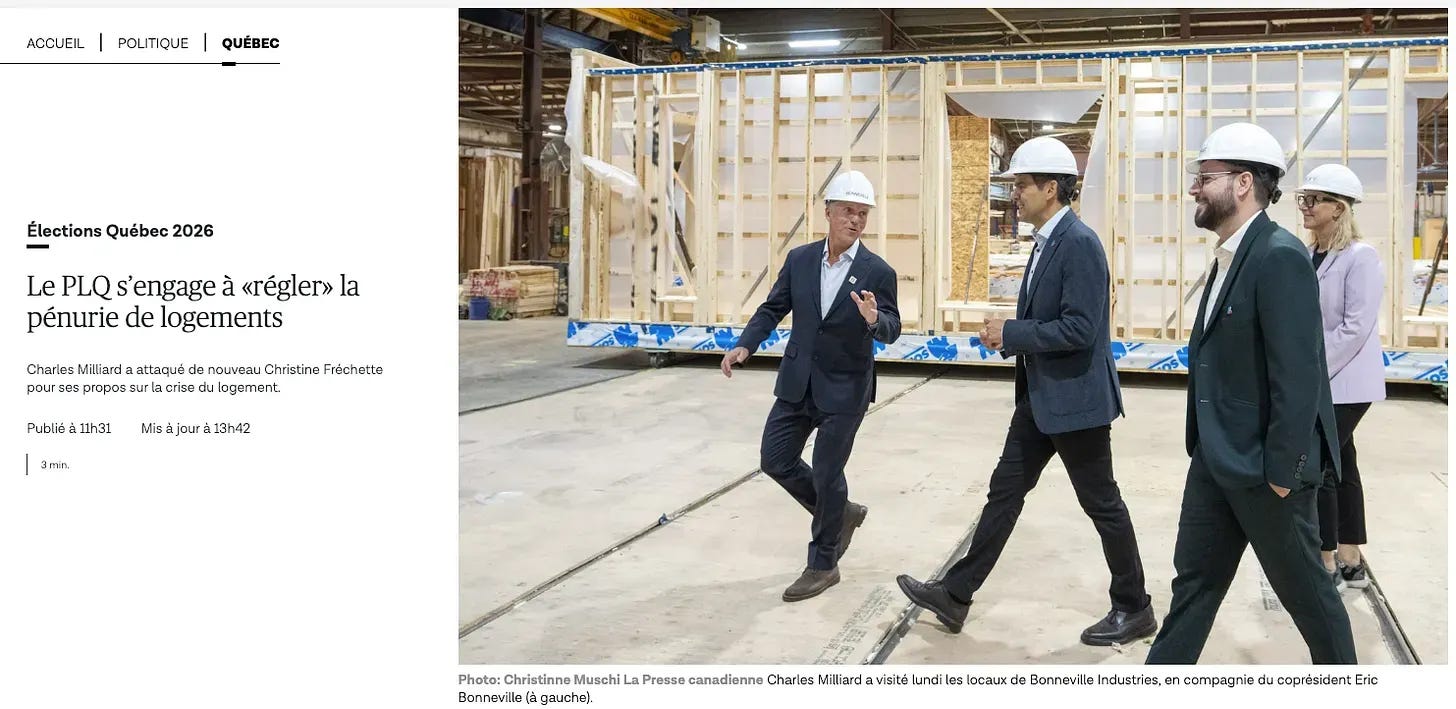
There’s just one problem: it can’t be done.
Quebec has never built more than 68,000 housing units in a single year. The Canada Mortgage and Housing Corporation estimates that an annual average of 72,000 units is achievable. The QLP wants to build 40% more than that, a tall order.
The main obstacle is the shortage of construction workers. According to the Commission de la construction du Québec, the industry needs 17,000 new workers every year.
If I were Mr. Milliard, I’d make sure the figures behind his promises came from his research team, not his communications team.
Note: In an earlier version of this article, I wrote that no more than 68,000 housing units had ever been built in a single year in Quebec. In fact, that threshold has been exceeded twice since 1955, most recently in 1987, when construction began on 74,000 housing units. Thanks to Félix for setting me straight!
The CAQ as the Official Opposition?
Don’t laugh. The CAQ was dead at the beginning of the year. It’s now coming back to life, somewhat by default.
Until recently, Paul St-Pierre Plamondon was seen as the best candidate for premier. But the candidate perceived as the most competent has also become the least palatable to many Quebecers.
While the house of Canada–U.S. relations was burning, the PQ leader decided to blame the firefighters in Ottawa and Quebec City for what was happening to us. He then tried to extract as much political capital as possible from the situation instead of grabbing a bucket and lending a hand. Quebecers took note.
The premier, meanwhile, is staying the course and continuing to do what she can. Not all of the CAQ’s proposals are desirable or inspiring, but they are fundamentally no worse than those of its competitors.
The Quebec Liberal Party has yet to explain why Quebecers should vote for it, or what fundamentally distinguishes it from the CAQ.
The Quebec Conservative Party and Québec Solidaire, meanwhile, remain too marginal to be serious contenders.
According to Qc125’s polling aggregator and seat simulator, here’s where things stand:
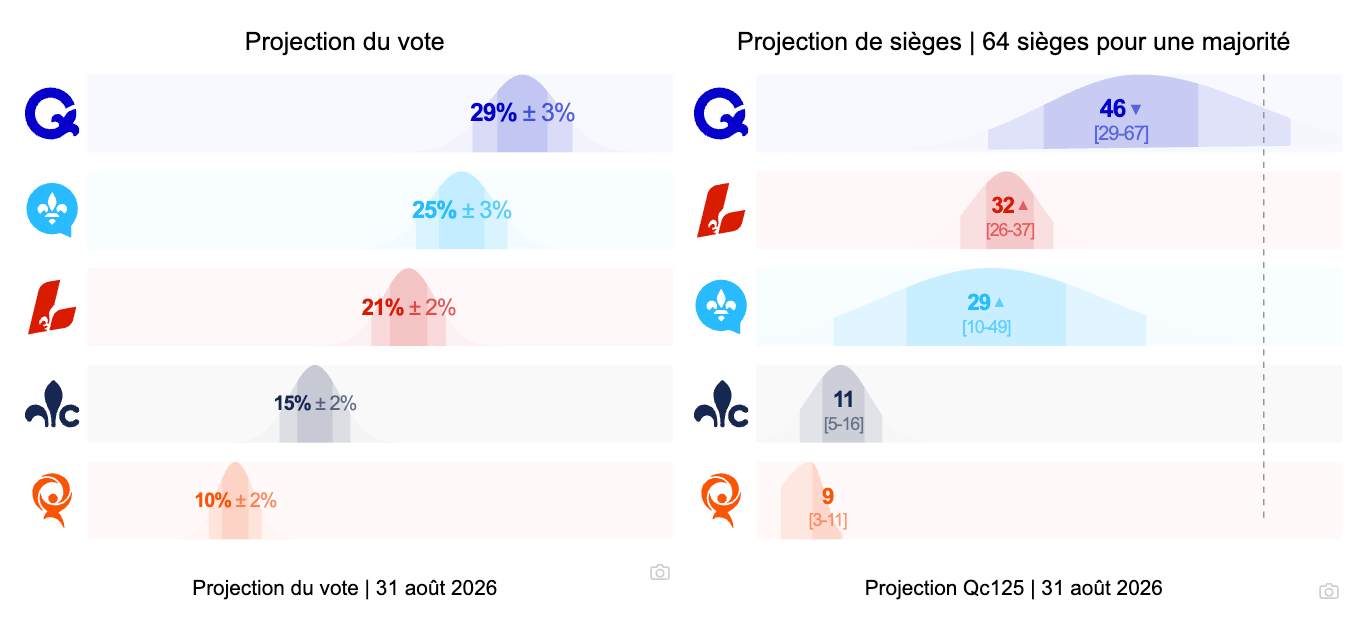
Source: Qc125.com
The CAQ is now only three seats behind the QLP, despite trailing it by a much wider margin in the popular vote.
The same trend can be seen in Qc125’s four most recent projections.
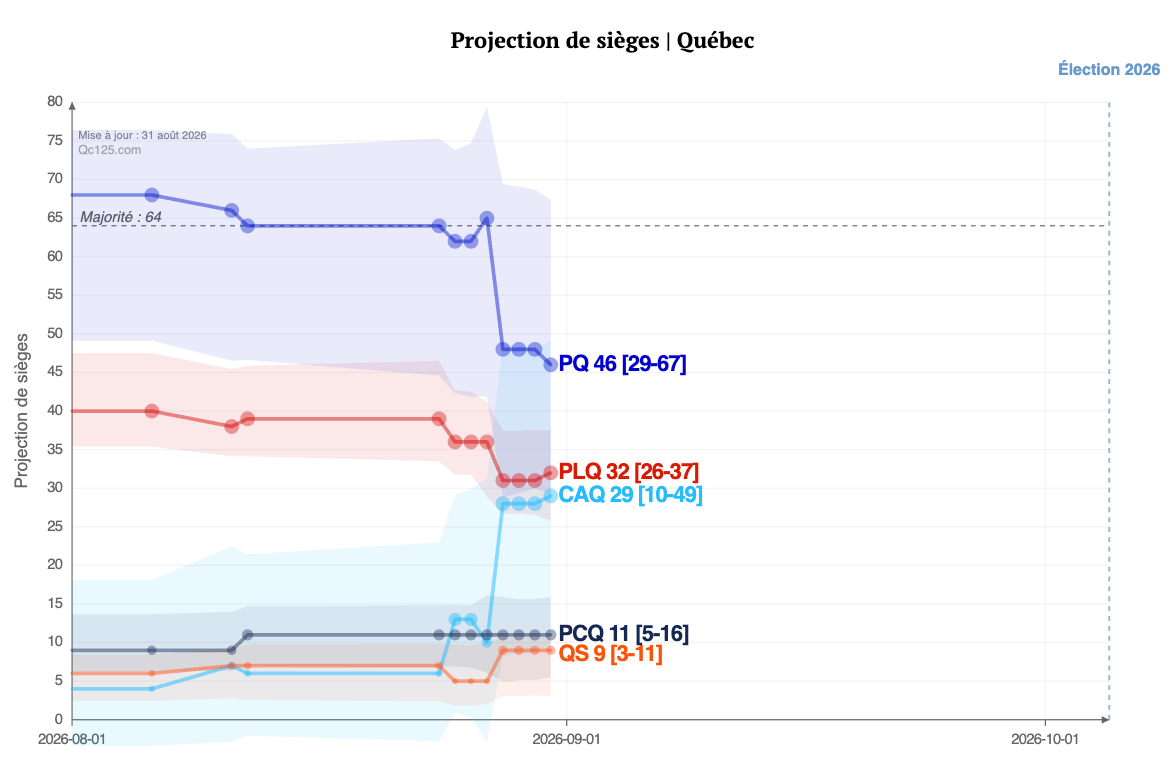
A few more percentage points lost, and the QLP could be relegated to third-party status, something that has never happened before.
There’s still more than a month left in the campaign. I’m not sure that’s good news for the Quebec Liberal Party.
By Sail and Steam
It happened on Sunday, but I can’t let this one slide.
Quebec Liberal candidate Michel Bureau candidly admitted that he had little chance of winning in Charlevoix. Fair enough, but let’s just say that isn’t how you win votes.
Mr. Bureau also described himself as a “Péquiste-Libéral” and said he had voted for the QLP only once, in 2022. Politically speaking, he would be equally comfortable with either a Liberal or PQ government, as long as it wasn’t the CAQ.
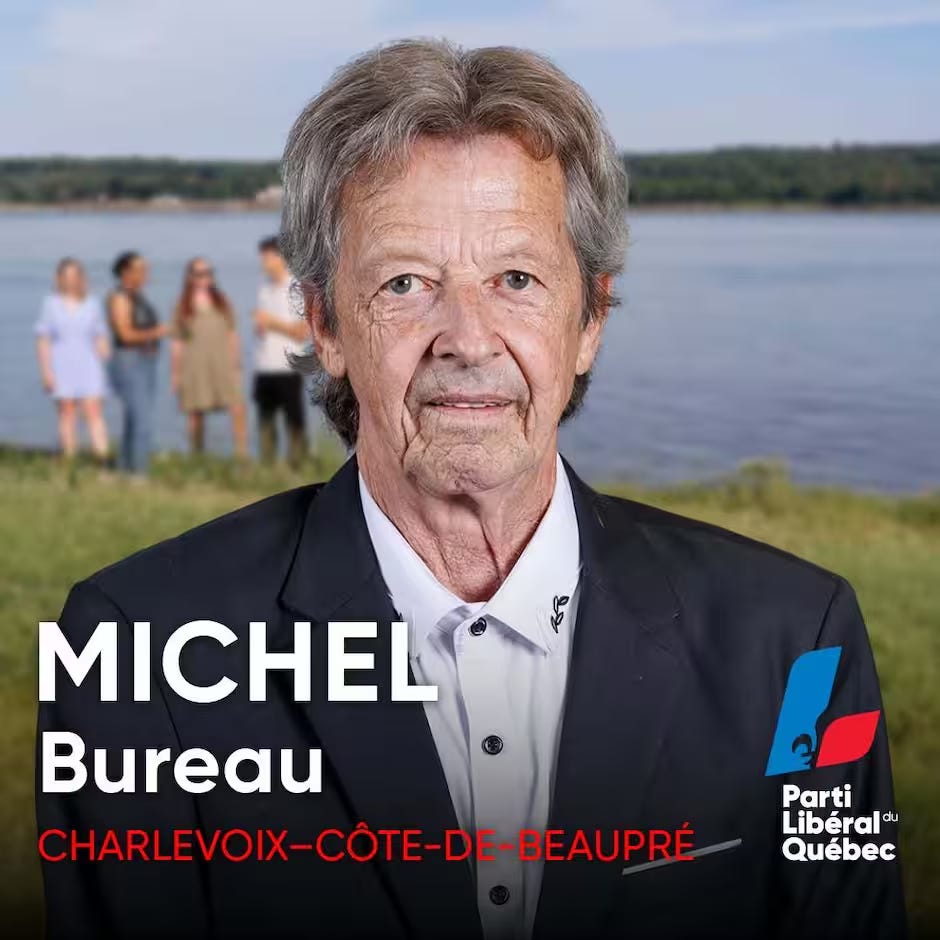
Mr. Bureau also said that the PQ candidate in Charlevoix, François Gariépy, could be “a very good MNA” for the region.
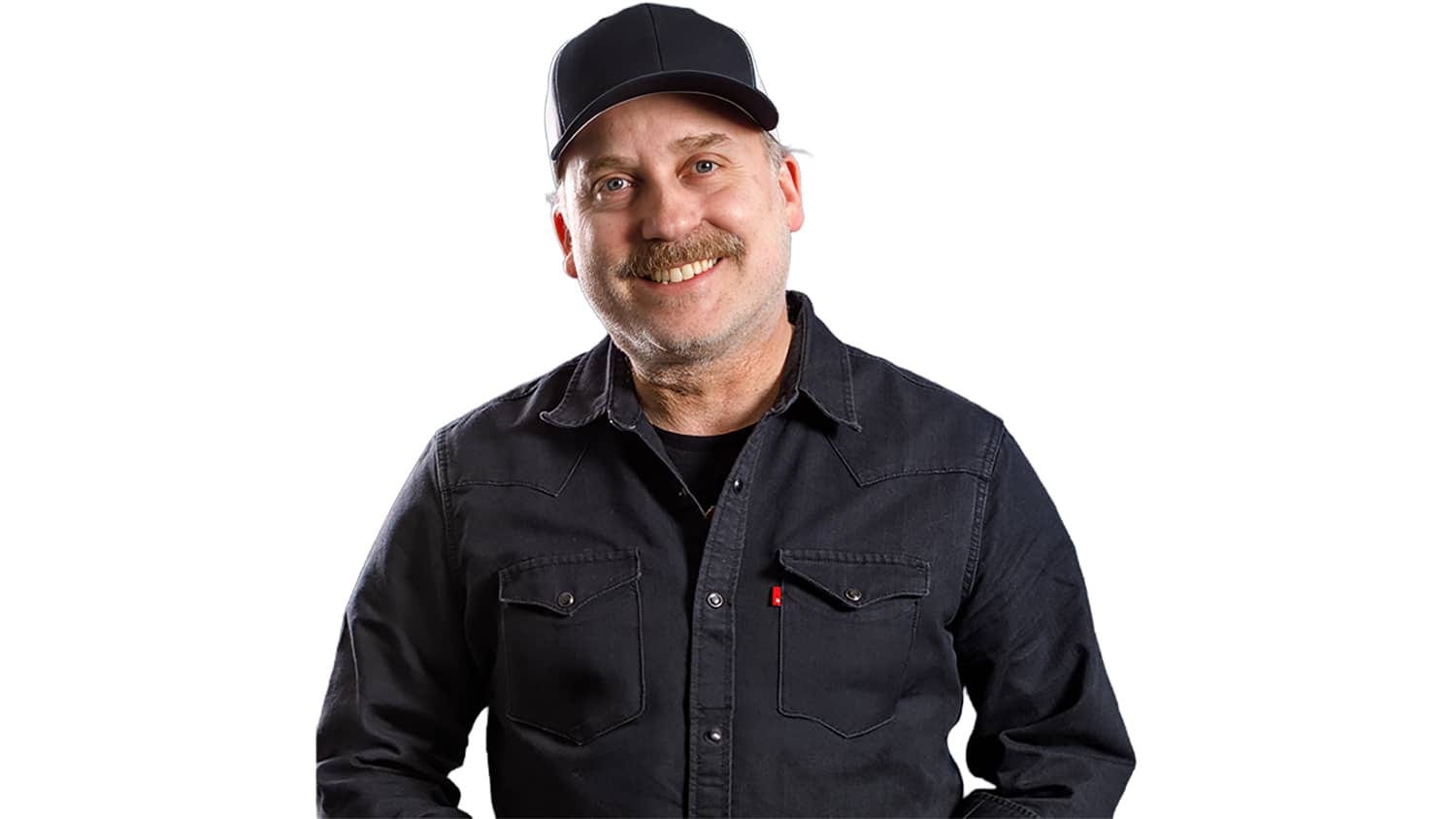
Which, while we wish Mr. Bureau the best of luck, gives us another opportunity to talk about Mr. Gariépy.
The Parti Québécois’s “Good Guy”
Parti Québécois candidate and former trash talk radio host François Gariépy had already made a name for himself with his sexist, misogynistic, and vulgar remarks, as well as for using the word “squaw” to refer to Indigenous women.
Today, we learned that as recently as this summer, Mr. Gariépy was still airing his adolescent fantasies on the radio, particularly about Anne-Marie Withenshaw, whom he called “Anne-Marie Withenchatte.”
😬
Earlier today, it was also reported that Mr. Gariépy believed artists facing financial hardship did not have “a real job.”
Parti Québécois leader Paul St-Pierre Plamondon, who has himself publicly disparaged artists, continues to defend his candidate, describing him as a “good guy.”
If you feel that standards have slipped, you’re not alone.
The good news is that Mr. Gariépy spent several years at Radio X, and there’s still more than a month left in the campaign to unearth more of his greatest hits.
-30-
My name is Patrick Déry. I’m a French-speaking Québécois writing for a living, and trying something different here. If you enjoyed reading this text, you can support me by buying me a coffee. You can also subscribe to this media (free or paid, your choice).
Comments, shares, and “likes” are always appreciated