


Have you ever coached amateur sports? I coach a wonderful soccer team made up of equally wonderful teenage girls. Soccer games are long, though, and yesterday’s forced me to finish this newsletter later than I would have liked. So thank you for your patience.
On today’s menu: a pollster contradicting himself, the CAQ promising to invest $1,000 in your next baby, the QCP imagining things are better in Ontario, PSPP showing us a document he has not read, and Québec solidaire wanting the government to become a co-owner of your home.
I would have liked to tell you about the Quebec Liberal Party, but I could not find anything interesting to say. Someone should probably tell them the campaign has started.
(The QLP talked about building social housing, if you must know. But so did QS, while the PQ and the CAQ did the same during the last campaign. I do not know anyone who is against social housing, but it remains damn complicated because of all kinds of bureaucratic and regulatory requirements, not to mention the chronic labour shortage in construction. Pulling a number out of a hat will not solve those problems.)
When a Pollster Mangles His Own Poll
It always makes me smile when hyperpartisans accuse pollsters of trying to tip the scales in favour of their own political preferences. That reflects a profound misunderstanding of how the media operate and of the value of credibility, both for pollsters and media outlets.
I have therefore never doubted the methodology of major polling firms such as CROP or Léger.
That said, political preferences can show through in how the results are interpreted. That is what happened today in Le Journal de Montréal.
The latest Léger poll, like other recent surveys, confirms a tightening race between the Parti Québécois, still in first place at 29%, and the CAQ, now second at 24%.
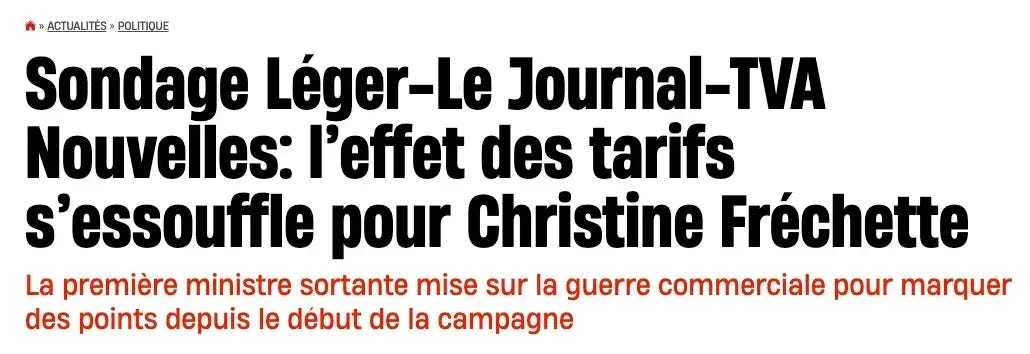
The headline translated that into: “Tariff Effect on the CAQ Losing Steam — PQ Remains Ahead.”

Online, it was even more explicit: the story was that the tariffs were having no effect on support for the CAQ, as though the polls were becoming less favourable to it.
Huh?
The Parti Québécois now leads the CAQ by only five points. That puts the parties within the margin of error, which is 3% in either direction. In other words, the CAQ could be tied with the PQ or even ahead. (The PQ could be at 26%, with the CAQ at 26% or 27%, for example.)
In late March, the PQ held a 24-point lead over the CAQ. This summer, the gap was around 10 points. Last week, it was seven points, and this week it is only five.
After three months during which the gap held steady at 10 points, it has been cut in half within a few weeks. How can anyone conclude that the CAQ’s momentum is “losing steam”?
The reporter’s write-up tries to reconcile what looks like an internal tug-of-war within the pollster. It is rather amusing to read.
“Christine Fréchette’s recent rise in the polls slowed this week…”
So that is bad for the CAQ?
“…even though the CAQ leader continues to slowly close the gap with the front-running PQ.”
So that is good?
“The outgoing premier is banking on the trade war to score points at the start of the election campaign.”
Yes, absolutely.
“But the impact of that strategy may be limited, according to pollster Jean-Marc Léger.”
Oh? Has Trump lifted his tariffs?
“After a three-point increase in voting intentions last week — as negotiations with the Trump administration broke down — the CAQ’s gains are now within the margin of error.”
So the CAQ is still gaining to the point where we can no longer be certain whether it is in second or first place? And the geopolitical context appears to be helping it, does it not?
“Since this is the third time we have gone through a round of tariffs, people react very emotionally at first, but it does not last long,” Jean-Marc Léger says.
How can he know that when the poll has just been conducted?
“And each time, the reaction will be weaker and shorter. People have moved on,” the pollster predicts.
Are we doing astrology now?
“And yet, Quebecers say they are prepared to wage a war of attrition against their American neighbour: 66% of respondents support imposing new tariffs on American products.”
So, people are still fully engaged with the issue and have not moved on? I’m confused.
You can read the cognitive dissonance being dissected in real time here.
+++++++
Contrary to the conclusions Mr. Léger is trying to draw, I believe the geopolitical context will continue to benefit Christine Fréchette.
Quebecers must choose between an aspiring premier who shoots at everything that moves, an official opposition leader who has been largely missing in action, and a premier who moves forward calmly and resolutely. Ms. Fréchette is also showing that she can work with Ottawa. That is not a political preference, but a simple observation.
After eight years in power, worn ragged by its own incompetence and crude populism, but benefiting from a vote split among five parties, the CAQ is being reborn as a safe-haven option.
The Number of the Day: $1,000
That is the amount a CAQ government would deposit into a Registered Education Savings Plan (RESP) for every newborn in Quebec. Parents would have three years to open the account.
We have therefore officially entered the realm of pronatalist policies. Good grief.
First, this kind of policy does not work, because the main determinants of fertility (primarily the desire to have children and how many) are largely shaped by a society’s level of education. Once that rises, there is no going back. Several countries have tried such measures without success. At best, their effects are temporary.
Second, even assuming that cost were a determining factor, the amounts required to offset the cost of raising and housing an additional child would have to be considerable to make a difference and change the minds of prospective parents.
Third, those amounts would have to be even more staggeringly enormous because the money would have to be paid to every new parent. There is no way to ensure that it goes only to those for whom it would actually make a difference. (The same is true of electric vehicles subsidies, by the way.)
In short, even at “only” $1,000 per child, and with nearly 80,000 births a year at present, we are potentially talking about tens of millions of dollars every year SIMPLY TO GIVE A BONUS FOR BABIES WHO WOULD HAVE BEEN BORN ANYWAY. Because, let us be clear: unless they are damn bad at math, no one is going to have a child in exchange for a $1,000 cheque that can be cashed a decade later. (Or $1,200, if you want to be precise, because of the 20% federal top-up.)
It is also likely to be a highly regressive tax measure, since those most likely to contribute to an RESP are generally more educated and affluent.
In short, populism, pure and simple.

The (Conservative) Quote of the Day
“While a Quebec entrepreneur is filling out forms, their Ontario competitor is growing their business, finding new customers, and creating jobs. Entrepreneurs should spend their time producing and selling, not trying to understand government paperwork.”
— Éric Duhaime, leader of the Conservative Party of Quebec, in a news release
Except…
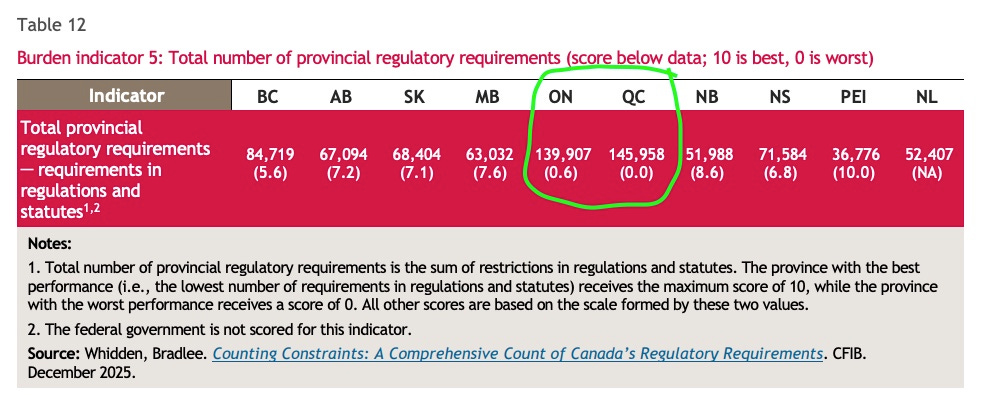
According to a report published in 2026 by the Canadian Federation of Independent Business (CFIB), the regulatory burden is much the same in Quebec and Ontario.
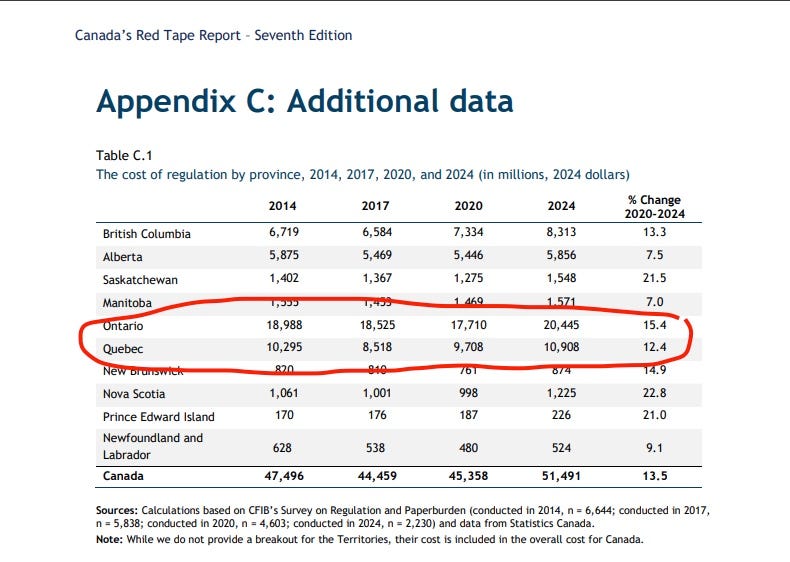
Another CFIB report also concluded that the cost of regulation is similar in Ontario and Quebec on a per-capita basis.
That report also found that a majority of Ontario entrepreneurs believed the cost of the regulatory burden was too high and, as a result, would not recommend that the next generation go into business.
In fact, that sentiment was even more widespread in Ontario than in Quebec.
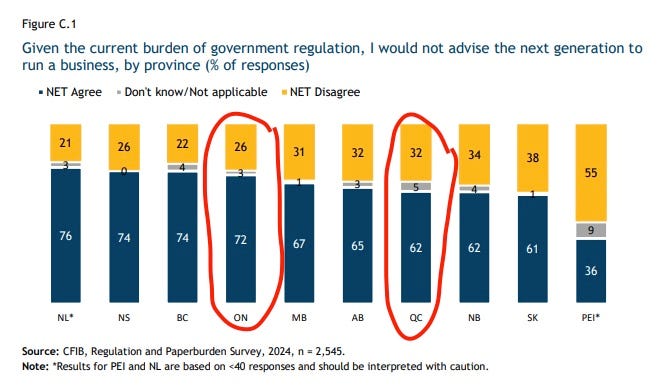
In short, Ontario may not be the model to emulate. But, as Éric Duhaime might say, better a bad example than no example at all.
In his defence, the Conservative Party’s news release also mentions Alberta, where the regulatory burden is objectively lighter, even though that does not seem to make Alberta entrepreneurs any happier. See the last table.
The (Belated) Photo of the Day
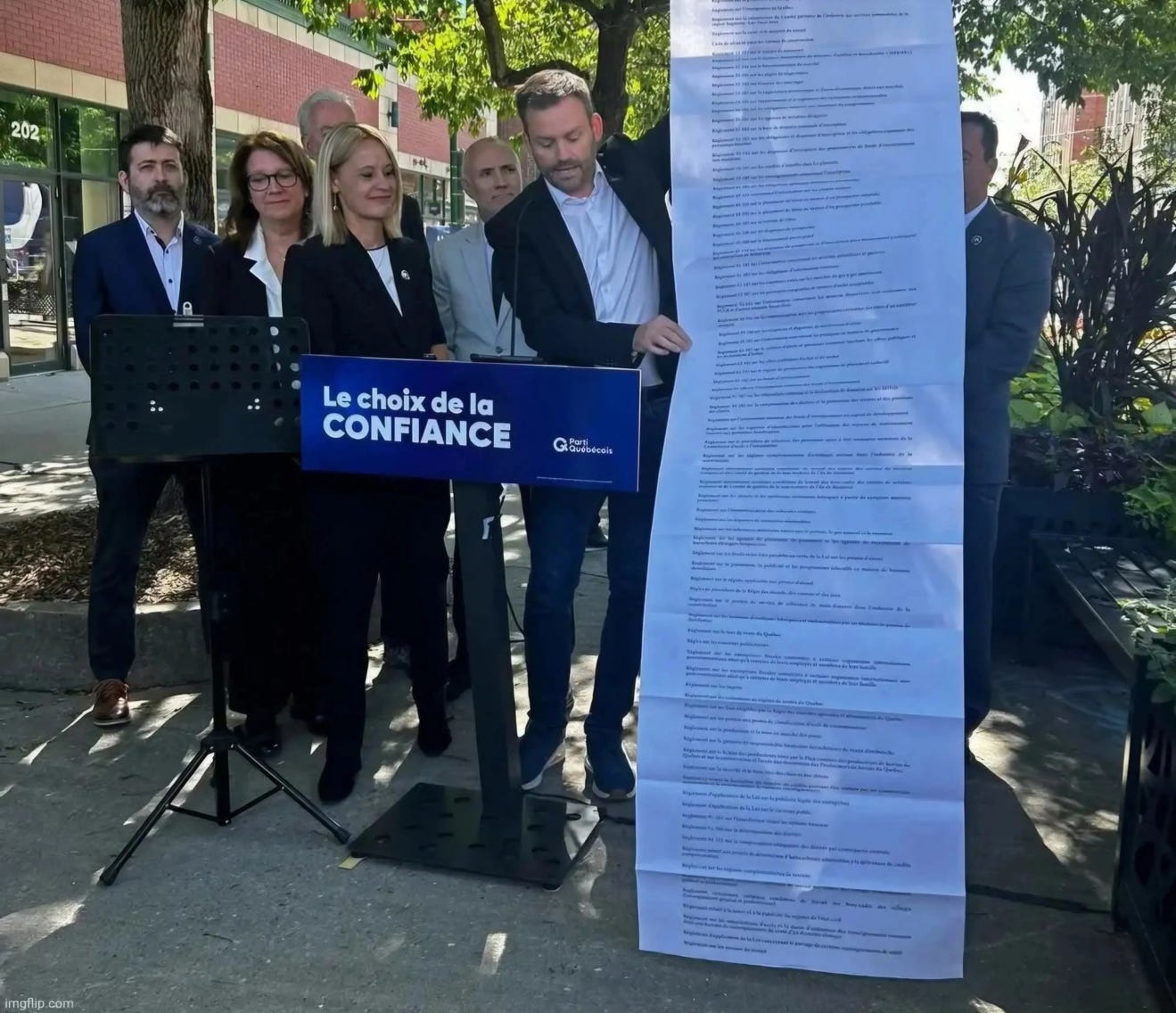
Like the Conservative Party, the Parti Québécois also wants to reduce the regulatory burden on businesses. PQ leader Paul St-Pierre Plamondon engaged in a little political theatre on Monday to make sure everyone understood the message.
That prompted one wag to create the following montage:
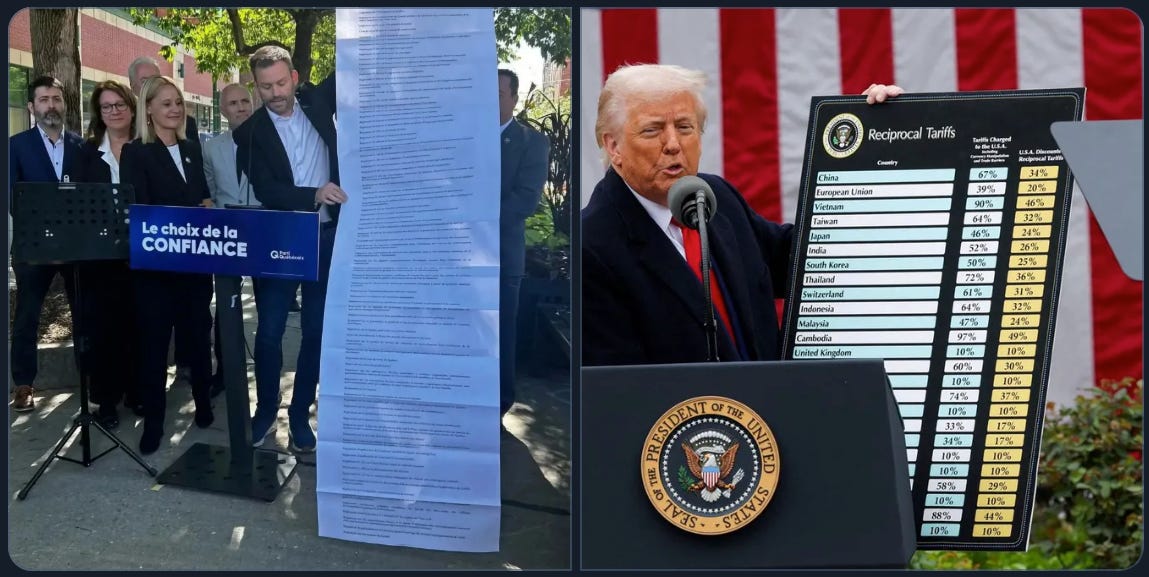
(No, I do not think PSPP can be compared to Donald Trump. But it made me laugh, so I am sharing it with you.)
There is something rather ironic about the document the PQ leader chose to brandish, though he was probably unaware of it.
As one sharp-eyed social media user noticed, the eight-foot-long sheet includes a list of Autorité des marchés financiers regulations governing the securities market that also exist in every other province. In short, these regulations facilitate the trading of all kinds of financial products across the country.

If you take the time to look at the numbers and titles of the regulations, you will find them all on the Canadian Securities Administrators’ website.
Quebec cannot really repeal these regulations unilaterally, unless it is prepared to let Ottawa regulate securities instead of the provinces. The idea is not altogether far-fetched, but I find it hard to believe that this is what the PQ leader wants.
At least PSPP was holding a list of actual regulations rather than his grocery list.
The PQ Wants to Exempt Used Goods from the QST
Over the past few months, the Parti Québécois has dipped into the traditional conservative playbook several times, promising lower gasoline prices, a more efficient government, and less regulation for businesses. It has even dipped into the same pool of candidates, recruiting from Radio X, as pure an outlet for conspiracy-minded conservative propaganda as you can find.
These proposals are not necessarily without merit. But coming from the traditionally centre-left and statist PQ, it feels a little like watching a teenager start smoking to look tough.
Today, the PQ went one step further by proposing that used goods be exempted from the QST.
Yesterday, I explained why this was a bad idea, not so much because of the objective (helping disadvantaged families is fine) but because of the proposed way of achieving it. I have not changed my mind.
Québec Solidaire Wants to Invest in Your Home with You
This happened on Sunday, but I absolutely wanted to come back to it. It proves that I should not have taken the day off.
Québec solidaire wants to help first-time buyers purchase a home. So do I. Except QS’s solution does not make one blessed bit of sense.
The idea is for the government to co-invest by acquiring a stake worth up to 15% of the value of a new home, to a maximum of $50,000.
🤯
The government would recover its investment when the property was sold…
🤯🤯🤯
…but it would have to be sold below the median market price.
🤯🤯🤯🤯🤯🤯🤯🤯🤯🤯🤯🤯🤯🤯🤯🤯🤯🤯🤯🤯🤯🤯🤯🤯🤯🤯🤯
Do we really want to involve the government in the purchase and resale of houses and condominiums between private individuals? Really? How many forms and government employees would we need to add for that?
And even assuming we wanted to do it, is there a single buyer who would willingly tie their own hands by agreeing in advance to give up part of their capital gain?
Then there is the fun we would have determining the median price for a particular type of property, because, as everyone knows, all houses are identical and easily comparable.
What’s more, this would once again be a demand-side measure, putting additional upward pressure on prices, however marginally.
Moral of the story: if you have to draft a public-policy proposal, stop by the SQDC afterward, not before.
Today in 2022
On the sixth day of the 2022 campaign, September 2, Bernard Drainville uttered his now-famous “Enough already with the GHGs!” to justify the proposed third link between Quebec City and Lévis. He added: “The wait we deal with does not need to be studied. You just need to be in your car, stuck in traffic, and the damn wait keeps getting longer and longer.”
In fact, when the government eventually studied it, it discovered that travel between Lévis and Quebec City had declined.
François Legault eventually appointed Bernard Drainville environment minister.
I am pretty sure he is still laughing about it.
-30-
My name is Patrick Déry. I’m a French-speaking Québécois writing for a living, and trying something different here. If you enjoyed reading this text, you can support me by buying me a coffee. You can also subscribe to this media (free or paid, your choice).
Comments, shares, and “likes” are always appreciated
Vous abordez le pouvoir de prédiction (astrologie), tôt dans votre analyse. Permettez-moi d'en faire usage aussi au sujet du 1000$ dans un REEE. Il m'est d'avis que cette initiative pourrait au contraire être bénéfique pour un plus grand accès aux études supérieures si ce montant n'était pas laissé au bon vouloir des gens et obligatoirement déposé dans un régime. Au contraire de vos dires, une utilisation du fruit de ce 1000$ vingt ans plus tard ( pas dix) à un simple taux de rendement de 6% permettrait facilement de couvrir au moins 2-3 sessions universitaires + appart et bouffe à des gens qui n'auraient pu se le permettre (avec contribution de 25$ par moi par le citoyen comme engagement sur 20 ans). Je vous prédis donc une croissance des coût de manière exponentielle des études supérieures en 10 ans. Avec un peu plus de pédagogie autour de ce programme, et considérant que le coût à l'éducation supérieure aura grandement augmenté en 2046, je dirais au contraire que cela pourrait être une bonne initiative, si le programme est strictement géré, à la manière d'un RAP, disons. Mais je comprends que la CAQ ait possiblement lancé cette annonce de manière plus électoraliste que réellement en initiative bienfaisante.