


I’m late again because I wasted time getting angry about a news story I had partly missed. You’ll soon understand why.
Today, the CAQ picks on anglos, the CAQ funds a federalist group, the PQ wants to decide what gets read in our schools, a PQ candidate talks nonsense, and we get a shining example of boneheaded policymaking.
Let’s dive in!
Second-Class Quebecers
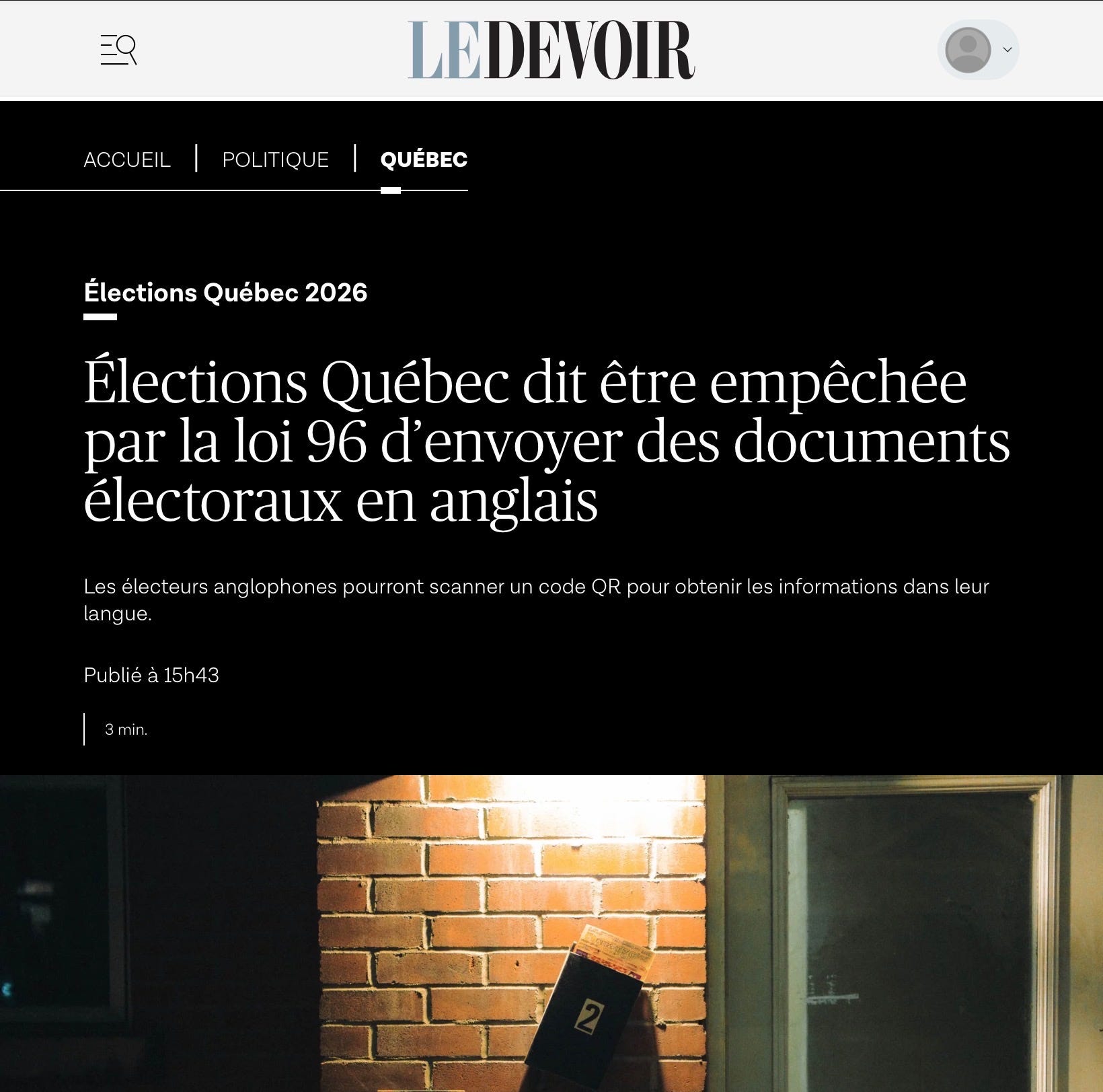
For the first time in our history, voter information materials, the provincial election guide, registration notices, and reminder cards will be sent to voters in French only.
Those who can prove they’re eligible for English-language education will have access to services by phone. Everyone else will have to manage online, including seniors who don’t own a cellphone and therefore can’t scan a QR code.
Nearly 94% of Quebecers can function in French. But that still leaves 6% who can’t speak it.
Quebec also has a historic English-speaking community whose democratic rights are every bit as valid as ours. Two-thirds of its members speak French. Can’t we show a little courtesy to the others, many of whom are older?
Élections Québec said it tried to obtain an exemption from Bill 96, which requires government bodies to communicate in writing exclusively in French, but its request was denied.
No one will learn French any faster or more easily just because we make their lives miserable before an election.
It’s petty, stupid, and mean-spirited. It’s unworthy of the kindness, tolerance, and openness that the vast majority of Quebecers of all backgrounds show one another every day.
I refuse to believe this is what we’ve come to.
The CAQ Outsources Its Work to a Federalist Group
The governing party, at least until October, awarded contracts to Mission Leadership Québec, a group that promotes federalism in Quebec.
It isn’t illegal, but it’s unbelievably stupid.
The CAQ, as a political party, is a separate entity from the Quebec government. The party is at issue here, not the activities of the executive branch.
The other parties all have budgets and permanent organizations financed through donations and public funds. In the latter case, funding is allocated mainly according to the number of votes received in the previous election. Parties can spend that money on all sorts of things, including polling, advertising, office space, and permanent staff salaries.
Why on earth would the CAQ, by far the party with the greatest financial resources, hire an organization with a political agenda of its own to carry out the CAQ’s political activities? After 14 years in existence, four elections, and eight years in power, why doesn’t it have the expertise to organize meetings with voters? Why doesn’t it hire its own contractors to do this work?
What we know so far is that the CAQ recruited people to attend a town hall last Sunday. Why not simply invite its own supporters, as every party does?
At the very least, this raises questions about public funding for political parties. When a party has reached the point of outsourcing its own partisan activities to another organization, perhaps it’s because it has too much money.
One of Mission Leadership Québec’s directors has acknowledged doing paid work for the CAQ and said that some of the proceeds were used to fund his organization’s activities.
This is really weird.
The Parti Québécois Wants to Decide What Gets Read in Schools
If elected, which remains a very real possibility, the Parti Québécois promises to establish a list of 40 to 50 “Quebec and Francophone classics” from which teachers could choose two books a year.
PQ leader Paul St-Pierre Plamondon gave three examples. All were from Quebec, which rather predictably tells us where this is heading.
At the risk of having Victor-Lévy Beaulieu throw bricks at me, I don’t think this is a good idea.
The priority should simply be to get students reading. Anything. It can be from Quebec or somewhere else. It can have been written in French or translated into French. The first objective should be getting them off their phones. Harry Potter in French is perfectly fine. Let’s build the habit first. The rest will come naturally.
Then there’s the whole question of what would make the list. Are Dany Laferrière and Kim Thúy Quebec enough to be included? What about Mordecai Richler?
Above all, I wouldn’t want a civil servant deciding, much less a political party.
+++++++
In high school, assigned reading was almost always synonymous with “a boring book.” In Secondary 4 or 5, it was Agaguk. I remember nothing about it except that I hated it and that it put me off reading novels for quite a while.
Culture isn’t something you impose. It’s a world you embrace.
If my high school teacher had suggested a novel that appealed more to a teenager, I might have started reading seriously ten years earlier.
The PQ Wants to Get Kids Moving at School
I agree with this! In fact, you have no idea how happy I am to be enthusiastic about a Parti Québécois proposal.
The PQ wants to add an hour of physical activity a day. Great! Send the kids outside for an extra hour at lunch or into the gym, whichever works. As long as they move, l’affaire est ketchup, as my grandmother used to say.
It could also take the form of a daily sports period. Not phys ed, sports: here’s a ball, there are two hoops, figure it out, and we’ll talk again in an hour. No teacher needed, just a supervisor.
I’m biased in favour of the measure because I’ve been thinking about it for years, and also because my youngest is a handful who needs to burn off energy. But there’s another reason I favour physical activity: we’re heading towards a major public health crisis.
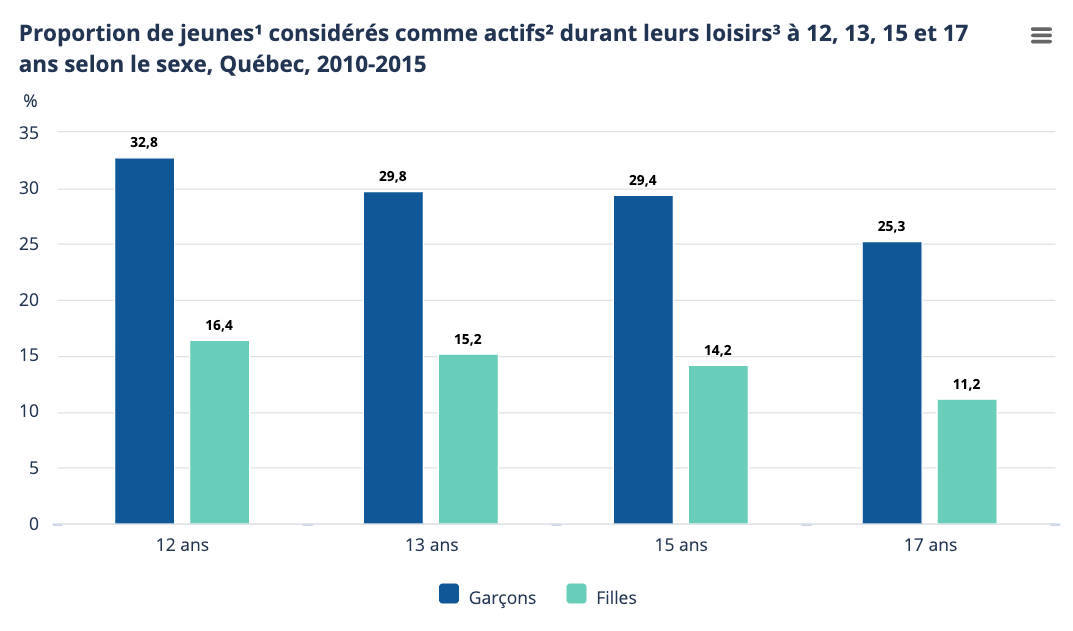
Barely 30% of 15-year-old boys are considered “active,” meaning they get enough physical activity of at least light intensity on five or more days a week. Among girls, the proportion is under 15%.
By age 17, the proportions fall to 25% and 11%, respectively. That’s appalling.
A friend of mine teaches physical education at CEGEP. He was telling me how some young adults can barely jump up and down with any coordination because they’ve never done it in their lives. Many can’t sustain physical effort for 20 minutes. At 18.
The PQ proposal would also be an excellent opportunity to extend the school day by an hour, bringing it more in line with the realities of life in 2026, when both parents work.
However, that would mean extending the workday by an hour for most school staff. That’s where things are likely to get sticky.
A Former Journalist Talking Nonsense
On Tuesday, Parti Québécois MNA and immigration critic Alex Boissonneault made the following statement:
“More people settled in Quebec during the CAQ’s time in office, meaning over the past eight years, than between the Quiet Revolution and the end of Philippe Couillard’s term.”
(You can listen to him here in French, starting at 11:55.)
Wow! More immigrants in eight years than in nearly 60! That sounds like quite a stretch.
Except… it isn’t true. As in: not even close.
I should note at the outset that the data for 2026 are incomplete. I assumed that the final total would be the same as in 2025.
Since the CAQ came to power, Quebec has received approximately 712,000 immigrants, including temporary immigrants.
From 1961 to 2018, the final year of the Couillard government, the figure was almost 1.56 million, according to data from the Institut de la statistique du Québec.
Asked about the MNA’s glaring error, a PQ spokesperson said it was a “good-faith” slip of the tongue and that Mr. Boissonneault had actually meant to count Philippe Couillard’s term as part of the more recent period.
Okay. Add roughly 200,000 to one side and subtract about as many from the other. That gives us 1.29 million between 1961 and 2014, compared with 893,000 since then. We’re still nowhere close.
The PQ also says it would rather use net migration, which subtracts the people who leave the province or the country. That comparison works because thousands of Quebecers have moved elsewhere every year for more than 60 years. But I call bullshit. That’s not what Boissonneault was talking about, and I’ve never seen net migration invoked anywhere in the immigration debate.
For the past five years, the only figures the PQ and the CAQ have kept hammering us with are the numbers of permanent and temporary immigrants: how many are admitted annually in the first case and how many are present in Quebec in the second.
We can debate those figures. But the attempt to rescue Boissonneault’s claim by massaging the data every which way in search of a lifeline doesn’t fly.
I’ll end with a question for Mr. Boissonneault, now that he has suddenly taken an interest in historical migration statistics.
Since 1962, Quebec has lost residents on net to other provinces every single year. That means that for 64 consecutive years, with 2026 still to be determined, more people have left Quebec for another province than have moved here from elsewhere in Canada. Those who leave are generally in the prime of their working lives. In all, 800,000 Quebecers have found the grass greener elsewhere in Canada over the decades.
My question is this: despite all our advantages, why do more Quebecers leave Quebec than other Canadians move here?
This brain drain has cost Quebec $50 billion.
Do as I Say
“We really need to stop using the word ‘immigrant’ once someone has been accepted as a resident, because it divides us. Once someone becomes a Quebecer, that person is a Quebecer, and we are all Quebecers.”
— Paul St-Pierre Plamondon, September 2, 2026
“In some school boards, such as Laval, children from immigrant backgrounds account for 82% of students.”
— Paul St-Pierre Plamondon, August 29, 2026
P.S. The 82% figure is both inaccurate and misleading, as I explain here.
Today’s Boneheaded Policy Announcement
This one is federal, but the political populist logic is the same as at the provincial level, so it’s worth discussing.
The suspension of the federal excise tax on gasoline was set to end next Monday, on Labour Day. Ottawa has decided to extend it until the end of January 2027.
CAA is happy. The Convenience Industry Council of Canada is happy. Doug Ford is happy. Even Pierre Poilievre is happy. Enough said. Environmental groups and even tax experts are less pleased, but who cares?
“Just days before the tax was set to return, motorists can breathe a sigh of relief,” according to La Presse.
You have no idea just how relieved you are.
The excise tax amounts to 10 cents per litre, plus sales taxes, for a total of 11.5 cents. Average gasoline consumption is roughly 1,000 litres a year, or 83 litres a month.
You can probably see where I’m going with this.
For the average driver, suspending the excise tax means saving a little over $9 a month. For the federal government, it means forgoing half a billion dollars in revenue. Every month.
And that’s without mentioning that, in real terms, gasoline costs the same as it did 20 years ago, as I explain here.
But since we collectively lose our minds every time the price displayed at a gas station rises by a few cents, while wilfully ignoring every decline, no rational argument stands a chance.
We can expect the Conservative Party and the Parti Québécois to come back with the same kind of ill-conceived promise. It would be costly for public finances without making much difference in our pockets. It would also be regressive, environmentally counterproductive, and based on a false premise.
In short, it checks every box for a boneheaded policy.
-30-
My name is Patrick Déry. I’m a French-speaking Québécois writing for a living, and trying something different here. If you enjoyed reading this text, you can support me by buying me a coffee. You can also subscribe to this media (free or paid, your choice).
Comments, shares, and “likes” are always appreciated