Quebec Sovereignty: Worse Than Austerity
Twenty-five years ago, Quebec’s independence could have been achieved at virtually no cost. Not anymore.
(Texte français disponible ici.)
Quebec has a new premier, Christine Fréchette.
Don’t get too attached. This will be nothing more than a brief interlude before the next election, which will take place in October and could see the CAQ disappear. Ms. Fréchette is likely to have her Kim Campbell moment.
After an eight-year hiatus, it’s going to be a race between the Parti Québécois and the Liberal Party once again. Currently, the PQ has the best chance of forming a government—and getting a majority in the Salon Rouge, even if it wins just a third of the vote.
There’s much to be said about support for sovereignty, which has hit an all-time low after stagnating for 20 years. About what was essentially a generational project. And about the PQ’s stubbornness in confusing the political desires of its supporters with those of Quebecers.
But today, we’re going to talk about money. Not because material things are the only source of happiness, but because there is a cost to ensuring the best possible life for all our fellow citizens and the best future for our children. The present and the future are not made up solely of good intentions, but of resources.
Before we go any further, two things.
First, what follows is not a critique of the legitimacy of independence as a political project. We can revisit that later but, personally, I have never questioned it. Like many Quebecers, I voted Yes in 1995. Like many more Quebecers, I would vote No today. Sovereignty is an answer to a question. If the question changes, the answer may change as well.
Second, since I’m going to talk about numbers, I’ll ask for your patience. I promise to keep it simple, with visuals to help everyone follow along, even those who haven’t had their morning coffee yet. It makes for an interesting read, and in my opinion, it leads to a difficult but inevitable conclusion.
(Yes, I sold the punchline with the title, but stick with me—it’s worth it, and even more so for those who plan to vote Yes in a potential third referendum. And I have a surprise in store for you, just before the end.)
+++++++
Every year, Quebecers, like residents of all provinces, send significant sums to Ottawa. This mainly includes income tax, the GST, other taxes, and employment insurance contributions.
Ottawa also sends money to or spends for Quebec. This ranges from pensions to equalization payments, including employment insurance, child benefits, health-care transfers, national defence, interest on the federal debt, the portion of the federal government’s operating expenses that concern us, etc.
The difference between what we send and what we receive represents the financial contribution or cost of being part of Canada. It was recently discussed in La Presse. Others have done so before.
I crunch the same numbers from time to time in my Excel spreadsheet, and I’d like to delve a little deeper into the financial costs and consequences of sovereignty.
The principle behind the calculation is fairly simple arithmetic. The difficulty consists of correctly accounting for revenues and expenditures and allocating them in the right proportions to the right categories. There are different ways to calculate this. Statistics Canada, the Parti Québécois, and federalist economists have done so.
What interests me above all are the implications of the calculation. But first, let’s find the right figure.
The Statistical Method
Statistics Canada has been performing this calculation for several years, and the Institut de la statistique du Québec reproduces it in the Quebec economic accounts of income and expenditures, using data from Statistics Canada.
In 2024, Quebecers sent $84 billion to Ottawa and received $111 billion. In other words, Ottawa subsidizes us to the tune of $27 billion a year.
Why do we receive more from the federal government than we send? Essentially, because we are relatively poor. Quebec has a lower fiscal capacity than other provinces, for all sorts of reasons—historical, structural, but also related to our public policy choices. It is not a matter of tax rates, but of the size of the tax base. Ours is smaller, which means that, at equal tax rates, Quebec’s tax revenues are lower than Ontario’s.
Detailed tables are available at this link. If you look through them, you’ll eventually find the $27 billion in an Excel spreadsheet that looks like this:
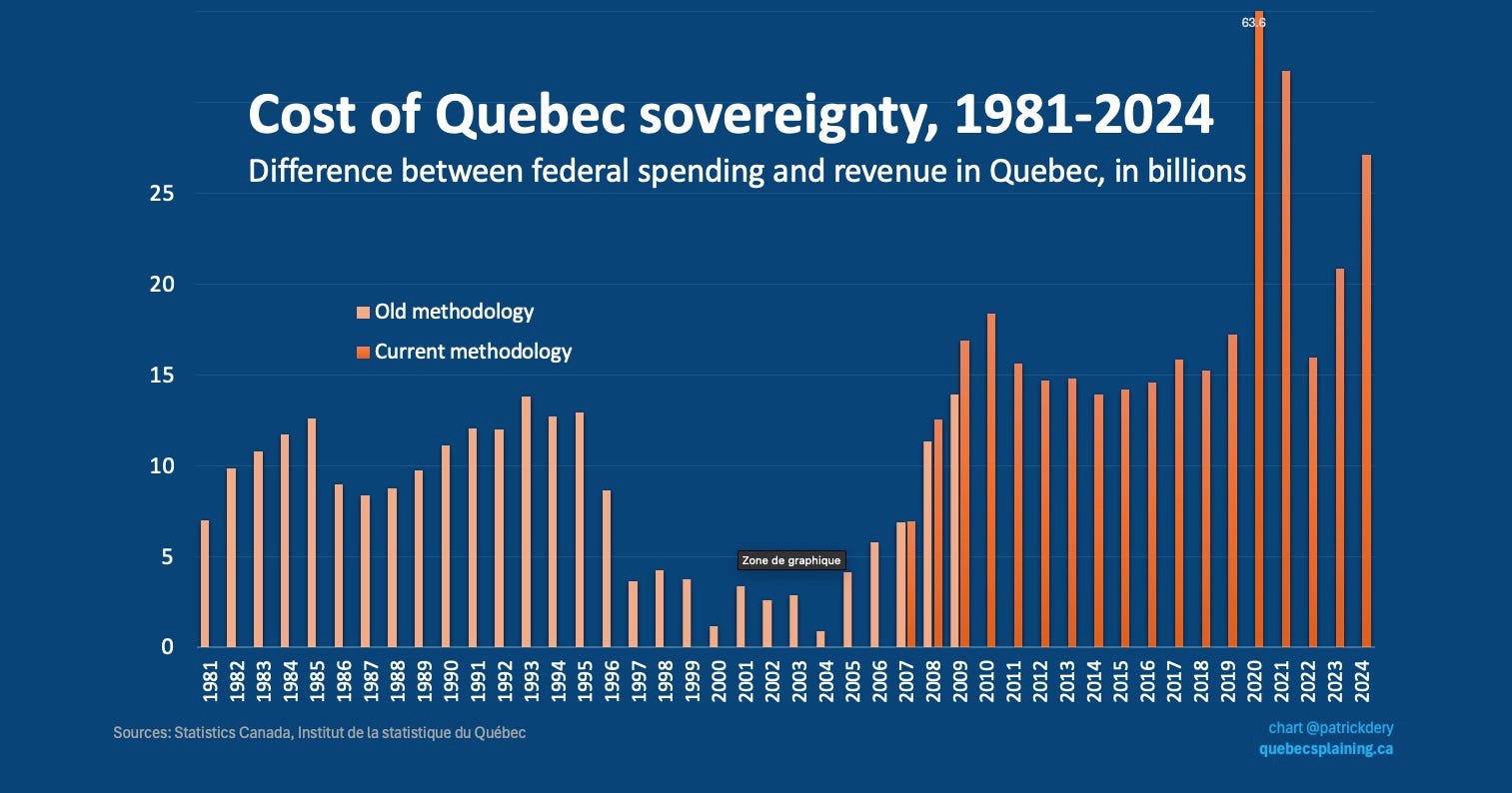
This deficit that Quebec runs with the federal government is nothing new. Since the 2010s, the amount has fluctuated between $15 billion and $20 billion a year. In a way, it’s not that huge either. Quebec receives about $3,000 per capita. Saskatchewan and Newfoundland receive about twice that amount. The other Atlantic provinces receive three to four times as much. But since Quebec has a population of 9 million, that adds up to a large figure: $27 billion.
PQ politicians dispute part of the methodology, mainly the way Quebec’s share is determined. Other pro-sovereignty researchers, on the other hand, have found it a very good indication of reality, “give or take 10%.”
In a 2024 ad, Parti Québécois leader Paul St-Pierre Plamondon noted that Quebecers receive “virtually no direct services to the public” for the tens of billions they send to Ottawa each year.
That’s not completely false. But not completely honest, either.
It’s true that most public services are provided by provincial governments (hospitals, schools, the administration of justice, etc.). But a large portion of these services is funded by Ottawa. In 2024, $30 billion spent by the Quebec government came from federal transfers, mainly equalization payments and health-care transfers.
The federal government is also responsible for national defence, the coast guard, customs, passports, immigration, broadcasting regulation, currency, and so on. All of these services would exist in one form or another in a sovereign Quebec. In 2024, these expenditures totalized approximately $22 billion, according to Statistics Canada’s methodology.
The calculation must also include funds sent directly to Quebecers, such as employment insurance, old-age pensions, and child benefits. That amounted to $37 billion in 2024.
Transfers payments to municipalities, nonprofit organizations, Indigenous communities, and others, as well as interest on the federal debt, must be added. That brings the total to $111 billion, which would also be spent by the Quebec government. Perhaps minus a certain amount due to eliminated overlaps, but that’s not guaranteed, as we’ll soon see.
So, when the PQ leader says that we’re sending (at the time) $82 billion and receiving “hardly any direct services for the public,” he’s playing semantics. The federal government isn’t burning through our billions. It funds indirect services (the military, defence, immigration, and so on). It funds part of the services provided by the provinces and cities. It also funds tens of billions in benefits of all kinds, which end up in our pockets.
The PQ’s Method
In its budget of a sovereign Quebec (of Year 1 budget), the Parti Québécois uses a different methodology to estimate federal spending allocated to Quebec. Basically, the PQ chose to account for spending based on the location of the recipients rather than the territory where the spending occurs. That’s a valid approach. Six economists verified the calculations.
Unlike the Institut de la statistique and Statistics Canada, the Parti Québécois does not explicitly state the amount of our deficit to Ottawa, preferring instead to calculate the budget balance of an independent Quebec by factoring in the benefits of eliminating duplication with the federal government, and the efficiency gains resulting from achieving independence. However, we can figure out their estimation of the deficit with Ottawa by reading between the lines.
Once separated from Canada, the Parti Québécois calculates that Quebec would recover $75 billion in revenue currently sent to Ottawa.
As for federal spending allocated to Quebec, the PQ estimates that it amounted to $99 billion that same year.
So, in 2021, our deficit to Ottawa—or the federal subsidy, if you prefer—was about $25 billion. However, that was a pandemic year, during which the federal government paid out billions in benefits to individuals and in business subsidies.
In the public accounts, the ISQ and Statistics Canada calculate that our deficit to Ottawa was nearly $32 billion in 2021. This leads to the conclusion that the PQ calculates net federal transfers to be about $7 billion lower than Statistics Canada’s estimates.
In 2024, using the PQ’s method, we would arrive at $20 billion, rather than Statistics Canada’s $27 billion. The PQ also believes we could achieve efficiency gains of about $9 billion. I’ll come back to that.
The Pessimistic Approach
While the Statistics Canada calculations reported by the ISQ are strictly accounting-based, the PQ’s budget is an eminently political document. This does not invalidate the approach, but just as an entrepreneur seeks to sell their business plan, sovereigntist politicians seek to sell their vision for the country. This influences perceptions, the analytical framework, and the choices they make.
Others dispute the PQ’s calculations, which they deem overly optimistic. They also assess that the Year 1 budget underestimates the repercussions and costs of separation, particularly the scale of the debt and the costs of financing it. This is the view of economists Robert Gagné, Louis Lévesque, Alain Paquet, and former editorialist and Senator André Pratte, who at the time was also chair of the Quebec Liberal Party’s national political commission.
On the issue of debt and payments, it’s hard to argue against them. It is almost certain that the interest payments on Quebec’s new consolidated debt (after adding its share of the federal debt) would be proportionally higher, for two reasons. First, because Quebec’s credit rating, while very good (Aa2 or A+, depending on the agency), is still lower than Canada’s, which remains exceptional (AAA). Second, because part of Quebec’s very good rating is linked to its membership in the Canadian federation and an implicit payment guarantee, which would disappear in an independent Quebec. The loss of this guarantee, which would result in higher interest rates, could add up to an additional $4 billion per year to debt service.
The analysis by Gagné and Co. also highlights other valid points, notably regarding the establishment of a Quebec army in light of NATO’s 2% GDP spending target, which would increase an independent Quebec’s expenditures by $8 billion. If you have heard about Greenland over the last year, you probably understand that it is in Quebec’s interest to remain within NATO.
In short, even starting from the Parti Québécois’s more optimistic scenario, we quickly reach $30 billion—and more.
+++++++
We’re left with a “hole” of 20 to 30 billion to fill in an independent Quebec.
As I mentioned, the Parti Québécois estimates it can achieve savings of nearly 9 billion by eliminating overlaps between the two levels of government. Given that federal program spending in Quebec is around $20 to $30 billion, depending on the methodology chosen (the one chosen by the PQ being more generous), that seems optimistic, especially since other factors will push spending in the opposite direction.
It’s hard to deny that debt payments would be higher. Other costs are also likely underestimated. Transferring programs from one jurisdiction to another is more than just an accounting exercise.
Currently, employment insurance and pensions are managed by Ottawa. In an independent Quebec, new programs—and, above all, new systems—would have to be built from the ground up. Imagine something like SAAQClic, but a hell of a lot more complicated than renewing driver’s licenses or license plates. (SAAQClic should have cost about $600 million, which was already expensive for an IT project of that scope. It is now set to cost over a billion.)
The same goes for passports, immigration or asylum applications, and everything related to managing land, sea, and air borders, as well as airports. The federal government isn’t particularly competent, but it’s been doing this for years, and processes and systems are already in place. Quebec has little to no expertise in these areas, except for the part of immigration it manages. Everything else has to be built from scratch.
As a former entrepreneur, I can confirm that anything that Murphy was right, and that everything that can go wrong usually does. Building new systems is complicated; it’s even more so if you have to hire tens of thousands of employees while developing and implementing new processes on a train moving at full speed. Broadly speaking, everything a government undertakes ends up costing more than expected—it’s almost a universal law.
And that’s not even counting the lack of technological expertise within the Quebec government, the fact that Quebec already has at least ten billion dollars in IT projects on its plate, and that, among those currently being rolled out, dozens are behind schedule. And we want to add more?
All of this makes me doubt that we’ll see significant savings, at least in the early years of a sovereign Quebec.
What is the true cost of independence?
All things considered, a revenue shortfall of $20 billion does not seem unreasonable in the aftermath of Quebec’s independence.
In practical terms, this would mean we would have to generate an additional $20 billion in revenue, take on $20 billion in debt each year, cut $20 billion from government spending, or any combination of these three factors that adds up to the same total.
What is $20 billion?
For the current year, it is equivalent to the total spending of the Ministry of Education—the amount the government plans to allocate for the operation of the approximately 3,000 elementary and secondary schools in Quebec.
It is one third of the budget allocated to health care.
It is the amount allocated to our universities (Ministry of Higher Education), daycare services (Family), the courts (Justice), municipalities, and housing (Municipal Affairs and Housing) combined.
Where do we cut?
Schools? Hospitals? Daycare centres? Long-term care facilities? Prescription drug coverage? Parental leave? Twenty billion dollars is one out of every seven dollars the Quebec government spends. That’s enormous.
In the current conditions, giving up the federal financial contribution—which ultimately comes from provinces wealthier than Quebec—would be like shutting down the Ministry of Education or cutting a third of the Ministry of Health. Those who think the period of “austerity,” when liberals were in power last time in Quebec, has been painful, haven’t seen anything yet.
This is not a conclusion I reach lightly. We can certainly wish that our governments had managed our finances better so that this would not factor into the opportunity cost of sovereignty.
Personally, I find this embarrassing. But it remains the harsh reality, despite the fact that Quebec is the country’s largest province, the second most populous, that it is crossed by a vast waterway, that it can rely on abundant and inexpensive energy, that it is brimming with natural, human, and educational resources, that it is home to the most trilingual population in North America, that it boasts a vibrant and unique culture, and that it serves as a bridge between America and Europe.
Quebec’s GDP is barely higher than Alberta’s; we have twice the population. Is it oil? Undoubtedly. They’ve exploited it. Just like Norway, a social-democratic archetype.
It hasn’t always been this way. In the early 2000s, the net federal transfer balance to Quebec was nearly in equilibrium, give or take a few billion, as shown in the chart below.
(Note: I committed a “chart crime” by combining data illustrating the same phenomenon using different methodologies. But the common data—covering the years 2007 to 2009—leads me to believe that the orders of magnitude are sufficiently comparable for the exercise to be valid. If that still offends you, just pretend that there are two charts: one ending in 2009 and the other starting in 2007. And don’t tell my stats teacher…)
A few billion dollars is no small sum, but given the size of Quebec’s budget, it was a gap that could have been bridged. It wasn’t entirely far-fetched to argue that an independent Quebec, having gained full control over its own policies, could have benefited from an additional boost that would ultimately have offset the loss of federal funding.
It wouldn’t have solved everything, but we’d have been closer to something manageable. It wasn’t political, but factual. Of course, one might still prefer federalism over sovereignty, but that didn’t change the facts. And whatever one may say about Lucien Bouchard, he delivered on that account.
But today, for several years now and for the foreseeable future, there is little doubt that Quebec’s independence would represent an enormous financial risk in the short and medium term, and that those hit hardest would likely be those who receive the most services and support from the government: children, young families, seniors, the sick, and the most vulnerable of our citizens in general.
That is the true cost of independence. It’s not the billions. It’s the people.
We’re left with the impression that, for some, the end justifies the means, and that every cause, every revolution, must entail its share of sacrifices and victims. This is nothing new. The first victims of revolutions are often those we claim to be liberating.
The speck in the eye of the PLQ and the CAQ for having mishandled rather than intelligently transformed the delivery of our public services over the last 25 years or so should not make the PQ forget the enormous beam currently in their own eye.
Could Quebec and Quebecers recover from this? Undoubtedly. Perhaps after a certain number of years, we might even manage to make up for lost ground. But at the cost of how much suffering inflicted on our most vulnerable fellow citizens? At the expense of how many young people’s futures? In what (worse) state would we leave our healthcare system? Who believes we would take better care of the frailest of our seniors when we barely manage to give them a bath once a week or change their diapers, and the population will continue to age during this period of turmoil?
Regardless of the merits of sovereignty—which, in my humble opinion, have been significantly diminished for all kinds of reasons—our mismanagement over the past thirty or forty years has stripped us of the means to achieve it. This is not a detail to be dealt with later.
There are many reasons why Quebec is now subsidized by the rest of the country, and while the ultimate responsibility may certainly be debated, it does not change the reality.
I don’t know for whom the pro-sovereignty politicians want to achieve independence, but it is no longer for Quebecers—which we should understand to mean all the inhabitants of our province. It is for themselves first, and perhaps for a few others. The majority of us, who do not want it, will have to endure it.
To those who doubt it, here is what François Gendron, who was an MNA for the Parti Québécois for 42 years, had to say about the independence project a few months before his departure:
“Would we be capable of doing it? Yes. We just have to decide to live within our means. We just have to decide to tax according to our priorities. We just have to decide that, if we want a larger basket of services, by definition, taxes will be higher.”
Or we’ll go deeper into debt. Or we’ll have fewer services.
Some will see remarkable intellectual consistency in this. For my part, I see a kind of obsession and stubbornness that goes beyond the facts—and Mr. Gendron, despite his impeccable public service record, is not the only example of this.
When conditions on the ground change, policy must change too.
Still skeptical? Here is what the economist Vincent Geloso, one of those who reviewed the sovereignty budget, had to say at the time:
2. I became a sovereigntist in spite of the sovereigntists. I am simply convinced that Canada is a dysfunctional federation because of equalization payments and federal transfers. These mechanisms create perverse incentives for Quebec politicians, since they can promise levels of public spending that exceed Quebecers’ wealth. They can also afford to reject pro-growth policies, since the potential revenue associated with certain policies that are sacrificed is partially offset by these transfers. (…) A sovereign Quebec would be forced to slash spending and adopt pro-growth policies while inviting more private sector involvement in the provision of public services.
(…)
4. If you don’t believe that the sovereigntists will cut spending, that’s your prerogative. My role as an arbiter was not to judge whether I believed they would fulfill their promises. That said, it’s hard to believe otherwise given point 2, above. Sovereignty amounts to tighter budgetary constraints, and fiscal consolidation is inevitable. Many instances of sovereignty have been followed by such measures.
+++++++
I must say a few words in closing about Jean Charest, who has strangely become a point of reference for many separatists, since he argued that an independent Quebec would be economically “viable.”
Of course, there are plenty of “viable” countries—more than a hundred others less wealthy than Quebec. But do they all have universal health care, subsidized childcare, universal drug coverage, universal parental leave, and everything our very imperfect social safety net aims to provide us?
In a 2022 comparison, Quebec ranked 21st in GDP per capita among OECD countries, essentially developed nations. This is highly enviable, placing it ahead of the Czech Republic, Italy, Slovenia, and Spain.
But behind Ireland, Switzerland, Norway, Denmark, the Netherlands, Australia, Sweden, Germany, Iceland, Belgium, and Finland, among others.
To put it bluntly, we are trying to afford a Northern European social safety net with the economy and productivity of Southern or Eastern Europe.
We might be better off choosing the efficiency of the former group to avoid ending up with the problems of the latter.
-30-
This text is 3,691 words long, which is roughly fifteen pages of a book. The research, writing, and methodological soul-searching took me a week.
My name is Patrick Déry. I write (mostly in French) for a living, and do my best to Quebecsplain in English in this space.
If you enjoyed reading this piece, you can encourage me by buying me a coffee. Comments, shares, and likes are always appreciated.
You can also subscribe to this media by clicking on the button below.


I assume PSPP projections exclude the lost income from those who will vote with their feet (and liquid assets) and move to more inclusive parts of Canada. Separatism will throw the 1M+ francos in ROC under the bus, while perpetuating the lie of protecting the French language.
