


(Texte français disponible ici)
Yesterday, I told you exactly what I thought of the Parti Québécois’s ham-fisted proposal to cut the QST on gasoline in half. I had plenty of reasons, including the likelihood that oil companies would simply pocket the tax savings.
Today, I discovered that a party leader had already explained the problem quite well. Guess who?
Source: outgoing Environment Minister Pascale Déry’s account on X. (No relation, but we know each other. Hi, Pascale!)
You’re going to tell me this isn’t the first time he has changed his mind. And you’ll be right.
Before getting into the details, a quick roundup:
QS wants free transit for people 25 and under and 65 and over
In Montreal, transit has been free for seniors for the past three years. Their ridership has increased by 15 to 20 per cent. That means between 83 and 87 per cent of the seniors now riding for free were already using transit—and helping fund the chronically cash-strapped STM—before the policy was introduced.
My mother-in-law is a retired federal public servant. She doesn’t need us to pay her subway or bus fare.
Just help those who really need it.
The CAQ wants to cap Hydro-Québec rate increases at 3% a year
Same flawed logic as above: give everyone a blanket discount instead of charging according to use and then redistributing money to those who need it.
Or, if you prefer, the opposite of what Nordic social democracies generally do. And, on top of that, subsidize waste.
Norway did not get rich by selling its oil at a discount. It did so by putting the profits into its sovereign wealth fund. The nest egg of this country of six million people is now worth more than C$3 trillion. That is six times the assets of the Caisse de dépôt.
I’ll wrap up this section with a chart that captures the sheer scale of the opportunities we have squandered.
Translation : Average Electricity Price for Residential Customers
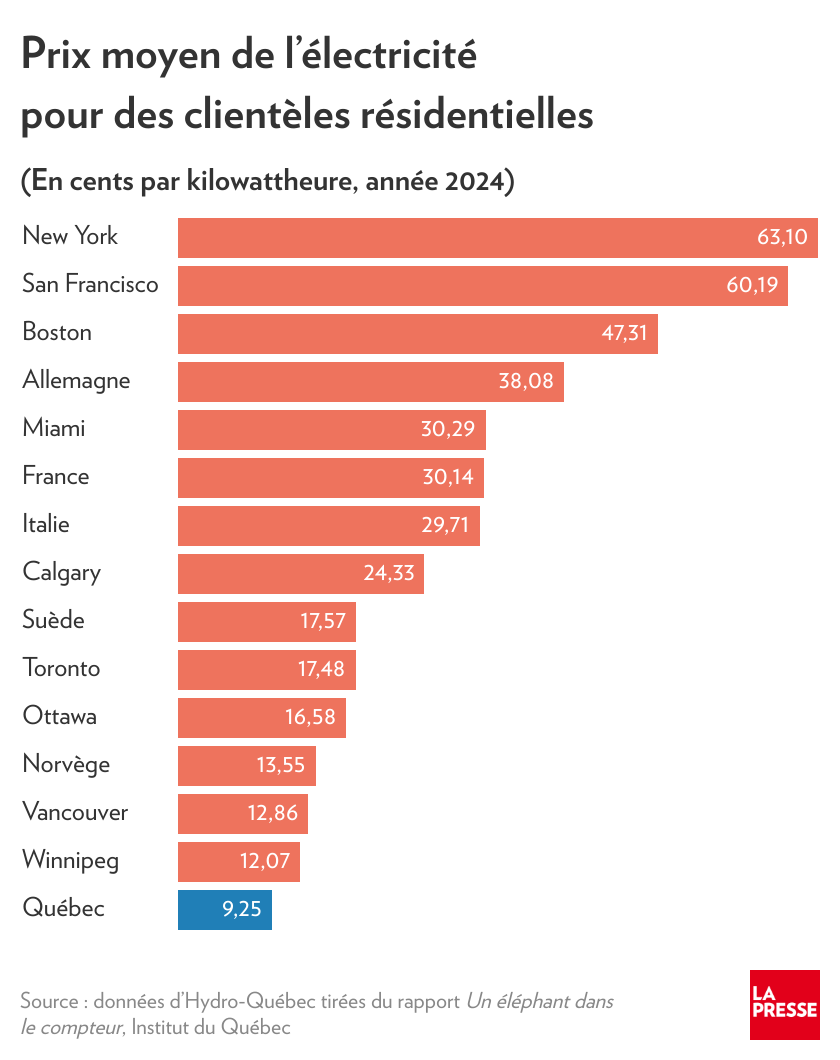
Source: La Presse
The CAQ wants to deregulate the alcohol market—in moderation
…particularly to encourage the sale of Quebec products. If it were bold, it would allow Quebec-made alcoholic beverages to be sold freely. Now that would be a real change.
The problem is that it would prove the SAQ no longer serves much purpose.
The QCP wants parents to choose their child’s school
…even within the public system, without being restricted by their home postal code. Éric Duhaime is also calling for a school system with “1,000 different speeds, almost one for every student,” and for local administrators to be given more leeway.
I’m inclined to favour the idea, for reasons I explain here.
The QLP wants to devote 5% of the health budget to prevention
…within 10 years. Now there’s a promise that will get the crowds fired up.
Charles Milliard also wants the scope of practice for different health professionals to be “fully expanded.” I agree with that, and I’ll discuss it below. Mr. Milliard also had the clarity and courage to say that it will take at least 10 years before we see a marked improvement in our health-care system. (A note to the QLP comms team: as part of the “statesman” image you’re trying to craft around Mr. Milliard, this is something that could have set him apart. Six months ago.)
Now for the pièce de résistance…
Let’s Talk Health Care with PSPP
Paul St-Pierre Plamondon reiterated his desire to abolish Santé Québec, the agency that now runs the health-care system in place of the Ministry of Health. I’ll get to the rest and come back to this in a moment.
The PQ is also calling for “stronger front-line care,” an all-purpose category that has appeared in every platform from every party since the dawn of time.
Apparently, even Samuel de Champlain used to talk about strengthening the front line around the fire on cold winter evenings in his Abitation in Quebec City. Of course, back then, the front line kept the Iroquois from attacking, which was rather important.
Seriously, though, unless we completely rethink the way we approach health care, this is nothing more than wishful thinking. We can talk about “strengthening” CLSCs all we want, whether with $150 million, as the PQ proposes, or nearly $10 billion, as Québec solidaire proposes—which, as Jean Perron might put it, is certainly not pulling out half the stops. None of it will make any difference if resources remain insufficient and if the incentives to use them properly and adopt best practices are inadequate. I’ll come back to that below as well.
Finally, the PQ leader wants to increase the number of medical students, as does the Conservative Party, which the Parti Québécois increasingly resembles. I agree with that too.
Taking an Axe to Santé Québec—and the Missed Opportunity of 2023
I completely agree with PSPP that we should take an axe to Santé Québec.

But not for the reasons PSPP has given.

The PQ leader estimates that eliminating redundant positions at the Ministry of Health and Santé Québec would save between $40 million and $100 million. That is not insignificant, but at the scale of this year’s gargantuan $69-billion health-care budget, it is peanuts.
Mr. St-Pierre Plamondon comes a little closer to the answer when he calls Santé Québec a “state within a state,” meaning that elected officials have less control over what happens at the agency. Santé Québec also seems immersed in a corporate culture that has led it to devote more attention to caring for its image than to caring for patients.
The dashboard introduced by former health minister Christian Dubé has been gutted several times. Today, it is barely recognizable, less comprehensive, and far less transparent.
The point of making indicators publicly accessible, a widespread practice throughout the Western world (and Ontario!), was not to hide how badly things were going, but to show it, so that we could understand and improve. Santé Québec seems to have forgotten that it is accountable to us and that the data belong to us.
It was also a little alarming that one of the first decisions made by its high-priced “Top Guns” was to hire consultants to define their mission.
Here you go: “Provide timely access to quality care.” That took me all of 10 seconds.
Because, over the years, I’ve had dozens of hours to think about it while waiting in emergency rooms.
In short, the overall impression is of people who don’t know what they’re doing and haven’t quite realized it yet. They spend a hell of a lot of time applying methods they picked up in their MBA programs, methods that have nothing to do with health-care best practices or sound public policy.
Unfortunately, the bad idea from 2023 is becoming a kind of bureaucratic “too big to fail” that must now be rescued, lest we end up with yet another failed reform and unforeseeable consequences.
Santé Québec has failed to demonstrate its usefulness and has turned out to be the same centralized monster, just in a different form.
But don’t touch it. Things could get even worse. We have no more time to waste; we need to focus all our attention on patients. And besides, if we defenestrate all these Top Guns, who will “run” the system?
The system itself.
There are already enough managers in every region, every hospital, every department, and every subdepartment. The hierarchy is so tall that those at the top are more likely to hinder than to help.
I wrote the following three years ago, when Santé Québec was being established:
“And that may be the greatest danger of the Dubé reform: that four or five years from now, we realize it has failed to produce the desired results and that we have to start all over again.
“If that happens, we’ll really be in trouble, and 2023 will look like the good old days.”
Basically, to spare you from reading all 5,800 words of it, here were my conclusions:
“The first principle is to do anything that can help, immediately, even if it isn’t perfect. That leads to the next two.
“The second principle should be the full scope of practice for all health-care providers, based on their respective training, regardless of what the Collège des médecins thinks. We’re no longer talking about ‘low-hanging fruit.’ It’s lying on the ground, rotting. All we have to do is pick it up.
“The third should be to cover all medically necessary care, regardless of who provides it or where. To be clear: a parallel ‘private’ system, outside the public system, where patients pay out of pocket, should no longer exist for necessary care (…)
“The fourth principle should be complete transparency. For indicators, data, and government documents in general. Elected officials are merely their custodians. They belong to us. Our decision-makers and their control-obsessed staff should no longer have any say in the matter.
“A fifth principle should be delegation, both of authority and funding. Innovation is never born inside a centralized straitjacket. The ministry or the new agency will have to let institutions and hospitals operate freely. Sometimes, this will lead to mistakes, even damage. But the status quo will undoubtedly be more harmful. And successful experiments, unlike failures, will be replicated. For this to work, funding must follow patient volume, with no conditions other than compliance with professional standards and the public reporting of indicators. Transparency will create pressure to improve efficiency.
“Other perverse incentives in our health-care system will also have to be corrected. Seniority rules should be reconsidered, and shifts distributed more evenly. The rationing of both medical procedures and physicians should be abolished. Technology should be embraced.”
I had also added preventive care for seniors with the help of paramedics (which the QCP is proposing) and “an ideal form of federalism within Quebec’s health-care system.” That meant not only removing the ministry from day-to-day operations, but also allowing regional institutions (the CISSS and CIUSSS) to manage themselves, free from political interference, so they could innovate and be compared with one another, with local governance mechanisms in place.
Finally, I called for higher medical-school admission quotas. The government did that a few months later, in the summer of 2023, but we can raise them further if we want to catch up with Europe.
If you want to understand why Quebec is in such a bind, much of it starts here.
(Doctors per capita, OECD data.)
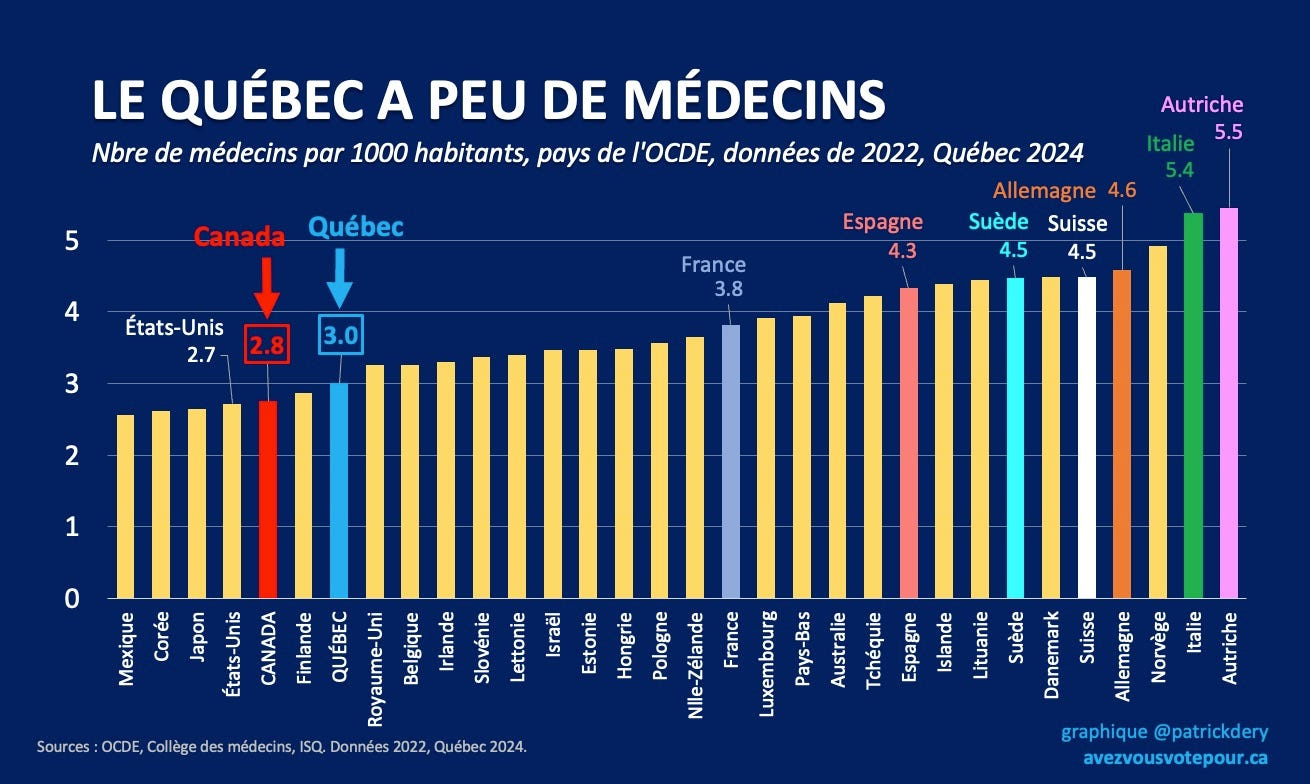
France and the Netherlands have roughly 25 per cent more doctors per capita than Quebec. Sweden, Denmark, Norway, Switzerland, and Germany have 50 per cent more. Italy and Austria have nearly twice as many.
Now imagine that, on top of having fewer doctors than almost anywhere else, Quebec reserves a broader range of procedures exclusively for physicians) and bars other professionals from performing them) than almost anywhere else. Almost everything has to go through doctors, but we don’t have enough doctors. That, in a nutshell, has been our health-care system for the past 40 years.
Things are improving, particularly for nurses and doctors, but we could still “faire mieux” (do better), to borrow a slogan from the last election campaign that has aged rather poorly.
Remember this?
Okay, don’t get mad!
Getting back to doctors, we also make poor use of them: Quebec family doctors spend too much time in hospitals, while specialists spend too little. We can thank Mr. Legault for that too.
A former vice-dean at the Université de Montréal once explained how Quebec could train more doctors, in less time, throughout the province. Perhaps it’s time we listened to him.
The False Statement of the Day
“After eight years under the CAQ, Quebecers can no longer afford what they could in 2018.”
— Charles Milliard, leader of the Quebec Liberal Party
I have a feeling I’ll have to repeat this again before the end of the campaign, but research by the Université de Sherbrooke’s Research Chair in Taxation and Public Finance found an “improvement in the real financial situation of all households” between 2019 and 2026.
There is a perception that purchasing power has declined because pandemic-related government assistance ended in 2022. But over the period as a whole, we became better off, as our incomes grew faster than the cost of living.
The impoverishment of Quebecers makes for a convenient slogan.
The impoverishment of political discourse, unfortunately, is very real.
-30-
Comments, shares, and “likes” are always appreciated. It also helps the Substack algorithm notice me, so don’t be shy!
My name is Patrick Déry. I write for a living, and I am trying something different here. If you enjoyed reading this piece, you can support me by buying me a coffee. You can also subscribe to this publication (for free or as a paid subscriber; the choice is yours).