Quebec’s specialist doctors need to bring their union back down to earth
Sometimes, too much is as bas as too litt
The Fédération des médecins spécialistes du Québec (FMSQ) is angry.
Negotiations with the government have reached a deadlock. The FMSQ is now boycotting the system through which consultation requests are routed to specialists—the infamous CRDS, a centralized and inefficient system whose shortcomings have been detailed by the Auditor General. Some 300 appointments are reported to have already been cancelled, and more than 6,000 available slots were withdrawn.
The FMSQ has denied any responsibility. Santé Québec has called for sanctions to be imposed on doctors at fault in cases where patients’ health is at risk. The FMSQ has served a formal notice on Santé Québec, accusing it of creating a “climate of fear” and criticizing it for tactics “amounting to intimidation” and for “illegal reprisals bordering on bad faith.”
In short, things could not be better.
As with every round of negotiations with doctors, a medical federation insists that it’s all about access to care. But as usual, it always comes down to the money. The FMSQ was asking for a 17% pay rise. Québec is offering 11% over five years. The gap amounts to several hundred million.
Even in the FMSQ’s ivory tower, someone realized that a 17% increase was indefensible. Demands were scaled back to 14.5%, which is what GPs secured (following the recent debacle of Bill 2, which led to the Health Minister’s resignation and the Premier telling blatant lies).
The political and media skirmish between the government and the FMSQ is less interesting than the bigger picture. Once the ruling party and an interest group are at odds, the outcome is generally decided by leverage. Usually, this favours the doctors’ federations.
In this sense, doctors are no different from other union members, except for the figures, which are bigger. Quite bigger.
According to the RAMQ, doctors’ salaries cost $8.7 billion in 2024–2025. Of this, about $5.1 billion went to the 11,500 medical specialists who billed the government. If doctors were a ministry in the government of Quebec, it would be the fourth largest, behind Health, Education and Higher Education (universities). And ahead of Employment, Family, Municipal Affairs, Transport and the Economy.
Which brings us to the individual remuneration of a specialist doctor.
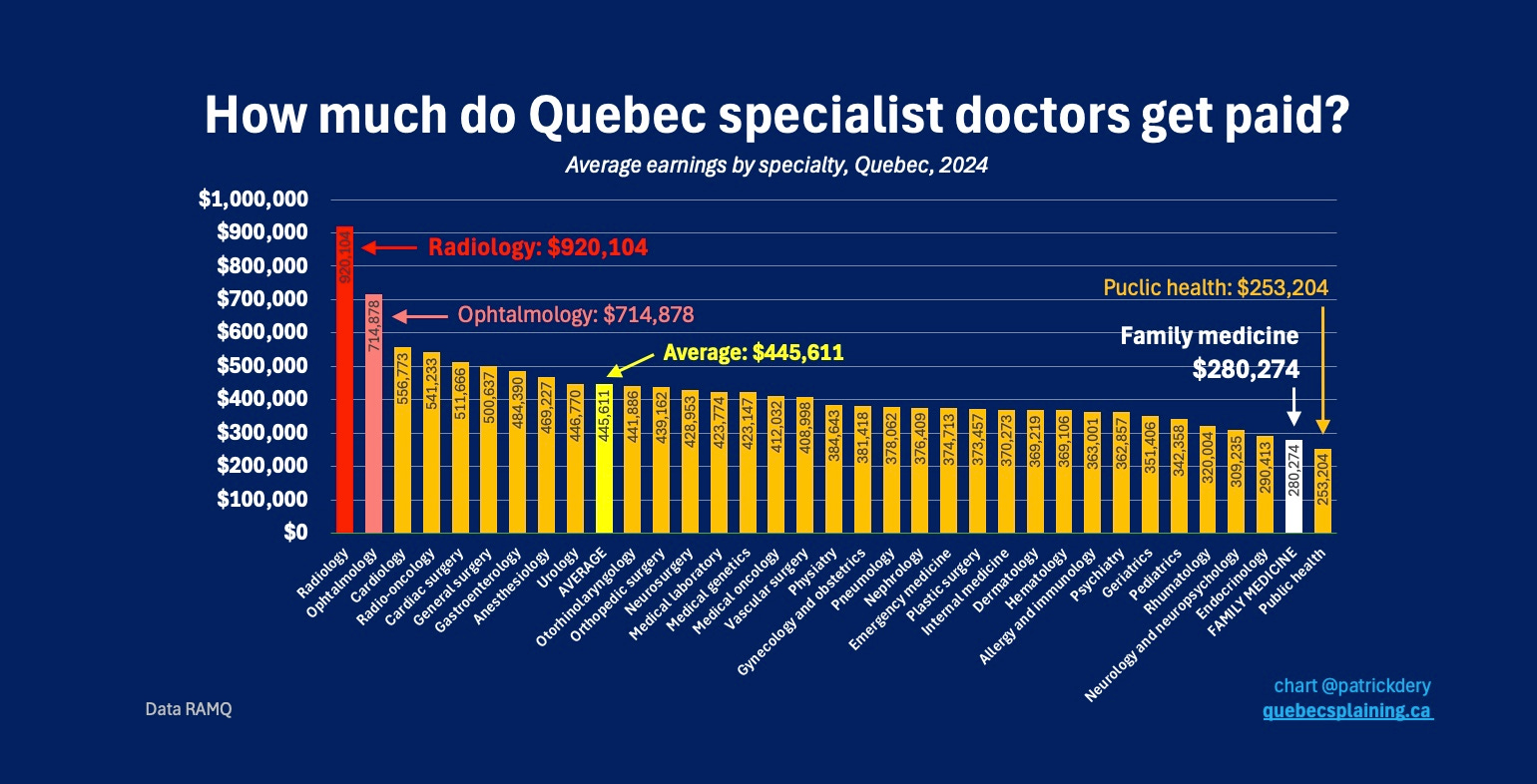
In 2024, in Quebec, specialist doctors received an average of $445,611, again according to RAMQ data. That’s not even for working full-time. According to a recent HEC study, the average full-time equivalent remuneration for a Quebec specialist doctor was $548,000 (in 2022).
The FMSQ disputes these figures, arguing that it is only $460,000. Cry me a river.
In some cases, practice and equipment costs must also be deducted from gross earnings. For radiologists, this can be particularly costly, at around $200,000 a year. But as the average radiologist earns $920,104, we won’t worry too much about them. And medical specialists working in hospitals (about three quarters of them) have no office costs.
Furthermore, in Quebec (and Canada), doctors can incorporate their practices. This allows them to pay taxes at the much lower corporate rate.
For example, an employee earning $500,000 a year would, in theory, pay an effective tax rate of around 47%, or approximately $235,000. For companies, the maximum tax rate is 26.5%, and can be as low as 12% on the first $500,000. Medical associations have already published material showing how their members can save money by incorporating their practice. (See “Optimisation de la rémunération” here, page 14.) There are even firms that specialize in tax planning for doctors. In short, all sorts of strategies are available for doctors to pay significantly less taxes.
But let’s go back to the remuneration of specialists, and take a moment to look at the following table.
As previously mentioned, a typical specialist doctor in Quebec earned $446,000 in 2024.
(Number crunchers will note that the median—the midpoint—is more representative than the average, which can be influenced by outliers. The median was not available, but I was able to determine from the distribution that it lies somewhere between $400,000 and $450,000 a year. So, we’re in the same ballpark.)
For a general surgeon, the average gross revenue is $500,000. For a cardiologist, it is $557,000. For an ophthalmologist, it is $715,000, or around $600,000 after expenses. And for a radiologist, around $700,000 after expenses. On average. In Quebec, hundreds of specialist doctors earn over a million a year. In 2024, there were 377 of them, twice as many as ten years earlier. Around ten earned over two million.
Why must it keep going up with every round of negotiations? In the name of what principle?
Specialist doctors in Quebec—like those in the rest of the country—are already among the highest-paid in the world, as demonstrated by a study by the Institut du Québec published a few years ago.
Countries such as France, Finland, Spain, Italy, Sweden and Norway manage to have healthcare systems that function better than ours—or, at the very least, are less dysfunctional—whilst paying their doctors half as much as we do. (In Europe, most doctors working in hospitals are employees.)
Quebec doctors were granted significant pay rises some twenty years ago, with the promise that this would encourage them to work more, thereby improving access to the healthcare system.
The opposite happened. The average number of procedures billed and days worked by a single doctor fell as many of them chose to buy themselves time, which makes sense when you’re already earning a small fortune. Yes, many specialist doctors still work very hard. But, on average and at the margin, they work slightly less than before. Pay rises, by discouraging work, have reduced access to care in Quebec.
Certain specialties are exceptions and have seen an increase in the volume of procedures due to technological advances (performing cataract surgery or interpreting imaging results takes less time than it used to). In any industry, a productivity increase would have reduced expenditure: for the same cost, one can produce more and sell a good or service at a lower price. It is through this economic mechanism that our standard of living has risen dramatically over the past 100 years. In healthcare in Quebec, the opposite has occurred, and the incomes of radiologists and ophthalmologists have skyrocketed.
One might add that specialties dominated by women—those that often require more time with patients—have benefited less from pay rises. No one is going to feel sorry for psychiatrists and geriatricians, who earn a very good living, but there is a major problem if incentives lead to these specialties being underpaid compared to others (or are the others overpaid?).
It is also telling that the lowest-paid specialty is public and community health. Good public health policies can have a significant multiplier effect on an entire population. (The reverse is also true; just remember how the first few months of the pandemic were managed in Quebec.) But in Quebec, prevention isn’t worth much. It is illness that is insured, not health. We say “assurance maladie,” and not “assurance santé.”
Such inconsistencies are possible because, strangely enough, the government has no say in the remuneration of individual specialties: the many associations of medical specialists, of which there are about three dozens, sort this out amongst themselves. Looking at the chart, one gets an idea of which groups carry the most weight. (For the record, Gaétan Barrette, a former Health minister in Quebec who was president of the FMSQ when the major “catch-up” in remuneration took place, is a radiologist by training.)
The solution is obviously not to give $600,000 or $700,000 to every medical specialist.
Quebec and Canada have chosen to have few doctors, but to pay them more than almost anywhere in the world. And Quebec and Canada remain among the places in the developed world with the fewest doctors per capita.
This is a resounding failure of public policy.
In recent years, Quebec’s government has (finally!) significantly increased the number of medical school places, but we won’t see the effects of this for at least a decade, especially as many doctors are due to retire soon. A quarter of Quebec doctors are over 60. Among cardiac and thoracic surgeons, who operate on the heart as well as cancers, the average age is 57.
Sooner or later, the government will end up giving in, as it always does, and hundreds of millions will be added to specialists’ pay, just as they were for GPs, with no benefit to patients. A rise of “only” 11 per cent in specialists’ pay would result in additional expenditure of around $600 million over the next five years.
As a comparison, in the latest budget, the government announced that $209 million would be allocated over the next three years to build 1,000 affordable homes.
What does Quebec need most in 2026? An additional 3,000 affordable homes, or to overpay certain medical specialties even more, without this making any difference to access to care?
Could it be that we are not putting the money in the right place?
+++++++
In the most recent negotiations, public sector employees secured a minimum of 17% over five years, rising to 20% depending on inflation. Teachers secured up to 24.5%. Construction workers received 22% over four years. Quebec police officers received 26 to 33% over six years, which sets the tone for Montreal, where the collective agreement expires this year. In short, everyone who can is pulling the blanket over to their side.
It must be said that the (bad) example comes from the top. In 2023, members of Quebec’s National Assembly voted themselves a 30% pay rise, even though they were already the highest-paid MLAs in the country, in addition to enjoying a more than generous pension scheme (MNAs from the Parti Québécois and Québec solidaire voted against it). Quebec’s MNAs received another pay rise last year, and they will receive another this year and next. In total, over five years, their salaries will have increased by 51%. I doubt that many Quebecers feel that they are better governed.
In some cases, it is deserved: Quebec’s nurses and teachers were among the lowest paid in the country. But what they were asking for above all was recognition, stability, support and slightly more predictable working hours or assignments. They were given none of that, which means the problems causing up to a quarter of young teachers and nurses to quit in the first years of their careers are still there.
In any case, we will not solve Quebec’s structural labour shortage through a bidding war on all sides.
The demands of the Specialist Doctors’ union are an example of union logic taken to the point of absurdity: everyone else is getting pay rises, so we want ours too, whatever the starting point is.
A lot of doctors feel uneasy about this, but few dare to speak out to tell their federation—and their colleagues—that perhaps a little soul-searching is needed regarding pay rises when the walls of Quebec’s hospitals are literally held together with pins and patients are dying on waiting lists.
A few years ago, a group representing several hundred family doctors, the Regroupement des omnipraticiens pour une médecine engagée (ROME), called on the government to take the money earmarked for pay rises and reinvest it in the healthcare system.
Do you know of any other sector where a professional association has campaigned against pay rises for its own members?
Dr. Simon-Pierre Landry, who was president of ROME, spoke of a “disconnect” between the leaders of medical federations and the majority of doctors, the former being caught up in a constant drive for pay rises, whilst the latter are generally more interested in improving working conditions and the healthcare network.
Dr. Landry felt that the situation had become awkward in the presence of patients and other professionals within the healthcare system. “If nothing is done, we believe we are heading towards a social and political crisis.” We are already well on the way there.
It is time for other doctors to stand up and bring their unions back down to earth.
-30-
This text is 2,214 words long, which is roughly nine pages of a book. The research, writing and creating the tables took me just over two days and left me feeling like I needed to see a doctor.
My name is Patrick Déry. I write (mostly in French) for a living, and do my best to Quebecsplain in English in this space. I also enjoy making numbers talk and putting together charts that you won’t see anywhere else.
If you enjoyed reading this text and if it did not get you sick, you can encourage me by buying me a coffee. Comments, shares, and likes are always appreciated.
You can also subscribe to this media by clicking on the button below.


