The first lies of Quebec’s likely next premier
How to say one thing about immigrant workers, and the opposite three days later.
(Cet article est disponible en français ici.)
Two candidates are vying to succeed François Legault. The prize: leadership of the CAQ, but also the position of Premier of Quebec for a few months. The party may cease to exist by the end of election night in October, but that’s not the kind of thing that stops the ambitious.
Since immigration is and will continue to be a hot topic, it’s worth taking a quick look at what the two contenders think about the Quebec Experience Program, or QEP, a program that promotes permanent residency (by the federal government) for immigrants who are particularly well integrated and can demonstrate that they can speak, read, and write French. Many immigrant workers came to Quebec at our invitation, with the government pushing recruiting efforts as far as South American and African countries.
The QEP was abolished without notice last November, leaving in limbo thousands of aspiring Quebecers who had left everything behind to begin a new life here.
The breaking of this moral commitment sparked an outcry across Quebec. Because, in addition to reneging on a promise, we are shooting ourselves in the foot, as has been pointed out by businesses and unions, mayors of large and small cities everywhere in the province, health and education workers, and so on.
The current Minister of Immigration, Jean-François Roberge, is still making the calls and defending the indefensible. His aplomb and his ability to string together lies and contradictions command admiration. But on April 12, Mr. Roberge will have a new boss. What will the new policy be?
Bernard Drainville, one of the two candidates for Legault’s succession, believes that Quebec has taken in too many immigrants in recent years, but he also recognized (belatedly) that immigrants that are working are probably useful. He ended up promising a quasi-grandfathering clause for most QEP candidates. (Drainville is probably also counting his votes in Quebec regions where the departure of immigrant workers would hurt most.)
Christine Fréchette, currently the favourite due to her support within the party, served as immigration minister for two years. She is more moderate than the premier and most of her colleagues, and even managed in early 2023 to convince François Legault to welcome 60,000 permanent immigrants per year, a number he had considered “suicidal” for Quebec only a few months earlier.
Fréchette’s openness to immigration placed her almost in the “radical left” wing of the CAQ, if such a thing exists. After confirming that she was trying her luck at succeeding Legault, Fréchette was asked what she intended to do about the PEQ, which is currently one of the two main issues in the race (the other is the third link between Quebec City and its south shore, which is part of the CAQ’s gospel).
Will Christine Fréchette break with CAQ orthodoxy on immigration, or will she hold the same stance as Minister Roberge, who is also supporting her in the race?
At the end of January, as a prelude, Fréchette relayed on X a statement by Jean-François Roberge, who is adamant about abolishing the QEP.
A week later, on February 2, Fréchette was more explicit, promising to “rapidly increase the pace of invitations” under the PSTQ, the program that replaces the QEP. This amounts to saying that those who are not invited will eventually have to pack their bags, even if they are here at our invitation. This is therefore a continuation of the Roberge doctrine. Fréchette also promised to prioritize temporary workers in health, education, construction, manufacturing, and tourism, aligning herself with her opponent, Bernard Drainville, even if she tried to deny it.
But don’t see this as a grandfathering clause. At least it’s what Fréchette said.
Two days later, on February 4, Fréchette again rejected the idea of a grandfathering clause for QEP orphans, calling the proposal—and therefore her opponent’s proposal—“simplistic.”
(It’s a contradiction, but not quite a lie. It’s more of a case of “it’s a duck, not a chicken,” a common source of confusion in politics. Don’t worry, the big lies are coming.)
On February 7, Fréchette gave an interview on the Politiquement Parlant podcast, in which she detailed her stance and arguments.
Before going any further, please let me reassure you: I’m not going to overwhelm you with 5,000 words of lies and fact-checking, as I did with Roberge. But it’s still worth going into a little more detail into Fréchette lines, if only to see her skating backwards while doing the splits. And the lies become even more blatant when one reads her full statements.
You can hear Fréchette discuss the PEQ here (in French) starting at 25:45 minutes:
“On the one hand, I would start by saying that there are many families, there are many immigrants and their families who are worried [sic] right now, and that really strikes a chord with me.”
Always show empathy and that you are listening, especially when you are really not listening.
“Of course we have to find solutions. These are people who are, how can I put this, crucial to the proper functioning of our economies and our businesses, particularly in rural areas, so we definitely have to come up with a way to solve this issue and alleviate concerns.”
If these people are “crucial,” why was the QEP abolished? And why not bring it back? It would be simpler, and everyone is asking for it, but the CAQ’s dogma forbids it. But let’s hear what Fréchette has to say.
“So what I’m proposing is a humanitarian action plan. I would say that we need to speed up the pace of invitations for the new program, the PSTQ, which is the program we’re directing people who were on the QEP to, because doing so will reduce the waiting time.”
So, now, it’s “humanitarian” to do less than the minimum to keep our word. Nice spin by the political staffer, who’s earned his paycheque. Can you hear the violins in the background?
“And if we significantly increase the number of invitations for next month, then people will have received a response that I hope will be positive, provided they are in fields such as health, education, construction, and I would add recreational tourism as well because we have many resource regions that depend on tourism for their economic well-being, so that’s very important to me.”
Now tourism. The list of areas that the PSTQ will have to cover is growing, as is the list of regions where decision-makers and potential voters are infuriated. But that part is okay, because politics is also about adjusting to reality.
“Basically, people’s fear is because they think their permits will not be renewed by the federal government. That’s what creates significant uncertainty” (…)
This repeats Jean-François Roberge’s messaging about the “bad federal government,” when, in fact, it is Quebec that has created uncertainty by abolishing the QEP, and it is the QEP that virtually the entire civil society is asking to be reinstated.
Fréchette then talks about low population growth and the need for labour to replace the many retirees.
Then there is the question of the grandfathering clause that everyone is calling for.
“But we can’t implement—I was Minister of Immigration for two years—we can’t implement a grandfathering clause. It’s a false promise, in the sense that you can’t say to people who didn’t file an application for a given program, in this case the QEP, ‘if you had had the opportunity to apply, would you have done so?’”
Yes, we could, and should, because we suspended then abolished the program, taking away the opportunity for those people to apply under the QEP, after promising them they could when they met its conditions. Many immigrant workers decided to come to Quebec because of that promise. That’s the whole point!
“At that point, lots of people are going to raise their hands and say, ‘Yes, I would have [applied].’ We could end up with 100,000 or 150,000 raised hands. And then, if we say to those people, ‘Well, if you intended to apply, we’ll add you to the program,’ we’ll reach our immigration thresholds much too quickly. And we’ll have to put the people in the new program—the PSTQ—on hold because we’ll be letting the people with grandfathering clauses first. That would create an injustice (…)”
To sum it up:
A grandfather clause is a “false promise”;
We could suddenly find ourselves with 100,000 or 150,000 more applicants for permanent residence;
Quebec’s immigration thresholds would be reached too quickly;
In addition, it would cause injustice to PSTQ applicants.
(It would be quite the opposite in the latter case, since it would allow us to respect our moral contract with QEP applicants, but let’s move on.)
In short, forget about the grandfathering clause. And just to make sure the message gets across:
“So, there you have it, unfortunately, it is not feasible to grant a grandfathering clause. I know it sounds good in the media. The concept seems simple, but in reality, the mechanics don’t allow for it. The only mechanism we can put in place is to steer people toward the PSTQ, and then we’ll speed up the process to retain them and invite them on a permanent basis.”
Okay, we understand, a grandfathering clause is unworkable. So, what did Christine Fréchette ultimately do?
Yes.
She promised to grant a grandfathering clause to PEQ orphans.
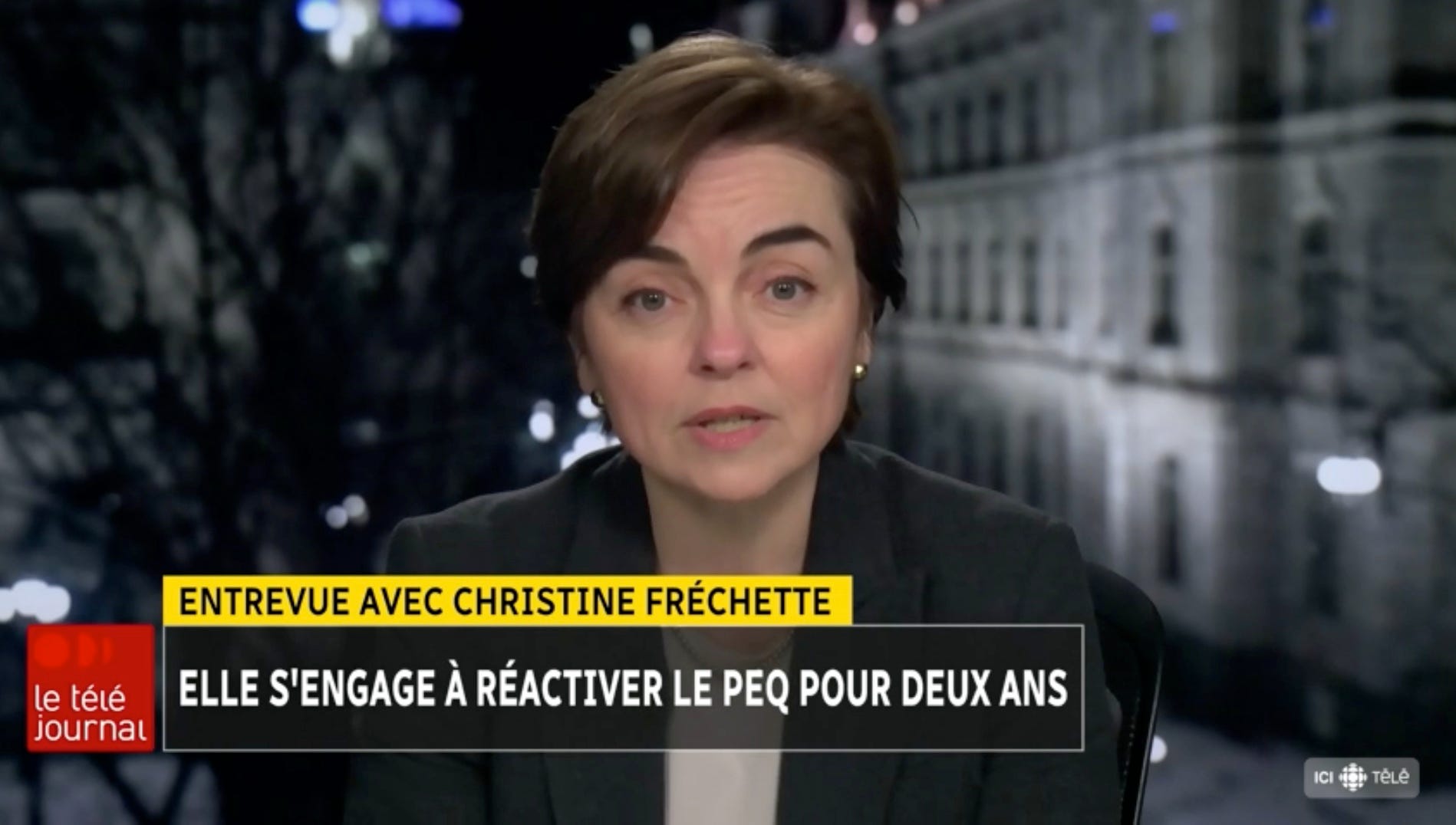
Here is what Fréchette had to say on February 10 to Patrice Roy of Radio-Canada, just a few days after explaining at length that a grandfathering clause was a “false promise” that was impossible to fulfill.
“If I am elected leader of the CAQ, I commit to reactivating the QEP program for a period of two years, and, therefore, to offer a grandfathering clause to those who were in Quebec when the QEP program closed last November. This will give people predictability. We will take a more transitional approach, which will give people the opportunity to be selected through the QEP or the PSTQ, which is the other program through which permanent residence can also be obtained.”
In just three days, what was impossible became the way forward. In addition, the QEP has been reactivated for two years and will be able to coexist with the PSTQ without creating any injustice.
Obviously, some people had to work incredibly hard to make this happen. Don’t laugh.
And what made Christine Fréchette change her mind?
“I’ve been out in the field too, you know, I’m touring Quebec. It’s very important to me, I talk to people, people write to me, I talk to them, and I heard a lot of concerns out in the field, and it touched me, I’m sensitive to their reality. It’s important for me to offer a way forward that takes into account the concerns that exist on the ground, whether within businesses or immigrant families (…), and therefore also to respond to the needs of businesses, particularly in rural areas, where the need was acute.”
So, essentially, Fréchette said the same thing she had said the week before, but it now led her to the opposite conclusion. Note the skepticism on Patrice Roy’s face.
But that’s not all. Last week, Fréchette raised the spectre of 150,000 additional immigrants, as we saw above. It was less crude than Roberge’s half a million tsunami, but it was still a large enough number to scare people into two choices: either we say no, or it’s an invasion.
Roy then asked Fréchette how many people would benefit from the grandfathering clause:
“Well, we don’t have the exact number, but I can tell you that, in terms of thresholds, it will be respected. So, we have a total of nearly 29,000 workers who will be eligible for selection under our programs, so I imagine that initially we will take a 50-50 approach between the two programs and adjust as the situation evolves.”
The tsunami of unwelcome immigrants is now just a bad memory. And they lived happily ever after.
+++++++++++++
Since Christine Fréchette said several things and then the opposite of those things, she either lied then or is lying now. The fact that she was Minister of Immigration for two years and her reputation as a studious minister make it unlikely that this was an honest mistake. So did the sudden change of heart.
The most likely hypothesis is that she stuck to her guns as long as it seemed more profitable—or less damaging—before returning to a policy that was more politically acceptable and with which she was also more comfortable. Since Roberge’s initial stance was based on false premises and false arguments, Fréchette was swimming in the same swamp.
In hindsight, it is understandable that Christine Fréchette may not have been comfortable with the changes coming to the QEP, and that her departure from the Ministry of Immigration was probably not coincidental. Jean-François Roberge, on the other hand, seems quite comfortable with dirty work.
In the meantime, our likely next premier has told her first big lies.
Did you vote for that?
My name is Patrick Déry. I write (mostly in French) for a living, and I try my best to Quebecsplain in English here. I also like to call out politicians who repeat lies because I believe we deserve better. If you enjoyed reading this text, you can encourage me by buying me a coffee. Comments, shares, and likes are always appreciated.
You can also subscribe to this media by clicking on the button below.


