The Principles of the Quebec Liberal Party
Beyond brownies and fling-flangs.
The first thing that comes to mind when discussing the principles of the Quebec Liberal Party is that it doesn’t seem to have any. And I’m not talking about ethics or “brownies.”
The way Sona Lakhoyan Olivier handled herself as an elected official is obviously pathetic. Not only did the Liberal MNA for Chomedey make her constituency office staff—who are the payroll of the government—work on Paolo Rodriguez’s leadership campaign, but she also destroyed the evidence when she became the subject of an investigation. Then, she tried to influence her employees’ potential testimony. When the Ethics Commissioner lambasted her, she added another lie by saying she made a “mistake.”
Ms. Lakhoyan Olivier was expelled from the caucus and the party, which was the least that one could expect. The UPAC and Chief Electoral Officer investigations could make other heads roll, but it seems more likely that the Chomedey MNA’s case is an isolated one.
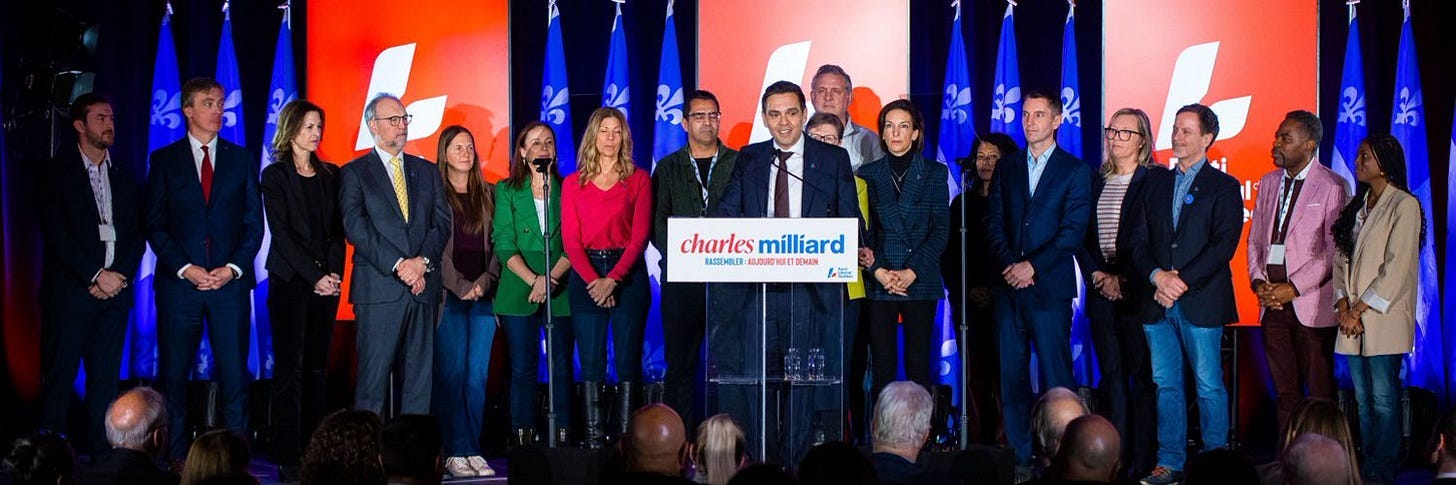
No one seriously believes that the new leader of the QLP, Charles Milliard, would tolerate, encourage, or resort to such outdated antics. Nor would Monsef Derraji, André Fortin, Madwa Nika Cadet, or Enrico Ciccone, to name just a few. Moreover, the media’s appetite for scandals within the QLP would likely have eventually exposed the “fling flags,” had there been any others.
Polls regarding the QLP also seemed to show that this is what many Quebecers believe. Between Pablo Rodriguez’s resignation in late December, and early April, the Liberal Party rose from a low of 21% to a high of 32% in voting intentions. That’s not too bad, since the leadership race was a non-event, that the new leader remains largely unknown to the general public, and that the issue of illegal financing remained in the background all the while.
Since then, the QLP has stopped rising and even dipped slightly, hovering around 28%. If this were just a single poll, one might conclude it is within the margin of error, but it looks like the beginning of a trend. Something has hurt the party more than Ms. Lakhoyan Olivier’s shenanigans. What happened?
I will offer a very personal and generally unconventional interpretation. You may disagree.
But first, I want to break down the fluctuations a bit. It won’t take long, but it will add some perspective. Before the scandal that would see the downfall of M. Rodriguez, the QLP was holding steady at around 25 to 27% of voting intentions, which was its best performance in five years.
(The images below are taken from Philippe J. Fournier’s inevitable Qc125.com.)
Following the ouster of parliamentary leader Marwah Rizqy, which led to Pablo Rodriguez’s resignation, support for the QLP dropped to 21%. This was still better than the support levels below 15% recorded throughout 2023 and part of 2024. There were no brownies back then, but not much inspiration either.
With the coronation of Charles Milliard, support for the QLP steadily rose to 32%. It’s obvious that a new leader of a ruling party always sparks curiosity, but it’s still noteworthy that this rise occurred despite the ongoing, extensive coverage of allegations of illegal financing and ongoing investigations by the UPAC, the Chief Electoral Officer, and the Ethics Commissioner of the National Assembly.
Between early February and mid-April, dozens of articles mentioned the allegations and the multiple inquiries going on. Yet, support for the QLP kept rising.
Then came the first snag: Mr. Milliard, what do you think of Bill 96?
Much like Robert Bourassa, whom he holds up as a role model, Charles Milliard responded in three parts: he was neither for, nor against it, and quite the opposite.
On April 16, Charles Milliard stated that he wanted to remove certain provisions from Bill 96, notably the one prohibiting government employees from communicating in any language other than French with immigrants who have been living in Quebec for more than six months, as well as certain rules applying to small businesses. So far, so good.
Then, Mr. Milliard explained that he wanted to protect “a large part of Bill 96” and, consequently, that he wished to renew the use of the notwithstanding clause to shield the law from the application of both the Quebec and Canadian Charters of Rights, and from judicial review.
That day, Mr. Milliard crossed the Rubicon, breaking not only with his party’s position on Bill 96 but also with the quasi-constitutional nature of the Quebec Charter—a legacy of Robert Bourassa that the CAQ had trampled upon by first passing Bill 21, then Bill 96. It caused a stir in the caucus.
The next day, April 17, Mr. Milliard half-backtracked, leaving open the use of the notwithstanding clause. To his English-speaking audience, he added that he wanted to ensure the use of the clause would no longer be necessary, without saying how he intended to achieve that.
(My take, for what it’s worth: the simplest way would be to stop infringing on the fundamental rights of Quebecers, or to remove the derogation clause from Bill 96 and then let the courts do their job.)
Two days later, on April 18, the figure skating session took a different turn, and Mr. Milliard said he would sit down with legal experts in the government to determine whether the notwithstanding clause was necessary. He also said he wanted to make additions to Bill 96 to promote French proficiency among young people and increase investments in the francization of immigrants. It smacked of desperation and improvisation. But the linguistic toothpaste was out of the tube, and would not go back in.
+++++++
In Quebec, three topics will always get media coverage above almost anything else: the Canadiens in the playoffs, Céline, and language issues.
For three days, every Quebecer interested in politics watched Mr. Milliard juggle the plates being thrown at him, trying to drop as few as possible of them.
Ronald Reagan had this saying: “If you’re explaining, you’re losing.”
The Liberals’ momentum stopped there. And the slide began.
Some will conclude that it was mainly English-speaking Quebecers who turned their backs on the QLP.
When we look a little more closely at the Léger polls conducted before and after Mr. Milliard’s double about-face, we see that support for the Liberals among English speakers dropped from 61% and 65% in the two earlier polls (those from March 21 and April 4) to 57% and 59% in the two later polls (those from April 19 and May 17). So, let’s say from 63% to 58% on average, with all the caveats that must be noted for a smaller sample size. The drop is real, and could have been greater when accounting for the fact that overall support could have risen still.
Among Francophones, the support dropped from 23% and 22% previously to 19% and 17%. So, on average, from 22.5% to 18%. As a proportion of total support, we’re talking about an 8% drop among Anglophones and a 20% drop among Francophones.
I repeat: all things considered, Francophones reacted more strongly.
I think the majority of Quebecers—at least those who are still open to changing their vote—believe Mr. Milliard when he says he would never have tolerated and will never tolerate illegal financing and vote-buying.
Generally speaking, they are even willing to trust him more than Mr. Rodriguez and the other leaders that the QLP has had since the 2018 election.
I also think that, as the fundamental rights of many of us are being trampled, a lot of Quebecers hope for an approach based on unwavering principles.
So far, they are still waiting.
-30-
My name is Patrick Déry. I write (mostly in French) for a living, and do my best to Quebecsplain in English in this space.
If you enjoyed reading this piece, you can encourage me by buying me a coffee. Comments, shares, and likes are always appreciated.
You can also subscribe to this media by clicking on the button below (free or with a subscription fee, your choice.)


