The useful myth of a Quebec labrador
From generating power to generating outrage
Who would have predicted that, in the summer of 2026, just a few weeks before the elections in Quebec, we’d be squabbling over Labrador?
The Parti Québécois tried to stir things up last week during discussions between Quebec and Newfoundland regarding the current and future development of hydroelectric power on the Churchill River in Labrador.
The issue is of paramount importance to Quebec, since the Churchill Falls power plant supplies 15% of our electricity. It is also politically charged for Newfoundlanders, many of whom feel they were taken advantage of by a 1969 contract which still allows Quebec to purchase electricity at 0.2 cents per kilowatt-hour until 2041 —a pretty good deal, considering producing it can easily cost twenty to fifty times more.
The PQ’s argument has two prongs. The first is that Quebec Premier Christine Fréchette lacks the legitimacy to negotiate with her Newfoundland counterpart Tony Wakeham, since she was elected only by members of her own party after François Legault’s resignation earlier this year.
The second is that Quebec suffered a historic injustice when Labrador was granted to Newfoundland in 1927 by the Privy Council in London, a “British colonialist tribunal,” in the words of a Parti Québécois MNA.
The first argument is particularly far-fetched when you consider where it comes from. In 2001, when Lucien Bouchard had had enough of the Parti Québécois and resigned as its leader, there was no leadership race. Bernard Landry was crowned party leader and, consequently, premier. Not a single Quebecer—not even a single member of his own party—had the opportunity to vote for him.
That didn’t stop Mr. Landry from leading Quebec for two years until the next election, overseeing the tabling of two budgets, signing the “Paix des Braves” agreement with the Cree Nation, and committing the province to the goals of the Kyoto Protocol.
No one seriously believed that Bernard Landry was acting illegitimately. Our electoral system may not be ideal, but that’s how it works. Even if it’s tempting from a partisan standpoint, Parti Québécois MNAs should think twice before attacking its integrity.
Now, Labrador.
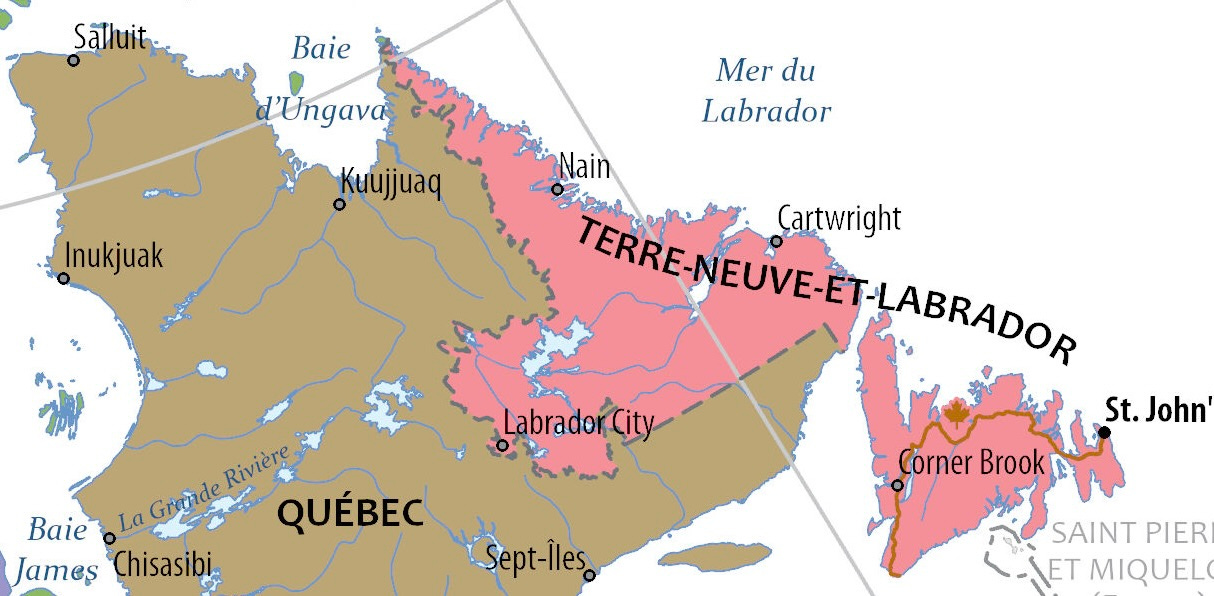
When I was in elementary school, back in another century, it seemed obvious that the triangle-shaped area over the Côte-Nord—with its distinctly French-sounding name—must belong to Quebec. Our geography teachers did nothing to dispel that impression, and the border was even drawn as a dotted line, unlike those of the other provinces.
It was annoying. Seen from space, the Quebec Peninsula is one of the most recognizable features of North America, jutting boldly into the Atlantic toward Europe, of which it is, in a way, an extension.
Natural geography thus made the decision to give Labrador to Newfoundland seem like an illegal seizure of our territory, with a rather disappointing aesthetic result. It was as if that Privy Council had taken a chunk of Quebec just to spite us.
Decades later, René Lévesque spoke of “judicial theft.” Once again, it was the Brits against us. The Conquest of New France replayed itself endlessly, with British colonialism haunting us right into the 21st century. Bring out the muskets!
It’s both tragic and romantic, but it’s also a bit of an exaggeration.
Between the end of French rule and the early 20th century, Labrador has been tugged in every direction with each redrawing of the map of what would eventually become the province of Quebec. The development of the territory surrounding the Churchill River naturally led to disagreements between Newfoundland (which was still a British dominion) and Quebec. At the time, Ottawa sided with us.
The dispute led to the 1927 decision by the Privy Council in London—and to our collective bitterness that has lasted nearly a century. Our collective memory, however, did not last that long.
First, we tend to forget that the 1927 decision was not a court ruling, but an arbitration sought and agreed to by all parties, the general terms and protocol of which were negotiated over a period of 15 years. At the conclusion of the negotiations, all parties agreed that a border existed and had to be defined. That is what the Privy Council was asked to do.
In other words, the scenario of a Labrador belonging exclusively to Quebec was not even considered. Furthermore, two of Canada’s three lawyers were appointed by Quebec. It cannot be said that this was done behind our backs or over our heads.
What matters most is what happened next. In the decades that followed, successive governments in Quebec had numerous opportunities to affirm or challenge—implicitly or explicitly—the 1927 decision. Aside from official recognition of the borders, most of the actions taken by the Quebec government have been in line with acceptance of the current borders, including the way in which mineral and energy resources have been exploited in the region.
Moreover, Quebec had numerous opportunities to negotiate the return of part of Labrador’s territory through its many interactions with its neighbour. In the 1930s, just a few years after the infamous 1927 decision, Newfoundland—financially strapped—was even prepared to sell Labrador. Quebec never stepped forward at that time nor afterward.
This entire story was recounted in great detail in the 1972 report by the Commission d’étude sur l’intégrité du territoire du Québec (CEITQ), which had received its mandate from Premier Daniel Johnson Sr. during the negotiations for the original Churchill Falls contract in 1966. It was recounted a few years ago by journalist Jean-Benoît Nadeau in a landmark article for the magazine L’actualité, which asked the question: “Was Labrador really ‘stolen’ from Quebec?”
The answer from the CEITQ commissioners—who ultimately wrote 33 volumes on Quebec’s borders, including 18 devoted solely to the issue of Labrador—is “no”.
In its Livre bleu sur l’indépendance du Québec, the Parti Québécois cites the CEITQ’s work and continues to characterize the 1927 decision as an “injustice.”
It’s worth reading what Jean-Paul Lacasse, the commission’s secretary and now professor emeritus at the University of Ottawa’s Faculty of Law, had to say to journalist Nadeau in 2022:
“Many Quebec nationalists still grieve over ‘their Labrador,’ but what can you do? These are unsubstantiated claims with no basis in fact. (…) The 1927 ruling contains no blatant falsehoods or evidence of fraud. Any legal challenge would be doomed to failure. It was with a heavy heart that we reached this conclusion.”
The PQ also cites in its Livre bleu the book Quebec: An Uncertain Territory, co-authored by Professor Lacasse and late geographer Henri Dorion. The authors meticulously detail the imprecision of certain parts of Quebec’s borders—particularly on the Labrador Peninsula—as well as the real problems this causes today. They never endorse the “judicial theft” theory.
“(…) numerous acts recognizing the border as it was demarcated in 1927 have left Quebec in a relatively weak position with regard to a potential renegotiation of the border.” (p. 84)
“(…) Quebec has no legal grounds on which to challenge the demarcation itself.” (p. 98)
They add the following regarding the surprising attempt by Quebec and Canada to argue before the Privy Council that Newfoundland had no claim to Labrador and that Labrador should belong entirely to Quebec:
“It must finally be acknowledged that the position jointly defended by Quebec and Canada before the Judicial Committee of the Privy Council was historically and geopolitically indefensible.” (p. 98)
One can debate how the lawyers chosen by Quebec presented their case before the Privy Council, and one can certainly wonder whether a different approach would have yielded a different result. But no one can fault Newfoundland’s representatives for having been more competent than Canada’s.
There was neither fraud nor injustice, only an unfavourable decision—and many missed opportunities afterward. Nearly 100 years later, almost everyone has moved on, which explains why a staunch nationalist like Mr. Legault negotiated a tentative agreement with Andrew Furey, Mr. Wakeham’s predecessor.
+++++++
Why is the Parti Québécois suddenly making such a fuss about Labrador?
First, it’s a matter of principle, because the PQ believes that Quebec should receive compensation for the lost territory. It may also be a matter of political necessity.
If an agreement is reached with Newfoundland before the next election, it will be more difficult for the Parti Québécois to back out of it, especially if the PQ can’t win a majority in next October’s elections. In addition to the political price to be paid, it’s easy to imagine that the Liberals and Conservatives—and even more so the CAQ—would want to preserve a major economic agreement.
Conversely, a breakdown in negotiations with Newfoundland would fit perfectly into the PQ’s game plan.
Currently, polls show that the Parti Québécois, with 30% of the vote, is just a few seats away from a majority government. If an election were held tomorrow, the PQ would win about 60 seats. It needs 64 to secure a parliamentary majority in Quebec’s National Assembly.
As I reported recently, the Parti Québécois’s rhetoric took a sharp turn about two years ago. The strategy now seems to provoke us whenever it can—whether by invoking “deportations” and “executions” that took place before the founding of modern Canada, or even Canada itself; by citing “mass immigration” imposed by Ottawa (even if Quebec controls most of it); by bringing up the Plains of Abraham; “British colonialism”; or the high-speed train of “Canadian unity.” And now, Labrador.
If this sounds a lot like rage farming, it’s probably because it is.
One could say that Paul St-Pierre Plamondon, the leader of the PQ, has shifted from Génération d’idées, a youth think-tank he founded, to the generation of outrage. Because elections will take place in Quebec on October 5th. And the PQ needs a majority in order to be able to hold a third referendum on Quebec’s independence.
In theory, a government—even a minority one—controls all the levers of the executive branch and can govern until it decides to bring itself down, as Jean Charest and Pauline Marois did in Quebec, or Stephen Harper and Justin Trudeau in Ottawa. Opposition parties also tend to be relatively compliant, especially if they’re rebuilding, which is often the case for the parties that lost the election.
In practice, it’s easy to imagine that the prospect of another referendum could lead opposition parties to form a united front against a Parti Québécois government—and even to try to bring it down if it stubbornly insists on holding a referendum that most Quebecers don’t want.
Someone in the Parti Québécois has certainly reached the same conclusion, which could explain the rather inflamed rhetoric of the last few months. If PQ activists are mobilized, and if PQ voters turn out just a little more, the Parti Québécois could gain an additional 2 or 3% in support. Simulations have shown that this could be enough to secure a parliamentary majority. (It’s still bonkers to even consider a majority with 32% of the vote. I discuss this here.)
So that’s also part of the reason they’re trying to rile us up about Labrador and the rest.
Time will tell if that’s enough to get Quebecers to go out and protest in Wabush. In the meantime, the PQ’s statements have caught the attention of Newfoundland-and-Labrador Premier Tony Wakeham, who doesn’t seem too eager to reach an agreement before the next election.
That would be a small political victory for the Parti Québécois. As for the “best interests of Quebec,” which the PQ likes to claim as its own, that’s another story.
-30-
This text is 1,927 words long, or roughly eight pages in a book. (1927 is also the year the Privy Council tore Labrador away from Quebec!) It took me a little over two days to research, write, and navigate the Churchill River all the way to the source of our contradictions.
My name is Patrick Déry. I’m a French-speaking Québécois writing for a living, and trying something different here. If you enjoyed reading this text, you can support me by buying me a coffee. You can also subscribe to this media (free or paid, your choice).
Comments, shares, and “likes” are always appreciated.


Well done!
🇨🇿 (=✅️)
