Towards a “majority” government with 31% of the vote?
Quebec democracy is broken
This week’s media bombshell: according to a Léger poll, the Quebec Liberal Party has caught up with the Parti Québécois in voting intentions.
So, depending on your favourite media outlet and your favourite body part, the Péquistes and the Liberals are now either neck and neck or elbow to elbow.
I will go even further, at the risk of making some political analysts’ brains explode: given the margin of error, it is possible that the QLP may even have surpassed the PQ due to the typical 3% margin of error for a poll with such a sample size (1,041 respondents).
In other words, the QLP may be sitting at 33% and the PQ at 28%. Break out the champagne! Or the tissues! Stop the presses!
Or maybe the QLP is at 27% and the PQ at 34%. Put away the champagne and break out the tissues! And vice versa! And restart the presses!
But maybe it’s neither one nor the other.
The margin of error is less than 3% most of the time, but pollsters can be spectacularly wrong because polling remains an imprecise science (see, for example, the Orange Wave of 2011 or the collapse of the PLQ vote in 2018).
So, maybe the PQ is at 40%. Take cover!
+++++++
All kidding aside, statistically speaking, it’s entirely possible that the QLP has caught up with the PQ in voting intentions. Political polls are generally reliable, and Léger’s polls are usually spot on. So, if an election was held tomorrow, the result would probably be as predicted.
Statistically, that’s true. But democratically? Not even close. For two reasons.
The first reason is that the election is not tomorrow, but seven months from now. Robert Bourassa liked to say that six months is an eternity in politics, as Pierre Poilievre recently learned the hard way. (Which also means that seven months is 1.166666 eternities, with an infinite row of sixes, for those who like really precise numbers.)
So, everything can still change several times one way or the other. (Does anybody remember the “Coderre effect”? Or Pablo Rodriguez?)
All of this is conjecture and speculation, which obscures a fundamental issue, leading us to the second reason: even if the QLP and the PQ were neck and neck, nose to nose, belly button to belly button, or toe to toe from a statistical point of view, the race isn’t even close if we look at what that would mean in terms of the number of seats in Quebec’s Assemblée nationale.
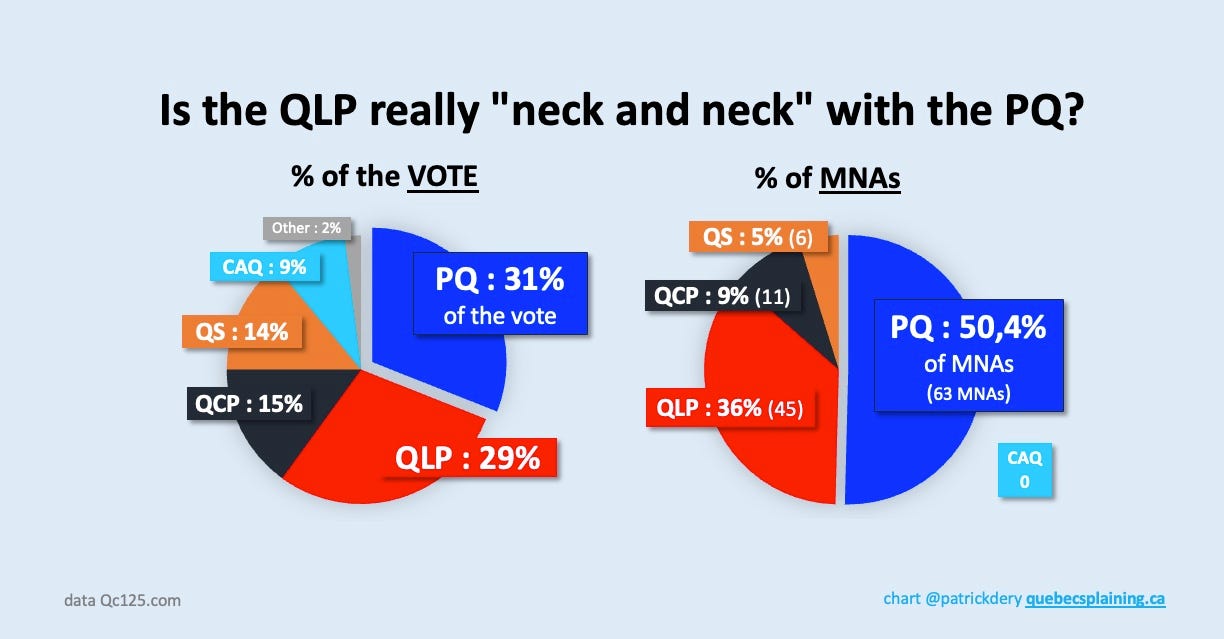
Because, despite a slim advance that’s within the margin of error, the Parti Québécois would still win about 20 more seats than the Liberals. The PQ would thus probably get a majority of seats in the Salon rouge, while the QLP will have to make do with being the official opposition for the next four years. This is quite clear when we look beyond the vote and consider the projected number of elected MNAs.
The Léger poll made for some great headlines, but the race isn’t even close. If elections were held tomorrow, the PQ, with less than a third of the vote, would probably elect more members than all the other parties combined. It’s not neck and neck; it’s one side with its nose above the fray and its elbow firmly planted in the ribs of the others.
It is sometimes said that democracy is the dictatorship of the majority. In Quebec, we have entered a new political era: the dictatorship of the minority.
And, amid the background noise of political pundits who keep track of the score like all of this was a game, we are losing sight of a major issue, namely the slow atomization of our democracy: in Quebec, a political party can form a “majority” government with a third of the vote, or even less.
The 31% of the vote that the PQ received could give it 63 seats. Since the National Assembly has 125 seats, the PQ would have exactly the minimum number of seats needed to control the legislature for four years and, consequently, all legislative and governmental action.
Even though only 31% of Quebecers would have voted for it.
If we increase the PQ vote to 33% and decrease the QLP vote to 27%, as allowed by Philippe Fournier’s election simulator on the Qc125.com website, the PQ majority strengthens to a very comfortable 70 seats.
Can you think of many situations in life where it is possible to have a “majority” with a third of the votes?
In Quebec politics, it is.
+++++++
This has been going on for some time now. But it’s getting worse.
The PQ has been in “majority territory” for a little over a year. But the PQ has never polled over 38%, staying mostly between 31% and 35%.
Never in Quebec’s political history has a government obtained a parliamentary majority with such low support from the electorate.
As of now, the record for the smallest majority belongs to the CAQ. In 2018, the party founded by François Legault won 74 seats with only 37.4% of the vote. Perhaps tellingly, the previous record belonged to Maurice Duplessis, whom Legault has claimed as an inspiration. In the 1944 election, the Union nationale du “Cheuf” won a majority with 38% of the vote.
In 1944, the division of the vote between three parties allowed for this electoral anomaly. The same phenomenon repeated itself in 2018 to favour the CAQ, but this time, four parties were politically viable. Today, five parties can hope to win at least 10% of the vote, or close to it: the Parti Québécois, the Quebec Liberal Party, the Conservative Party of Quebec, the Coalition Avenir Québec, and Québec solidaire.
Every time the political pie is divided further, the threshold required to form a majority government decreases.
This division of the vote among five viable electoral parties is unprecedented in Quebec’s history. Our voting system, which dates back to a time when there were only two political currents—one conservative, the other progressive—cannot properly digest five parties.
In Canada, a similar scenario occurred in the late 1990s and early 2000s. Jean Chrétien’s Liberals took advantage of this to win three consecutive “majorities” with 40% of the vote or slightly less, which helped sow in Western Canada the seeds of resentment that are being reaped today.
But in Quebec, this is more recent. The problem is also exacerbated by the fact that the Parti Québécois could use this “majority” to trigger a referendum on sovereignty, which is not desired by the population, either in form or substance.
And as the CAQ prepares to use its legislative steamroller to pass a series of laws whose democratic foundations are questionable, the shortcomings of an electoral system that seeks, above all, to manufacture majorities, whether real or artificial, are staring us in the face.
François Legault should know. In 2012, the CAQ finished only five points behind the PQ and four points behind the Liberals, but with 35 and 31 fewer seats. Small consolation, the PQ had formed a minority government and the CAQ held the balance of power.
In 2014, Legault was again in the front row to witness the problems with our voting system. Although he had increased his party’s representation from 19 to 22 MNAs, the Liberal Party formed a “majority” government with only 41.5% of the vote.
That was too much for him. In the spring of 2018, François Legault made a formal commitment to reform our voting system, with the Parti Québécois and Québec solidaire. (And Quebec’s Green Party, if you’re wondering who is the guy on the right.)
It is worth quoting some of the words spoken by François Legault at that time:
“So, I am happy today to reiterate my commitment. If we are elected on October 1, a CAQ government will introduce a bill in the first year of its term, and a CAQ government will set in motion a reform of the voting system to be adopted during its first term.
So, I think the current system has served us well, but it is increasingly showing its limitations. Citizens feel that their vote counts less and less. The status quo is fuelling cynicism in Quebec. Mixed proportional representation is a system that has proven itself in several countries around the world and will give more weight to each vote. It is a good compromise for our regions, it is a good compromise for our democracy, it is a good compromise for Quebec. That is why I am pleased that it is part of the program and priorities of a potential CAQ government.
In closing, I would like to highlight the exceptional work of the Mouvement Démocratie nouvelle. You can count on us.”
The joint press briefing by the opposition parties is available here if you want to increase your level of cynicism.
In the fall of 2019, the CAQ kept its promise and tabled its electoral reform bill. The good intentions did not go any further.
By the end of 2021, two years and a pandemic later, Legault was seeing himself as some kind of Father of the Nation—or so he seemed to believe. He was enjoying this a lot. The man who had pledged to be a transformational was one-term Premier was now thinking about a second term. (And, eventually, a third. But polls changed his mind.)
With less than a year to go before the election, the Nouveau Cheuf realized that reforming the voting system could deprive his party of an artificial but valuable majority. Being foremost a pragmatic, Legault threw the electoral reform bill into the dustbin of the National Assembly.
During the 2022 campaign, when asked about his broken promise, Legault explained—without laughing—that he had to uphold his commitment of not keeping his promise to change the voting system.
It takes a certain stature to be willing to give up power if that power is not in line with the will of the electorate. François Legault has shown us time and again that he does not have that stature, but that didn’t stop him from being re-elected by a “majority” in 2022 (with 41% of the vote…) or the CAQ from governing uninterrupted for eight years.
And that is what the CAQ’s thinking heads have always been primarily interested in. Not in making an honest effort to act in accordance with the expectations, objectives, or promises made to Quebecers, but taking advantage of every moment in power to carry out their ideological agenda, with as few constraints as possible. Other governments have done this before them. But the CAQ has been more effective and relentless.
What goes around comes around. If elections were held today, the CAQ would be wiped off the Quebec political landscape: with 14% of the vote, it would not win a single seat. After having won 90 seats in 2022, the CAQ would cease to exist.
Next October, we could witness the biggest political meltdown in Quebec’s history.
The irony is that if Legault had implemented a mixed proportional voting system, as he had promised, his party would be assured of keeping 15 to 20 seats.
+++++++
The last time a party obtained a parliamentary majority after winning a majority of the vote was in 1985, with Robert Bourassa 2.0. Guy Lafleur had retired from hockey for the first time. He would return three years later.
The time before that was in 1973, with Bourassa 1.0. Lafleur was starting his third season in the NHL. He had scored 55 points the year before, and people were wondering if he would become the player everyone hoped he would be.
Then we go back to 1962 and Jean Lesage. Lafleur was 11 years old and made heads turn with his scoring prowess at the Quebec City Pee-Wee Tournament.
Over the past 60 years, Quebec has held 16 general elections. That has given us 14 majority governments and two minority governments.
Of the 14 majority governments elected since 1966, only two have received the support of at least 50% of Quebecers: Robert Bourassa in 1973, and again in 1985. (Bourassa also came very close in 1989.)
All other times, the “majority” was only in name: the party in power had a majority of seats in the National Assembly, but only a minority of Quebecers had voted for it.
René Lévesque’s iconic victory in 1976? 41.4%.
At the time, it was the third-smallest “majority” in history. In other words, it was an anomaly, due to the resurgence of the Union Nationale: under normal circumstances, a party that obtained 41% of the vote formed the official opposition.
Jacques Parizeau’s big comeback in 1994? 44.8%.
Jean Charest’s “two hands on the wheel”? 42.1%.
Philippe Couillard’s “vraies affaires” (straight goods) of 2014? 41.5%.
François Legault’s historic victory in 2018, which ended 50 years of QLP-PQ duopoly? 37.4%.
Each time, a majority of Quebecers lost their elections. That’s not healthy, democracy-wise.
Sometimes it was downright ridiculous. In 1998, Lucien Bouchard’s Parti Québécois won 42.9% of the vote and formed a majority government. Jean Charest’s Liberals, who had won the election night with 43.6% of the vote, found themselves in the opposition.
Daniel Johnson had done the same thing to Jean Lesage in 1966. And Maurice Duplessis to Adélard Godbout in 1944. (Some kind of Quiet Revolution could have started 15 years earlier…)
The results in terms of public policy were not always bad. In hindsight, pretty much everyone recognizes the competence of the first Lévesque government. But in a democracy, the process also counts.
And, in the long run, the process always ends up influencing the results. The current government has understood that it can do whatever it wants until it is voted out of power. Its legislative action is beginning to be clearly abusive if one believes in the principle of a parliamentary democracy existing within a system of checks and balances.
The chart below illustrates quite clearly when the democratic fracture happened in Quebec. Before 1966, in 27 general elections, the party that formed the government won more than 50% of the vote 22 times. The other five occasions included four majority governments and one minority government. It wasn’t perfect, but most of the time, it worked.
In 1966, something broke down. There have been 16 elections since then, which have produced 14 majority governments, as I mentioned earlier. And these “majorities” have reflected a majority of the votes only twice.
(Note: the scale of the graph starts at 30%, not zero. The colours of the bars correspond to those of the parties. You can click to enlarge.)
IMAGE
This decline in Quebec’s representative democracy has been going on for decades, so we didn’t really notice what was happening as we got used to it, a bit like a lobster falling asleep before the water starts boiling. (Contrary to popular belief, frogs jump out when the water gets too hot. So, Quebecers aren’t really frogs after all.)
Today, a political party can hope to hold the levers of power for four years as long as it manages to get the support of 30 to 35% of voters. Instead of rallying a large majority around a truly unifying project (such as the survival of a society in the face of our immense demographic challenges), all one ambitious politician has to do is make enough people angry about a polarizing issue by appealing to their resentment.
It’s easier to divide than to unite. It’s also more tempting and more profitable, politically speaking.
No wonder immigrants are being targeted. The CAQ is more populist than previous governments. And today’s PQ is considerably more populist than the PQ of Bouchard, Parizeau, and Lévesque. The trend is clear. The issues at stake, in terms of demographics, the sustainability of our public services, and our society’s ability to function, are existential. But the public debate is dominated by scaremongering that calls for increasingly divisive and simplistic solutions because that remains the easiest way to gain power.
Imagine you are going on a trip, a group of ten in a minibus. As soon as four passengers agree, the doors are locked, and they decide for the other passengers.
That has been the state of our democracy for the past 30 years.
Next time, the doors could be locked as soon as three passengers agree. The seven other passengers will just have to buckle up for the next four years.
Did you vote for that?
Perhaps we have reached the point where we need to demand an upgrade of our democratic machinery.
-30-
This text is 2,799 words long, or about 12 pages of a book. The research, writing, and designing of the charts took me about two days.
My name is Patrick Déry. I write (mostly in French) for a living, and do my best to Quebecsplain in English in this space. I also enjoy making numbers talk and putting together charts that you won’t see anywhere else.
If you enjoyed reading this text, you can encourage me by buying me a coffee. Comments, shares, and likes are always appreciated.
You can also subscribe to this media by clicking on the button below.


