


(Texte français disponible ici.)
Election news has slowed to a crawl in the wake of the debate, which is still dominating campaign coverage. Who came out ahead? Who fell short? You can read my debate recap and other campaign news here. There was another debate Wednesday night. I skipped it. One was enough. Besides, I had this to write.
Since Tuesday’s debate ran so late, I’m taking it easy today with a lighter topic, one far less likely to stir up strong feelings: the state of French in Quebec.
But first, one important story, because we still have functioning courts, followed by another one to make you smile, because the third item probably won’t.
The Superior Court Does the Government a Favour. The Government Just Doesn’t Know It
At the start of the campaign, we learned that, for the first time, voter information cards and other election material would be sent out only in French.
A citizen challenged the decision and asked that all the material be sent in both languages. On Wednesday, the Superior Court ruled in his favour, pointing to a risk of “serious and irreparable harm” for the roughly 6% of Quebecers who do not understand French.
The voter reminder card will therefore be sent in both languages. In practical terms, certain provisions of the Charter of the French Language, as amended by Bill 96, will be suspended for ten days, just long enough to send it out. The rest of the election material has already been sent in French and will not be reprinted.
In his ruling, Justice Sylvain Lussier noted that election results could be overturned if a violation of voting rights were established, citing the recent case of the voided election in Terrebonne.
In other words, the government’s mindless stubbornness could have thrown the whole thing into chaos the day after October 5. The Superior Court just saved it from itself.
Remember, Élections Québec had repeatedly asked, since 2023, for an exemption from the Bill 96 requirement that it communicate exclusively in French. It simply wanted to carry on as it always had, doing something that had never caused a problem.
Let’s be serious. Election material sent out once every four years is not going to turn Quebec into Louisiana.
In Manitoba and New Brunswick, as well as in federal elections across the country, the material is sent in both languages. Ontario also provides it in both languages in areas with a significant francophone population.
In the United States, the Voting Rights Act requires election material to be provided in different languages in different parts of the country, including Spanish, Bengali, Chinese, Korean, Filipino, several languages from India, and several Indigenous languages.
In Texas, voter registration cards are automatically bilingual, in English and Spanish, under state law.
The Cannabis Industry Is Not Amused
“The only company you brought to Bécancour was a pot company.”
— Christine Fréchette, speaking to QLP Leader Charles Milliard on Tuesday night
Cannabis has been legal in Quebec since 2018. The legal age was initially 18, but Uncle François (Legault) and Uncle Lionel (Carmant) decided to raise it to 21, after briefly flirting with 25. Everywhere else in Canada, the legal age is 19, except in Alberta, where it is 18.
On Tuesday, in front of more than a million Quebecers, Auntie Christine took a swipe at an industry that employs 8,000 people in Quebec, generates $1.4 billion in economic activity, and puts nearly half a billion dollars into government coffers, according to figures supplied by an industry group that was not amused.
Way to win votes in a close election!
Is French Declining, or Are French Canadians?
“We have never experienced linguistic and cultural decline this severe in the past century.”
— Paul St-Pierre Plamondon, leader of the Parti Québécois, during Tuesday’s debate
I immediately pointed out how preposterous the claim was, including on X/Twitter and Facebook, if you would like to follow me on either. I promised myself I would come back to it.
Because it is completely disconnected from reality. Delusional. Dissonant.
Let’s start with culture.
Does anyone seriously believe Quebec culture has declined over the past 100, 50, or even 30 years? Has the leader of the Parti Québécois taken the full measure of everything we continue to produce: books, music, theatre, television series, films, and no shortage of actors, writers, musicians, singers, and directors?
We even have the luxury of our own media ecosystem to keep that culture alive. No other province has anything like it, and it compares favourably with those of many countries. Ten daily newspapers. Four conventional television networks, several with local stations. Two 24-hour news networks. Dozens of radio stations. Thousands of digital media outlets and creators of every kind.
And that’s just in French. Quebec culture also exists in other languages, not just English.
Quebec is Canada’s cultural powerhouse. Quebec culture is so vibrant, so fertile, and so strong that it draws creators from elsewhere, turns them into Quebecers, and then helps them shine on the world stage. Through the tremendous reach of the global Francophonie, and even beyond it, Quebec manages to do more than countries many times its size.
Culturally, Quebec punches well above its weight. Funding is up for debate. So is how we should deal with the digital giants.
But cultural “decline”? That is not merely pessimistic. It is fantasy.
Unless you think we peaked in La Bolduc’s day.
Now for the language.
All the data presented below come from Statistics Canada. They are also routinely used by the Institut de la statistique du Québec and the Office québécois de la langue française.
In other words, solid, credible stuff.
I can already hear people objecting that these are “self-reported” data, particularly when it comes to someone’s ability to carry on a conversation in French. That is a limitation. But it has always been there, has remained constant, and has applied equally over time. More importantly, neither StatsCan, the ISQ, nor the OQLF has ever considered it serious enough to invalidate the data.
Some series go back to 1951, others to 1971. I used whatever was available. In one case, I did a little statistical archaeology and made it all the way back to 1901. The full analysis is available here.
Here’s the gist. Stick with me; you’ll quickly see where this is going.
Proportion of Quebecers Who Speak French, Since 1951
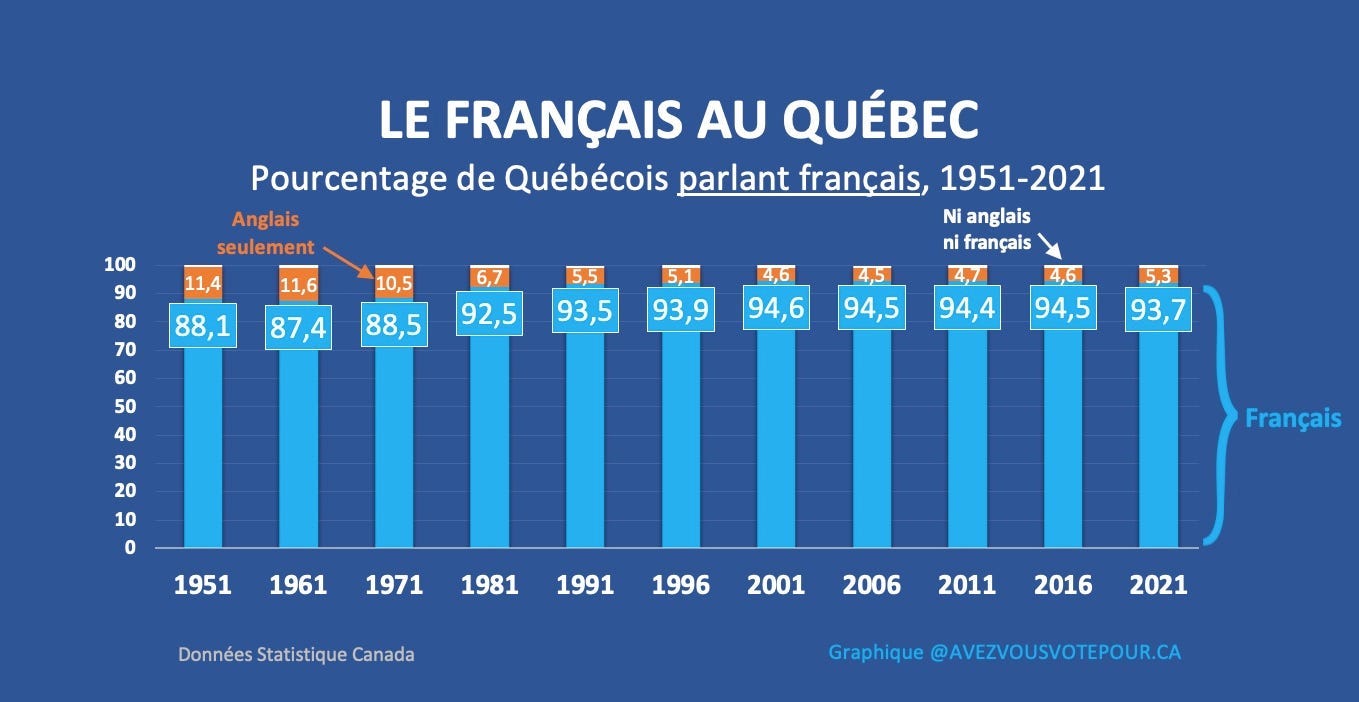
The proportion is higher than it was 50 years ago.
We are still near an all-time high.
The proportion of Quebecers who speak only English has been cut in half.
Proportion of Quebecers With French as Their Mother Tongue, Since 1901
(I’m particularly proud of this one. I had to comb through ancient census volumes archived as PDFs. It was no picnic. Apparently, PDFs with hyperlinks weren’t really a thing in 1931.)
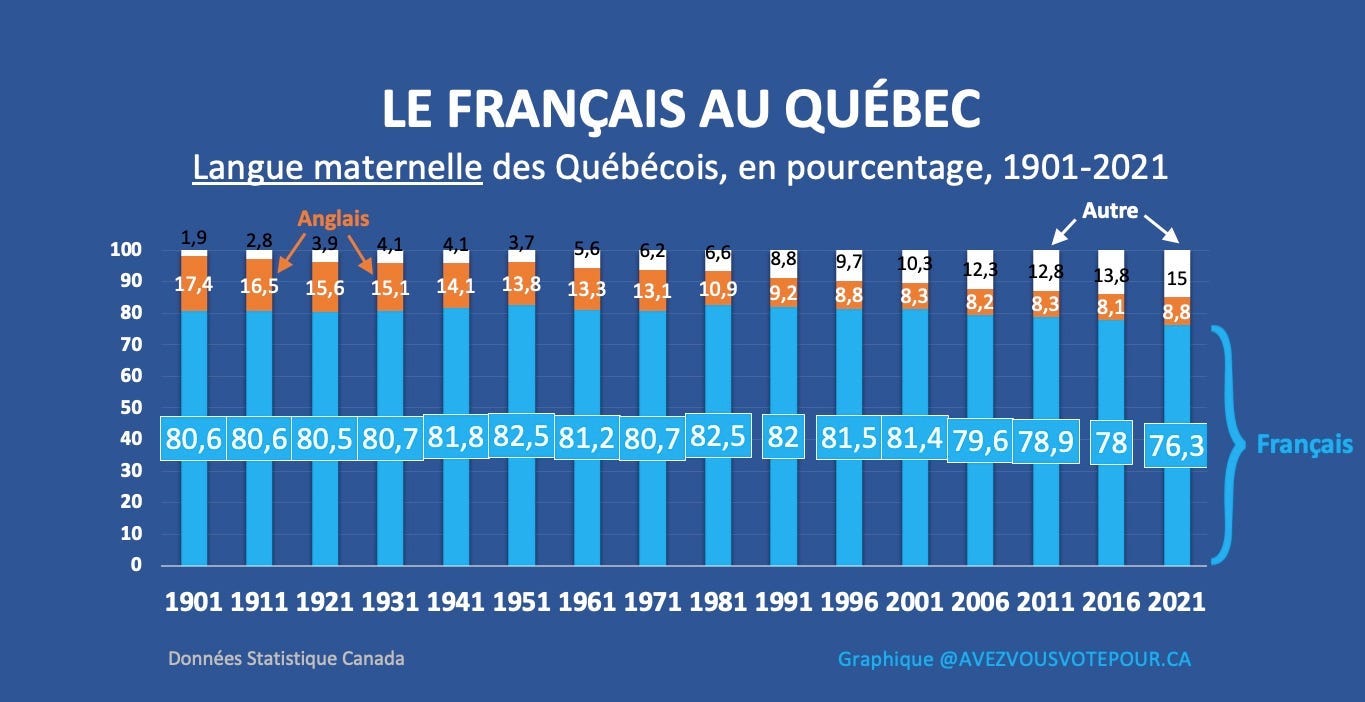
There has been a slight decline in recent years because of immigration.
English has fallen much more sharply and has also been cut in half.
“Other” languages have filled the gap. These people and their children have all gone, or will all go, to school in French.
Here is the same series with “other” removed from the equation:
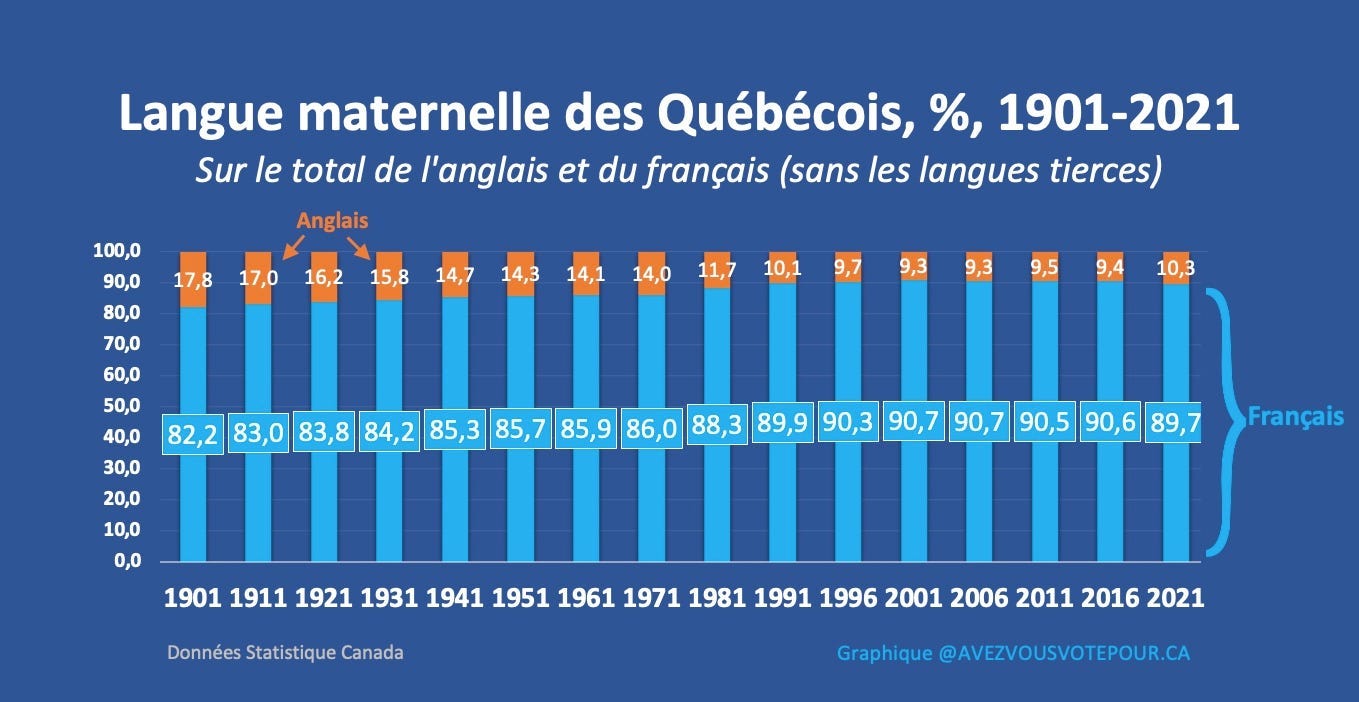
Once you look only at English and French, it becomes pretty clear who gained ground.
Quebecers’ First Official Language Spoken, Since 1971
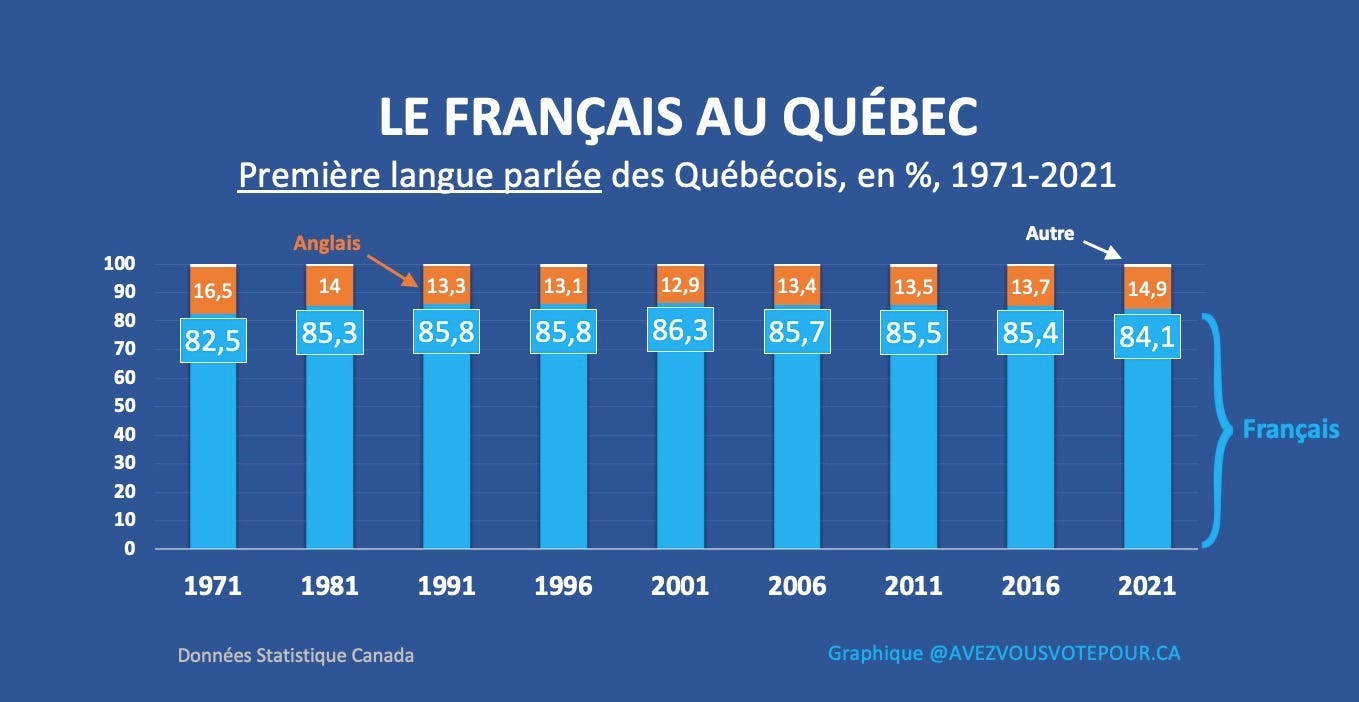
A very slight, gradual, and recent dip. Keep in mind that the data points are ten years apart at first and then five years apart, which distorts the timeline.
This is largely due to temporary immigration, since temporary residents have less incentive to learn French.
The proportion of people who have French as their first official language spoken remains higher than the proportion who have it as their mother tongue.
In other words, people in the “other” category eventually become francophones in practice, over one or two generations. Just not in six months.
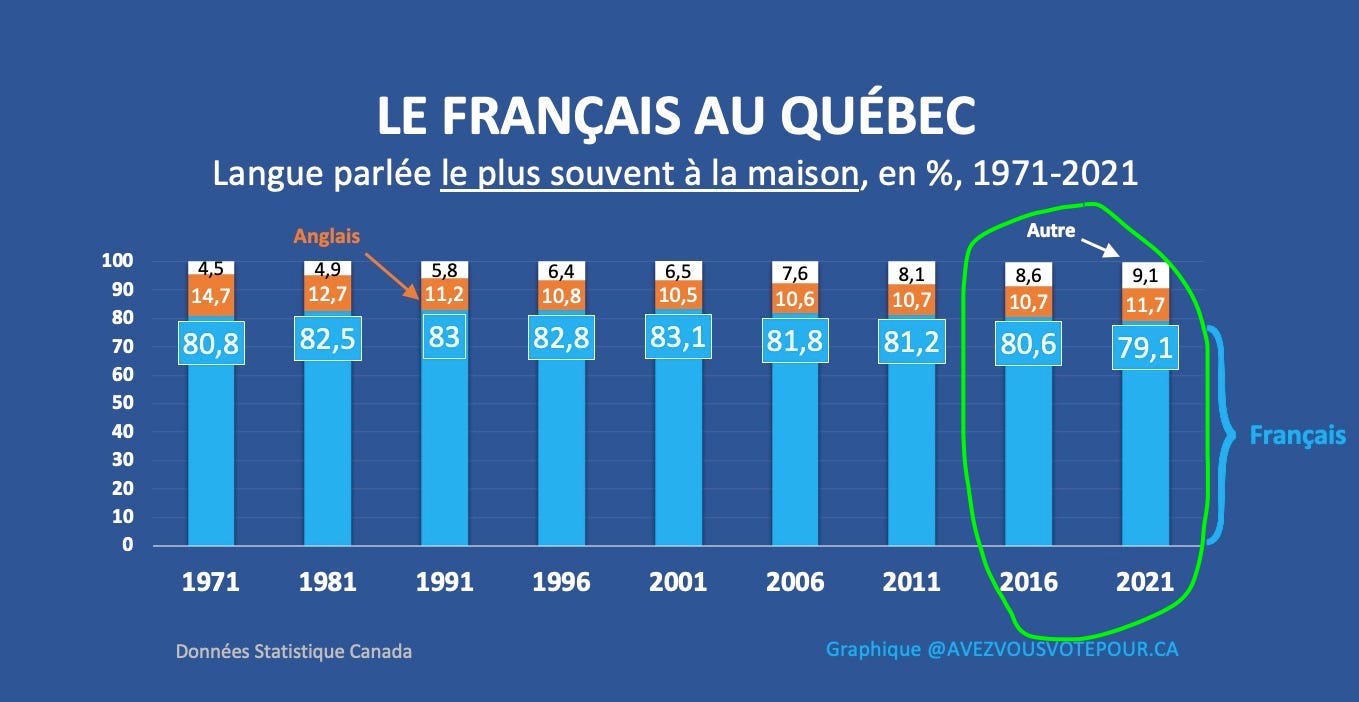
Language Spoken Most Often at Home
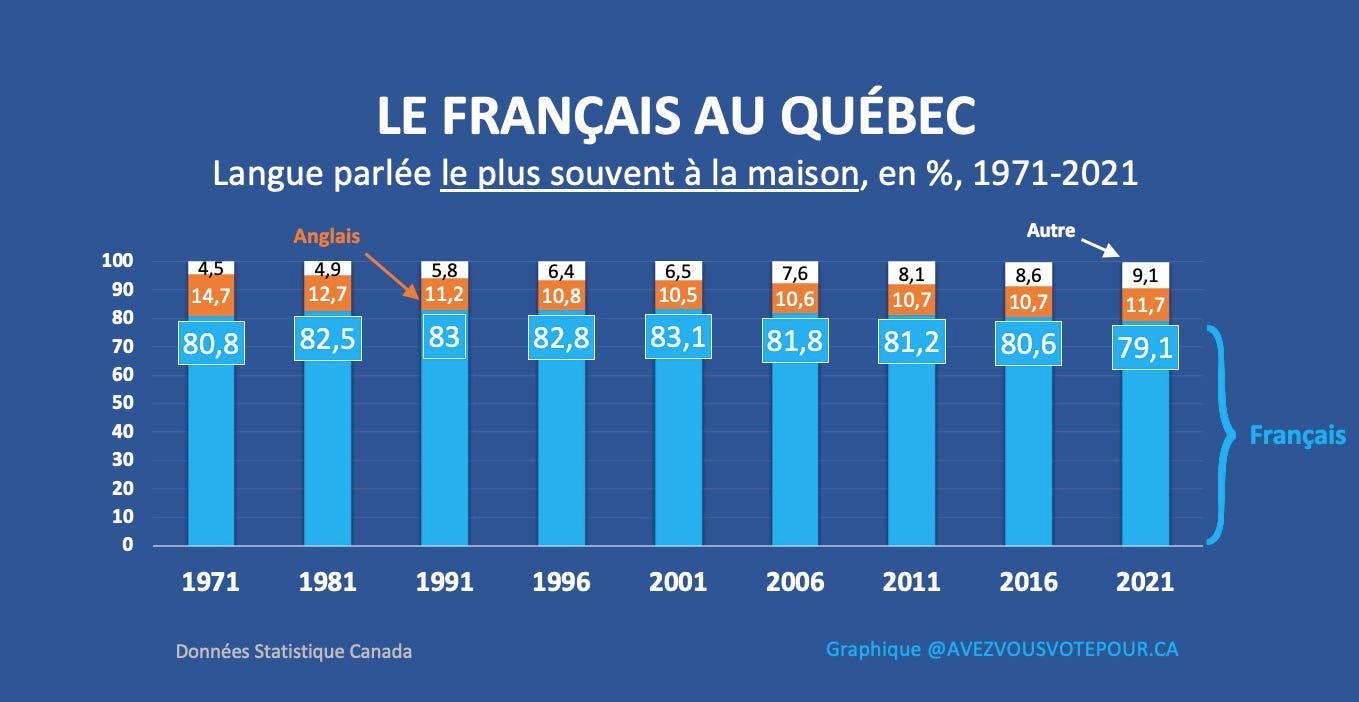
A recent dip because of temporary immigration.
We are still roughly where we were 50 years ago.
Once again, English has lost much more ground than French.
“Other” languages are filling the gap.
The OQLF has also documented language transfers, cases in which Quebecers shift away from their original language or from the mother tongue of an immigrant parent.
Since Bill 101 was adopted, most of these transfers have favoured French. Since 2001, roughly 75% have.
What about language use in public?
Here are OQLF data from 2024 that I previously presented here.
The first chart shows the use of French in public and how it changed between 2016 and 2022, broken down by the language spoken at home. The second does the same for English.
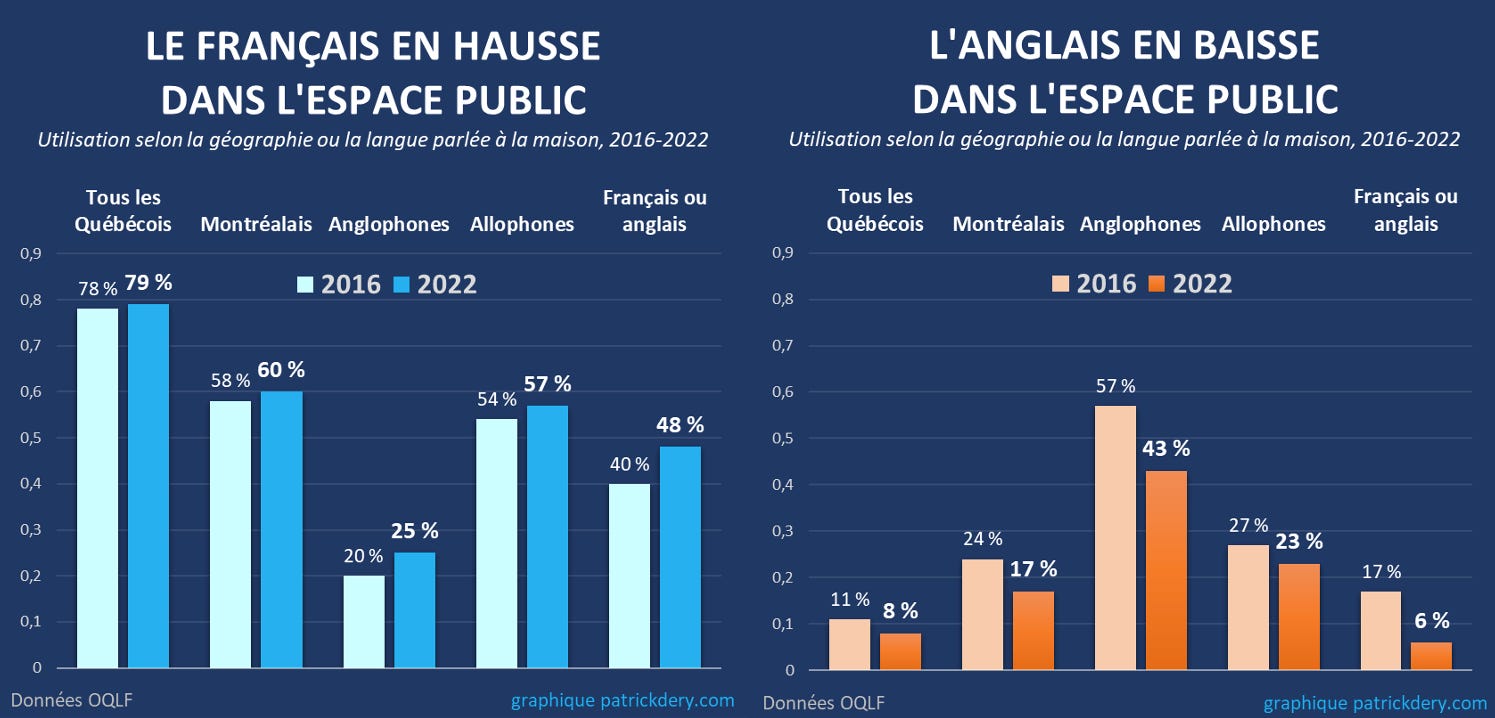
First chart: between 2016 and 2022, the proportion of Quebecers using French in public edged up. Admit it: you’re surprised!
This was true of Montrealers, anglophones, allophones, and people who speak both French and English at home.
Second chart: during the same period, the use of English in public declined. Admit it: you’re even more surprised!
The same pattern held among anglophones, allophones, and people who speak both French and English at home. Even they are being drawn towards French.
Why? Here’s my theory: because our anglos love Quebec and live here. Because we rub shoulders every day, generally without the problems politicians like to exaggerate. Because they are our neighbours, our colleagues, our friends, our partners, our hockey coaches, and our piano teachers. Because, more than their parents and grandparents, they see the value in speaking French. Because they have left their own schools in droves for French schools, or turned their schools into immersion centres for the language of Félix Leclerc.
That doesn’t match what you see around you? That’s why we have data. Public policy cannot be based on impressions or gut feelings.
However you measure it, French is not “in decline.” There are fluctuations. It may even dip slightly. But a slight dip is not a decline.
The word “decline” is never used by StatsCan, the ISQ, or the OQLF. There have been a few exceptions, nearly all recent and politicized, which I noted here, near the end of the article.
But some politicians, helped along by media outlets that struggle to interpret percentages struggle to put the news in context, will still try to frighten us with this:
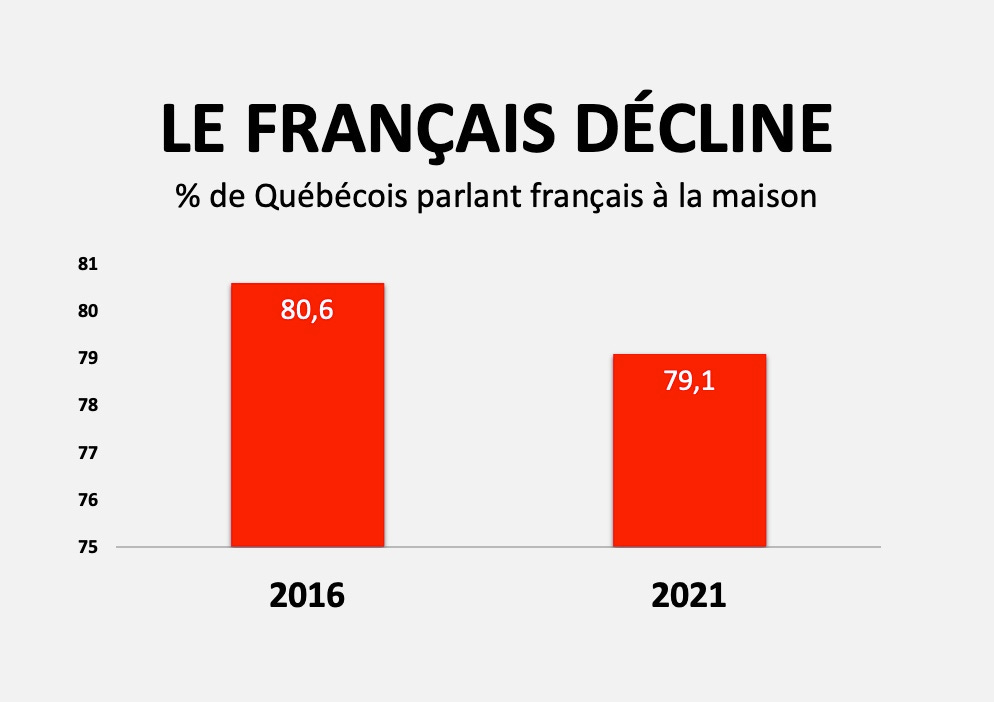
When what is really happening is this:
One last chart, this time showing absolute numbers.
Here is how the number of Quebecers in each mother-tongue group has changed over time.
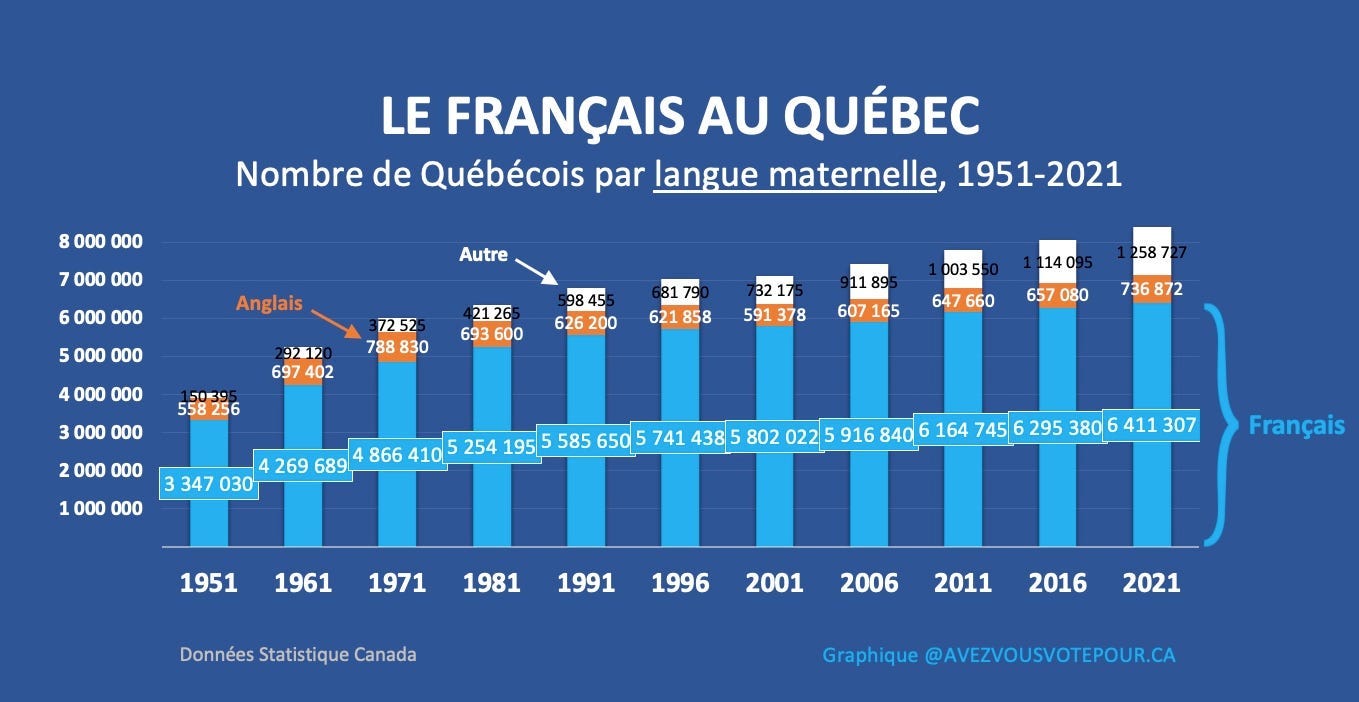
The number of francophones, by this definition, has never stopped growing. The same goes for every other group. More people have arrived, and sooner or later, most will become francophones.
In short, while things are not perfect, French is doing pretty well. The 2026 census may move the needle because temporary immigration has risen since 2021. The operative word is temporary. Most of those who stay will eventually speak French, whatever the doomsayers may claim.
The fearmongers would also have us forget that Quebec has never been 100% francophone and that Bill 101 was never intended to make it so.
The goal was a common public language. Common, not uniform. And it worked.
These days, politicians and other agitators obsess over mother tongue and the language spoken at home.
First, that was never what Bill 101 or the Parti Québécois of 1977 set out to change.
Second, with immigration, mother tongue and the language spoken at home will inevitably change for a generation or two before shifting mainly towards French.
We have trouble grasping how this plays out on the ground.
I have told you before about my former roommate, Paolo. He arrived from Chile nearly 50 years ago. He grew up in Warwick. He studied in Quebec City, where he still lives. He had a child with a Tremblay.
Paolo speaks Quebec French just like you and me. He feels like a Quebecer. He is a Quebecer. French is his language. His Spanish is only so-so. Yet Paolo still counts against French in the mother-tongue statistics, 50 years after arriving in Quebec and 50 years after we assimilated him to the core.
His daughter has never known anything but Quebec. She lives in Quebec City and lives entirely in French. Yet the Education Ministry’s dashboard classifies her as a “second-generation immigrant.” That allows politicians to stage a melodrama outside a school, blaming Quebecers who have never known anything but Quebec for the deliberate neglect and decay of our public buildings.
“Second-generation immigrants” exist only as a bureaucratic category. In everyday life, there is another word for them: Quebecers.
One last example, since it’s getting late.
Marie, the sister of a friend, also came from somewhere else as a very young child.
Marie also counts against French in the mother-tongue statistics. And even though she speaks Quebec French just like you and me, Marie would have lit up the Education Ministry’s dashboard. A first-generation immigrant. Imagine that!
What does Marie do today? She teaches French, Quebec French, to immigrants.
Yet Marie still tips the statistics in the “wrong” direction.
Maybe, even now, we still have trouble accepting that Quebecers who came from elsewhere, and English-speaking Quebecers who speak French, really are Quebecers.
+++++++
The birth rate among Quebecers is nowhere near high enough to replace the population. No public policy has ever managed to turn that around.
Immigration is our only lifeline. Without it, extinction awaits. Not tomorrow morning, but eventually. Demographically and statistically, it is inevitable.
Immigration can be French-speaking, and immigrants can become French-speaking. It can allow us to preserve our linguistic distinctiveness in North America without French “declining.”
French may fluctuate a little. It will probably evolve. But it will still be here, in a Quebec that remains overwhelmingly French-speaking, bound together by the social glue of a common language, with welcoming and enlightened policies to promote French, far removed from those we have seen in recent years.
But before we get there, we will have to accept something more difficult, something lurking beneath all the things left unsaid whenever people talk about the “decline” of French.
There is another, very real decline at the root of our collective anxieties. In some ways, it hurts much more and is much harder to accept.
It is the decline of the French Canadian, the pure laine Quebecer, those descendants of settlers steeped in maple syrup, those remnants of New France, and the image we still sometimes have of them.
There is not much we can do about that decline.
-30-
My name is Patrick Déry. I write for a living, and I am trying something different here. If you enjoyed reading this piece, you can support me by buying me a coffee. You can also subscribe to this publication (for free or as a paid subscriber; the choice is yours).
Comments, shares, and “likes” are always appreciated. It also helps the Substack algorithm notice me, so don’t be shy!
Great post. It is a danger to the raison d'être of many politicians though...they don't want to hear this truth. Also I noticed in the replies to your X post about it a certain undercurrent (or maybe just current) of racism. Some people are blaming the immigrants again.
I had thought, before seeing these charts, that one could surmise that the reason French is actually doing ok is because of Bill 101. But actually, there's not much difference in the pre-1977 dates and the post-1977 dates. It seems like the gradual growth continues. A little dip of anglos but then it comes back.
100% Quebec should have public signs in French, and it makes perfect sense to expect that if you live here, you can at least understand it. But all the other stuff about the election cards, the service in health care, even the choice of school...I mean I guess the government knows it is unconsitutional, since it protects those laws with the notwithstanding clause. I would have sent my kids to french school, even if I had the choice to send them to English school. Ironically I did not because I am also a confusing statistic...I am essentially a Franco-Ontarian, because I went to elementary school in French in Toronto. Then I married a Quebecoise (oops) so we don't have the right to send our kids to English school. But I mean...we are in Montreal. They should go to school in French, I think. But also families should be able to choose for themselves.
And frankly all of this is just to help some people get elected. It's all about scaremongering and finding votes.
Excellent! The big lie that "French is in decline" bears a striking resemblance to the "Great Replacement" theory peddled by right-wing American racists. Instead of trying to scare old stock Quebecers or right wing citizens, we need to celebrate the positive messages you articulate so clearly. Debate moderators and journalists also need to stop lying and peddling the "Kool-Aid" narrative that "everyone knows French is in decline." This positive message also puts a lie to the argument for separation/sovereignty/independence et al