


Did you watch the Radio-Canada debate?
Patrice Roy asked an excellent question when he said the point was to find out “what kind of Quebec we want to live in.”
I didn’t get an answer. The Quebec I want to live in has neither narrow ideological lanes nor opportunistic flexibility without any real conviction.
The Quebec I dream of is pragmatic and fair, efficient and empathetic, responsible and tolerant, idealistic and competent.
Every time one of the leaders opened their mouth, I felt I was hearing only a small fraction of that ideal. Yet building a better Quebec would take a little something from each of them, and from each of us.
PSPP spoke of “intelligence” and “optimism,” then moved straight to the “camp of lies and pessimism,” which currently includes 70% of Quebecers.
Éric Duhaime talked about taxes. Ruba Ghazal has plenty of good intentions. Charles Milliard talked about his gut again (what is it with him?), and Christine Fréchette just sounds phony.
Nobody challenged PSPP when he once again spoke of “the worst decline of French and Quebec culture in our recent history,” even though that is objectively and factually false. It bothers me that he keeps getting away with it.
All told, it felt a lot like last week’s debate.
Maybe I was just tired.
Still, I would have preferred fewer canned lines and fewer candidates talking over one another to hurl them back and forth.
But I did take a picture of the debate, just for you.
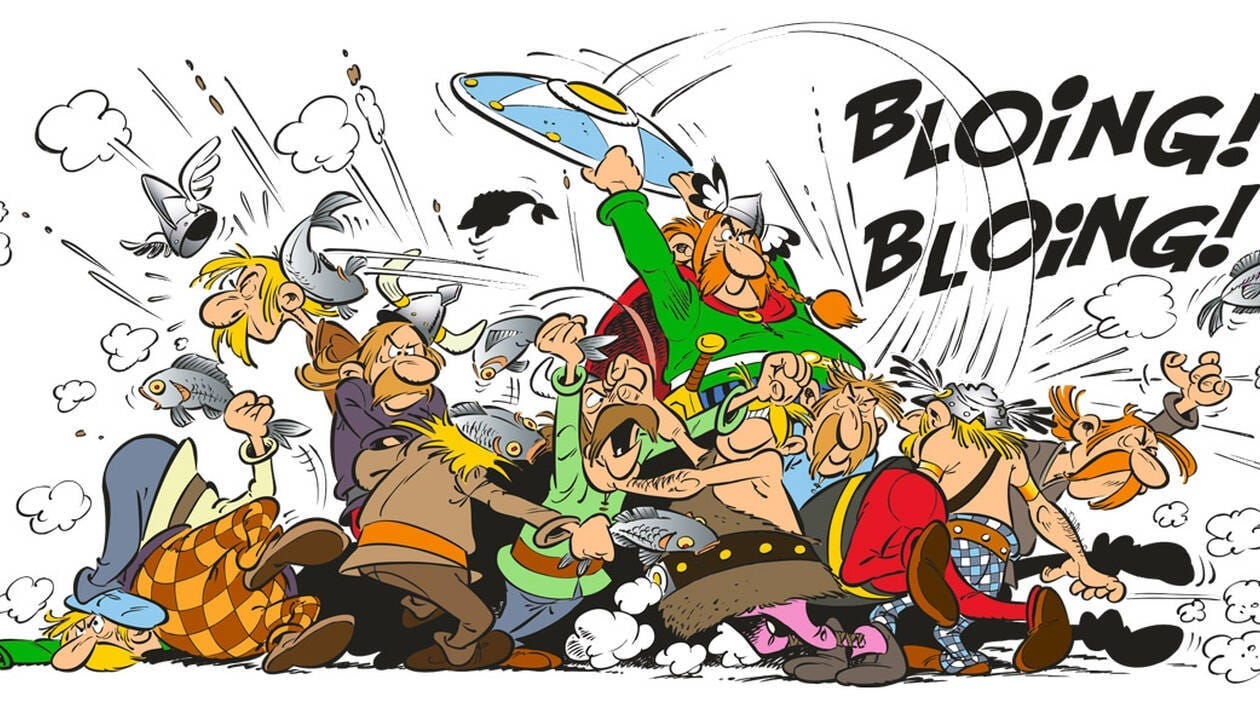
My ideal debate, since you’re kind enough to ask, wouldn’t really be a debate. It would be one question, followed by a long answer of three, four, or five minutes from each candidate. A few questions from the audience. Then another question on another subject.
A sort of kitchen-table conversation we could all sit in on at once.
It would be long. There would be no grandstanding, no slogans, and no canned lines. We would go to bed late without having covered everything.
But we might finally see something that has yet to emerge after three debates: a fuller expression of what each leader really thinks, something like a vision of what we could become.
And once everyone had talked long enough to exhaust their talking points, maybe we would start listening to one another.
Enough dreaming. Let’s dive in!
Flip-flop of the day
“I think that over the past few months, we’ve really had a problem with how we frame our messages in the Parti Québécois, and I take the blame.”
— Gabriel Pallotta, the PQ candidate in Sherbrooke, who was uncomfortable with his party’s rhetoric and said he wanted to “work really hard to clean it up.”
According to Pallotta, 30 to 40 PQ candidates share his view. At least, that was his view on Tuesday, until early evening.
“The Parti Québécois’s positions on immigration have remained the same and have been consistent for six years now. I decided to run as a PQ candidate because I agree with those positions.”
— Gabriel Pallotta, PQ candidate, beginning a strategic U-turn early Tuesday evening.
It didn’t end there.
“Under the pressure and potential hostility of a debate, I panicked and made some claims that simply aren’t true.”
— Gabriel Pallotta, repentant on Wednesday, and still the PQ candidate because it is too late to replace him.
I don’t know whether Pallotta expected to become a minister, but I’d hold off on renting an apartment in Quebec City.
Sherbrooke is the only riding outside Quebec City held by Québec solidaire. The race between the PQ, QS, and QLP is close, with all three parties within the margin of error.
Pallotta may have been trying to win over QS voters. Instead, he has given QS a considerable hand.
In the meantime, we get a headline like this:
A PQ candidate admits he lied about his party’s message on immigration.
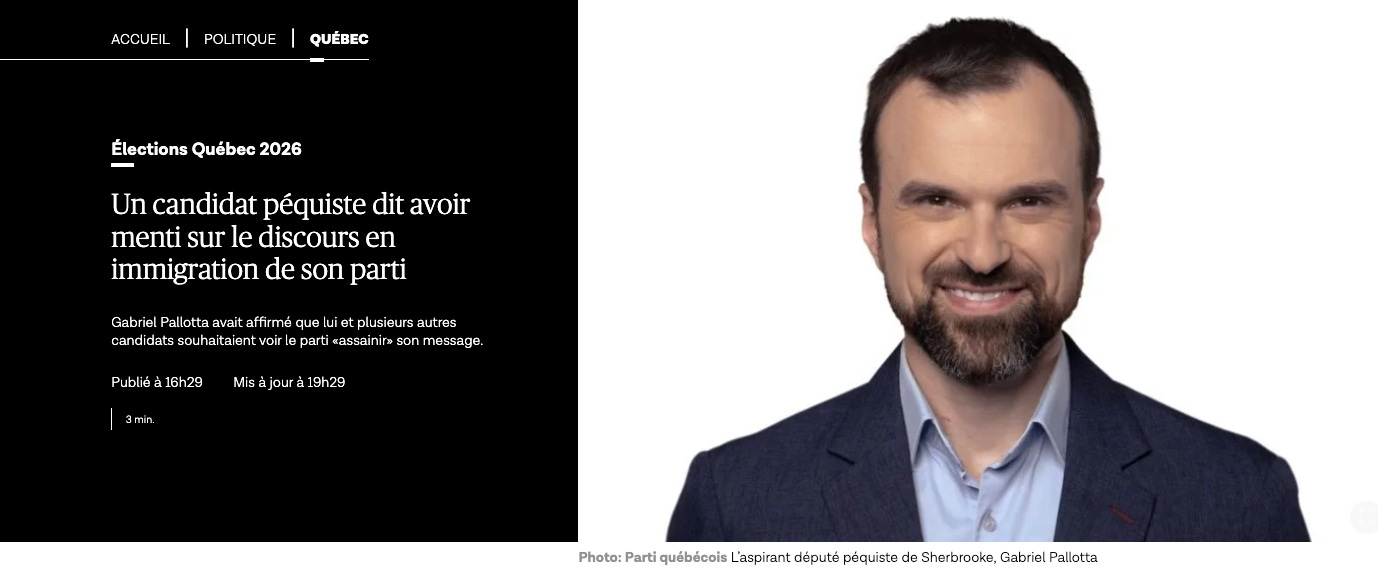
Source: Le Devoir
The good old days weren’t any better
The first televised leaders’ debate took place on November 11, 1962, between Jean Lesage and Daniel Johnson Sr.
Here it is, if you want to hear rolled Rs and watch everyone smoke, including the moderator.
My favourite moment is when Daniel Johnson admits that the Union nationale’s platform is less developed than the Liberal Party’s because his party has fewer resources than the party in power.
Today, that clip would go viral, and the politician who let it slip would spend the next day walking it back.
If you’re still not convinced the good old days weren’t any better, here’s the cartoon La Presse published the day after the debate.
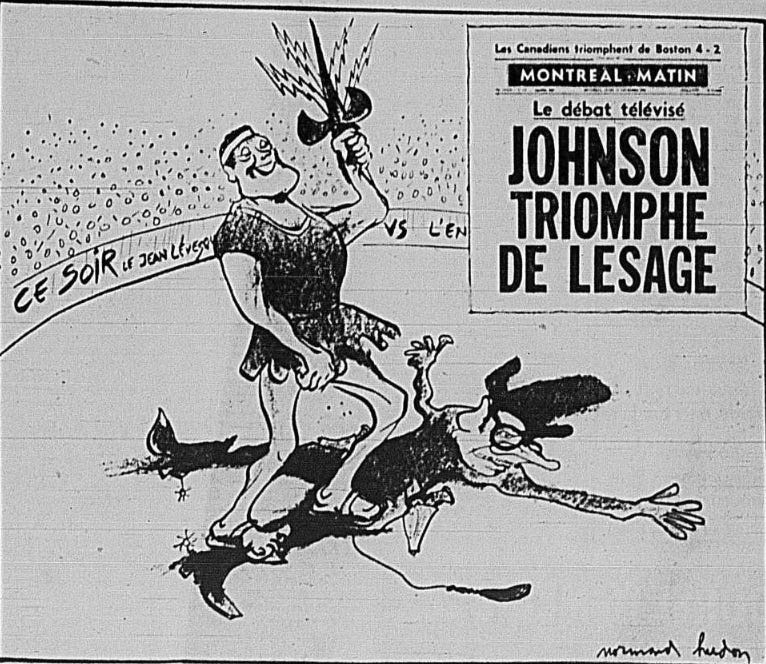
Source: La Presse’s election liveblog
Health care unions want to meet our needs
The nurses’ union (FIQ), the FTQ, the CSN, the CSQ, the family doctors’ union (FMOQ), and other health care organizations want to launch “a major national discussion” on “adopting solutions that will encourage people to choose careers in health and social services and then stay in them, so that the public health and social services system can meet the population’s needs.”
I couldn’t agree more. In fact, I doubt there’s a single person in Quebec who disagrees.
Look how clean and beautiful their hospital is, too. No patients in the hallways, and no holes in the walls or ceilings.
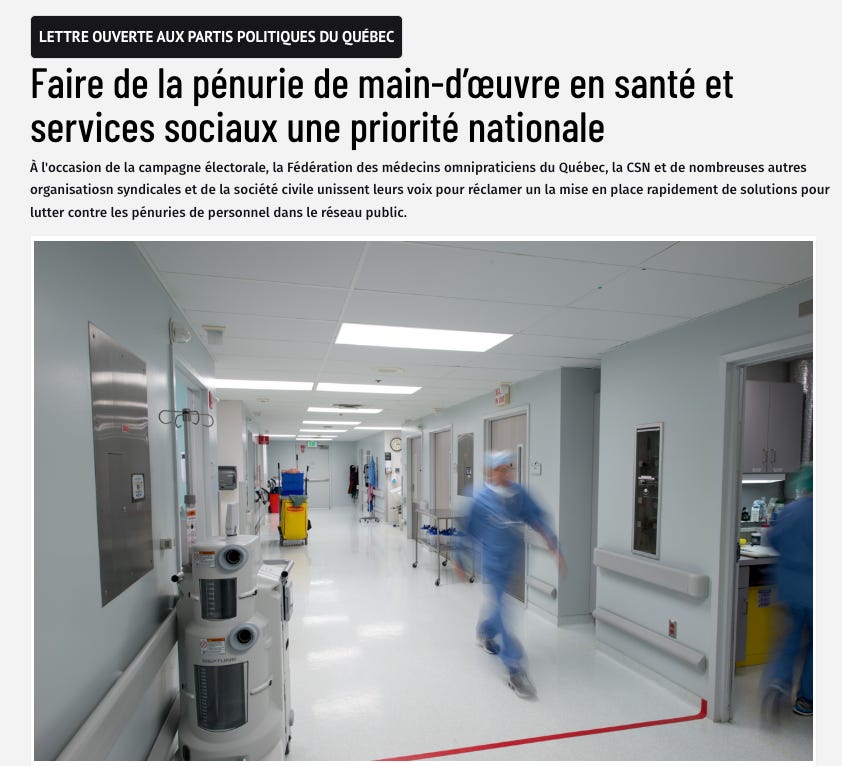
Source: CSN
I have a question for the family doctors’ union: would you agree to reconsider the many bonuses that have cost a fortune in recent years and delivered nothing?
Would you also be willing to take a pay cut to bring your compensation in line with the Canadian average, once Quebec’s cost of living is taken into account? That could free up hundreds of millions of dollars better spent elsewhere, particularly on hiring staff, instead of always resorting to cuts.
We wouldn’t even need a “national discussion,” because pretty much everyone agrees. Except you. So? What do you say?
I have a question for the health care unions, too: would you agree to rethink how work is organized?
For example, could the less stable or less desirable shifts (evenings, nights, and weekends) be shared across the workforce, as they are in anglophone hospitals in Quebec, elsewhere in Canada, and in Europe? Right now, they fall on young workers, who are leaving in droves because the arrangement is unbearable and incompatible with starting a family.
That would encourage people to “choose careers in health and social services and stay in them,” as you put it.
Hello?
Can I get an answer?
Anyone?

Why is the Parti Québécois filing complaints against a psychiatrist?
The Parti Québécois and two of its candidates have filed a professional conduct complaint with the Collège des médecins against psychiatrist Marie-Ève Cotton.
In all, over the past two years, five people associated with the Parti Québécois have filed complaints after Dr. Cotton expressed herself about the PQ leader, his views, or the party’s positions. Amnesty International’s Quebec section describes a pattern of harassment.
So far, every complaint has been dismissed, either initially or on appeal.
Who is Marie-Ève Cotton?
She is a psychiatrist who practises, among other places, in northern Quebec, under conditions you can imagine. She is also very active on social media, where she doesn’t hold back when commenting on current events or expressing her convictions. If you’re on Facebook, you may know her.
Dr. Cotton has no patience for social injustice, and she has the temperament and vocabulary to make her point forcefully. She also seems to have little tolerance for political bullshit, and she isn’t shy about saying so.
What’s interesting about her approach is that she starts with the people’s own words, backed by screenshots. That gives her posts a solid factual foundation (and makes them awkward for the people she quotes).
Her posts look like this:
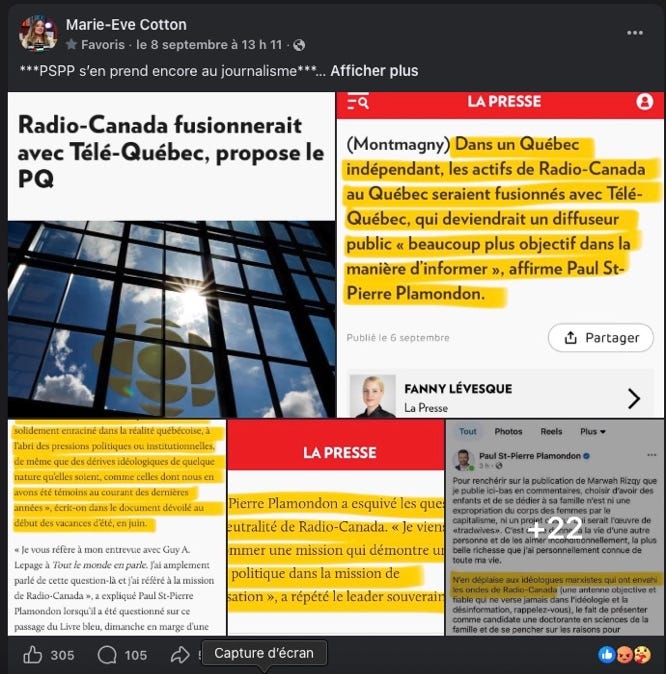
You can visit her page here.
I sometimes disagree with her on the details, but I find it hard to disagree with her diagnosis of the big picture. This isn’t a matter of left or right. It’s about fundamental rights, humanity, and decency at a time when those things, which ought to be taken for granted, are being battered at the highest levels, including here at home.
Marie-Ève Cotton has her own interpretation, of course, and she may occasionally go overboard rhetorically. But that’s hardly unusual among commentators, including professionals, especially on the radio (though those ones are on the right, so apparently it’s fine).
So what bothers the PQ?
Marie-Ève Cotton is an effective communicator who has built a substantial audience.
She also has a knack for pointing to uncomfortable truths. In the Parti Québécois’s case, that means its none-too-subtle flirtation with the far right.
Take PSPP denouncing “wokism” and “ideological disinformation,” the “radical left,” a label he even applies to former PQ ministers, or the “Marxists” at Radio-Canada. He takes shots at everything on the left to look tough to the right.
Yet PSPP has no problem giving an interview to Rebel News. The Quebec Press Council does not consider it a news outlet, describing it instead as an “activist organization close to far-right circles.” (He also took the opportunity to make up statistics.)
Or take the way PSPP repeatedly blames Ottawa for everything wrong in Quebec, whether the subject is immigration or, more recently, tariffs, even though our neighbouring country is led by a narcissistic sociopath (that’s my diagnosis; please don’t tell Donald Trump, or he’ll file a complaint against me for practising medicine without a licence).
Yet PSPP has no problem agreeing with Donald Trump when Trump invents a massive fentanyl and irregular immigration problem coming from Canada.
Or take PSPP denouncing supposed calls for violence from the far left, when actual violence is almost always on the right.
And so on. It’s happening before our eyes. You don’t need to be a psychiatrist to see it.
Some columnists see it too, including Yves Boisvert of La Presse.
“[PSPP] pretends not to see the difference between immigrants and refugee claimants, who arrive without asking the government’s permission. They all seem to blur together in what he calls ‘mass immigration.’
In language that sounds very much like Mathieu Bock-Côté’s, these are Trump’s themes: there is no border anymore; a deliberate policy of mass immigration is drowning us in diversity; security will disappear; and we are being ‘infiltrated.’
Add to that his call for university programs to be reviewed by a parliamentary committee. Why? To root out ‘wokism,’ another favourite theme of the right. It has become a cliché.”
(…)
“When you hear PSPP talk about immigration, you hear almost the same words as the American president’s, only delivered in a reasonable tone.”
(…)
“On immigration, nationalism, academic freedom, and ‘wokism,’ to use his word, he has chosen to place his positions in Trump’s ideological orbit.”
Boisvert is a filthy federalist who works for La Presse? Maybe. But what has he said that isn’t true?
Régis Labeaume, a longtime PQ supporter, saw the same thing and addressed PSPP (and François Legault) this way:
“Find something better than your dubious identity politics to convince us you can solve our real, pressing problems here at home.
(…)
It is simply not true that the generous, humane Quebec we know will embrace the wave of American intolerance, or the intolerance of far too many European political parties.”
I’ve also noted the shift in PSPP’s rhetoric and his more recent attempts to go easy on Donald Trump. Many of you see it too. Your posts and comments across social media show it.
These are the waters the PQ has chosen to swim in for the past few years.
But isn’t Marie-Ève Cotton is a doctor? Of course. She’s a citizen too. No one seriously thinks she is making clinical diagnoses when she comments on current events on Facebook, even when she talks about “mental illness.” And honestly, given some of the comments out there, she might have a case.
Some PQ supporters are awfully sensitive about this. If I got into an argument with a psychiatrist and they called me an idiot, I wouldn’t complain to the Collège des médecins.
I might tell them where to go, though.
+++++++
There’s another interesting parallel. PQ supporters don’t seem bothered when their leader calls past Liberal governments “corrupt” or links the QLP to organized crime.
Yet corruption is a crime. So is membership in a criminal gang.
Paul St-Pierre Plamondon is a lawyer. He knows what words mean. Should someone complain to his professional order?
PQ supporters also don’t seem bothered by having a candidate who has made crude, misogynistic remarks. St-Pierre Plamondon defended him by calling the criticism a “manhunt.”
So, a “womanhunt” is fine?
PSPP added, speaking of his candidate who had become a liability, that “we’re never going to cancel him and prevent him from participating in democratic life,” invoking the cancel culture he associates with a certain kind of left-wing politics.
Is cancelling someone okay when the right does it?
When political opponents or columnists criticize them, PSPP’s supporters can curse them all they want, but there isn’t much else they can do. With Marie-Ève Cotton, they have a way to make her life difficult: her professional order.
So, under a view of politics in which anything goes as long as you win, they’re using the tool they have.
Even though Marie-Ève Cotton has repeatedly been cleared by her professional order.
I’ll finish by connecting this to the time PSPP said he was “ashamed” of part of Quebec’s cultural community, whose “intellectual emptiness” and “servility” he had denounced.
And another connection: the PQ’s idea of taking control of Radio-Canada’s Quebec operations and merging them with Télé-Québec to avoid “ideological excesses,” as set out in its Blue Book (p. 353).
That sounds an awful lot like a deep desire for ideological conformity.
I would have serious doubts about handing the reins of a “majority” government to a party elected with barely 30% of the vote that seems deeply uncomfortable with dissent.
-30-
My name is Patrick Déry. I’m a French-speaking Québécois writing for a living, and trying something different here. If you enjoyed reading this text, you can support me by buying me a coffee. You can also subscribe to this media (free or paid, your choice).
Comments, shares, and “likes” are always appreciated. It also helps the Substack algorithm notice me, so don’t be shy!