


(Texte français disponible ici)
Have you been following the spy novel the CAQ tried to cast us in?
In case you missed it, I laid out the dubious timeline of events in the previous edition of this campaign newsletter, along with the outgoing premier’s even more dubious explanations.
The reality was even more embarrassing.
For two weeks, at least one CAQ employee had been hounding journalists to get them interested in the public ramblings of a second-rate American think tank whose influence remains unclear. The idea was to put the PQ on the defensive, but have the attack come from the media instead of the CAQ.
That worked out beautifully.
The funny thing is, this employee supposedly acted alone and didn’t think to tell his boss what he was doing. Of course.
Funnier still, those pesky journalists decided to do their jobs instead of swallowing the political spin. The CAQ ended up looking foolish, not the PQ.
Meanwhile, the outgoing premier and deputy premier, who will soon be out altogether, are still trying to clean up the bucket of spaghetti sauce they spilled everywhere.
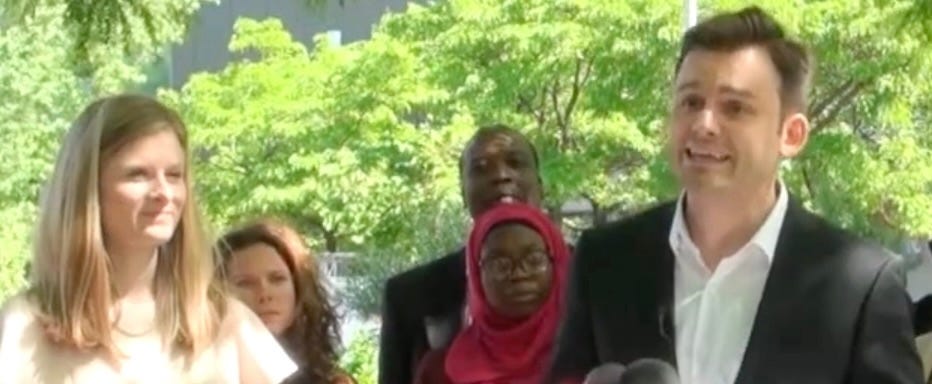
That produces press conferences like this:
Okay, let’s dive in!
Bye-bye, CAQ
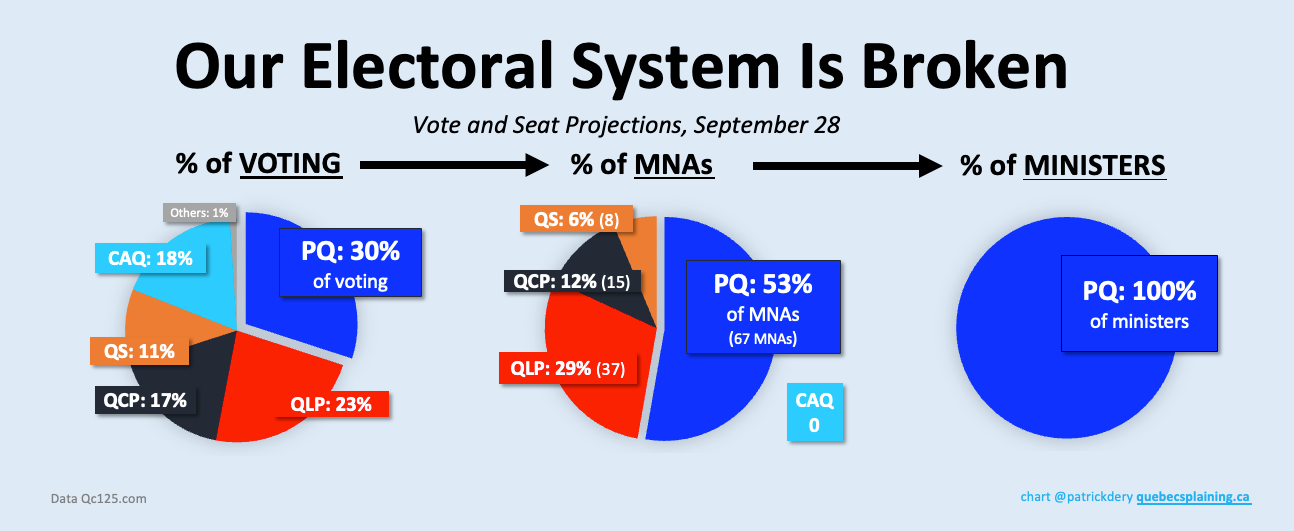
Three polls came out late Sunday or on Monday. All three say the same thing: the PQ could win a majority with 30% of the vote, and the CAQ could disappear.
I’ve written several times about the flaws in our electoral system, which hasn’t changed since the first legislative elections held in Quebec in 1792.
The result we would get if the election were held today shows, once again, that an update wouldn’t hurt.
How do I put this?
It. Makes. No. Effing. Sense.
With less than a third of the vote, the Parti Québécois could hold every lever of political, legislative, and executive power all to itself for four years.
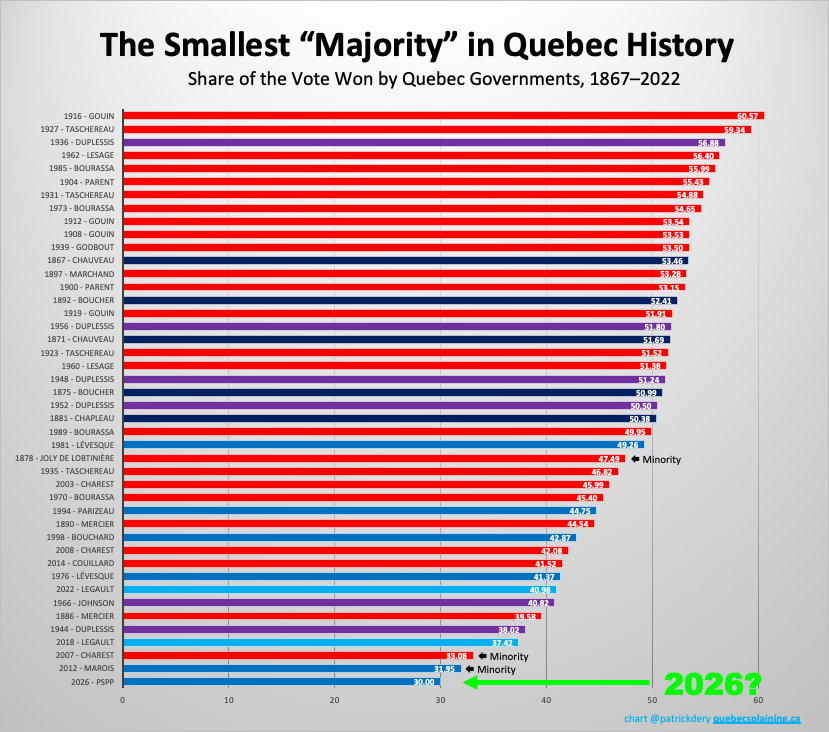
In our entire parliamentary history, only three parties have won a majority with less than 40% of the vote: Honoré Mercier’s Liberals in 1886 (39.6%), Maurice Duplessis’s Union Nationale in 1944 (38%), and François Legault’s CAQ in 2018 (37.4%).
Each time, a strong showing by third parties produced a result our two-party electoral system was never built to handle. Today, five parties have at least 10% of the vote. The system no longer works.
Quebec has also had three minority governments: Joly de Lotbinière’s QLP in 1878 (47.5%), Jean Charest’s QLP in 2007 (33%), and Pauline Marois’s PQ in 2012 (32%).
Paul St-Pierre Plamondon’s PQ could take us into uncharted political territory: a “majority” government with 30% of the vote.
Just to give you a sense of how surreal this is:
I won’t shed a tear for the CAQ, which gave Quebec the two worst terms in its recent political history and is about to be undone by the very thing it profited from.
Its impending disappearance from the National Assembly raises another question: what will happen to its war chest? A party that could have no elected members after the election might still be the richest, at least for a while.
Whoever becomes its next leader won’t be starting from zero.
The weekend and Monday served up a particularly rich political stew. Forgive me for feeding your cynicism. I’m just reporting what happened.
The cost of living, again and again
“The government needs to tighten its belt and give families a break.”
- Éric Duhaime, on 98.5
Every day, Éric Duhaime and other party leaders suggest that Quebecers have become poorer in recent years. Every time, it’s false. Every time, they’re allowed to stoke our frustrations, feed populism, and encourage counterproductive policies that are out of touch with reality.
On average, every type of household is better off than it was in 2019. Every one. Prices have risen, but our after-tax incomes have risen more.
You can still argue for lower taxes. But inventing reasons to cut them is dishonest. It’s also easy and politically rewarding.
Secular Bullsh*t, Part One
Sunday is the Lord’s Day. In this election campaign, this Sunday became the official day of Secular Bullsh*t.
(In case you’re wondering, I’m agnostic, rational to the point of being boring, and constitutionally allergic to being told what to think. You can imagine how little enthusiasm I have for religion, whether in general or in particular. Fundamental rights are another matter.)
Quebec has been broadly secular for 60 years. The last turn of the screw came 30 years ago, when religion was finally removed from schools.
On Sunday, the Parti Québécois pledged to “defend the Quebec consensus on secularism.” That’s the title of its news release. We’re off to a bad start.
The Centre of Excellence on the Canadian Federation compiled the results of several surveys asking Quebecers how they understand secularism as it applies to government employees. The surveys were conducted in 2020, 2023, and 2024.
First question, two choices:
1- The government should remain neutral and ensure that its employees display no religious symbols;
2- The government should remain neutral and not prevent its employees from practising the religion of their choice.
Take 30 seconds to guess how the responses split between the two.
Ready?
Here you go:
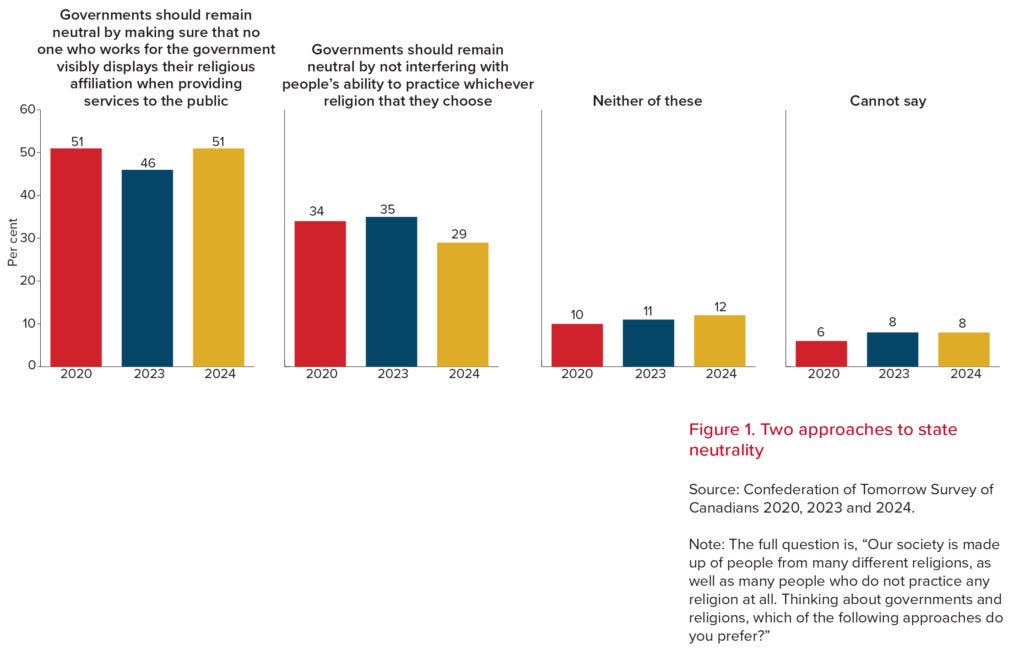
Source: Centre of Excellence on the Canadian Federation
In short, there’s a narrow majority, but no “consensus.” And we’re talking about fundamental rights. (You know, the ones we don’t like seeing a majority trample when they’re ours.)
Second question: Do you agree with banning certain government employees from wearing the hijab?
Take another moment to think about it.
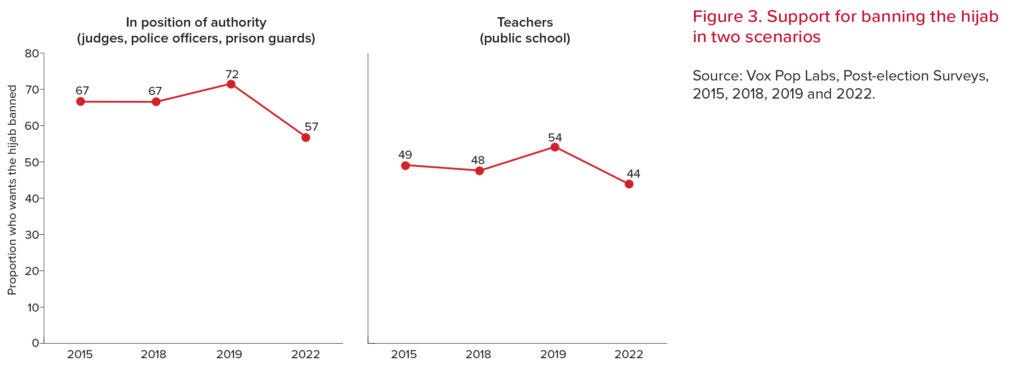
Source: Centre of Excellence on the Canadian Federation
Support is fairly high for people who exercise the state’s coercive power (judges, police officers, and prison guards), which is consistent with the Bouchard–Taylor commission’s findings. Still, we see a drop in 2022, after the issue received more media attention following the adoption of Bill 21. Does the consensus still exist?
For teachers, the average across the four surveys is below 50%. No consensus there, either.
The best is yet to come.
What if there were a dispute over the constitutionality of a law that conflicted with the Charter of Rights? Who should have the final say: the Supreme Court or the National Assembly?
What do Quebecers say?
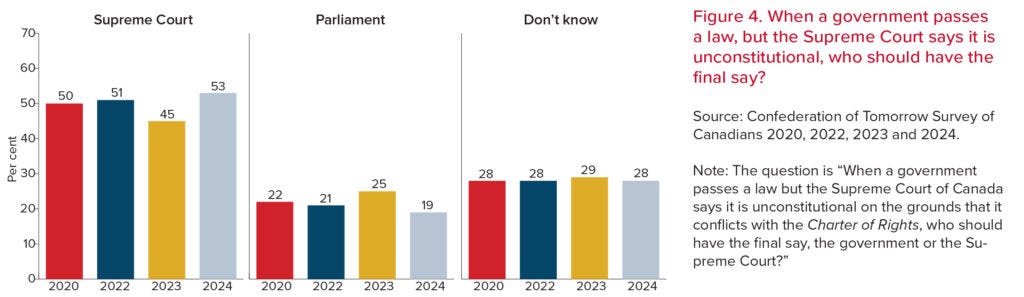
Source: Centre of Excellence on the Canadian Federation
Well, damn. That pesky Supreme Court that always leans the same way.
Boom.

Imagine if a few political leaders weren’t afraid to make a principled defence of fundamental rights.
Other than Québec solidaire, I mean.
Secular Bullsh*t, Part Two
A brief detour before we get to Sunday Night Mass.
In 2016, Paul St-Pierre Plamondon identified the PQ as a political vehicle for his ambitions. After denouncing the party’s “referendum obsession” in his essay Les Orphelins politiques, he got to work.
He launched his leadership campaign in June of that year with a production that would have fit right in with Justin Trudeau’s Liberal Party. Trudeau had become prime minister the year before.
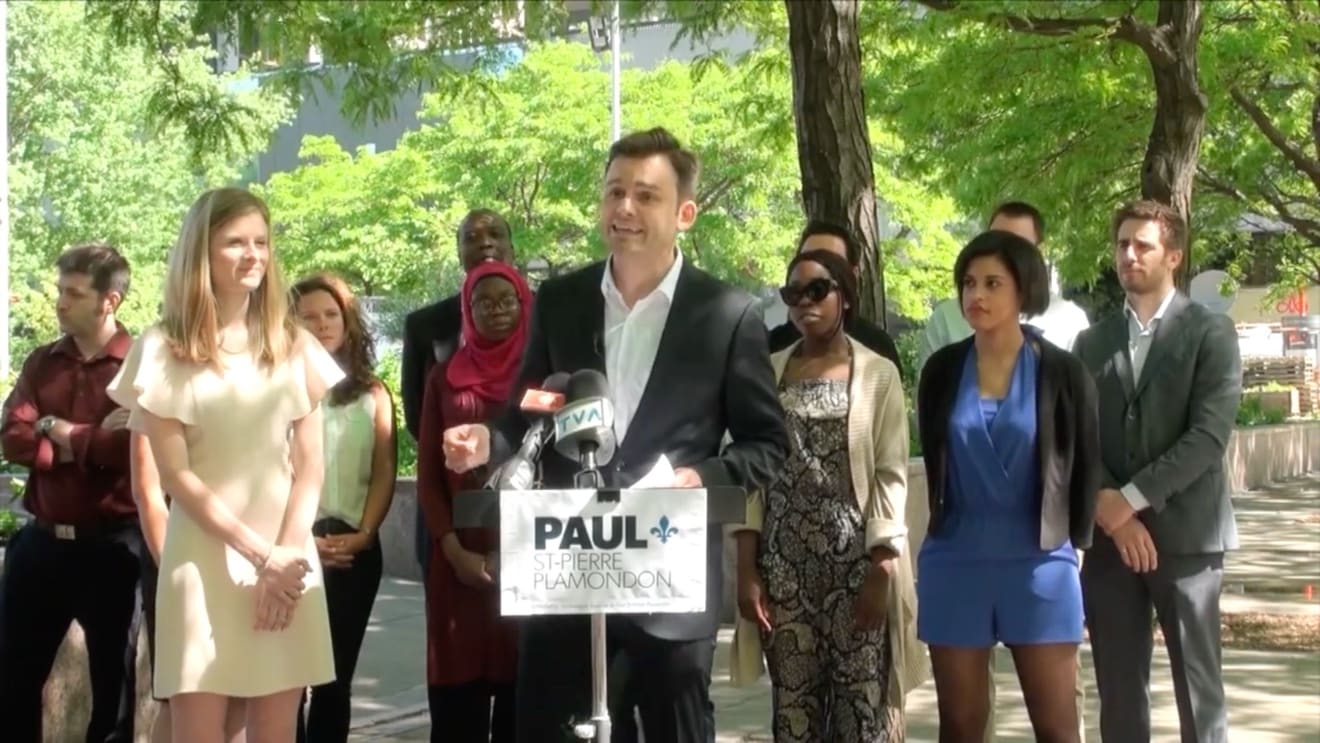
Source: YouTube
On that occasion, PSPP described himself as “a progressive and a democrat.”
He proposed, among other things, that the PQ become “the leader in preventing racism and all forms of discrimination” (at 10:24 here).
(Uncharitable minds might say the wording of that proposal hasn’t changed much. Only the preventing has disappeared. Read the sentence again.)
There was more: “An open, welcoming party that serves those who face injustice, regardless of their mother tongue, regardless of their religion, regardless of their political views.”
(Even artists who congratulate federal politicians? Asking for a friend.)
PSPP also noted how the values charter episode had excluded Quebecers from cultural minorities. His “racialized” friends (a term he wouldn’t use today) had become “allergic” to the PQ and were horrified that he wanted to lead it (at 11:30 here).
(A question, while I’m thinking of it: what do PSPP’s “racialized friends” make of the PQ’s evolution since he became its leader?)
In late August 2016, PSPP publicly debated Mathieu Bock-Côté to defend his principles on fundamental rights. At the time, he denounced “across-the-board secularism” as “a kind of dogma that limits individual freedoms” and championed “the freedom of conscience, the freedom of choice, the freedom to dress as one wishes that defines our democracies.”
Well, yes!
A few weeks later, in September, he explained that “the state has no business intervening, or should intervene as little as possible, in how people dress, except when it raises a societal issue for which there are truly serious, demonstrated reasons.”
Hear! Hear!
Source: YouTube
Fast forward to 2026.
On Sunday, PSPP instead defended Law 94, which bars school volunteers from wearing a hijab. That means mothers can no longer help out at their school’s corn boil. Apparently, overseeing the distribution of corn or butter must be free from divine influence.
Now for the big sermon. On Sunday night, the leaders of the five main parties were invited onto Tout le monde en parle.
The host asked a simple question: are you for or against wearing the hijab in public?
Here’s what happened.
Source: Radio-Canada
PSPP couldn’t even raise his card to show that he had no problem with the hijab in public spaces.
Here’s a cropped version of a photo you just saw.
I’m convinced PSPP hasn’t changed his mind about the hijab.
Know what has changed? The people around him every day and, above all, a segment of voters who are particularly hostile to religious minorities and whose support he wants to keep.
Notice, too, how everyone except Ruba Ghazal walks on eggshells for fear of displeasing the identity-focused voters they’re courting. Even Charles Milliard, the QLP leader, struggles to take a… liberal position.
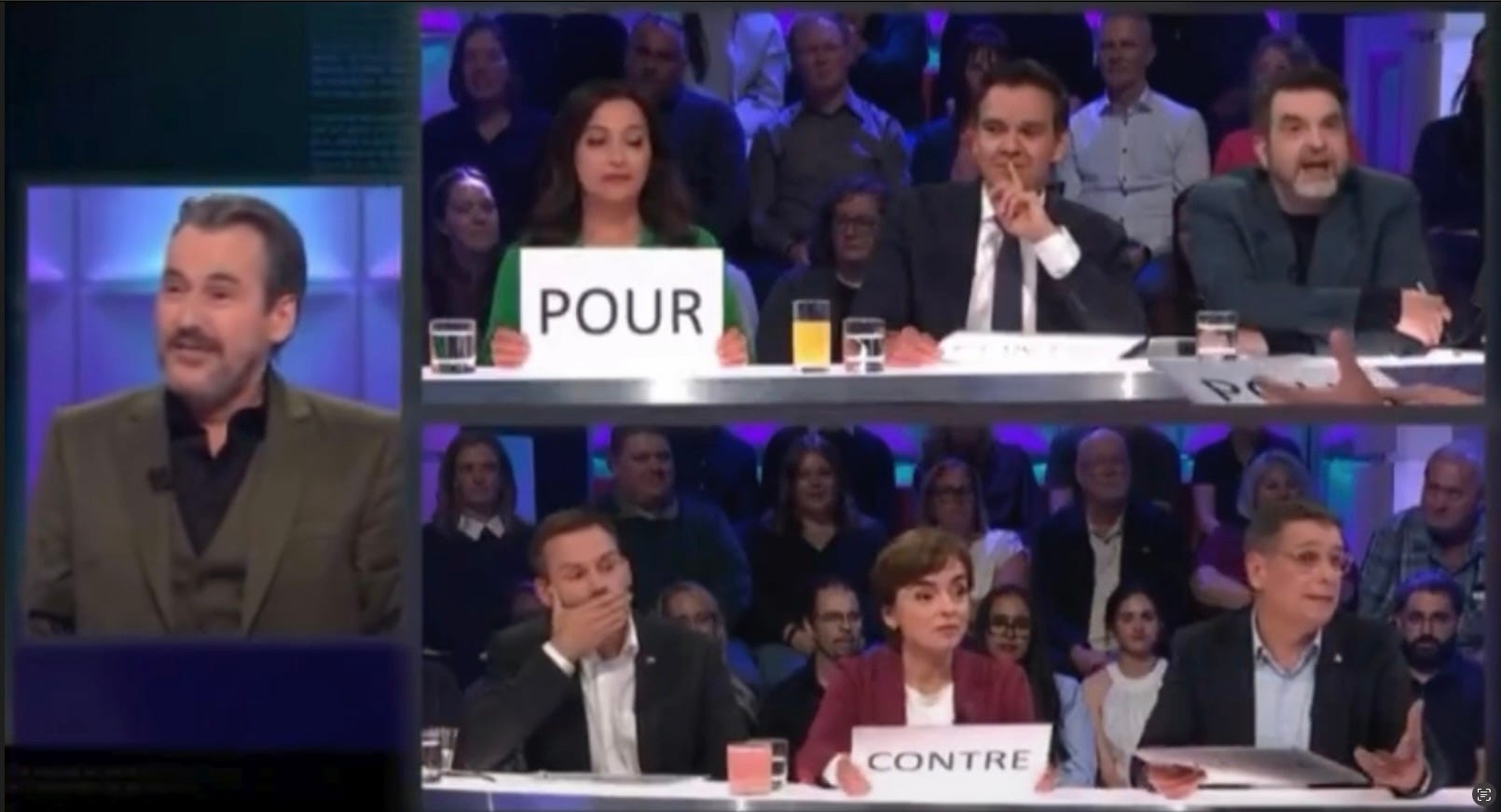
Do I have principles? How many votes might they cost me?
Welcome to Quebec politics in 2026.
-30-
My name is Patrick Déry. I’m a French-speaking Québécois writing for a living, and trying something different here. If you enjoyed reading this text, you can support me by buying me a coffee. You can also subscribe to this media (free or paid, your choice).
Comments, shares, and “likes” are always appreciated. It also helps the Substack algorithm notice me, so don’t be shy!