


(Texte français disponible ici)
It took me a little longer than I’d hoped to get back to writing after the election. On top of the few days off I’d planned and looked forward to, I spent nearly a week battling a nasty case of election flu sinusitis that kept me company every night. The motivation was there; the concentration, much less so. I still made progress on a few things I’ll have a chance to tell you about soon.
In the meantime, it would be unforgivable to let the arrival of the new government pass without comment.
++++++

(Source: Paul St-Pierre Plamondon, on X)
There was jubilation in the air in the Salon Rouge on Thursday as the newly elected MNAs were sworn in.
Tears flowed. Paul St-Pierre Plamondon, making his first appearance as premier, waxed poetic as he recalled the 2022 swearing-in.
“One day, the lily will bloom again,” he had predicted.
Back then, you could count his party’s MNAs on the fingers of one hand, minus two. Today, there are 59.
At the risk of spoiling the moment, I feel obliged to correct my new premier. Quebec’s official flower is the blue flag iris, not the lily. As for the symbol on our flags, it is a stylized representation of the yellow flag iris, which grows, among other places, along the banks of the Lys River in Belgium. The “fleur de la Lys” became the “fleur de lys.”
And honestly, who talks like that?
Perhaps there was a little helium in the Parliament Building’s ventilation system, and Paul St-Pierre Plamondon was drunk on grandeur, right through to the end of his speech.
“Long live Quebec, long live freedom, so long live a free Quebec!”
Charles de Gaulle, get out of that body!
+++++++
It’s fascinating to watch someone lay claim to the nation’s soul when three-quarters of voters voted against his party. At any rate, no one can say PSPP doesn’t see the glass as half full.
Still, you can forgive him for getting carried away when you think of some of the newspaper front pages the day after the election.
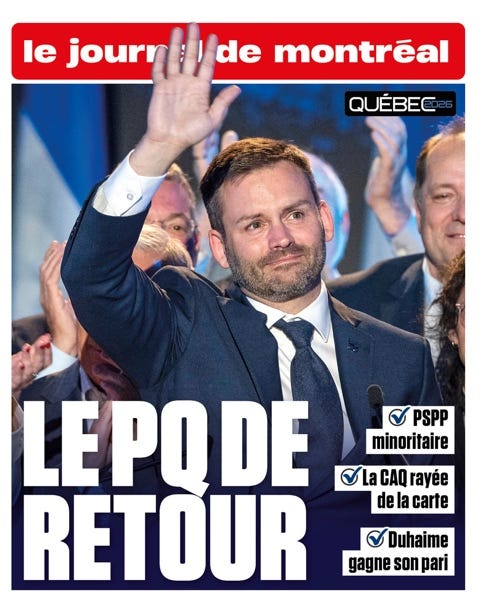
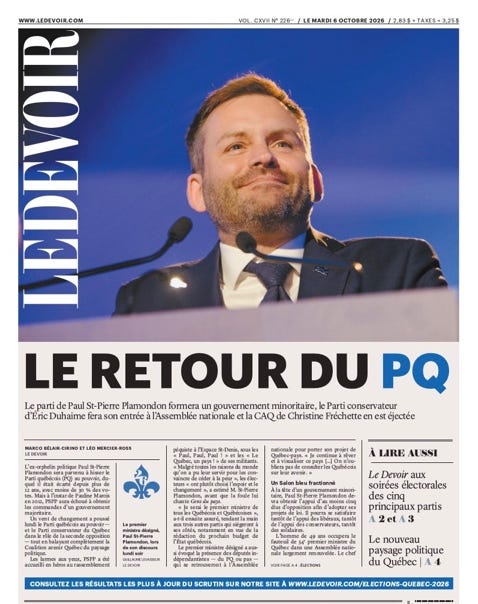
Or, if you prefer:
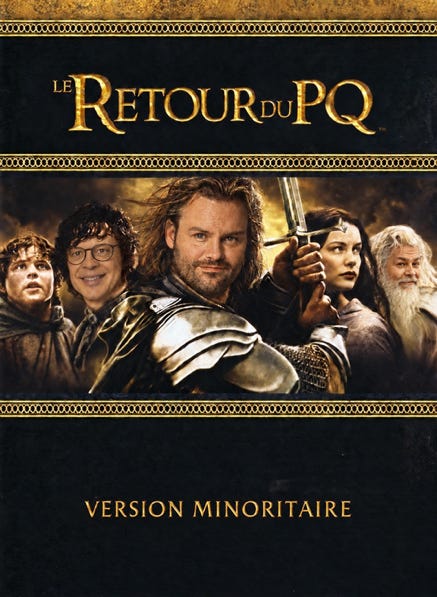
Since someone has to do it, I volunteer to help our premier and his caucus sober up.
Here are the election results again, as percentages of the votes cast. I have a feeling we’ll need frequent reminders.
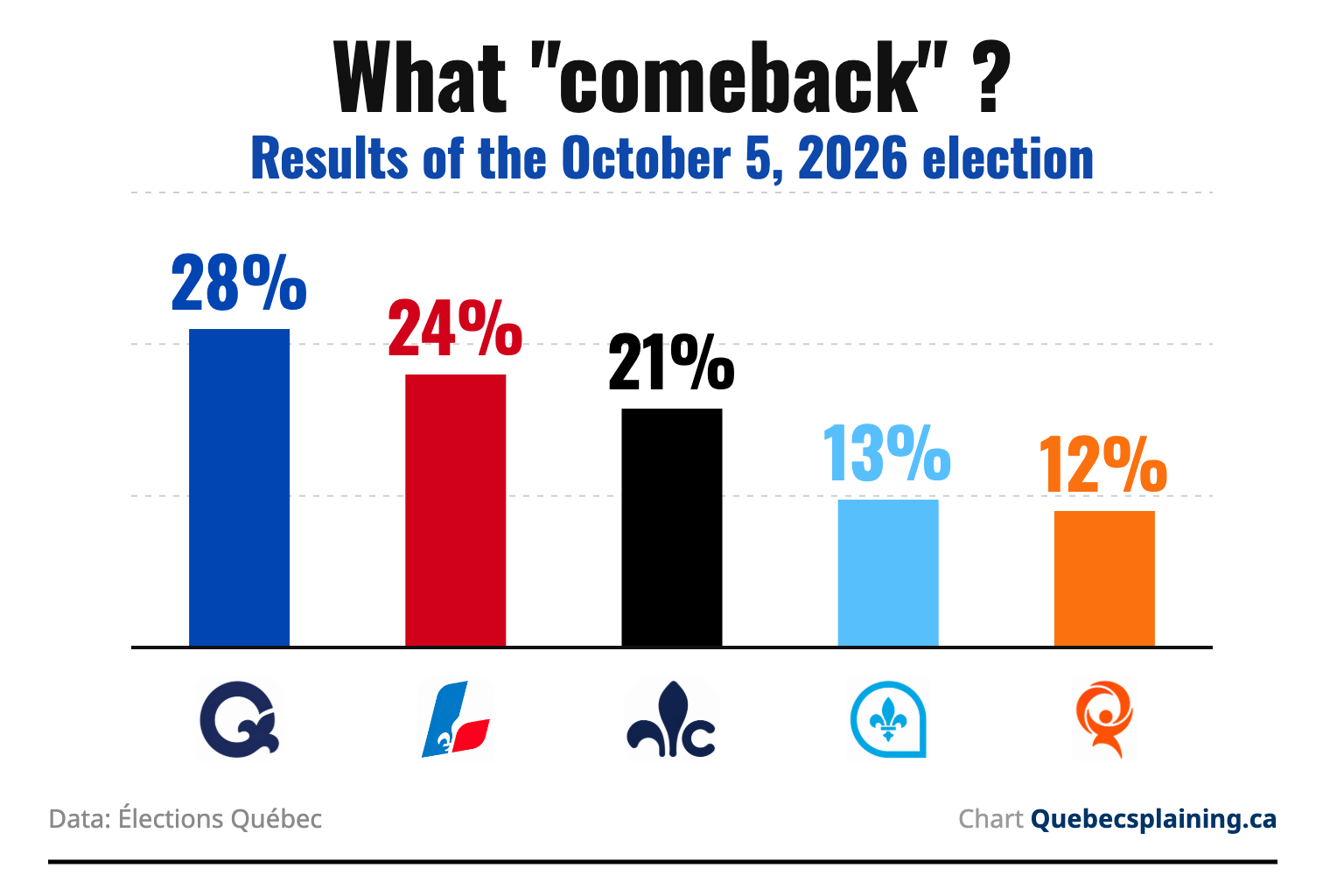
This is a long way from a triumph. If the Parti Québécois came close to winning a majority of seats, it was solely because the vote was so exceptionally divided.
The idea of a “return” is an exaggeration for another reason.
The PQ’s 28% share of the vote is one of its worst results. It’s better than in the last three elections; it’s worse than in the 11 elections before that.
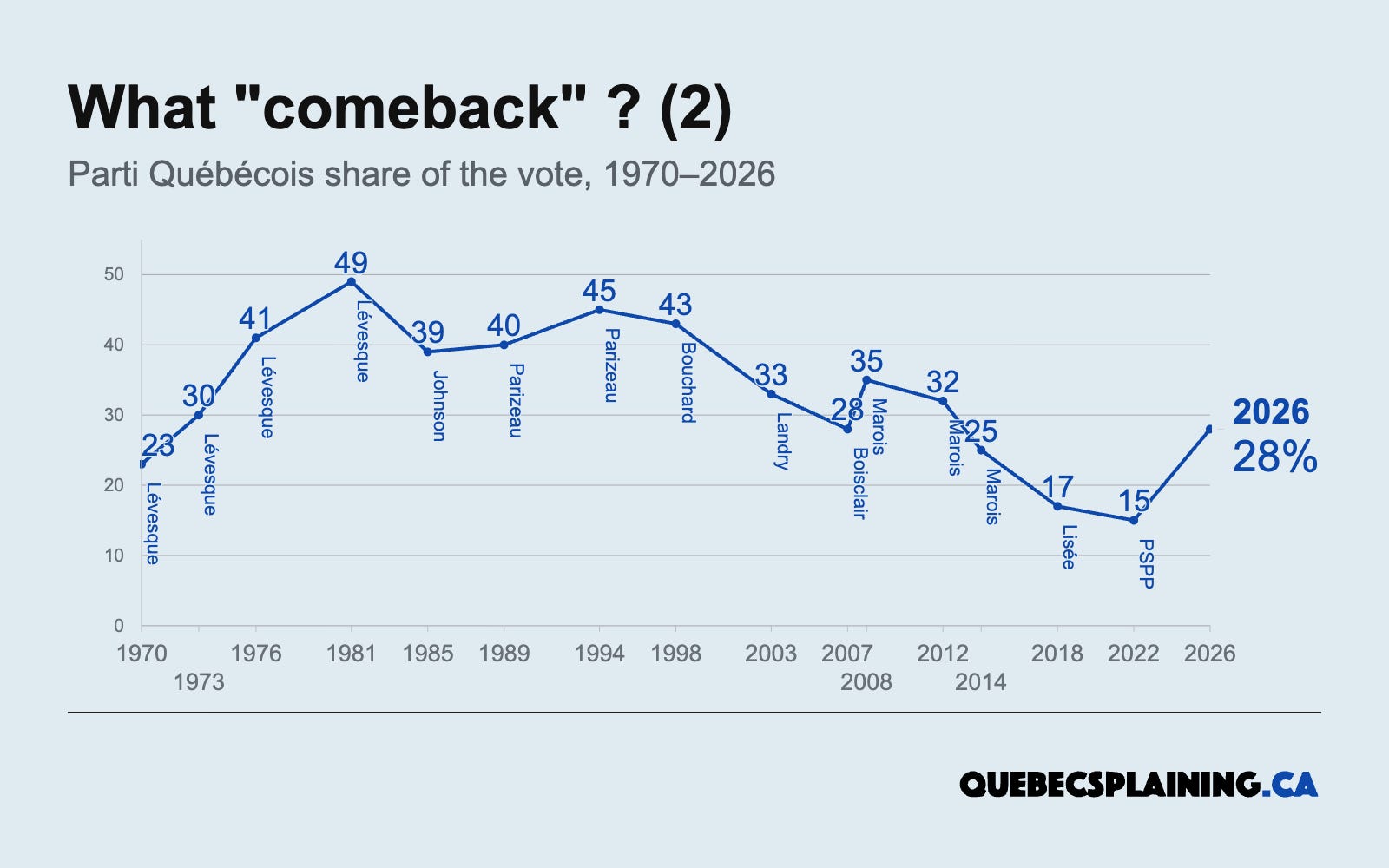
In 2007, André Boisclair’s PQ won 28.4% of the vote, a few tenths of a percentage point more than the 28.0% it received in 2026. The distribution of the vote worked against Mr. Boisclair, however, leaving him with just 36 seats and a third-place finish.
By comparison, with similar support, Mr. St-Pierre Plamondon won 59 seats. Five more, and his party would have formed a majority government.
PSPP also won more seats than Pierre-Marc Johnson did in 1985 with 39% of the vote (23 seats), or Jacques Parizeau in 1989 with 40% (29 seats).
Had the Parti Québécois’s votes translated into seats just a little less efficiently, there would have been no “return.” That’s easy to forget when you only count seats. And headlines fit for a novel are so tempting…
But this isn’t a column about our peculiar and unpredictable electoral system or some of the media’s bad habits.
It’s a column about the kind of magical thinking that says Quebecers were waiting for a PQ government to rediscover that they were sovereigntists, and about the realities of power.
Since launching this publication around the end of last year, I’ve written several times about support for sovereignty, which has been stagnant for 20 years, and about the lack of interest among a majority of Quebecers, who have moved on. I’m one of them.
Each time, on my social media accounts, I’ve received dozens of comments claiming that:
a) Support would rise again;
b) That’s how it was before the 1995 referendum;
c) Polls don’t accurately measure public sentiment;
d) Polls are rigged.
Let’s set option d) aside. The first three reflect the same euphoria that grips the most fervent sovereigntist activists, including members of the new government.
It’s also the fundamental premise of the PQ’s strategy in recent years, which the premier spelled out in his speech in the Salon Rouge.
“We will regain control of public finances by cutting waste and bureaucracy. (…)
Finally, we will refocus the state on its core missions: caring for our people, educating them, and protecting them and our culture. Cutting homelessness in Quebec by half.
We will get Quebec back on track, get our house in order, so we can once again have confidence in our state and our government.
Regain confidence in our ability to solve our problems collectively. Believe that it is once again possible to accomplish great things.
At that point, we will be able to resume the essential discussion about our national future. We will be able to resume our march towards normality, towards being a normal nation that looks after its own interests.”
Step 1: We solve the problems. Step 2: Quebecers rediscover their appetite for sovereignty. Step 3: We talk about it, and it happens.
That’s optimistic. In terms of public policy, the PQ government elected in 1976 is considered one of the best in Quebec’s history: the Charter of the French Language, political ethics reforms, the creation of the public automobile insurance plan, agricultural zoning, an overhaul of the Consumer Protection Act, and so on.
In the 1980 referendum, Yes won 40%.
Lucien Bouchard, hailed as a saviour after the 1995 referendum, also led a transformative government: the introduction of a public drug insurance plan, the establishment of a subsidized child care network, the expansion of parental leave insurance, and so on.
Yet Mr. Bouchard, a charismatic and popular politician, failed to move the needle despite facing a generally unpopular Jean Chrétien. Faced with Quebecers who were “indifferent” to “federal offensives,” he resigned. The third referendum never happened.
Unlike Lucien Bouchard, who practically walked on water, PSPP is loved above all by his own base. Quebec’s most popular politician in 2026 is Mark Carney.
That’s a lot of hills to climb.
There’s still the hope that “it’s like 1995.”
The argument goes like this. A year before the 1995 referendum, and a month before the 1994 general election, support for sovereignty hovered around 30% to 35%. A year later, Quebec came within a few tenths of a percentage point of becoming a country.
Once again, we’re back to banking on a swing in the public mood for lack of a lasting groundswell of support.
It’s terribly short-sighted. Ask the British. It’s also incorrect.
Here’s a chart I’ve shown a few times before and explained in detail here. It compiles Quebecers’ responses to more than 900 questions about their support for Quebec independence in one form or another over the past 50 years.
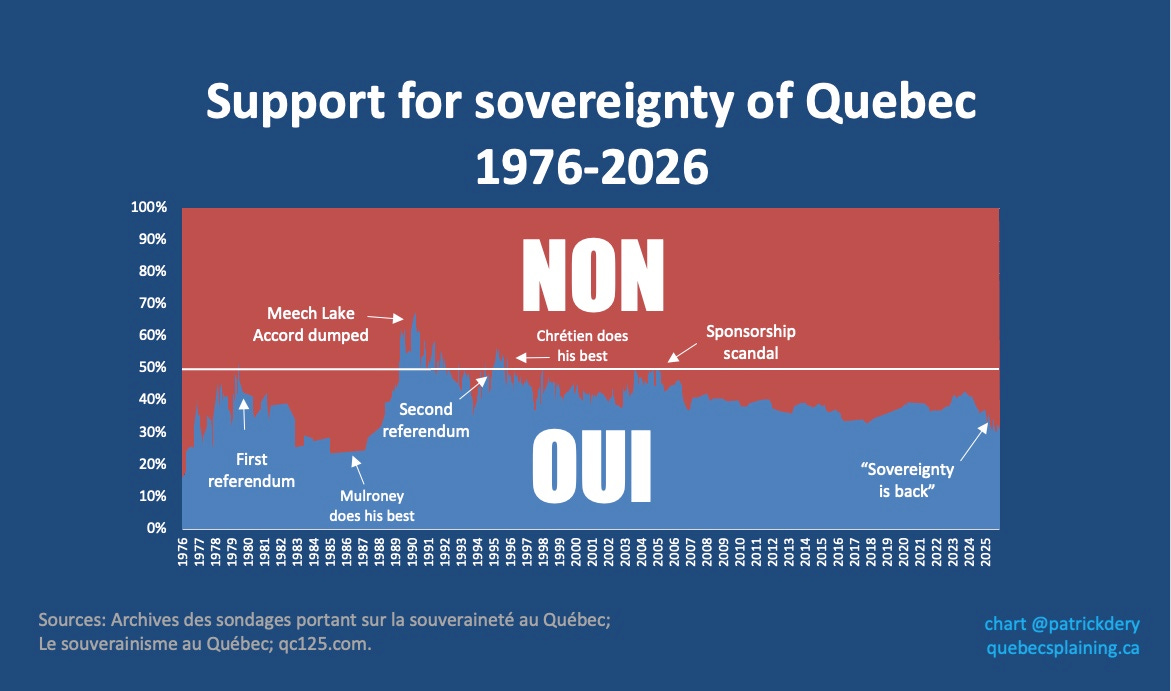
It’s true that support for sovereignty hit a low point a year before the 1995 referendum.
But that overlooks two things.
First, the dip to around 35% was very brief, essentially confined to the 1994 election campaign and the weeks that followed. By the end of the year, Yes was approaching 50% again.
Second, that low point had been preceded by historically high support for sovereignty. From early 1990 to late 1992, nearly three years, Yes had majority support almost the entire time, peaking at 70%.
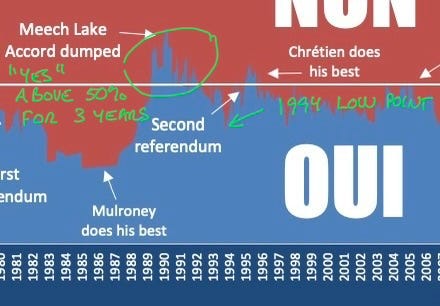
By comparison, current support for sovereignty, at 30%, is lower than ever. It also follows 20 years of stagnation for the independence movement.
Without explicitly saying so, Paul St-Pierre Plamondon may have acknowledged that reality.
When he talks about cutting bureaucracy, providing health care and education, halving homelessness, and “getting Quebec back on track, getting our house in order so we can once again have confidence in our state and our government,” PSPP isn’t describing a 24-month window that would take us to early 2029.
He is instead laying the groundwork for a larger undertaking, an agenda for a full term in office. Its success is a necessary condition for “regaining confidence,” and that confidence is itself a prerequisite for holding the national discussion and seeing it through to its conclusion.
Consciously or not, the PQ leader is quietly setting the stage for postponing the referendum. That has seemed inevitable for a long time. Now that he’s in power, it may be easier to admit.
In the meantime, let’s wish him luck all the same. Whatever our partisan preferences, his successes and failures will also be ours.
-30-
My name is Patrick Déry. I’m a French-speaking Québécois who writes for a living, and I’m trying something different here. If you enjoyed reading this article, you can support me by buying me a coffee. You can also subscribe to this publication (free or paid, your choice).
Comments, shares, and “likes” are always appreciated. They also help the Substack algorithm notice me, so don’t be shy!