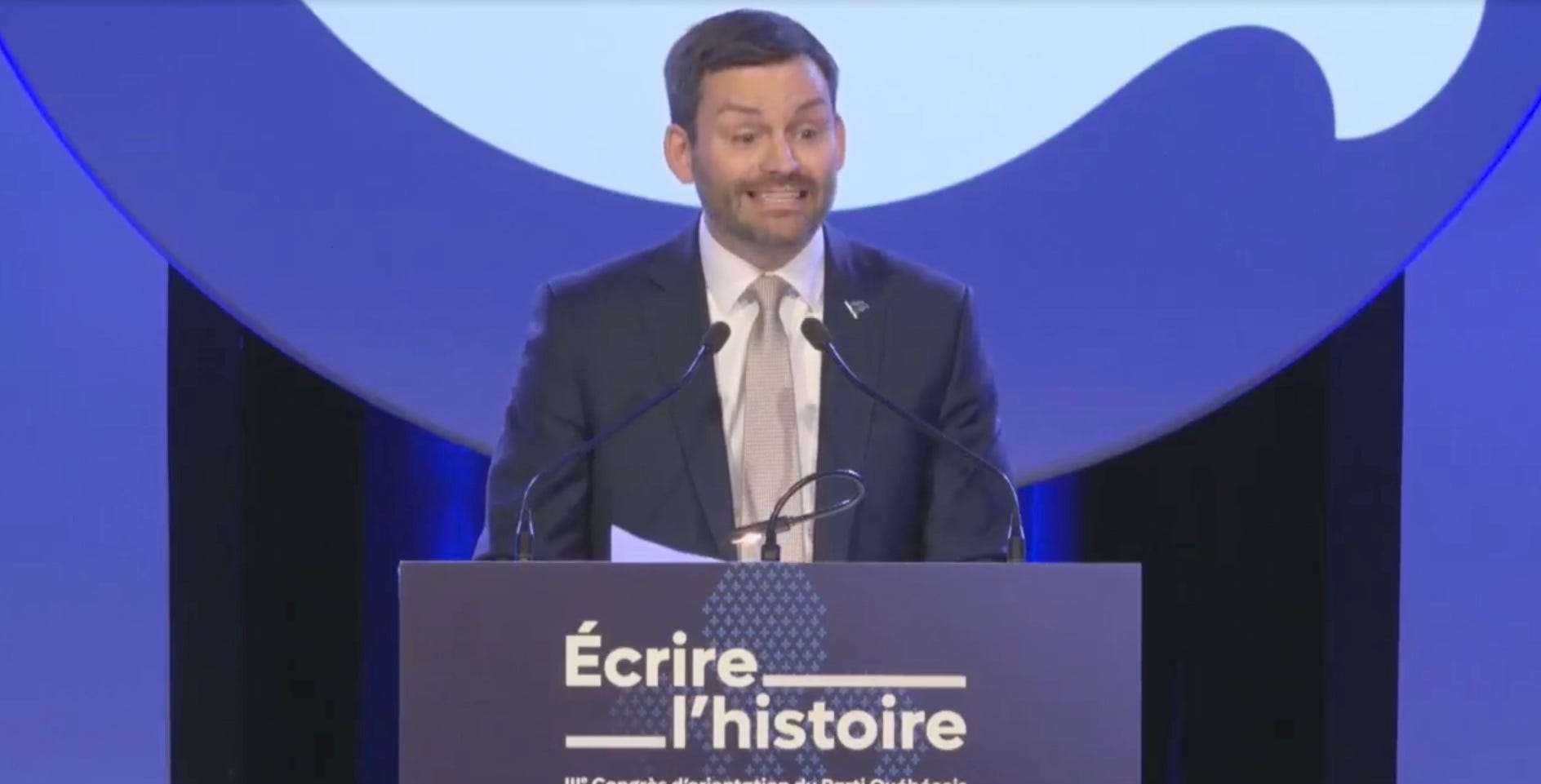
Paul St-Pierre Plamondon's somewhat cringey response to Mark Carney regarding the Battle of the Plains of Abraham (part 1)
It’s 1759 all over again.
There has been a lot of talk about Paul St-Pierre Plamondon’s closing speech at the Parti Québécois convention, but I couldn’t find the text anywhere. Since words fly away, I have transcribed the speech below. (Sorry for the delay, it took a while.)
Almost everyone agrees that using the Battle of the Plains of Abraham to celebrate the birth of the idea of Canada, as Mark Carney did, was way off the mark. But Plamondon himself went too far. I’ll let you discover for yourself where he goes wrong.
Personally, I found his response to Carney smacked of a slightly paranoid echo chamber that hadn’t had its windows opened in a long time. Note that speeches at political rallies—of all stripes—are aimed at a specific audience. That may be fine for activists, but play it to the average Joe, even a sovereigntist, and many will tune out.
You will find the full text below, interspersed with comments when the rhetorical flourish strayed a little too far from reality. (I ended up making a lot more comments than I initially intended. Blame it on St-Pierre Plamondon.)
What particularly annoys me is the refusal to accept that a society, a country, can change. The Canada of 2026 is not the Canada of 1867, let alone the British regime of 1760. Listening to and then rereading the speech, I was left with the impression that the only goal was to justify a conclusion that had already been decided. In my work, which is generally supported by data, I tend to do the opposite.
It’s also funny to hear all this coming from someone who once called himself a “disappointed federalist.” Clearly, the disappointment has grown since then.
In any case, here it is, so you can make up your own mind. And my apologies for the excessive use of nuances and corrections.
********
My dear friends,
Last Thursday, in Québec City, and more precisely, at the site of the Battle of the Plains of Abraham, Mark Carney decided to launch the referendum campaign.
It was clearly as leader of the NO camp that he chose, at the very site where British colonial rule over the French and Indigenous peoples began, to use the same technique that was used to prevent the emancipation of Quebecers in the last two referendums, the same technique that has been used for centuries and is at the heart of colonialism, that of lies, of crude and shameless lies uttered with all the confidence and smugness of someone in a position of colonial domination.
Note from Patrick: Is Mark Carney “in a position of colonial domination” over Quebec? That’s a strong start!
The Liberal Party of Canada received 43% of the Quebec vote in the 2025 election, more than any other party. Together, the federalist parties received 73% of the vote in Quebec. The Bloc Québécois got 27%.
Since 1968, the Prime Minister of Canada has been a Quebecer most of the time: Trudeau, Mulroney, Chrétien, Trudeau Jr. (who crossed the Ottawa River at age 12 and attended high school and the rest of his studies in Quebec). Even without including Paul Martin, who grew up in Ontario but represented a riding in Quebec, the position of Prime Minister of Canada has been held by a Quebecer for 44 of the last 58 years. Who dominates whom?
If we go back further, we can add Louis Saint-Laurent (9 years) and Wilfrid Laurier (15 years). In its current form, Canada has existed for nearly 159 years. A Quebecer has led the country for a total of 68 years. Other provinces might be jealous.
The current Chief of the Defense Staff of the Canadian Armed Forces is a Quebecer. The Chief Justice of the Supreme Court is a Quebecer. Three other judges on the court were born in Quebec, making a total of four. Out of nine! That’s not counting ministers and senior officials throughout the federal government.
Furthermore, Quebecers have discussed and voted between themselves leaving the federal system, which shows that this “domination” is fairly flexible. And they have voted twice to remain part of Canada. Even today, the NO vote would be… dominant.
So this is a rather consensual domination, isn’t it?
PSPP: The defeated always have a better memory than the victors, who strive to make people forget the past. This quote is from René Lévesque. And it predates the founding of our party. The year was 1951. So, the start of the NO campaign on Thursday has the merit of clarifying what will happen next.
Patrick: It seems fairly premature to talk about the start of the NO campaign. I understand that the PQ has promised a referendum before 2030, but right now, it is still the third opposition party in Quebec’s National Assembly.
PSPP: A new political cycle has indeed begun. A new chapter in our history is opening up before us. We are no longer the only ones who see it, hear it, and understand it, starting with the Liberal Party of Canada, obviously. Around us, in conversations with friends, our parents, our loved ones, everyone knows that we are on the eve of a decisive moment for our collective future.
Patrick: I don’t know if Quebecers “know” it, but according to Léger, only 28% of us want a referendum by 2030. That means that even people who are prepared to vote for the PQ don’t want one.
PSPP: But here, in the clear and shared understanding that if nothing changes, our language, our culture, and our unique, specific Quebecois way of seeing the world risk a long and painful decline that leads straight to extinction.
Patrick: There’s no need to be so gloomy. The number of Quebecers whose mother tongue is French has been increasing in absolute terms since… forever. The proportion of Quebecers whose mother tongue is French has declined slightly over the past 100 years, but English has declined even more, to the benefit of “other” languages. In fact, compared to English, French has grown in Quebec. The first language spoken by Quebecers remains French, and the proportion has remained essentially stable for 50 years. I explain all this in this text, accompanied by some really neat charts. You should read it, Paul.
PSPP: With the arrival of this new cycle, the NO camp realizes that it cannot rely solely on what it has been telling us for 30 years, namely that no one cares about the fate of Quebecers. This idea that these are old quarrels no longer holds water. So, they are turning to a lie that has been used very often in our history, one that is at the heart of British colonialism. This lie is that Canada is a respectful partnership that benefits Quebec.
Patrick: A “lie”, or simply a point of view? One may disagree, and Canada will always have room for improvement, but the majority of Quebecers are comfortable with this partnership, or at least do not find it too disrespectful: for 50 years, the NO vote has almost always been in the majority in Quebec, including during the last 20 years.
PSPP: In this new cycle, the yes camp, the camp of Quebec as a country, must, therefore, be the camp of truth and hope. The hope that, in the face of lies and abuse of power, justice will ultimately prevail and the quest of a people, the quest of the Quebec people, this quest that simply consists of existing, will be fulfilled.
Patrick: “Justice will ultimately prevail”? “A people’s quest that simply consists of exist?” It’s a bit melodramatic. Quebecers have “existed” for over 400 years, Quebec has had its own government and institutions for 160 years, and, as mentioned above, Quebecers are well represented in federal institutions. Moreover, the House of Commons recognized in 1995 that Quebec is a distinct society, and in 2006, that it forms a nation. And this is now enshrined in section 90Q.1 of the Canadian Constitution, courtesy of the CAQ. I think we can say that we “exist!”
PSPP: Like any normal people with their own democracy, like any other people in the world, a quest that began with the Patriotes, that this quest will finally find its meaning.
Because history must not only be respected. In the sense that it should never be tampered with or distorted. But history must also find its meaning. There must be meaning. Our motto in Quebec is “I remember.”[Je me souviens] But what good is remembering if our memory leads to our decline and then our disappearance, precisely by those who are obviously working today to erase our memory?
Patrick: I agree that history must be respected. Since we are talking about the Patriotes, I would like to take this opportunity to point out that among the Patriotes of Lower Canada—today’s Quebec—there were also English, Irish, and Scottish people. They were not fighting against the federal government, since it did not yet exist, but against the British Crown. Francophones and Anglophones fought together for a republic where everyone would have the same rights, regardless of their origin or religion. We were a long way from the Charter of Values or Bill 21!
That being said, who is “obviously working to erase our memory”? Unless they hire an army of Messmers [note : a popular stage hypnotist in Quebec], they’d better get up early. Because between the piles of books, films, documentaries, podcasts, and Wikipedia pages that recount pieces of Quebec’s past, plus the politicians and columnists who keep bringing it up, it’s hard to ignore.
PSPP: If we go back to Mark Carney’s speech in Québec City, on the Plains of Abraham, I apologize, I never thought I’d have to say this. But no, the Plains of Abraham are not the birthplace of a united Canada. I... [the audience stands and applauds] The Plains of Abraham have never been a symbol of a supposed partnership or collaboration either.
Patrick: The exact quote from Mark Carney’s speech is: “The Plains of Abraham symbolize a battlefield, and also the place where Canada began to make the historic choice to favour adaptation over assimilation, partnership over domination, collaboration over division.”
I agree that this is historically inaccurate. The Battle of the Plains was just that: a battle, and in a battle, one side seeks to impose its will on the other at the point of a sword or a gun. There was no question of “partnership” on the Plains in September 1759.
On the other hand, the fate of French America was decided later, by the Treaty of Paris in 1763, and not during what is known in Quebec as the “Conquest.” France ceded New France because it was more interested in recovering and preserving its possessions in the West Indies. It could have ended differently if France had really cared about New France.
Returning to Carney, if he had wanted to name a moment that saw the beginning of an opening toward “adaptation rather than assimilation, partnership rather than domination, collaboration rather than division,” the Quebec Act of 1774 would have been a better choice. Quebecers were then recognized for their language, religion, and laws. There was still a long way to go, but the reference would have been more appropriate.
But apart from the brain cramp about the Battle of the Plains, Carney’s speech is explicit about the contribution of French Canadians, and later Quebecers, to the building of what eventually became Canada. He names the dark periods without embellishment: “The usual scenario of conquest: the vanquished are assimilated, their language suppressed, their faith forbidden, their laws replaced. This is what conquerors have done for millennia. From the Great Deportation of the Acadians to the Durham Report following the Patriotes Rebellion, some have sought to impose this model: assimilation, the usual logic of conquest.” It is difficult to criticize Carney for glossing over the less glamorous parts of Canadian history.
PSPP: [The Plains of Abraham] are rather a clear symbol of the domination of one people over another. That’s all! With all the loss of freedom, respect, and self-esteem that comes with it. And in that sense, it is a symbol for us of a long, unfinished struggle to regain that freedom, respect, and self-esteem.
Patrick: Paul, you may be idealizing the French regime. New France was linked to France, but it was not a democratic state. Neither was France. It wasn’t until 1792 that the first election was held here, and that was granted under British rule. Given what happened after the French Revolution, it’s reasonable to think that it might have taken until around 1850 to have elections here if France had retained its colonies in North America. (In France, they took place in 1848.)
As for “respect” and “self-esteem,” Quebecers have made a lot of conscious political choices since over the last 250 years. If anyone still has nightmares about the Battle of the Plains, the cure may not be political…
PSPP: Mark Carney chose to quote Charles Taylor in his speech. Essentially, he explained that, according to the philosopher Taylor, we are all like blank pages. So, over time, on that blank page, we can rewrite history, and that leads to collaboration. I will first quote Pierre Falardeau, who studied Charles Taylor.
Patrick: Just to clarify before you quote Falardeau, Carney didn’t say that, and neither did Taylor. Here is Carney’s quote from his speech: “Canadian philosopher Charles Taylor argues that, fundamentally, human beings are not blank slates, but that our identity, both personal and national, is constructed through history. That the past has sedimented into the present. That our choices are shaped by what came before.” It seems that, on this point, you, Taylor and Carney seem to be pretty much agreed.
PSPP: The problem with Falardeau’s quotes is that they are often “spicy.”[meaning: the guy used to swear a lot] But I apologize in advance. I’m going to quote him in full as he said it. As we say in Quebec, hold on to your hats. “Today, we’re missing the point. We’re faced with a society dominated by another, occupied by another; it’s that simple. And that’s been humanity’s problem since the beginning. But that’s it. You have philosophers like Charles Taylor who come and talk to us about identity. Who [swearing – it’s not translatable]? It’s not a question of identity, it’s a question of theft, theft of things.”
Patrick: Now it’s an “occupation”? Where? Are there soldiers on the streets? French people who actually lived through the occupation during World War II might think we’re exaggerating a bit.
As for “theft,” again, let me remind yourself that France ceded New France to England by treaty, preferring the Caribbean to our acres of snow (thank you, Voltaire!). In a way, that might hurt even more. But there was no “theft.”
PSPP: There are clearly fans of Pierre Falardeau [in response to applause in the room]. Pierre Falardeau is certainly colourful, but he’s full of truth. To which I would add what I have to say about this and what I think about it. I’ll go further. Not only should the idea that we are blank pages never be used to falsify or rewrite history, but this idea of a blank page that would allow a new partnership to be established can only be an intellectual deception when we see that history repeats itself.
Patrick: Taylor said exactly the opposite about the blank page…
PSPP: And that’s the key. So, let’s review the facts together and then see how history repeats itself and that there is a problem, an issue. It repeats itself with incredible consistency. Let’s go back to the beginning: the Plains of Abraham.
Let’s look at the work of historian Éric Bédard, who reviewed General Wolfe’s correspondence. It’s important to note that, at that time, England was suffering military defeats at the hands of the French Canadians. Those who are now Quebecers had won a number of battles, which led General Wolfe to describe Canadians, or Quebecers at the time, as “vermin.” He wanted to avenge the defeats against that vermin, writing that he wanted to leave behind famine and desolation. The result at the time was burned farms. People hiding in their basements or in churches that would burn down in circumstances that would cause them to die in rather horrific circumstances.
And then some people will respond to that: “Yes, yes, but that was in 1759. It’s not the time anymore to bring up those facts.” I’m not mentioning this to victimize anyone, to victimize myself at all. I’m just saying… No sensible, honest person can conclude on that basis that this is the foundation for collaboration and partnership. It’s not possible. [Everyone stands up again.]
Patrick: It’s a bit baffling how political supporters applaud when you remind them of the worst moments of our ancestors. Is the next referendum going to be about the Battle of the Plains of Abraham or about the type of society we want to live in?
PSPP: Some will say yes, but that was in the beginning. Over time, things have improved and changed. Okay. Let’s take a moment to look at the Patriotes’ revolt, which happened much later. And the deadly repression that we’re really talking about.
Patrick: In 1837, 1838, and 1839.
PSPP: We can also look at the conscription crisis, when the Canadian army came to shoot at our people in Quebec City.
Patrick: In 1918.
PSPP: Let’s start with the deportation of the Acadians.
Patrick: In 1755.
PSPP: Or should we take Louis Riel and the Métis?
Patrick: In 1885.
PSPP: Should we take French schools, which were banned in order to assimilate…
Patrick: In 1916. (In Manitoba.)
PSPP: …following Lord Durham’s strategy?
Patrick: In 1839. I think I detect a pattern here… We talked about the Patriotes earlier. That was before the Confederation. People close to the Patriotes (Lafontaine, Taché), even former Patriotes (Cartier, who had to go into exile) contributed to the achievement of responsible government and eventually to the march toward Confederation, together with English Canadians. Yet they were the first to witness the abuses of the British regime and the repression that followed the rebellions. But they concluded that it was possible to move forward, and they did so.
The deportation of the Acadians: that was almost three centuries ago. The Acadians themselves have moved on. Many have served as politicians, some in the current federal government. One of them even became the Governor General of Canada, representing the British Crown in the country! Can we leave them out of all this? I’m not sure they would agree to be used for our political purposes.
Conscription and the shooting of protesters in 1918, four of whom died: I won’t defend that, but it was a little more complicated than “the Canadian army came and shot our people.” See the book by historian Jean Provencher.
Nor will I defend the treatment of Louis Riel, who was executed by an openly racist government in 1885. But a hundred years later, in 1992, the House of Commons recognized Riel as the founder of Manitoba. In 2017, the Chief Justice of the Supreme Court said that Riel had not received a fair trial. Last November, on the 140th anniversary of his death, Mark Carney paid tribute to him. This is a far cry from John A. MacDonald, who endorsed Riel’s hanging.
Durham: yes, he wanted and recommended our assimilation, but it didn’t work. Quebec has now 8 million French speakers. On the other hand, Durham also proposed the establishment of a responsible government. And he would be turning in his grave at 100 miles an hour if he knew that “the people without literature and without history” had produced so many Canadian prime ministers. I would say that Durham lost and we won.
PSPP: But that’s not all, because there’s someone who will tell you, who may come and tell you, who will quote Justin Trudeau. They’ll tell you, well, because it’s 2026. Do you remember that?
Patrick: Trudeau didn’t say that, because he resigned in early 2025. The exact quote was, “Because it’s 2015,” and it was in response to a question about gender parity in his cabinet. Personally, I have a hard time being against that, whether it’s 2015 or 2026!
PSPP: He’s going to say, “That’s old news, it has no resonance or impact today. Everything has changed.” Is that really the case? Here, in the Parti Québécois, in the 1970s [during the October crisis], can we mention that all our information was stolen and that members were arrested for no reason? Poets, intellectuals, people arrested in complete violation of the rule of law? What is that if not subordination and repression?
Patrick: It was. But the Prime Minister of Canada at the time was a Quebecer. It’s hard to blame that on the “British colonial regime.” History is complicated. I would also make a distinction between isolated incidents, even serious ones, and a system of continuous repression, as in colonial India or apartheid South Africa. We’re not going to compare Quebec with India or South Africa, are we?
PSPP: What was the repatriation of the Constitution in 1982?
Patrick: An unacceptable change of rules in the middle of the game without the agreement of all the players. Nevertheless, to this day, a majority of Quebecers consider that this is not enough to leave Canada.
Perhaps this is because the country has changed since 1982: Quebec’s distinct character has been formally recognized by the Federal Parliament, as has the fact that Quebec is a nation. Quebec has gained powers in immigration. The right to opt out of federal programs is becoming increasingly formalized (federal politicians have apparently realized that this can help them get re-elected). In short, political reality has ended up achieving many of Quebec’s constitutional objectives. To quote Falardeau again: “Oxen are slow, but the earth is patient.”
PSPP: How would you describe Justin Trudeau’s policies?
Patrick: Misguided? But it’s not just in Quebec that people think that! By the way, Quebec’s premiers haven’t always been unanimously supported either…
PSPP: Over the past ten years, even though he knows full well that his immigration strategy, in particular, will cause a major housing crisis, as his own officials have told him, he is proceeding anyway, knowing that Quebecers are strongly opposed to it. In what universe would you call that collaboration?
Patrick: There has been a housing shortage in Quebec for about 20 years, including in regions where there is little or no immigration. Our public policies are, therefore, also part of the problem. Also, Trudeau is not pursuing anything as he quit a year ago. Since then, Ottawa has completely reversed its immigration policies.
PSPP: So that’s it. In light of our history, I am compelled to ask the following question, and I ask it in front of all Quebecers who are wondering about our future and the significance of this event.
Patrick: Not the Plains again…
PSPP: How can we explain that the Prime Minister of Canada, Mark Carney, can show up on the Plains of Abraham and tell us such a blatant lie? Are we dealing with a total lack of intelligence? Or a total lack of knowledge? Even though he is the Prime Minister of Canada, he would have no knowledge of Canada? I don’t believe that for a moment; I respect his intelligence.
Patrick: That’s a good one, a bit like Julius Caesar praising his enemies before saying he had defeated them soundly. Nice.
PSPP: I think Mark Carney is an intelligent man who is part of a long line of colonialists who apply the techniques of British colonialism point by point, techniques that have been known and applied around the world for centuries. British colonialism is based on the idea of leaving a certain amount of power to the population that is dominated.
Patrick: Paul, I don’t know about you, but I can’t name a single British colony that had a parliament elected by universal suffrage, its own courts, independent media, and the opportunity to vote twice on its political destiny during colonial rule. Or under any other empire, for that matter.
***
Well, that’s all very well, but this is getting a bit long, and I’d hate for you to get a tendonitis if you’re reading this on your phone. To be continued tomorrow!
-30-
This text is just under 4,400 words, or about 18 pages of a book. The first draft of the speech transcript was done using software. Editing the transcript, fact-checking, and writing more or less impertinent comments took me about three four days, including the second part (please see next post, should be online by Sunday morning). It also left me with a constitutional headache.
My name is Patrick Déry. I write for a living. I also enjoy calling out politicians who get carried away by their public persona. If you enjoyed reading this text, you can encourage me by buying me a coffee. Commenting, sharing and “liking” are always appreciated.
You can also subscribe to this media by clicking on the button below.


