


I am particularly proud of this edition of your daily campaign journal for two reasons. First, I almost managed to wrap it up at a (more or less) reasonable hour. Second, I found a way to work Gandalf into it.
Let’s dive in!
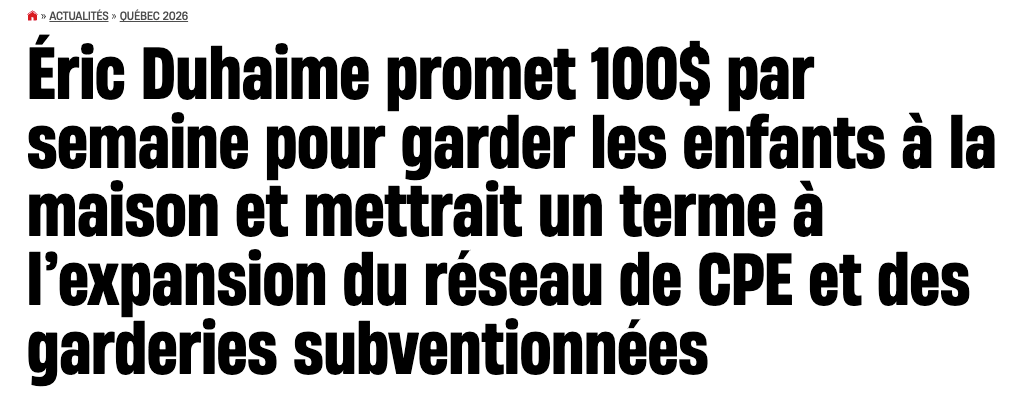
The QCP Promises $5,000 a Year to Parents Who Keep Their Children at Home
Since subsidized child care was introduced 30 years ago, Quebec has seen a significant increase in women’s employment rate. Today, it is the province where women aged 25 to 54 are the most likely to be employed.
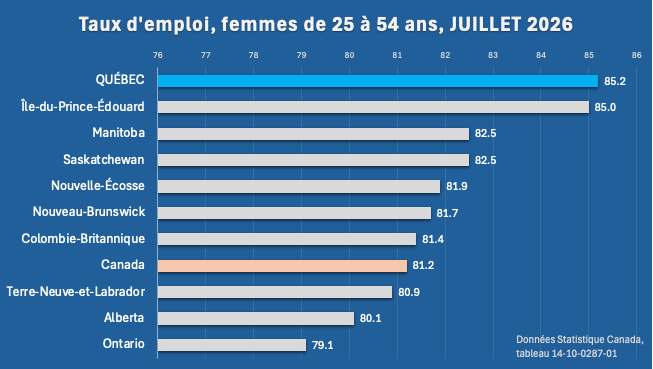
That is striking if we recall that Quebec used to have one of the lowest women’s employment rates in the country. (And thank you to the Atlantic provinces for ranking behind us. Otherwise, it really would have been embarrassing.)
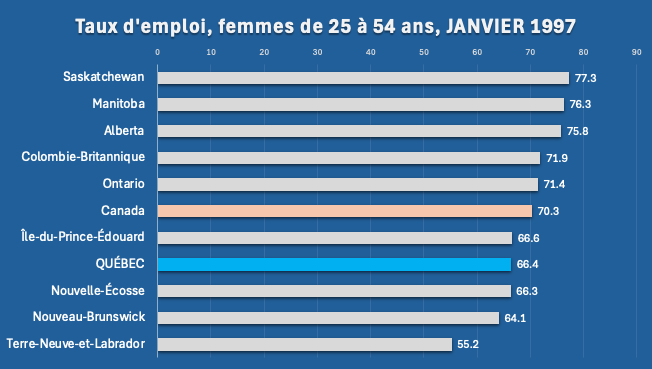
While Canada as a whole, including Quebec, gained 11 percentage points, Quebec gained 19. That’s gigantic.
After such a remarkable social advance, you might conclude that it is high time to finish building out the network of subsidized spaces. That would be fair to couples who pay taxes for a system they cannot access, to women who may have to put their careers on hold when no space is available (which happens, especially outside the major urban centres), and to educators, who tend to be underpaid in unsubsidized centres.
Quebec Conservative Party leader Éric Duhaime would rather make keeping children at home a matter of public policy, under the guise of freedom of choice.
Mr. Duhaime points out that subsidized daycare spaces are often a “lottery.” That is true. We could simply subsidize the spaces that are not already subsidized instead of turning the clock back 30 years. And if we really want to help lower-income families, targeted assistance remains the right approach.
Nobody is going to give up their job for $5,000 a year. But the policy could create a perverse incentive for disadvantaged families.
As a reminder, a central, though often forgotten, goal of the CPE system was to give children from disadvantaged backgrounds a better start in life. In other words, it was meant to give every child an opportunity to experience a stimulating environment that would prepare them for school.
I’ll conclude with this magnificent five-deck headline from the Journal de Montréal. At that point, one does not even need to read the article.
Charles Milliard Wants Us to “Stop Analyzing the Polls”
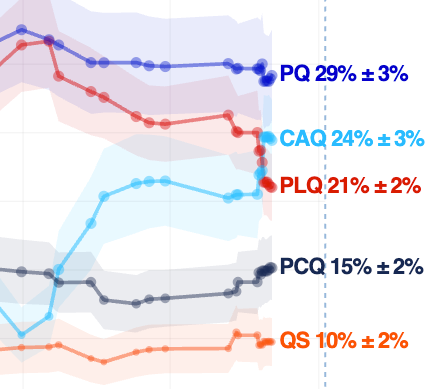
I understand. Here is the QLP’s polling trajectory since April.
Source: Qc125.com
Mr. Milliard insists that his campaign is going well and believes federalist voters will return to the Liberal fold as his party unveils more “rigorous” announcements.
For some reason, the fable of the tortoise and the hare comes to mind. Well, hope springs eternal.
The QLP Promises a Public Telehealth Platform
Since Mr. Milliard wants us to analyze his party’s platform, let’s look at today’s announcement: greater use of telehealth.
I am 100 per cent behind the objective of this proposal. As it happens, in another life, I published a roughly 50-page research paper on telemedicine (or telehealth, which is the same thing, only more inclusive).
The Liberals want to get there through a public platform. In other words, technology infrastructure created by the Quebec government. Does SAAQclic ring a bell? The electronic medical record? The digitization of the health care system in general?
As Gandalf said when a massive, fire-breathing demon was getting dangerously close to the Fellowship of the Ring: “Fly, you fools!”

Gandalf, contemplating yet another health care IT project.
In 2026, nearly 100 per cent of health care professionals and Quebecers already have a platform. It is called a smartphone. For years, health care professionals in other countries, including physicians, have used apps such as FaceTime much as we use the telephone here, generally without video.
Quebec does not need a “platform” that will cost hundreds of millions, take years to build, barely work, keep journalists busy, and lead to a minister’s resignation followed by a commission of inquiry.
We just need to pick up our phones.
The Language Fanatics
For the first time in our history, voter information cards and other election information will be sent out in French only.
As I explained yesterday, this is petty, mean-spirited, and punitive toward some unilingual members of the historic English-speaking minority, whose political rights are being trampled. It will not make anyone love or learn French. Nothing about it will alter the trajectory of French in Quebec one way or the other. To put it in plain terms, it is just there to piss people off.
Facing the uproar, Premier Christine Fréchette said she wanted to “review” the CAQ government’s decision to prevent Élections Québec from mailing documentation in English. Ms. Fréchette delivered her verdict today: the decision stands. (Personally, I think Ms. Fréchette was mainly reviewing the political fallout on either side.)
Élections Québec had requested an exemption from Bill 96, which requires communication exclusively in French. French Language Minister Jean-François Roberge and French Language Commissioner Benoit Dubreuil refused.
Why? Because.
I cannot help drawing a parallel with the CAQ government’s failed attempt to require health care workers to verify whether a patient was eligible for English-language education in Quebec before providing care in that patient’s own language.
As a reminder, voter information cards are bilingual in New Brunswick, Manitoba, and even Ontario. The same is true in federal elections from coast to coast.
According to the 2021 Census, only 3.4 per cent of Ontarians have French as their first official language spoken. In Manitoba, the figure is 2.7 per cent.

Where Is Charles?
Still on the subject of election information.
Language issues are a minefield for Quebec Liberal Party leader Charles Milliard, who performed a triple about-face last spring after tying himself in knots. That probably explains his silence on social media for two long days after the controversy broke.
Because an election campaign is underway and he could not avoid the question forever, the Liberal leader said he “shared Élections Québec’s concerns,” while acknowledging that “there was not much he could do.”
Liberal values in action, ladies and gentlemen.
Mr. Milliard has often invoked Robert Bourassa. How fitting, since it was under Mr. Bourassa’s government that the Quebec Charter of Human Rights and Freedoms was adopted.
Political rights are neither a Liberal question nor an Anglophone issue. They are a matter of fundamental rights, which had always been a subject of consensus in Quebec until the CAQ came to power in 2018.
Is there still a political party in Quebec willing to defend them today?
Mr. Milliard finally woke up on Thursday, shortly after 5 p.m., and called on Ms. Fréchette “to correct this situation immediately,” while calling for “a consensus among all political parties.”
We have seen more forceful defences of fundamental political rights.
Photo of the Day
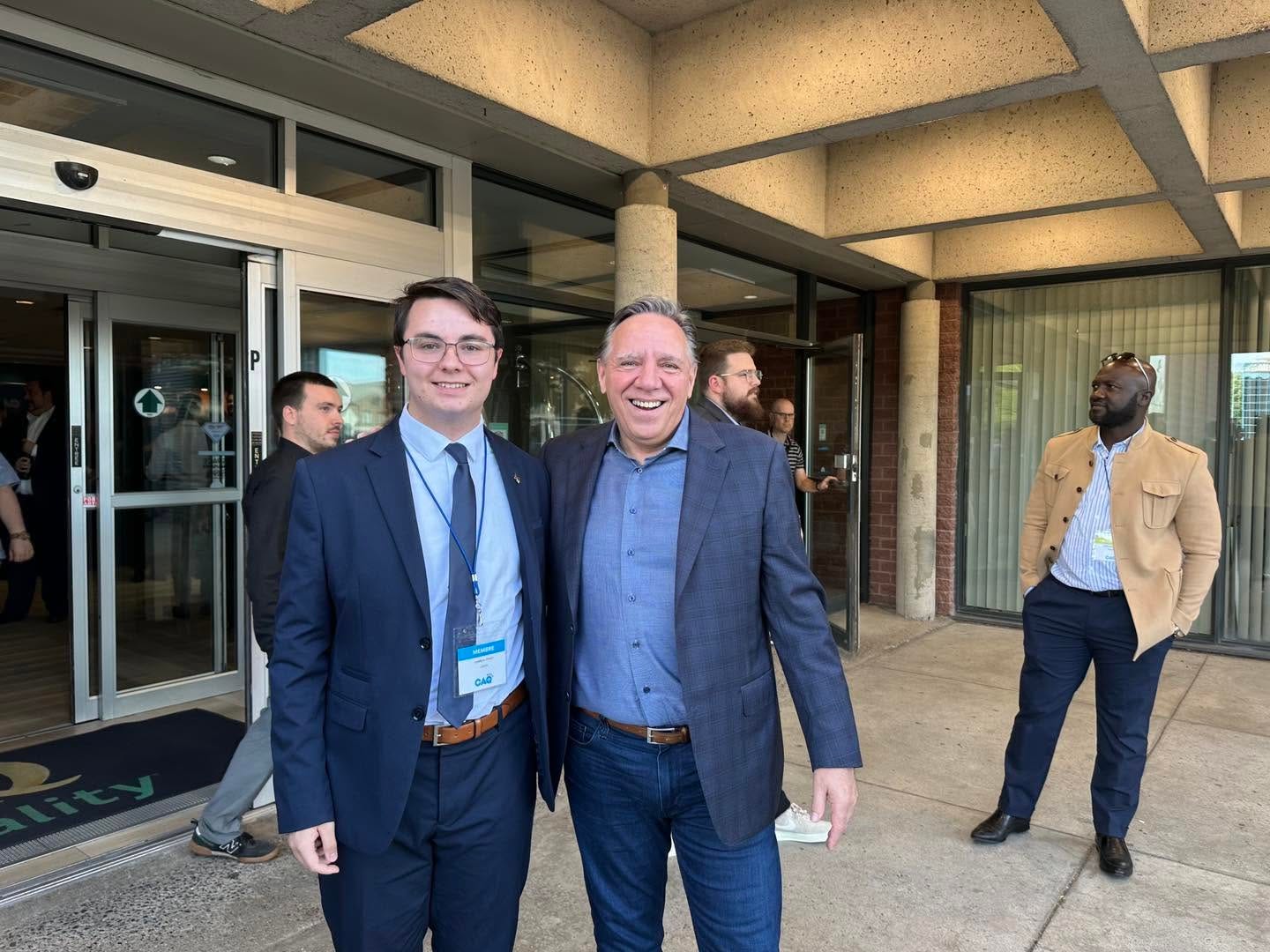
Meet Shawn Labelle, the Liberal candidate in Labelle and a member in good standing of the Coalition Avenir Québec until 2029. (The photo was taken in 2023.)
Source: Facebook
The Contest for the Dullest Promise
The Parti Québécois has promised to hold a province-wide summit on education. The Quebec Liberal Party is not happy. It says it thought of the idea first. Québec solidaire rushed to announce that it agreed.
🥱
Do you know anyone eagerly awaiting advance polling so they can cast a vote in support of an education summit?
Quebec has the highest dropout rate in the country. It is a human, social, and economic tragedy. Education drives everything else.
Leaders of Quebec’s political parties, what is your vision for education?
What do we do to motivate young people to finish high school within five years? Only two-thirds of boys manage to do it.
What do we do to create dynamic schools with compelling sports-study or arts-study options for everyone, not just for the lucky ones or those who attend private school?
What do we do to ensure that students with particular needs can reach their full potential? The first thing rationed in the public system is support services: special education technicians, educational consultants, psychoeducators, and so on. Are you going to change that? How? When?
Why do we always have money to subsidize companies owned by millionaires and billionaires who do not even dare to take the risk of financing their projects themselves, but never have money for this? Why is it so easy to fund ignorance indirectly?
And what do we do to ensure that gifted and highly gifted students can also reach their full potential? There are specialized schools in the public system, but very few of them. Quebec needs all its young geniuses, not only those whose parents can afford to send them to private high school. Excellence in education is an enormous taboo. Maybe it is time to break it. In minor hockey, AAA exists for elite players. Not only does that offend no one, but every parent hopes their own kid will make it one day.
Finally, what do we do to encourage our education system to foster excellence and healthy competition organically? Parents choose which private school their children attend. That raises standards across the board. In the public system, your postal code decides, and parents are stuck with the result. There is no incentive to do better. What if parents in the public system could vote with their feet, and the best schools were allowed to expand their enrolment?
Do we want to abolish subsidies for private schools or, better yet, fund every school at 100 per cent so that all schools are equally accessible to everyone? How would we do that? (A good mark here for Québec solidaire, which at least had the merit of staking out a position on the issue.)
Promising an education summit is convenient because it puts off any discussion of difficult or unpopular decisions until later. But it also reflects a lack of courage. Of course, it is easier to blame our schools’ problems on newcomers than to propose solutions to problems that have been with us for decades.
We still have a month ahead of us to discuss the most fundamental issue for the future of any society.
If you want to be premier and cannot take a position on this, either you are out of ideas or you are afraid of your own convictions.
And I will stop here before I get angry.
PS: That reminds me. PSPP was corrected over the twisted link he drew between immigration and overcrowding at a school in the Quebec City area. I would be surprised if that kept him from doing it again.
-30-
My name is Patrick Déry. I’m a French-speaking Québécois writing for a living, and trying something different here. If you enjoyed reading this text, you can support me by buying me a coffee. You can also subscribe to this media (free or paid, your choice).
Comments, shares, and “likes” are always appreciated
A thought on Sport-Étude: in my experience of it (I mentor a coach who was running a program, and I was a club administrator who had to deal with the school-side bureaucracy), it's a mess. I suppose it depends on the sport, but there's no reason why kids can't do normal school during the day, and then practice their sport at night. Somehow this works for the rest of the country, continent, even the world...I don't think Quebec is a world leader in youth sport so...
What Quebec needs is a stronger school sport system overall. If school was the main place where everyone played sports, that would increase public health outcomes no doubt, and also increase opportunities for elite sport development (if that's important to you).
The limiter for this is teacher's unions. Good luck getting most (not all) teachers to stick around after school and volunteer (again, like they do in the rest of the world) in a public school. This is the real reason for Sport-Étude, probably. To replace what teachers do everywhere else.
It certainly can't be couched this way (Let's do it the way Ontario does because they are way better at it) on the campaign trail, but surely a smart politician can come up with a way to increase sport participation in high school. Which might help with "décrochage" too...