Quebec as a functioning society is on the brink of collapse
Quebec’s demographic winter is coming.
If you’re reading this and you’re living in Quebec, I’m about to ruin your day. You’ve been warned.
It’s for your own good—for ours, actually, and for our children’s—because we need to wake up. Fast.
Some people are afraid of spiders. Others are afraid of dogs, cats, mice, or clowns. Still others are afraid of journalists (usually politicians).
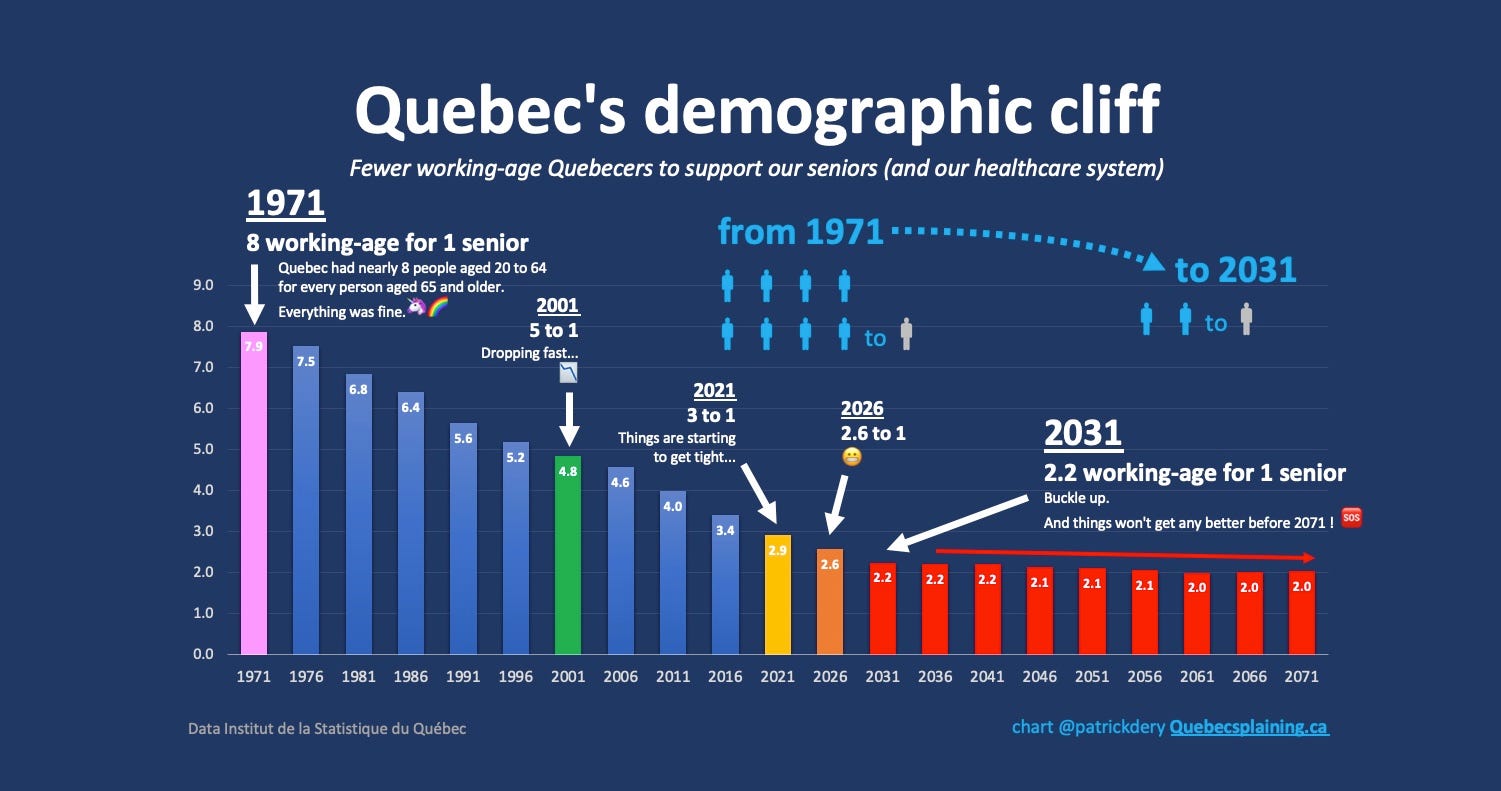
As for me, I’m mostly afraid of certain numbers: 2 and 1. As in the expression: 2 Quebecers of working age for every 1 Quebecer aged 65 and over. You have no idea how frightening this seemingly harmless statistic can be, because it gives a pretty clear picture of what lies ahead. Unfortunately.
In economics, we talk about the “demographic dividend” when a society has more young people than older people. To put it very simply—and at the risk of offending my mother and my in-laws—young people bring in money, and older people cost a lot.
The demographic dividend paid off for the baby boom generation, in Quebec and elsewhere. Everyone started having children during a period of unprecedented economic prosperity, just as Western governments came to the conclusion, around the same time, that the state had a certain responsibility for its population.
We built everything—from our roads to our hospitals, our civil service, and our social programs—and above all, our education and healthcare systems as we know them today. We also established certain standards and ways of viewing work and retirement.
All of this worked very well for a while, and most of us couldn’t imagine it ever ending. A few economists and demographers tried to warn us, but who wants to be told in the middle of a party that it might be time to start clearing the table?
A demographic “boom” always comes to an end—an end that’s very easy to spot and whose consequences are just as easy to predict. In Quebec’s case, the demographic dividend stopped paying off a long time ago. A growing demographic debt continues to mount, even if many still struggle to grasp it.
Our politicians don’t talk about it much. No one wants to campaign by saying things are going to get really bad, that major efforts—even sacrifices—will be necessary, and that it will hurt even more if we do nothing about it.
While we wave scarecrows about the imaginary threat posed by gender-neutral washrooms or largely French-speaking immigrants who are keeping our public services at arm’s length, we ignore the monster that is about to devour us all—sovereigntists or federalists, Francophones, Anglophones, and allophones, immigrants or native-born, left and right, woke and anti-woke.
Fifty years ago, there were seven “active” Quebecers of working age for every Quebecer aged 65 and over. Twenty-five years ago, it was 5 to 1. Fifteen years ago, 4 to 1. Five years ago, 3 to 1.
Today, the ratio is 2.6 to 1. In five years—which, in terms of public policy, is practically tomorrow morning—that ratio will be just over 2 to 1. It will stabilize then, but we’ll still hover around 2 “active” people per retired Quebecer—or, at the very least, generally “less active” for a few decades.
Here’s what that looks like. (You can check the raw data here.)
Quebec hospitals have been struggling for a while and it’s getting worse. There’s also a shortage of skilled workers just about everywhere. Imagine what it will be when our ratio of working-age people to seniors drops from 2.6 to 2.2 in five years. While this doesn’t seem like much, it is a huge gap. All things being equal, it is as if, with a wave of a magic wand, we were to remove 600,000 Quebecers from the workforce today (in reality, it is the result of people entering the potential workforce when they turn 20, and other people leaving when they then turn 65, but the effect is the same).
What’s more, Quebecers tend to retire relatively early, which extends the number of years during which an individual uses all kinds of services without contributing to their provision by providing labour. And I’m not even talking about the impact on public finances. Just the workforce.
They say that economists and meteorologists are the only two professions where people are paid to be wrong, but demographics are entirely predictable and can be measured decades in advance.
People have done so, but we didn’t listen to them, and Quebec’s successive governments—of all political stripes—have let us slowly slide down the slope toward the demographic precipice due to a lack of vision, courage, or competence.
That doesn’t mean we absolutely had to have more children or increase immigration—neither would have hurt, though that’s easier said than done—but we still should have acknowledged the reality, set the right priorities, and adjusted our public policies accordingly.
We should have maintained, built, planned, innovated, increased our productivity, and adopted best practices from here and elsewhere. But, aside from raising contributions to the Quebec Pension Plan, we have done almost nothing. In Quebec, a public policy that we might have hoped would be transformative is too often limited to a tax, a check, a subsidy, or even a mere wish.
The result is that today, our society has one foot on the edge of the precipice. The other is over it.
After forty or fifty years of neglect, the needs have never been greater for our schools, our hospitals, our roads, our bridges, and our entire public infrastructure. Despite massive spending, our fundamental infrastructure is deteriorating faster than we can repair it. That doesn’t stop some politicians from promising pharaonic tunnels under the St. Lawrence River.
In addition to building the future, we must also preserve the present. Educate, care for, and protect our children, our seniors, and our most vulnerable. Somewhat embarrassingly for a society that claims to be supportive and egalitarian, we’re already failing at this. In the coming years, fewer of us will be supporting the social safety net, yet that same net will have to support a greater number of us. Our collective solidarity will be put to the test like never before. It has already begun.
And fasten your tuque, as Québécois say (“Attachez vos tuques”), because this is far from over. We’re not talking about a “grey” storm or wave, but a demographic winter that will stretch over several decades: on the current trajectory, Quebec is facing a labour shortage for the next 30 to 40 years. At a minimum. Which just goes to show that, even if our institutions seem to have already reached their limits, that doesn’t mean we can’t sink even deeper.
It’s unpleasant to hear, and even today, it’s tempting to ignore it. But that doesn’t change the grim reality.
The same challenges exist elsewhere. But conditions and choices specific to Quebec could make things more difficult here. Consider, for example, the fact that we’ve decided to have fewer doctors than almost anywhere else in the Western world, or all the issues surrounding immigration.
The coming conditions will be especially difficult for our hospitals, those who use them, and those—especially women, in fact—who support them. But it is also the entire functioning of our society that is threatened: schools, construction, the dentist, or the local mechanic. There will be a shortage of everything. The most privileged will fare a little better, which will make the problem worse for everyone else, as we’re already seeing in healthcare, and as we’ll see with everything else.
Last, how are we going to rebuild everything that’s falling into ruin if there are fewer hands to hold the shovels and hammers? In the Montreal Canadiens’ locker room, one can be inspired by a moving message from those who came before: “To you from failing hands we throw the torch be yours to hold it high.”
In Quebec, there have been more torch passers than torch takers for quite some time now.
Again, all of this was entirely predictable, but our public decision-makers generally refused did not want to look beyond the next election or their obsessions, and our interest groups have preferred to pull the blanket as far as possible toward their side, regardless of the consequences.
Corporate interests and special interests have taken over; solidarity and the public interest have been pushed aside. But we’ve forgotten that we’re all sitting on the same blanket, that there’s a hole underneath, and that pulling too hard is dangerous.
Today, we’re preparing to kick out immigrants who are largely French-speaking and integrated, and who help us keep it all afloat. And, no, an immigrant worker in his prime doesn’t consume as many services as he produces. He’s just helping us out.
The final outcome won’t make anyone happy, except perhaps those responsible for the policies that led us here, safely entrenched behind their denial and—let’s face it—the comfortable situation, privileges, and pensions guaranteed by their years in power. In a few years, we’ll be holding state funerals for those who got us into this mess.
While some of our current elected officials wallow in the populist gutter—either by bandying about all sorts of bogus statistics on immigration or by trying to make us believe that the French language is going to disappear—we keep burying our face in the sand in the face of the most serious public policy challenge Quebec has ever faced.
Did you vote for this?
-30-
This text is 1,621 words long, which is about seven pages of a book. The research, writing, data processing, and attempt at artistry in Excel took me two days and aged me by two years.
My name is Patrick Déry. I write (mostly in French) for a living, and do my best to Quebecsplain in English in this space. I also enjoy making numbers talk and putting together charts that you won’t see anywhere else.
If you enjoyed reading this text and if it did not get you too down, you can encourage me by buying me a coffee. Comments, shares, and likes are always appreciated.
You can also subscribe to this media by clicking on the button below.


