


How have your been? Over here, my wife, who was born here and whose father arrived in Quebec 50 years ago, learned this week that she was an immigrant. I asked her to stop threatening our national fabric and making PSPP anxious. She said she would think about it.
There was a lot of news this Saturday. I’ll try to cover as much of it as possible, plus one little thing I forgot yesterday.
QS wants to fix the health-care system without any doctors; the PQ wants to freeze MNAs’ salaries; Christine Fréchette takes the political polygraph test; and the QLP trips over its own shoelaces yet again.
Before we dive in, I’d like to thank everyone who has subscribed over the past few days, especially those who decided to become paid subscribers. I realize that, in terms of how much reading you get for your money, it costs more than a newspaper. Every time someone makes that choice, I’m genuinely touched, and it gives me a real boost.
I’m trying to build something lasting here, something different and outside the traditional media. Your support is invaluable.
So, let’s get to it!
Québec solidaire is already planning its second term
The left-wing party has promised to increase the number of CLSCs in the province from 147 to 200 by 2030, at a cost of $1.8 billion a year during a highly hypothetical first term, and then add another 200 during an even more hypothetical second term. A quick calculation puts the additional cost at $8 billion, for a total of $10 billion. That includes staff and “infrastructure.” In other words, buildings.
(I don’t know about you, but after seeing so many billions thrown around, I’m starting to become numb to it all and assume that every promise is made with Monopoly money. Or, as a friend of mine who was finishing his postdoc by piling up student loans used to say: “My tombstone will read, ‘Someday, I’ll pay you back.’”)
I have nothing against investing spending money on health care, but I would rather see it go toward care than concrete. Without knowing what share of the promise is for infrastructure, it is the same old problem with QS.

Even if we leave the buildings out of it, it still won’t work. For one thing, the Nordiques have a better chance of returning to Quebec City than QS has of winning the election, but that is beside the point. It won’t work for two reasons: Quebec is short of doctors, and everything revolves around doctors.
We can open as many CLSCs and medical clinics as we like, but we will still need someone to hold the stethoscope. Quebec has the same problem with doctors that it does with jam: when you’re running low, you can try spreading it more thinly, but there is only so much you can do.
Medical-school admissions were finally increased substantially in 2023 after years of foot-dragging, but that will not make a difference for at least 10 years, and the aging population is having an opposite effect on accessibility.
The measure that could make the biggest difference, as quickly as possible, would be to expand every health professional’s scope of practice to the full extent of their abilities.
In other words, nurses, physiotherapists, chiropractors, social workers and others should be allowed to do what they were trained to do, while acts reserved exclusively for doctors should be kept to a strict minimum. The funding should then follow, allowing these same professionals to bill the RAMQ for their services without being supervised by a doctor.
It would not solve everything, but it would help eliminate duplication while freeing up doctors’ time.
How many political parties have proposed going that far over the past 20 years?

In short, eat your vegetables and get some exercise.
The PQ wants to freeze (well, unfreeze) MNAs’ salaries
Three years ago, PQ MNAs, along with those from Québec solidaire, put on an admirable display of their principles by refusing the enormous and utterly unjustifiable pay raise that CAQ MNAs had voted themselves. And I mean that without any cynicism.
Today, they are promising to freeze their salaries until the budget is balanced. That could take a while. Or hurt.
As a reminder, things were heating up inside the CAQ Équipe François Legault caucus in the spring of 2023, particularly after the first cancellation of the third-link project. To settle everyone down, the premier subtly granted a 30% pay raise to his to all MNAs, who were already the highest-paid provincial legislators in the country. Since 2023, the base salary of a Quebec MNA has risen from just over $100,000 to nearly $150,000.
And that does not include the pension plan, which accrues at a rate of 4% for every year served. According to several experts, it is the most generous pension plan in the country.
In 2013, a report recommended raising MNAs’ salaries and overhauling their pension plan.
In 2023, François Legault defended himself by saying he had “courageously” implemented the report’s recommendations. Presumably out of absent-mindedness, he forgot the part about reducing the pension plan. It happens to everyone. It just happens more often to people who vote themselves a pay raise.
A question for the PQ: why not simply promise to reverse the increase and restore the previous salary, adjusted for inflation? They would probably get the support of Québec solidaire and the Conservative Party. Or, better yet, keep part of the increase and reform the pension plan, as the 2013 report recommended. That would also be one hell of a test for the other parties.
For now, the PQ plans to start accepting the raises its MNAs had previously refused, to avoid having to “obtain every member’s consent, because obviously there could be too many of us to make that work.”
It would also mean more newly elected MNAs enviously eyeing the salaries collected by CAQ and Liberal members in a minority government where the governing party might hold only a few more seats than the opposition.
So, the real news is that the PQ is going to accept the pay raise. But they buried it so effectively in everything else that it barely registers, and the reporter didn’t lead with it. Clever. Very clever. I almost fell for it too.
Quote of the day
We teach young people not to lie. It’s time politicians did the same.
- Charles Milliard, QLP leader, speaking about the announcement by
the CAQÉquipe Christine Fréchette promising 25,000 reduced-fee spaces in Quebec’s child-care system.
In reality, there are only 10,000 new spaces beyond what had already been announced.
Point to Mr. Milliard. Besides, this is hardly Ms. Fréchette’s first lie or dubious claim. Here is my favourite:
For those who did not get it:
“At the CAQ, sound management of public funds is in our DNA.”
🤣
But getting back to Mr. Milliard, as the saying goes, people who live in glass houses shouldn’t bring out the squash racket, or something like that.
First, because the QLP had 15 years between 2003 and 2018, apart from a 19-month PQ interlude, to expand the network of subsidized daycares and CPEs.
To move faster without limiting itself to CPEs, the Liberal Party could have followed the example of privately run, publicly funded CHSLDs, which are fully aligned with the public model when it comes to both care and working conditions, and which also produce better results. (It helps to have a boss on site.) Instead, the QLP chose underpaid educators, a tax-credit system for parents, and unsubsidized daycares, a brilliant contraption that culminated in the totally-not-suspicious awarding of daycare permits to Liberal donors.
Second, because three parties have made announcements on child care:
CAQ: 10,000 new spaces and a $10,000 cheque for new educators (a bad idea; just raise their salaries instead);
QCP: a $100 cheque for children cared for at home and a return to the pre-CPE era;
PQ: completing the network and converting it into CPEs.
Meanwhile, the QLP still has nothing. Where is Mr. Milliard’s early-childhood commitment? Does he have a position on the proposals currently on the table?
So far, I have found nothing apart from this, on the QLP website, about playing French-language music in CPEs.
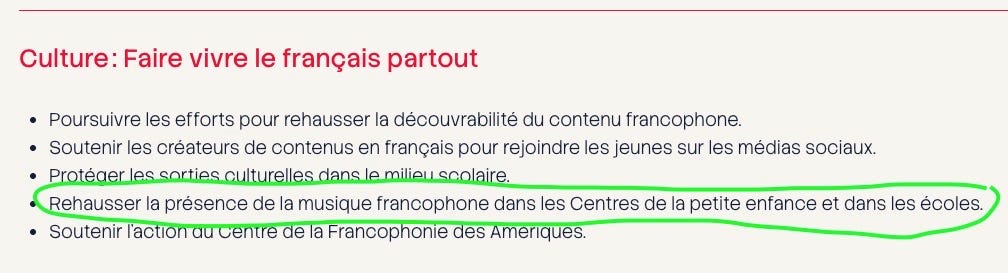
That seems a little thin.
Christine Fréchette takes the lie-detector test
Would an independent Quebec be “viable”? It is such an easy way for a journalist to generate a story on a slow news day, and heaven help the federalist politician who gets asked the question, because there is no right answer.
On Friday, it was Christine Fréchette’s turn. The premier argued that there would be “a great deal of risk and uncertainty.”
Also in the news today: water is wet.
(Actually, water is not really wet. It’s complicated. But you get the point.)
Taking on Quebec’s share of the federal debt, higher interest rates, a possible credit downgrade followed by still-higher borrowing costs, the renegotiation of trade agreements (do I really need to explain?), and so on. Why do you think Jacques Parizeau felt the need to explain Quebec independence to Americans on several occasions?
Ms. Fréchette’s statement produced headlines like these, even though they did not really reflect what she had said. Because the headlines were already written.
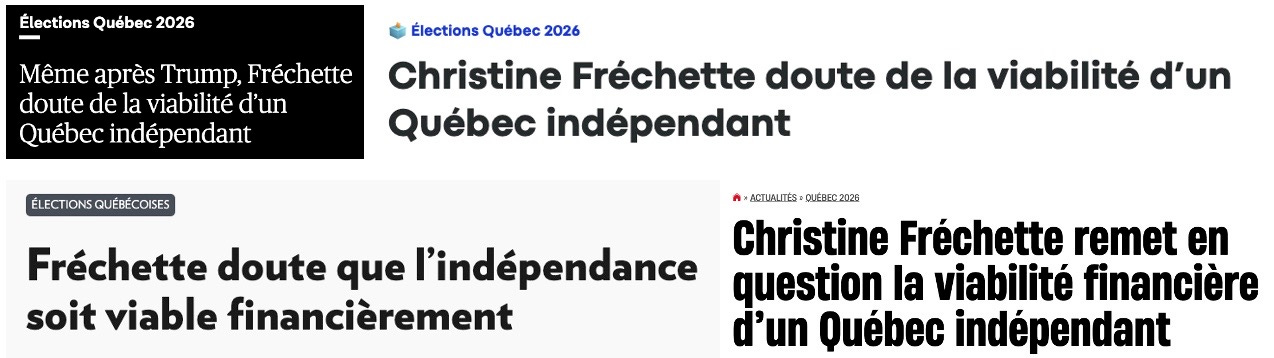
Ever since Jean Charest declared that Quebec had “the means” to become independent, the viability of a sovereign Quebec has become a sort of political polygraph test, and woe to anyone who fails it.
It is both funny and bizarre.
First, because Mr. Charest’s answer, despite his staunch federalism, had nothing to do with a scholarly assessment of how independence would affect Quebec’s finances and economy, and everything to do with political expediency. It was simply less trouble to say “yes” than to spend weeks debating the issue and risk being portrayed as a traitor to the Nation.
People tend to forget the many caveats Mr. Charest added after giving his answer: “One thing that must be said clearly is that breaking up a country carries a very significant cost. We have always said so.” Long before becoming premier, Pauline Marois herself spoke of “five years of turbulence,” before seeing her shadow and scurrying back into her burrow.
Moreover, between the time Mr. Charest made that statement and today, the gap between federal spending and federal revenue in Quebec has grown dramatically. It was $6 billion in 2006; it was $27 billion in 2024. That is one hell of a difference when it comes to the fiscal position of Quebec after a possible Yes vote. For comparison, Quebec’s entire education budget is $20 billion. I discuss it here.
Most importantly, the question itself is poorly framed.
Of course an independent Quebec would be “viable.” Portugal is “viable.” Greece is “viable.” Plenty of countries in Latin America, Asia, and Africa are “viable,” but they also provide social programs that reflect the means at their disposal.
There is no doubt that an independent Quebec would be “viable.” There is equally little doubt that, for at least 10 years, this “viability” would have consequences for either our finances, our public services, or our taxes, and most likely some combination of all three.
How much of an impact? That is difficult to say, hence the “uncertainty and risks.”
But it is easier just to administer an ideological purity test.
The word of the day that must not be named
Since the beginning of the election campaign, Paul St-Pierre Plamondon has avoided saying the word “referendum.” On Friday evening, speaking before supporters, he promised a “public consultation on Quebec’s future.”
I have three observations.
It is unbelievably silly.
I cannot understand why PQ supporters are completely beside themselves with excitement at the prospect of holding
a referenduma public-consultation-on-Quebec’s-future (whew!) when 70% of Quebecers do not want independence, and at least 60% have consistently opposed it for more than 20 years. To put it plainly, read the room.The Parti Québécois will have a hard time keeping its promise if it forms a minority government. Besides, while a PQ victory is likely, it is far from assured.
I played around with the Qc125 election simulator, giving the CAQ two extra percentage points and taking two points away from the PQ. Here is what that produces:
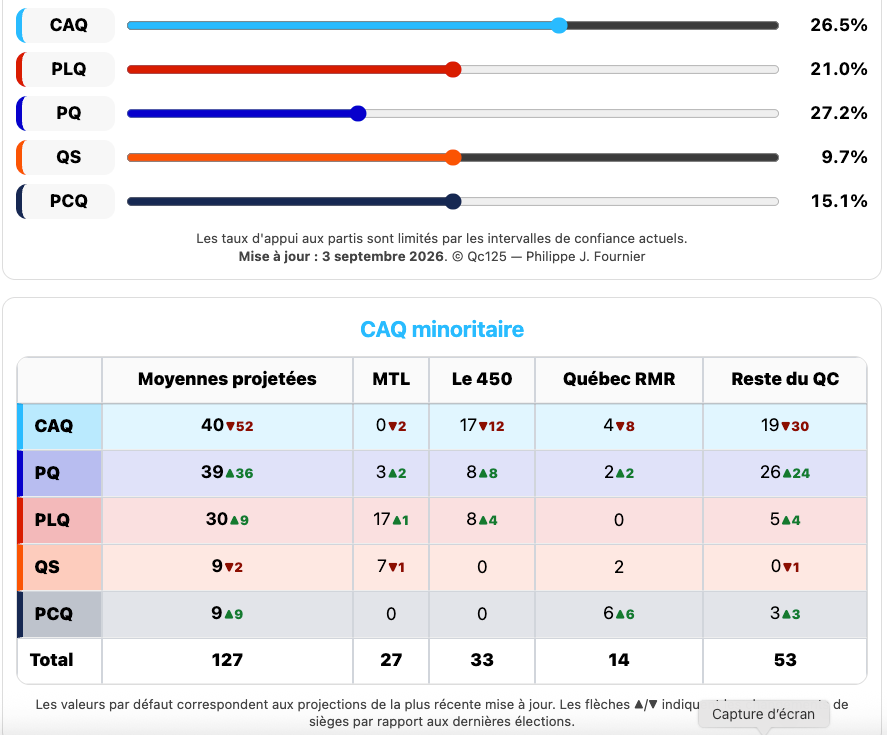
For months, the PQ’s rhetoric on independence and relations with the federal government has grown increasingly dogmatic. PSPP has started behaving a little like a guru whose certainties are constantly reinforced by his own echo chamber, as though his option’s unpopularity were the product of some kind of federal-government mind control and sovereignist unicorns would suddenly start raining from the sky after a PQ victory.
They’re in for a rude awakening.
Where is Charles (again)?
Robert Bourassa, rising in the National Assembly to respond to an opposition member who was as outraged as he was clumsy, began by saying: “Mr. Speaker, surely we are not going to shoot at an ambulance.”
His point was that the opposition member looked rather pathetic and that, although the premier still had to answer him, he would show some restraint out of simple human decency.
I would hate to shoot at an ambulance myself, but once again, I have to talk about the QLP for all the wrong reasons.
This morning, La Presse published a feature about the political parties’ war rooms, where their campaigns are run. The CAQ, the Parti Québécois, Québec solidaire, and the QCP all opened their doors to reporters.
The QLP did not.
The QLP is currently polling at 13% among francophone voters. This was an obvious opportunity to show a more likeable side to an electorate the party is trying to win over. This is not Communications 101. It is Communications for Dummies.
And the QLP communications team decided to snub the second-most-read newspaper in Quebec.
The QLP could have looked good in the day’s feature, like the other four parties:
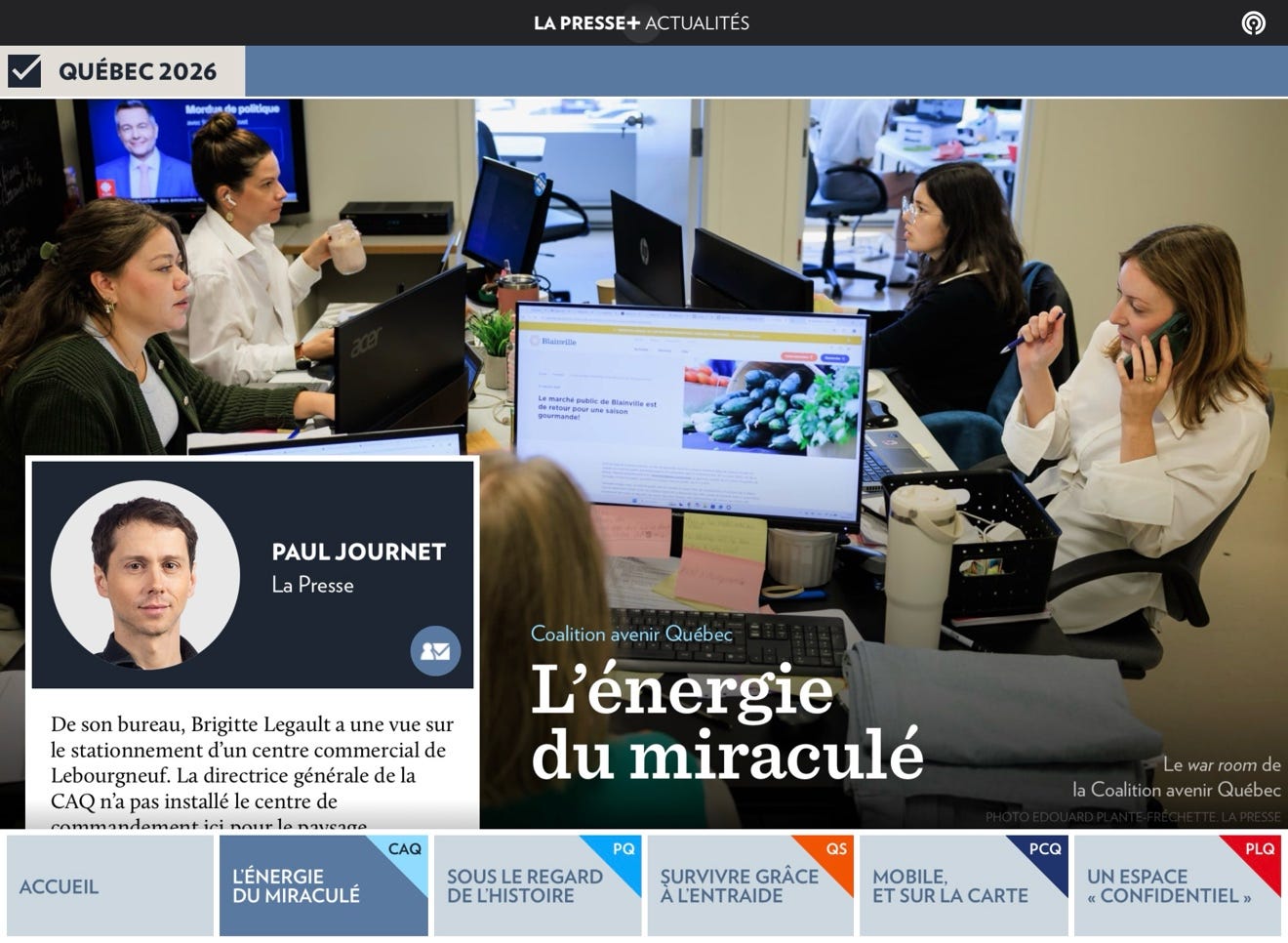
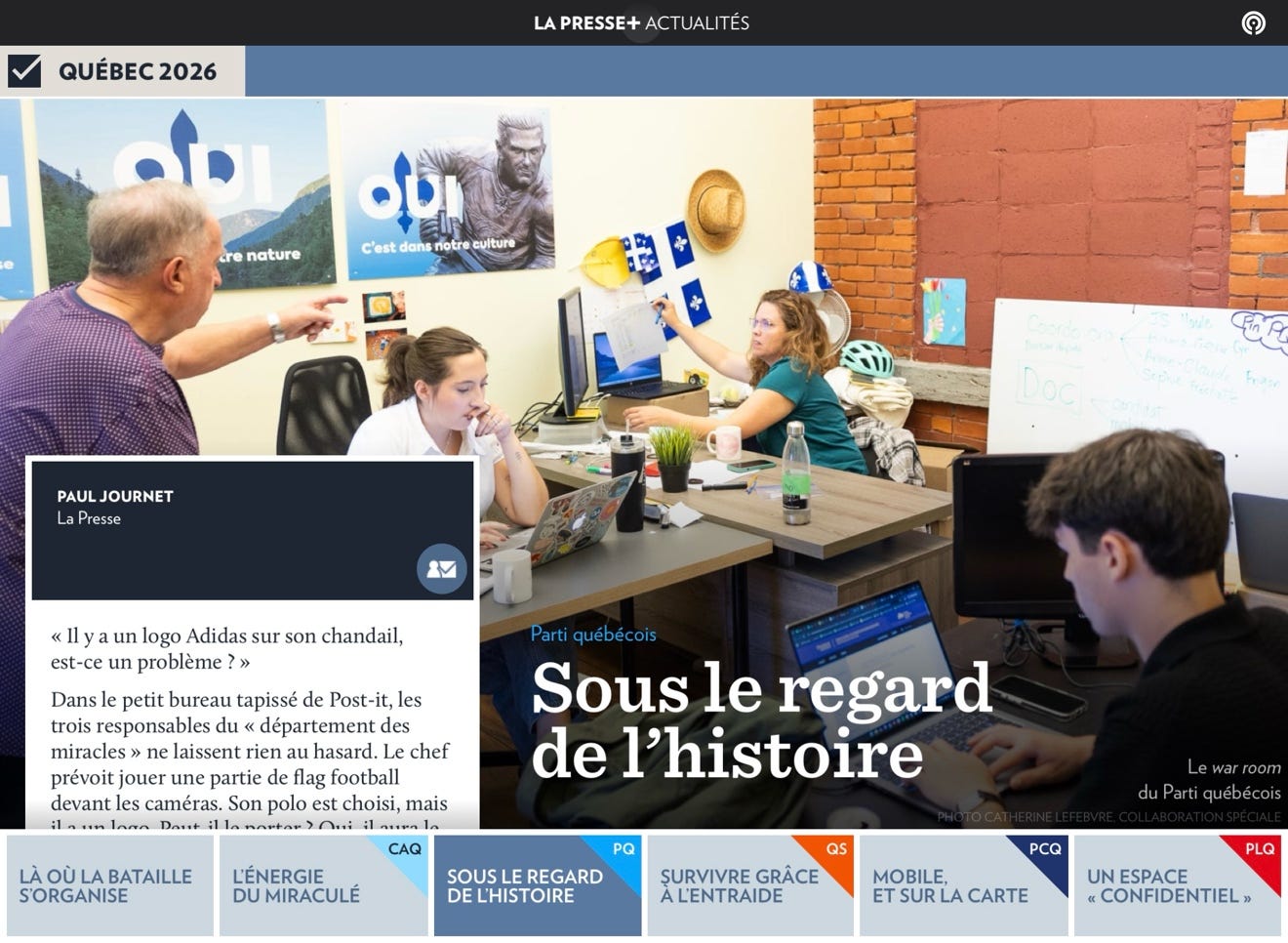
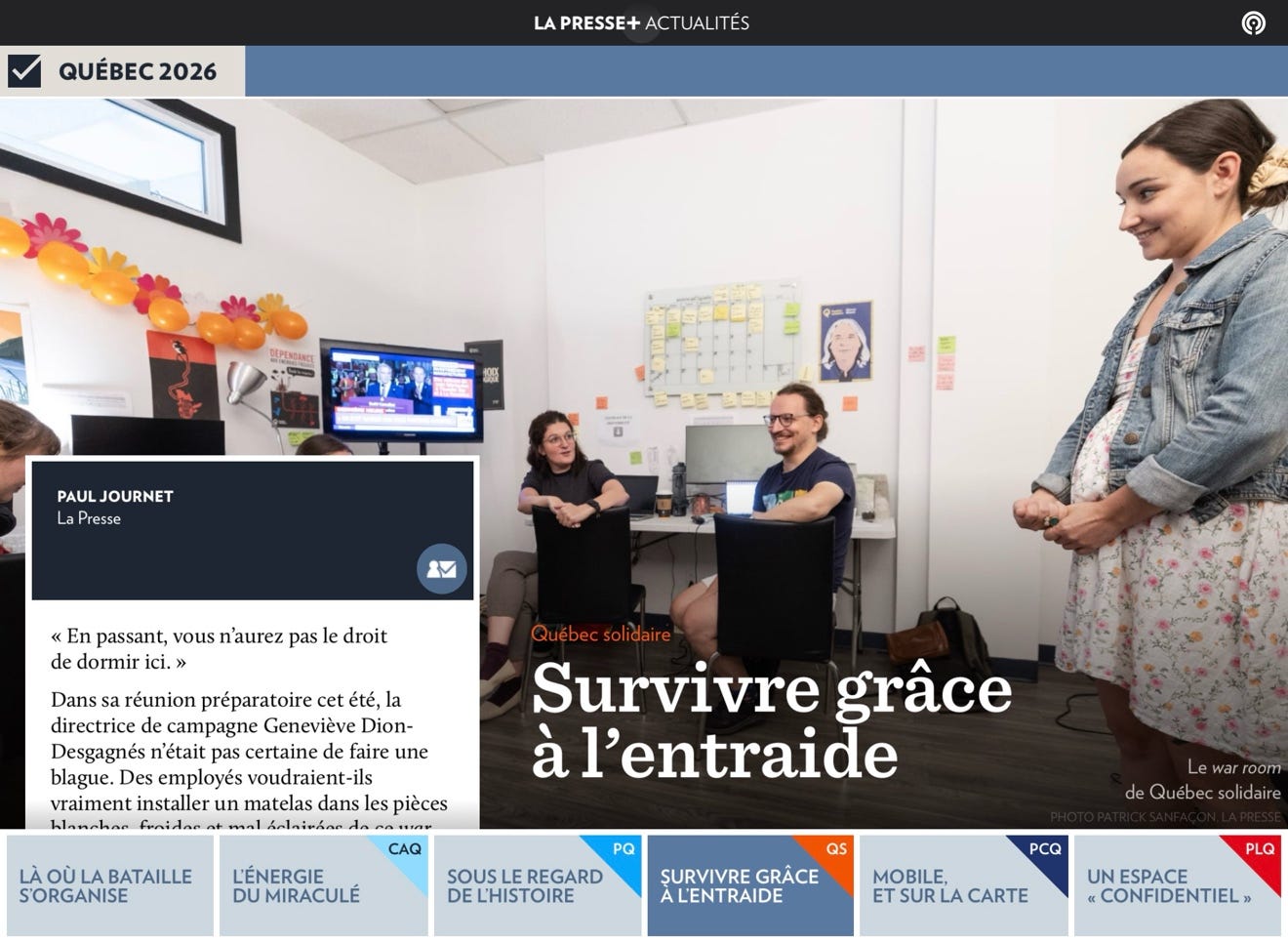
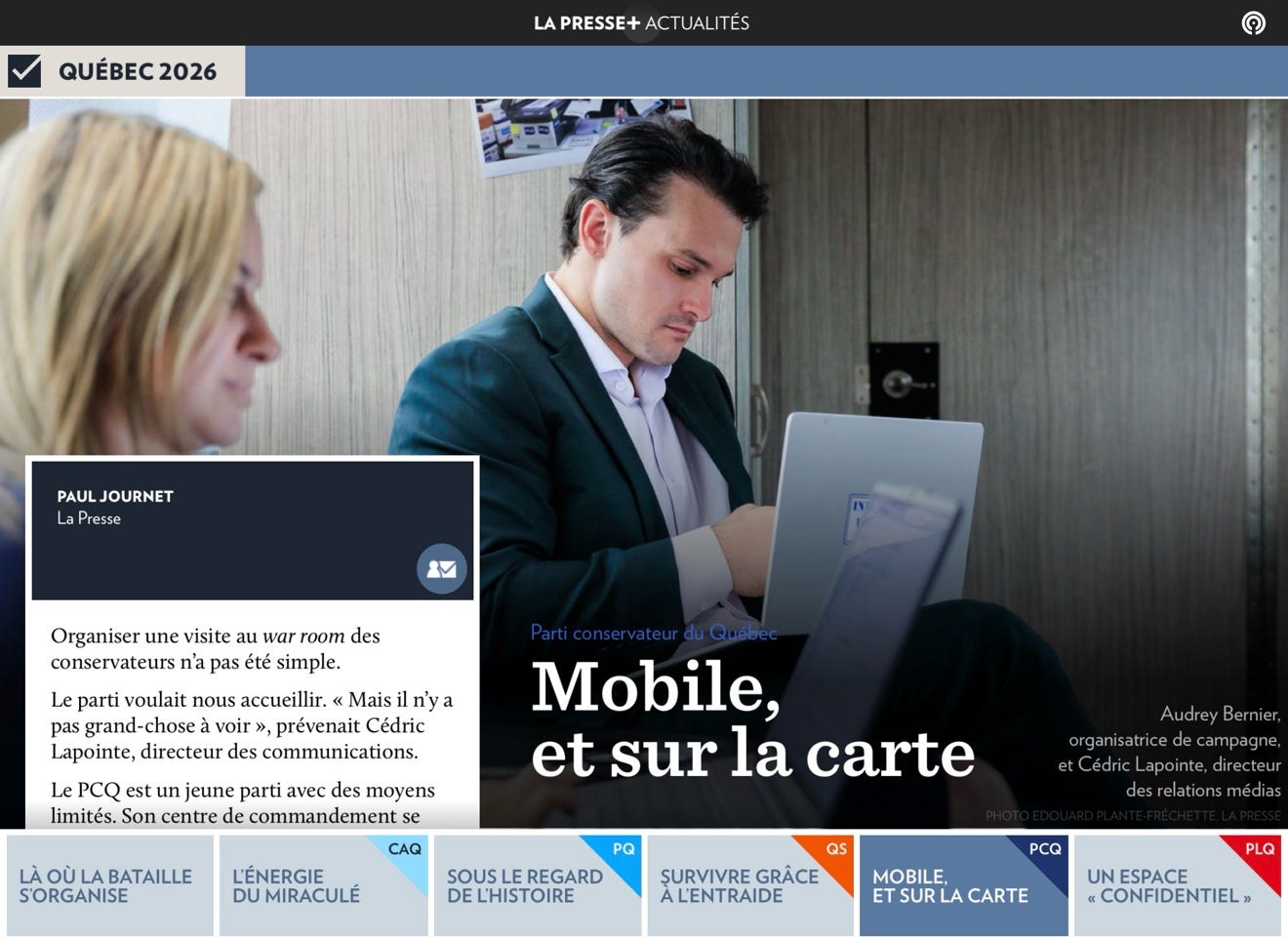
It appeared on page 3 of La Presse+. Hundreds of thousands of Quebecers read the feature.
When it came to the Liberal Party, those hundreds of thousands of readers saw this instead:
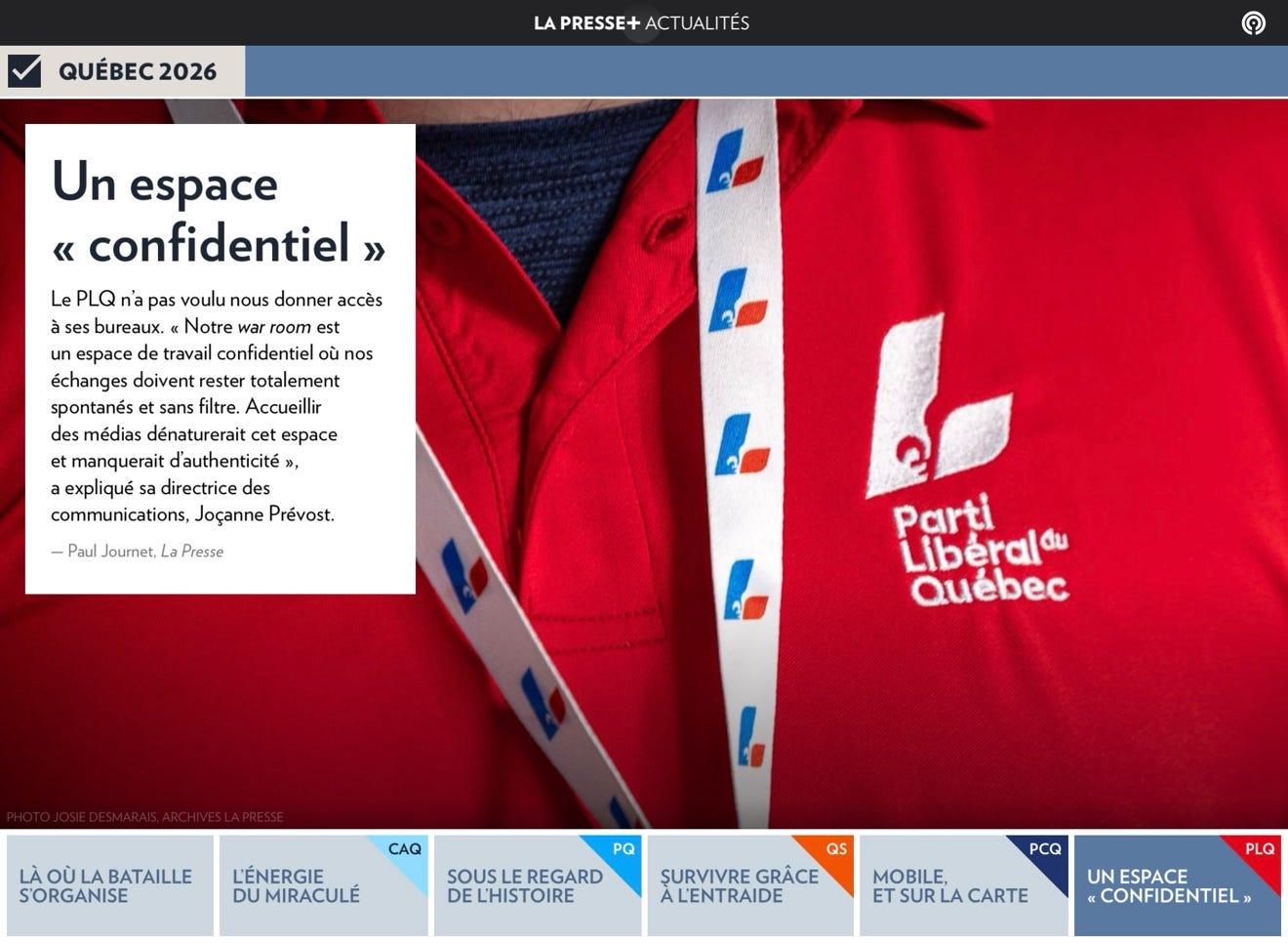
“Move along, nothing to see here.” Well done, champs!
The communications disaster continued, and the QLP leader later had the opportunity to acknowledge that it had been the wrong decision.
Which generated even more coverage.
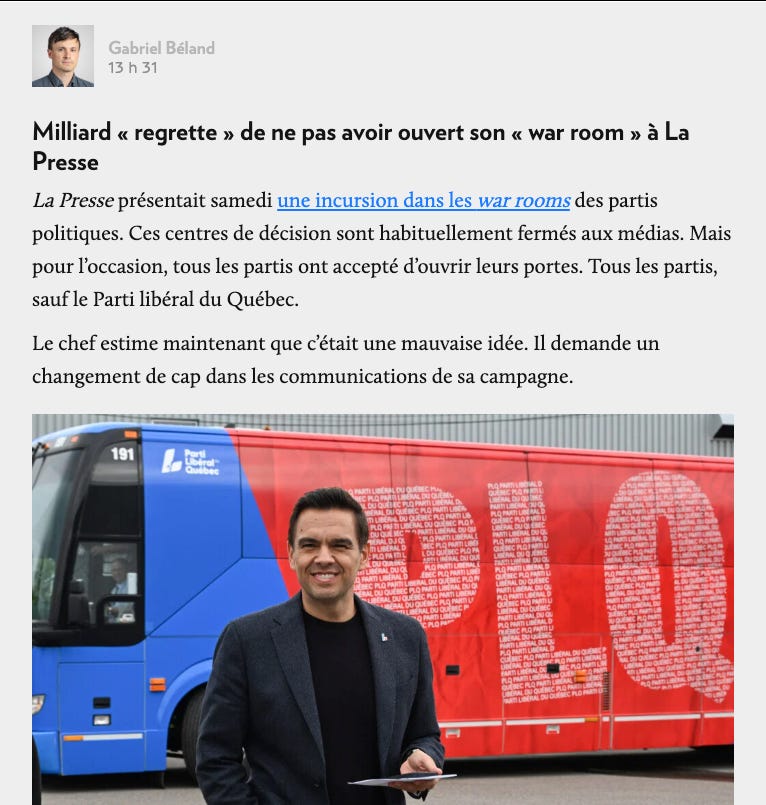
Fortunately for Mr. Milliard, the follow-up is buried in La Presse’s campaign liveblog. With any luck, only a few tens of thousands of people will see it.
Some real “junior stuff,” as Jacques Lemaire would say.
-30-
My name is Patrick Déry. I write for a living, and I am trying something different here. If you enjoyed reading this piece, you can support me by buying me a coffee. You can also subscribe to this publication (for free or as a paid subscriber; the choice is yours).
Comments, shares, and “likes” are always appreciated. It also helps the Substack algorithm notice me, so don’t be shy!