


Last soccer night of the season. My wonderful teenage girls, whom I’ve told you about before, fought hard and even took the lead in the first half. But with two players missing, they ran out of gas and eventually went down to defeat. It was a great game to close out the season, and I promise this is the last time I’ll use my daughter’s soccer as an excuse for publishing late.
From now on, I’ll blame my son’s hockey.
Now, the campaign. A few words about this stupid and counterproductive trade war with our neighbours, since it will loom over the remaining weeks of the campaign.
Canada’s counter-tariffs of 15% to 50% have taken effect on hundreds of American products, from mozzarella cheese and paper towels to sportswear, screws and bolts, tools, appliances, furniture, and so on. The Quebec government has also announced measures to encourage buying local, particularly for government contracts.
The net result is that everything will cost us more. Because we’ll pay more tax on imported products. Because the government will do business with suppliers that otherwise would not have won the contracts. (The lowest-bidder rule is another story.)
Premier Christine Fréchette calls it a “shield”. In reality, it’s a bill we will all share. There’s a reason we produce maple syrup and buy our oranges from Florida: doing the opposite would cost more. Tariffs can change trade flows, but they do not change the comparative advantages of a region or country.
PQ leader Paul St-Pierre Plamondon, who has apparently been spending a lot of time lately with liberal economists (in the philosophical sense of the word), opposes dollar-for-dollar counter-tariffs and advocates targeted tariffs with corresponding assistance. Economic theory and the experience of the past few months generally support his position.
Politically and strategically, it’s less clear-cut. On one hand, sociopaths like Trump feed on their opponents’ apparent weakness, and failing to respond could encourage him to go further.
On the other, when facing a much stronger opponent who has lost touch with reality and has no problem taking on dangerous levels of debt to indulge his whims, there is also a risk of being dragged into a tariff spiral. We probably aren’t too far from that scenario. Bring on the midterms, and let’s hope the Democrats win at least the House of Representatives.
I’m still left with the impression that we’re collectively shooting ourselves in the foot to make up for the punches our neighbour has landed on our face.
The Quote That Aged Badly, Fast
“It’s a tweet, and I told you I don’t comment on tweets.”
- PSPP during a media scrum, discussing Donald Trump’s threat to shut Bombardier out of the U.S. market unless the company built aircraft in the United States. On Tuesday morning, Bombardier shares fell 7%, before recovering some of the lost ground and closing down 2.5%.
(I wanted to add this yesterday, but that day’s instalment was already quite generous. I figured I’d have an opportunity to revisit it sooner rather than later…)
The problem is that President Trump’s policies often begin with an announcement on social media.
It is worth noting that Bombardier already employs thousands of workers in 20 states and does business with 2,800 companies across 47 states. But technically, since Learjet production ended, final assembly of its aircraft has taken place in Canada. Maybe that’s what bothers Mr. Trump. Who knows? With a little luck, he’ll have forgotten about it by tomorrow.
The Quebec government has sunk $2 billion into Bombardier over the past decade or so. It’s now worth nothing. The bill could rise even further if the government had to rescue Bombardier from the damage caused by a trade war.
When the Pollster Gets Tangled Up (Again)
A new poll today, with little change from yesterday’s or from the general trend over the past week.
Stick with me anyway. This is worth discussing.
Here it is:
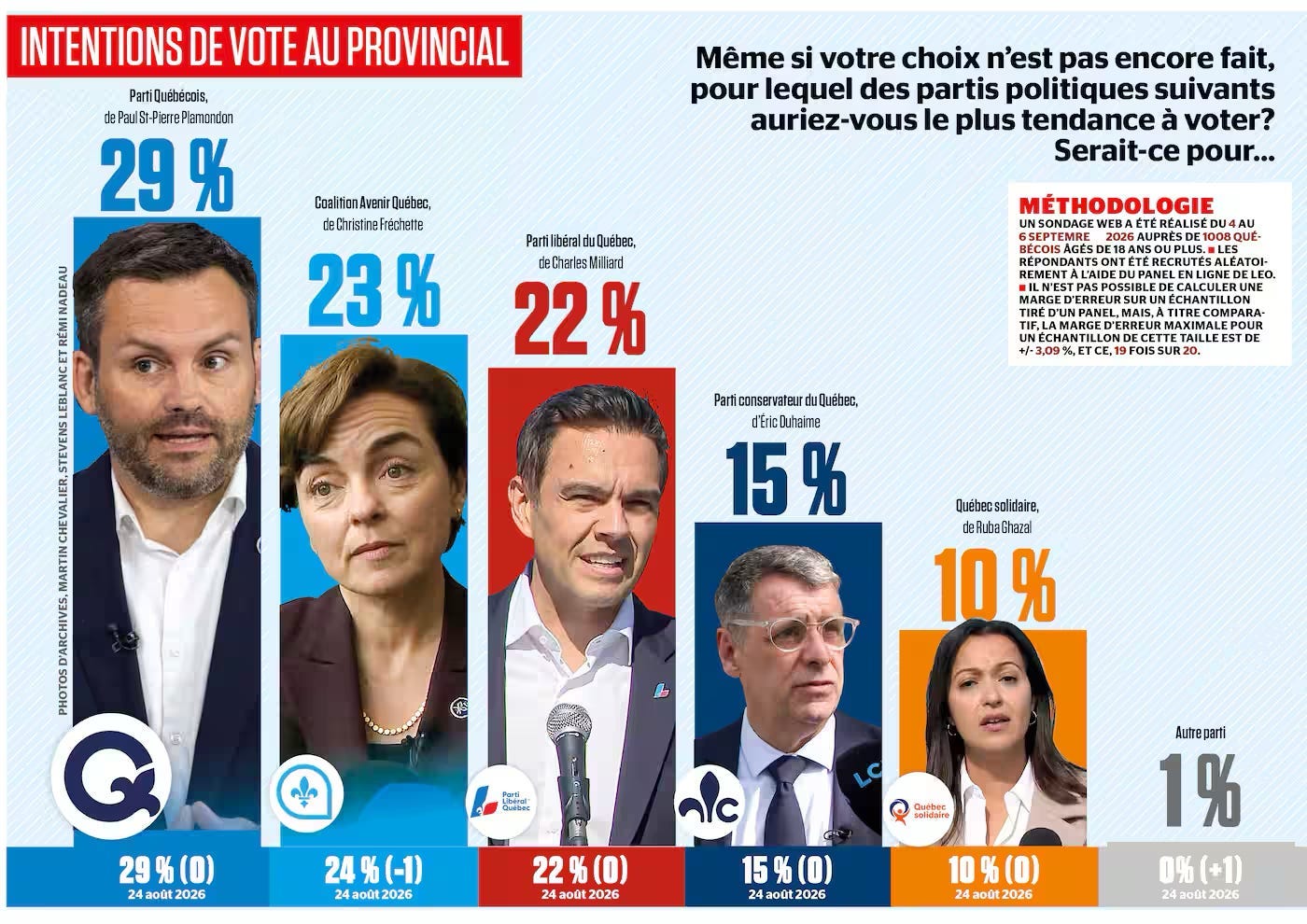
Ms. Fréchette looks sorry she couldn’t close the gap with the PQ. Charles Milliard has the sun shining directly in his face. Ruba Ghazal’s head has gone through the shrink ray.
You also have to wonder why the PQ logo is larger.
Meanwhile, the QLP and QS logos are ridiculously small because someone decided to squeeze the parties’ full names into the circles.

It’s the kind of thing you notice in ten seconds when you’ve spent a few years doing page layout (as I have), and in less than two seconds when you’re a graphic designer.
In principle, it should matter to a newspaper to appear neutral, at least when it comes to news and reporting.
+++++++
I don’t like to dwell too much on the conclusions that can be drawn from a poll. First, because there is a margin of error. Second, because the margin of error sometimes misses the mark. Third, because a poll is merely a snapshot in time, nothing more, and all kinds of things can happen. We can make statistical observations. That’s it.
Remember the 2011 Orange Wave with Jack Layton, Justin Trudeau going from third place to prime minister in 2015, and Mark Carney eating Pierre Poilievre for breakfast last year. Or Bernard Landry getting lost in Latin phrases after Jean Charest landed a low blow about Jacques Parizeau during the leaders’ debate. Or PKP raising his fist during the 2014 campaign.
Pollsters always have sophisticated analyses explaining why the vote stands where it does, and where it should go next. And all of it can be swept away overnight by the electorate’s unpredictable mood.
Last week, I noted the intellectual contortions of a pollster who seemed to be struggling to reconcile the numbers with his wishes. It’s less spectacular this week, but one passage in the analysis made me raise an eyebrow.
“The only real trend over the past three months is the Liberal Party’s decline.”
Really?
Here is what the Qc125 polling aggregator shows (one poll is good; a collection of polls is better).
On the left, three months ago. On the right, now.
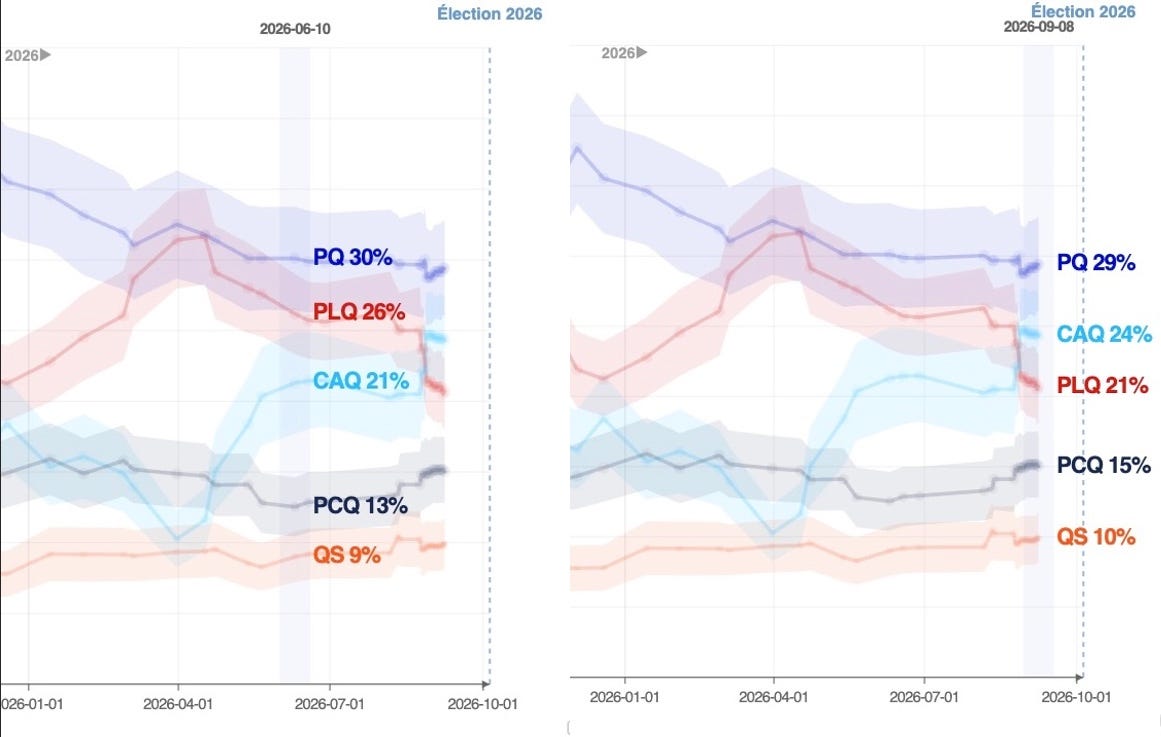
The CAQ and QLP have switched places. I find it difficult not to see that as a major change. (Yes, it falls within the margin of error of an individual poll, but 12 polls in less than three weeks confirm the trend.)
Limiting the analysis to the past three months is also a little convenient, especially since going back just one more month makes the movement even more striking. Here is what it looks like if I add mid-May as a starting point.
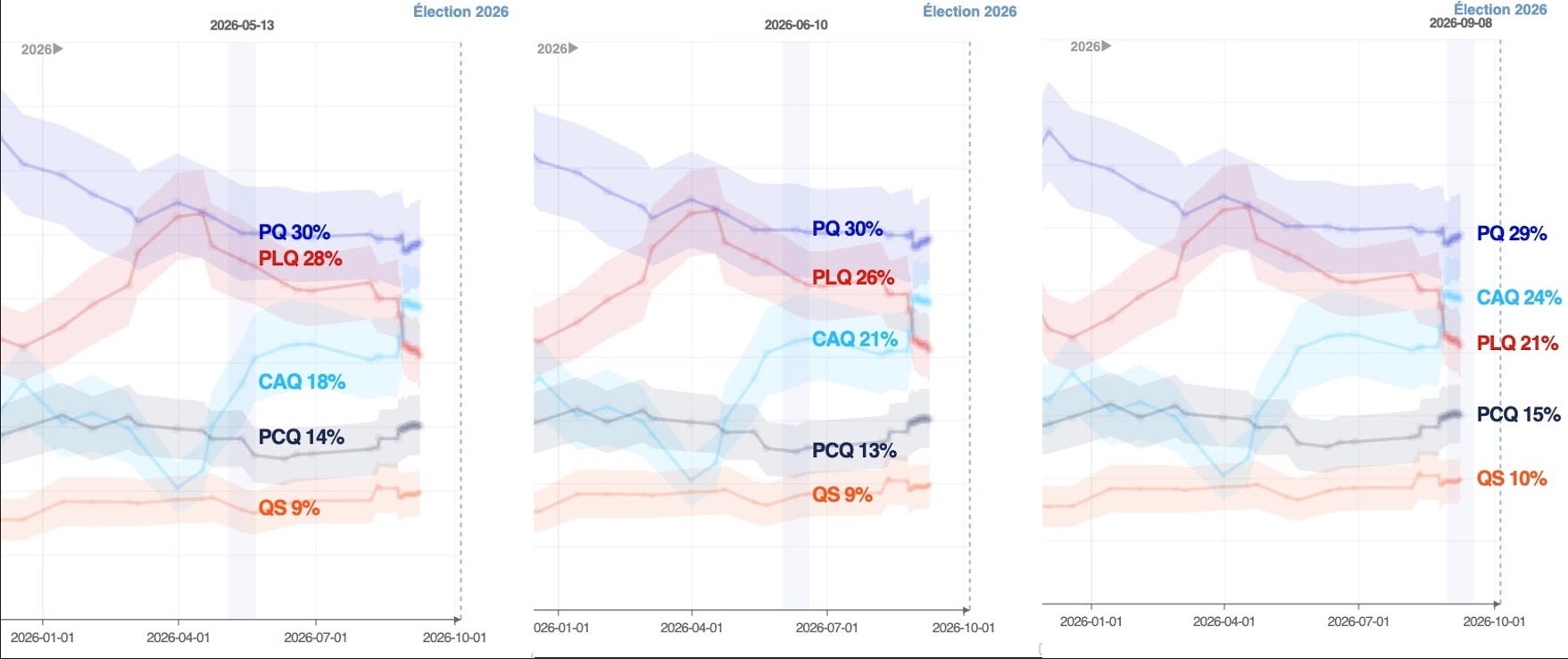
If the CAQ were to take one point from the QLP, it could form the official opposition. If it took two points from the PQ, it could form the government.
Everything else is conjecture.
Quebec City’s Mayor Wants to Eliminate Homelessness
“This isn’t just a problem in Quebec City, Montreal, or central neighbourhoods. It’s a problem everywhere, in Quebec’s cities, communities, and villages. And it is possible to change the trajectory.”
Bruno Marchand, mayor of Quebec City and former president and CEO of Centraide in the Quebec City region, is asking the political parties to commit to “zero homelessness.”
That sounds like an ambitious plan.
Until you remember that approximately 18% of Montreal’s office space is vacant. That some of it can be converted. That other cities have done so. And that 25,000 housing units are sitting vacant. In Montreal alone.
People who study public policy have also known at least two things for several decades. First, providing someone with a roof over their head is the best way to get them off the street. Second, even though it is expensive, it costs less than a succession of crises, hospitalizations, and police interventions.
About 12,000 Quebecers are experiencing “visible” homelessness. The real number is at least twice as high, possibly more, and it keeps rising.
It used to be a downtown problem, especially in Montreal. Then it spread to the suburbs, including where I live, near the métro in Laval. Last summer, while cycling, I saw tents in Terrebonne.
There is no métro in Terrebonne, and it’s getting pretty damn far from downtown. I’d like to insert a witty line here, but I’m feeling a little discouraged.
May I ask you a favour? The next time someone offers to give you back $1 a week through a tax cut that will cost the public treasury $100 million, think about that.
Today’s World Champion
Marie-Pierre Élie is running for the Conservative Party in the Quebec City region.
She is also a well-known conspiracy theorist who took anti-vaccine positions during the pandemic. Nothing unusual so far. I count at least five of them among the Conservatives.
Ms. Élie has no regrets. Nothing unusual there either for the Quebec Conspiracy Cuckoo Conservative Party. She says she’s even “very proud” (très fière.)
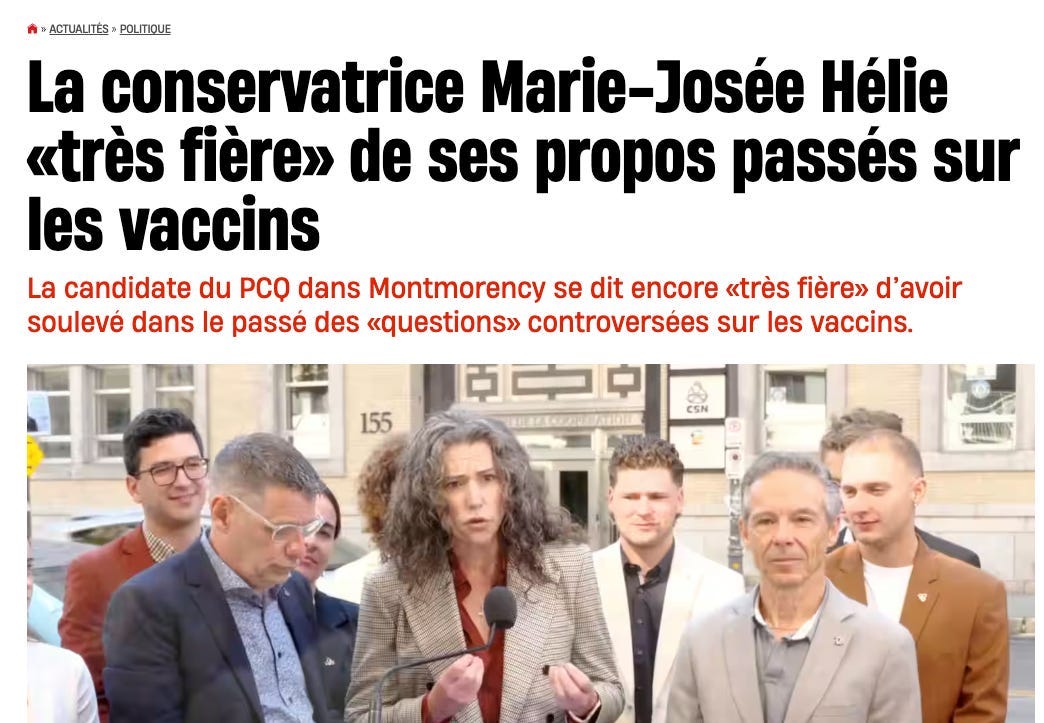
A quick salute to Éric Duhaime, on the left, who milked fears about vaccines for all they were worth during the pandemic, for both adults and children, but got vaccinated himself “after discussing it with his doctor.”
Ms. Hélie has found other ways to distinguish herself, including this one at her campaign launch.
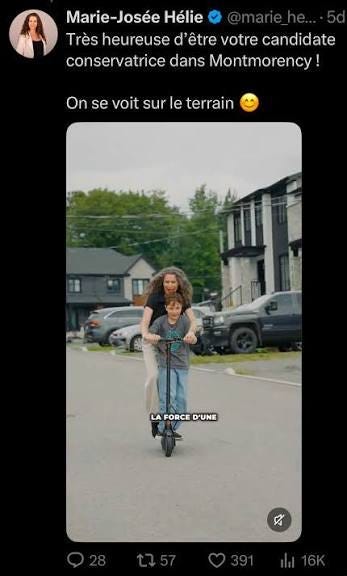
Two violations for the price of one in her candidacy announcement!
Ms. Hélie has a chance of being elected in Montmorency. It’s close, but it’s within reach.
Quebec may have found its Marjorie Taylor Greene.
I can’t wait.
PSPP Wants Us to Give Him a Majority of Seats
“The ability to act is greater with a majority government than with a minority government, where you have to seek another party’s consent to get anything done.”
Paul St-Pierre Plamondon, leader of the Parti Québécois, stating the obvious.
Mr. St-Pierre Plamondon knows perfectly well that, barring a spectacular reversal, he will not win a majority of the votes. So he is asking for a majority of seats in the National Assembly so that he can, among other things, call a referendum that a majority of Quebecers do not want. “Consent” indeed.
But… Mr. St-Pierre Plamondon also supports electoral reform, which, if done properly (remember the “if”), would bring majority governments to an end for the foreseeable future. Because that is pretty much the point of the whole contraption.
But… Mr. St-Pierre Plamondon would be perfectly happy to have a majority government. Just once. Sixty-four seats, pretty please.
Even if he won it with only 31% or 32% of the popular vote. A majority with 31%. And a 69% “minority.”
See how hypocritical this is.
This isn’t about wanting “a free hand.” It’s about using an artificial majority in the National Assembly to impose the will of a minority on the majority of the population.
+++++++
To those who think my views are coloured by my political preferences, I can assure you that my deep aversion to politicians who settle for a paper-thin majority to impose their agenda applies equally to every party seeking to exploit the flaws in our electoral system.
With my regards to the CAQ and QLP, which have indulged in this freely and show little remorse. But I expected better from the PQ, which got a taste of the system’s unfairness in the recent past.
In the 2022 election, the Parti Québécois received just under 15% of the vote. That should have been good for 10 to 15 seats. It won three.
Here is what Paul St-Pierre Plamondon said on October 3, 2022, on election night.
“In light of the results, which we recognize and accept, some very serious questions nevertheless arise. […] Rarely in our history have we seen such a disparity between the will of the people and the results in terms of seats.”
And the next day:
“The disparity between the popular vote and the number of seats is historic, and it is deeply problematic for democracy in Quebec. We received 15% of the vote, but not even 3% of the seats.”
I suppose our electoral system works poorly only for the losers.
Today’s Awkward Moment
On Tuesday, QLP leader Charles Milliard addressed the nation.
The speech, which he clearly did not write himself (or so I hope), contained a few valid points, though hardly original ones since they were shared by other leaders, including Christine Fréchette, a recurring problem for the QLP.
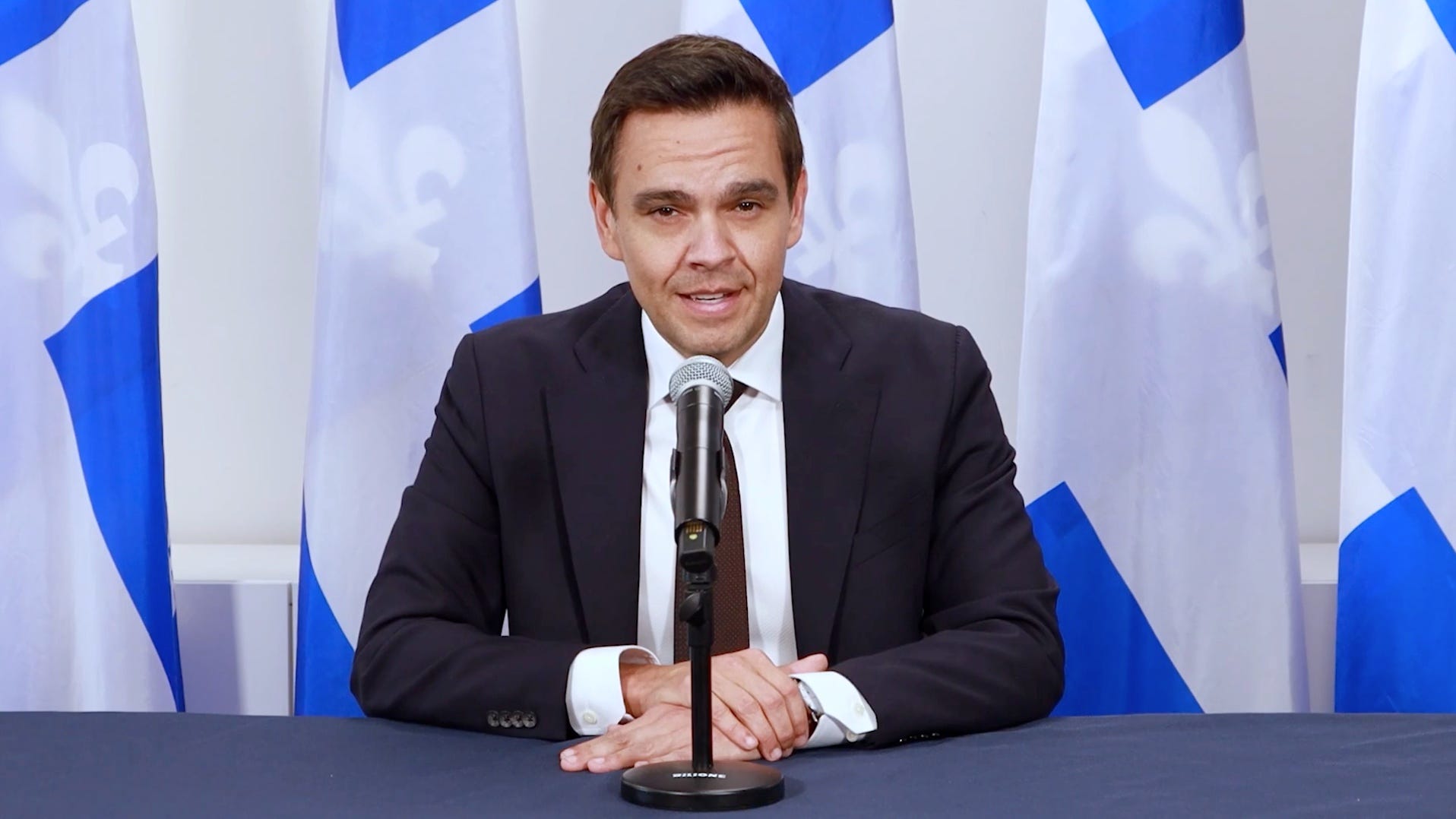
That said, why did watching it make me so uncomfortable? Was it the delivery, which reminded me of prayers being mumbled at Mass? The extreme coldness of a white-flag-on-white-background set, with the fleurs-de-lis fading away? The fact that he talks about his team while sitting there alone? The framing, reminiscent of François Legault’s pandemic addresses and the bad memories they evoke? The fact that the whole operation feels a little too prefabricated?
Or was it that, the day before, Mr. Milliard had denounced the government’s “theatre” in the following terms: “There will be a press conference, flags, long faces, and people lined up around a table telling us they’re there for Quebecers and will do everything they can to save Quebec.” Before putting on the same kind of theatre himself…
The point of a communications decision is to have a positive impact on the subject’s visibility or credibility.
I’ll let you judge for yourself. You can watch it here.
-30-
My name is Patrick Déry. I write for a living, and I am trying something different here. If you enjoyed reading this piece, you can support me by buying me a coffee. You can also subscribe to this publication (for free or as a paid subscriber; the choice is yours).
Comments, shares, and “likes” are always appreciated. It also helps the Substack algorithm notice me, so don’t be shy!