The Defence Bank, Linguistic Hypocrisy, and Sovereigntist Denial
The “fear campaign” isn't what you might think.
(Texte français disponible ici.)
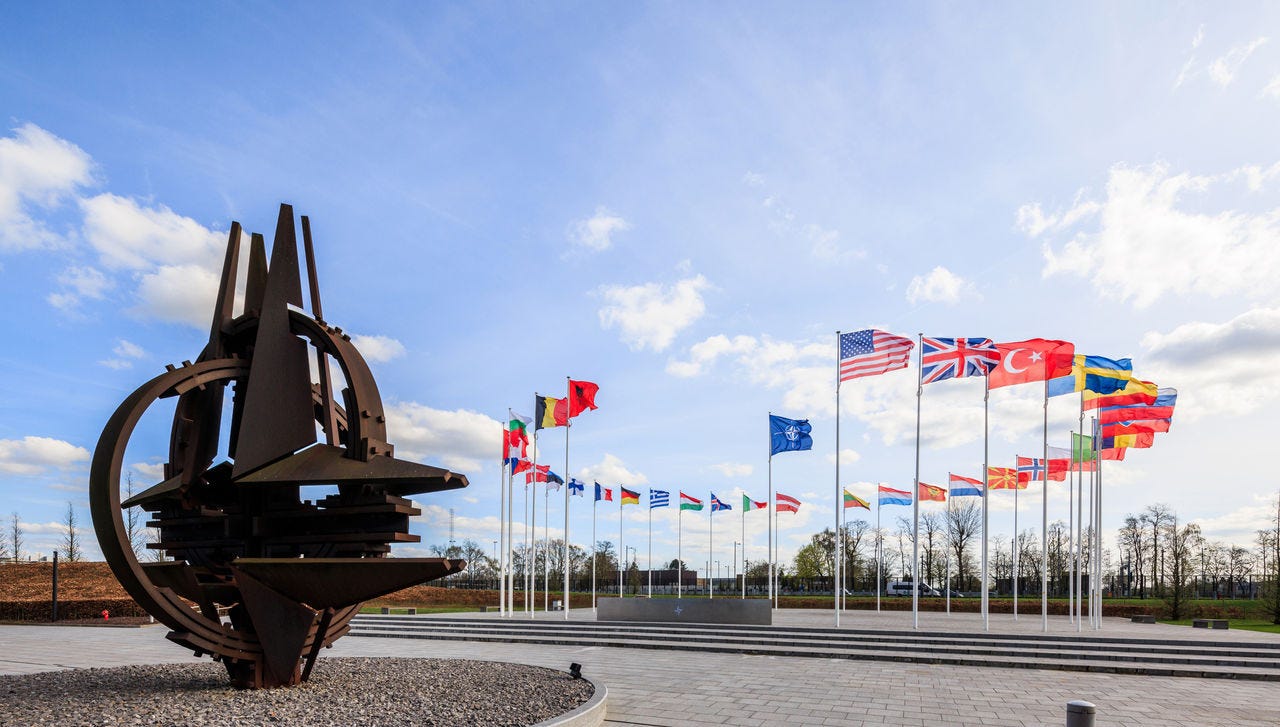
Canada will host the new Defence, Security, and Resilience Bank. In very broad terms, the bank will serve as a sort of financial arm of NATO, designed to support the development of defence capabilities of member countries.
Four Canadian cities, including Montreal, are vying for the headquarters, the prestige, and the anticipated economic benefits. The other three are Ottawa, Toronto, and Vancouver. Quebec politicians’ support for their city’s bid is almost as unanimous as their support for its hockey team during its playoff run. Only one party, Québec Solidaire, opposes it, for ideological reasons.
(Dear Ms. Ghazal, we’re against war too, but go ahead and explain that to Vladimir Putin or Donald Trump.)
Despite Montreal’s merits, Ottawa’s bid seems more logical, if only because the federal capital is home to both the seat of government, the Department of Defense and the military, as well as nearly all foreign embassies on Canadian soil.
That won’t stop Toronto, Vancouver, and Montreal from lobbying in the hope that the Defense Bank will set up shop in their cities, and each mayor and premier from touting their city and province. Because that’s what politicians do.
It was actually amusing to see Christine Fréchette tugging at Emmanuel Macron’s sleeve in the hope that he would do Montreal a favour. Did Ms. Fréchette seriously think that the head of state of Europe’s leading military power would risk appearing to try to influence NATO’s decision-making process, especially since France’s participation in the bank has yet to be confirmed?
Some of the arguments put forward to promote Montreal’s bid are even more fascinating.
In a letter to the National Post, Quebec’s Minister of International Relations and La Francophonie, Christopher Skeete, noted that Montreal is “the only North American metropolis where French is the official language and where English remains indispensable in business, science, and diplomacy.”
NATO’s headquarters are indeed located in Brussels, and its two official and founding languages are French and English, as specified in Article 14 of the North Atlantic Treaty.
Bernard Drainville, the Minister of the Economy, piled it on, noting that the eighteen countries that supported Canada “would be very happy for the bank to be located in a multilingual city” where one can “find people who speak [their] language.”
Other strengths of Montreal were highlighted. Yes, yes, the connection to Europe, international organizations, artificial intelligence, aerospace (the Defense Bank will not build aircraft, but let’s move on).
But “the only North American metropolis where English remains indispensable”? “A multilingual city?”
The same government that, for the past eight years, has placed the threat of the English language and the decline of French (which isn’t “declining” all that much, by the way) at the heart of its legislative agenda, suddenly sees the virtues of its metropolis’s bilingualism and multilingualism?
Because it’s mostly English that’s being discussed. No one speaks “multilingual.” But many Germans, Norwegians, Finns, and Eastern Europeans speak English, not to mention the British and Americans. And it’s true that Montreal is more English-speaking than Vancouver, Toronto, or even Ottawa is French-speaking. But since when has the CAQ considered this to be an advantage?
We’re talking about the same government that, with Bill 96, raised language requirements for small businesses, despite the additional costs and the message sent to entrepreneurs, and despite the tenuous link between the language of work with international clients and partners and the language spoken in daily life. (I used to work a lot with anglophones; I did not begin to use English with family and friends.)
We’re talking about the same government that starved English-language universities and raised tuition costs for students coming from other provinces because the previous premier, Mr. Legault, felt that he heard too much English in downtown Montreal, not to mention the damage to Quebec’s reputation when it comes to recruiting young talent from abroad.
We’re talking about the same government that imposed a cap on the number of students allowed to study in English in CEGEPs, and that is threatening to force students already enrolled in English in vocational and adult education programs to switch to French, even if there is no room for all of them in French-speaking classes.
We’re talking about the same government that considered passing a law to ban “Bonjour-Hi.” And now, we’re touting the city’s English character?
Well, who would have thought? Michael Rousseau would be pleased.
The prize for cognitive dissonance, however, goes to the Parti Québécois, whose MNA Pascal Paradis (hello, friend!) delivered a passionate plea for Montreal’s bid, extolling Montreal’s “linguistic diversity” and denouncing Toronto’s “fear campaign,” after Ontario Premier Doug Ford not-so-subtly raised the possibility of a referendum in Quebec.
The “fear campaign”? Can we put ourselves in the shoes of NATO leaders for just two minutes?
For the sake of argument, let’s say you’re a senior official or a five-star general within NATO. Your job description, as a decision-maker for a military alliance comprising 32 countries, includes trying to anticipate everything that could go wrong. In fact, being a bit paranoid is an asset, and it is this ability to anticipate pitfalls four or five steps ahead that has led you to the highly strategic position you hold today.
The member countries of your organization have chosen Canada—and Mark Carney to some extent as well—following the repositioning vis-à-vis the United States illustrated by his speech in Davos.
For the headquarters of the new Defense Bank, you must choose between four cities. One of them is located in a province that could secede from the host country, or, at the very least, hold a referendum on the issue, as the leader of the Parti Québécois, Paul St-Pierre Plamondon, has promised. Mr. Plamondon (or PSPP), is also the politician most likely to be the next premier in five months. Doug Ford didn’t need to point that out; there are people at NATO who must know that too. Political changes within member countries are certainly part of strategic intelligence.
PSPP also said that he considers Mark Carney—the guy who won Canada’s nomination—to be in a position of “colonial domination” over Quebec, much as England might have been over India or South Africa. No kidding.
Another sovereigntist party leader, Yves-François Blanchet, head of the Bloc Québécois, has argued that Canadian federalism poses a greater threat to Quebec than the United States.
Even if the bombastic rhetoric is more about posturing than substance, would you seriously insist that the NATO Secretary General recommend to the leaders of member countries that they locate the headquarters of the new organization in a region that could be torn apart for years over its political status, both before and after a potential referendum, when there are other perfectly suitable cities, including the country’s capital (Ottawa) and its financial hub (Toronto)?
Neither would I.
The “fear campaign” denounced by Quebec politicians of all stripes is not directed at Quebec, and it does not originate in Toronto. It is a distinct Quebec product, manufactured by sovereigntist politicians, and aimed at Ottawa because it serves their interests.
But sometimes, the political boomerang comes back, and there are consequences. It would be honest to own up to them.
-30-
My name is Patrick Déry. I write (mostly in French) for a living, and do my best to Quebecsplain in English in this space.
If you enjoyed reading this piece, you can encourage me by buying me a coffee. Comments, shares, and likes are always appreciated.
You can also subscribe to this media by clicking on the button below.


