


(Texte français disponible ici)
There’s something extraordinarily contrived about the interviews early on election night, as journalists try to fill airtime while waiting for results.
First, we get commentary on who’s “ahead” or “behind” with results from just one or two ballot boxes, which tells us nothing statistically. Besides, the first results come from advance voting, which took place before the CAQ’s meltdown at the end of the campaign and the Quebec Conservative Party’s comeback.
During the first hour after the polls close, it would be more informative to air a documentary on Quebec’s political history, a clip from Soirée canadienne, or old Cyniques sketches while a few more votes are counted.
Instead, we watched Patrice Roy express surprise over and over at “very, very incomplete” results. He must have repeated that 200 times.
🤷♂️
It’s also funny to hear party representatives refuse to address the obvious, saying there could still be surprises.
There are rarely any big surprises. If every commentator still talks about the NDP orange wave, it’s because that was the last time we were really surprised on election night, in Quebec and across Canada. That was 15 years ago.
We know the Parti Québécois will win, we know the CAQ will get clobbered, we know the QLP will form the official opposition, we know QS will find a way to hang on, and we know the QCP will enter the National Assembly as the third-largest party.
(I deliberately wrote this paragraph in the present tense, at around 8:45 p.m., and didn’t change a comma afterwards.)
Yet candidates, journalists, and commentators play along, as though an athlete ranked 24th in the world were about to win Olympic gold.
It’s not completely impossible. But it’s so rare that when it happens, they make a movie about it.

We keep up the illusion anyway, for the sake of the show.
So, at 8:37 p.m., Radio-Canada dramatically “predicted” that the Parti Québécois would form Quebec’s next government.
Oh, really.
For almost three years, every poll has been predicting exactly that, including three a week since the campaign began, each showing a lead of at least ten seats.
At 8:48 p.m., Radio-Canada followed up with another bold prediction: it would snow again this winter.
Since we need something to do while waiting for the results, I decided to put together a few statistics for you to keep.
But first…
The least representative government in Quebec’s history
It’s settled. The Parti Québécois will form government. It’s neither a surprise nor a disappointment: democracy has spoken.
The Parti Québécois deserves to form government. Not because it ran the best campaign, has the best team, the best platform, or the best take on sovereignty.
Maybe it does. Or not. It doesn’t matter.
The PQ deserves to form government because a plurality of Quebecers voted for the PQ.
But it didn’t deserve to form a majority government. Not because it ran a worse campaign, has a weaker team or platform, or promises a referendum.
The PQ did not deserve a majority government because a very clear majority of Quebecers voted for another political option.
Those Quebecers also have a right to be heard and represented. And the PQ has a duty to take their views into account.
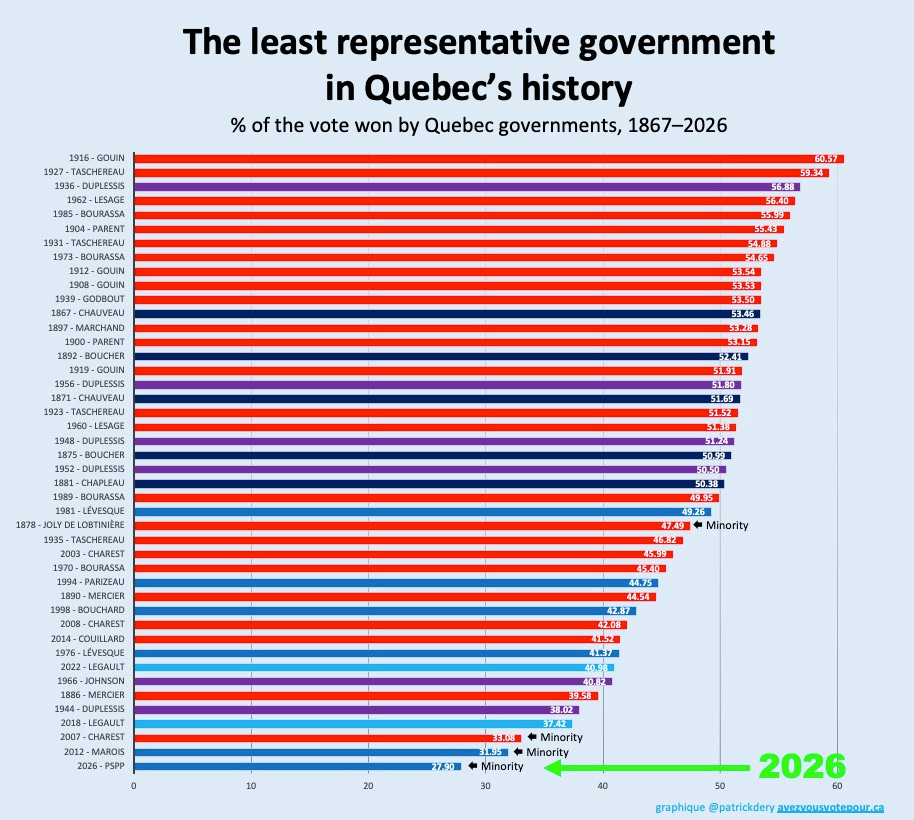
The government elected on Monday is the least representative in our entire political history.
This isn’t about the PQ, the QLP, the QCP, or QS. It isn’t about sovereigntists or federalists, the left or the right.
It’s about fairness and democratic legitimacy.
If Quebec were a mature democracy with a less prehistoric electoral system, we would have spent the evening, and even the past few weeks, discussing possible alliances for a coalition government, as happens almost everywhere in Europe.
The Parti Québécois leader would also have considered his options, perhaps even put out a few feelers to his political rivals.
Because Quebec’s democracy is ailing, the Parti Québécois and its leader spent the final days of the campaign handing out treats left and right (mostly to the right) to lock up a few more votes, promising a cabinet post for their Arthabaska candidate, a football stadium in Quebec City, and a discount on gas in Charlevoix.
Instead of trying to win broader support and represent more people, they looked for shortcuts so they wouldn’t have to consider what a majority of Quebecers wanted. By offering to buy votes, just like in the good old days.
I hope the PQ will fix the problem by changing the electoral system, and that the other parties will cooperate. And I hope we’ll fix it with genuine proportional representation, rather than some semi-proportional gimmick that could still deliver a “majority” with 40% of the vote, like the one currently being considered.
There was one piece of good news on Monday night, though.
François Legault was elected after swearing he would change the electoral system. His party will disappear because he lied.
The CAQ will go down as nothing more than an unfortunate interlude in Quebec’s political history.
Karma.
The final numbers
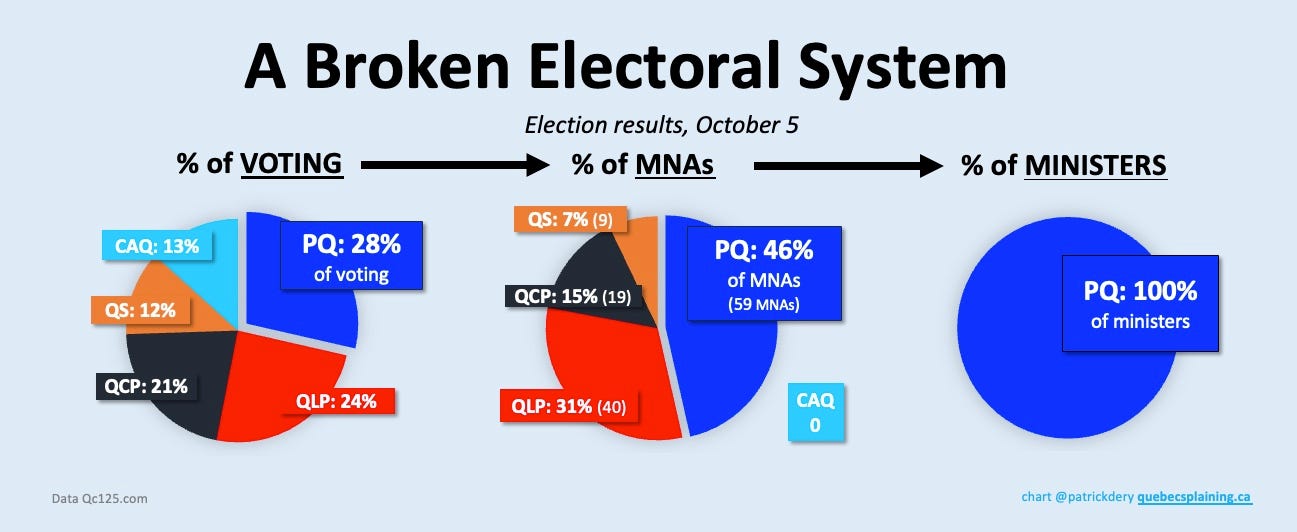
· The Parti Québécois formed government with less than 30% of the vote. That had never happened in 160 years and 43 Quebec general elections;
· The previous record was 32% under Pauline Marois in 2012, followed by 33% under Jean Charest in 2007;
· The CAQ’s collapse compared with the 2022 election is the worst in history, both in seats (-90) and in vote share (-28 percentage points);
· Second place goes to Robert Bourassa’s QLP: its caucus shrank from 102 to 26 in 1976, and its vote share dropped by 21 percentage points;
· The QLP may be back up to 40 seats, but it has recorded the second-worst result in its history, with just 24% support. That’s better than Dominique Anglade in 2022 (14%). But it’s lower than Philippe Couillard in 2018 (25%);
· With 28% of the vote, the Parti Québécois received less support than in its defeats in 1973 (30%), 2003 (33%), 2007 (28.4%), and 2008 (35%);
· The pollsters got it right.
Support for the Parti Québécois has barely budged in five months
· The QLP fell, the CAQ collapsed, QS rose a little, and the QCP rose a lot;
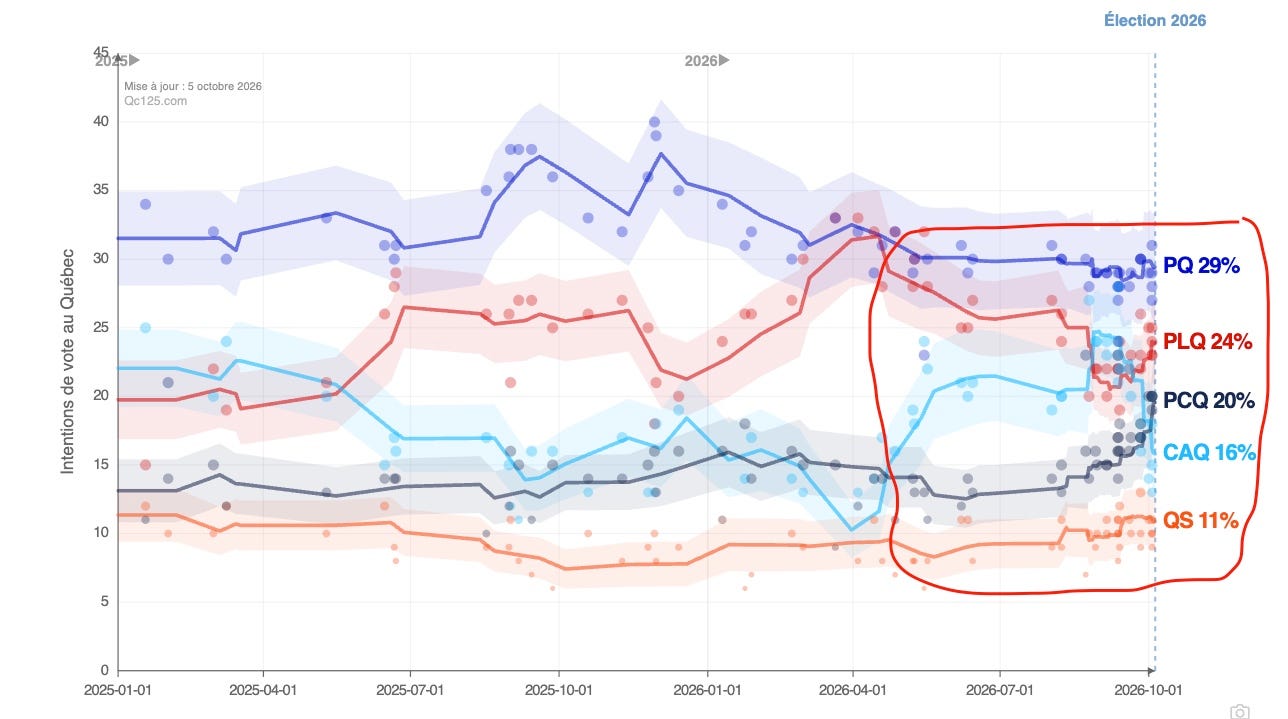
The final numbers are: PQ 28%, QLP 24%, QCP 21%, CAQ 13%, QS 12%.
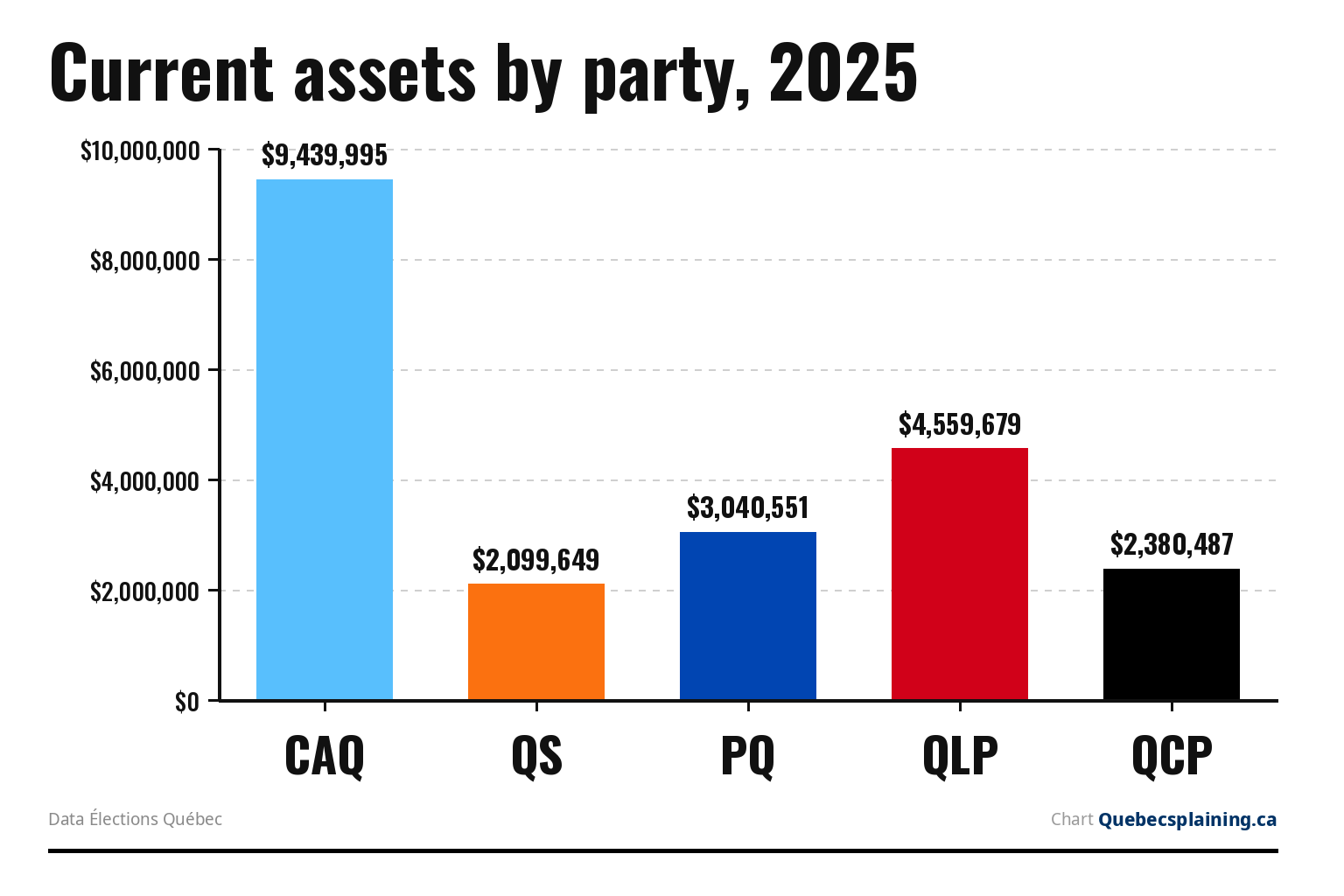
What will happen to the CAQ’s election war chest?
At the end of 2025, the CAQ had almost $10 million in the bank. For a while yet, it will remain the party with the deepest pockets… but not a single MNA.
Why vote?
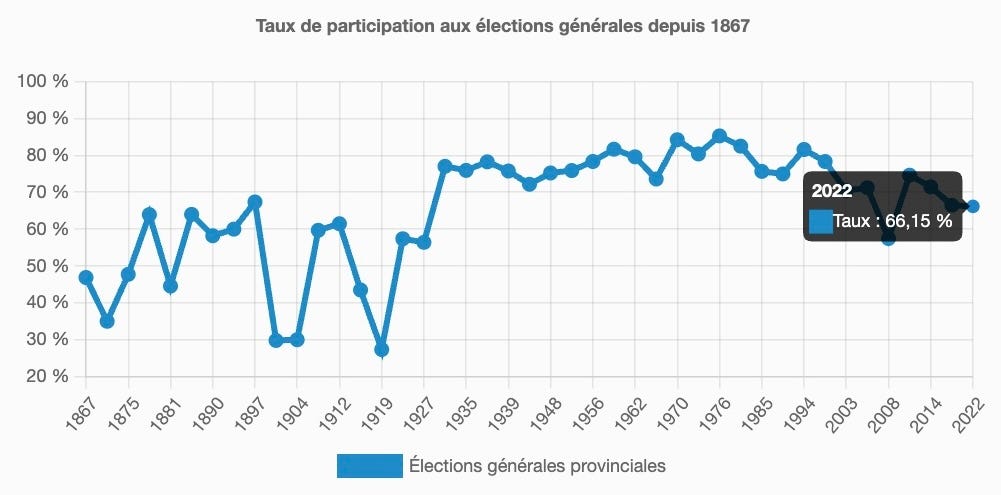
Final turnout should be around 68%, one of the lowest rates in the past 100 years and similar to the last three elections. No appetite for politics? A lack of trust? Both?
Source: Élections Québec
The quote of the evening
“We will be a government that speaks with great candour and authenticity.”
- Paul St-Pierre Plamondon, in his victory speech.
How do I put this? If the past is any guide to the future…
That gives me a few ideas for a column. I’ll come back to that soon.

The marathon is over!
That’s the end of my election marathon. In fact, in my mind, I was done on Friday, but I wanted to offer one final round of analysis on election night, for your sake and mine, to bring things full circle properly.
If my count is right, I’ve produced 31 editions of this campaign journal (not counting the few days off), for a total of 65,000 words.
That’s the equivalent of a 250-page book, plus the visuals, charts, and research.
Thanks for being here with me throughout this stimulating challenge. Thank you for reading, for the likes and hearts, the comments, and the support.
I’ve seen healthy growth in free and paid subscriptions, bringing this original, independent publication a step closer to long-term sustainability. That’s still my goal, and I’ll be counting on you to help me get there.
I’m taking a few days off to rest and think about where to take this publication in the weeks and months ahead.
It’ll be an eventful fall. Politicians will keep stretching the truth a little. And a few members of the Quebec Conservative Party’s all-star team have been elected. This should be good.
I’m already looking forward to it.
See you very soon,
Patrick
-30-
My name is Patrick Déry. I’m a French-speaking Québécois who writes for a living, and I’m trying something different here. If you enjoyed reading this article, you can support me by buying me a coffee. You can also subscribe to this publication (free or paid, your choice).
Comments, shares, and “likes” are always appreciated. They also help the Substack algorithm notice me, so don’t be shy!