


(Texte français disponible ici)
The Supreme Court has sided with the Quebec government in its battle to save Bill 21.
In a four-to-three decision, the Court ruled that Bill 21 is shielded by the pre-emptive use of the Canadian Charter’s notwithstanding clause, also known as the override clause.
Most champions of our superficial brand of secularism are overjoyed. On X, the ghost of François Legault celebrated too, “because that’s how we live in Quebec.”


A former political strategist turned commentator seized the opportunity to pay tribute to the Dear Leader.


(I had to check twice to make sure the AI slop with Stalinist overtones was real.)
Defenders of fundamental freedoms are surprisingly happy too.
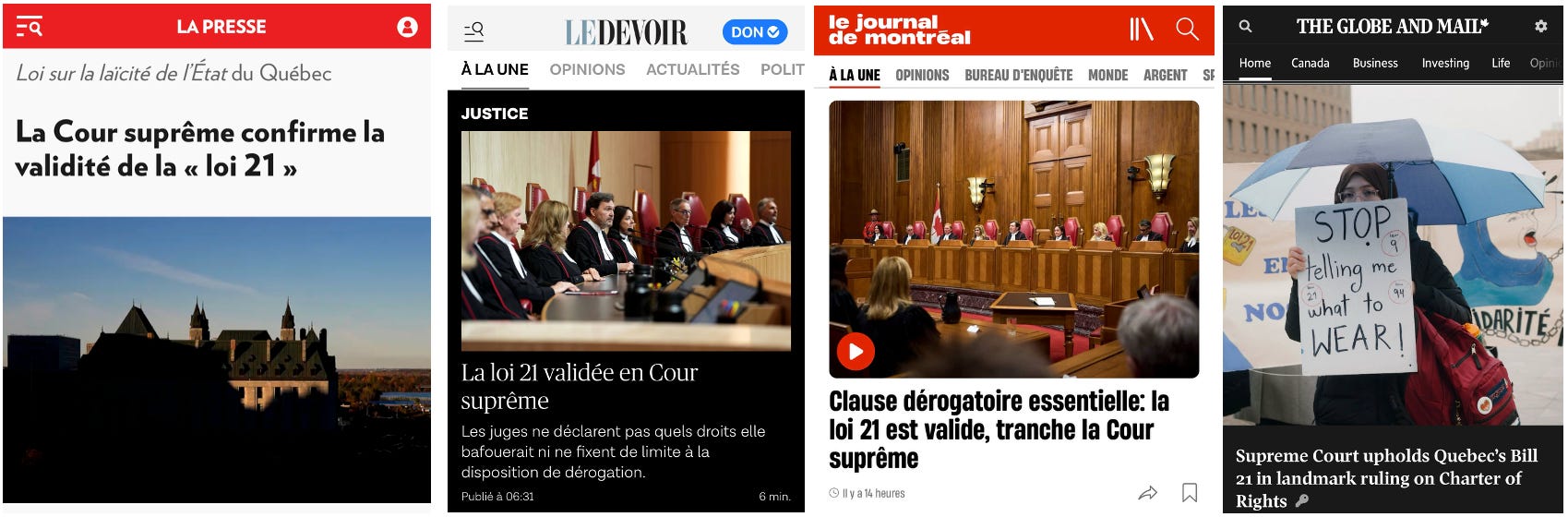
At first glance, it’s hard to see why. The headlines generally presented the Supreme Court’s ruling as an unqualified victory for Quebec’s government.
It’s a little more complicated than that.
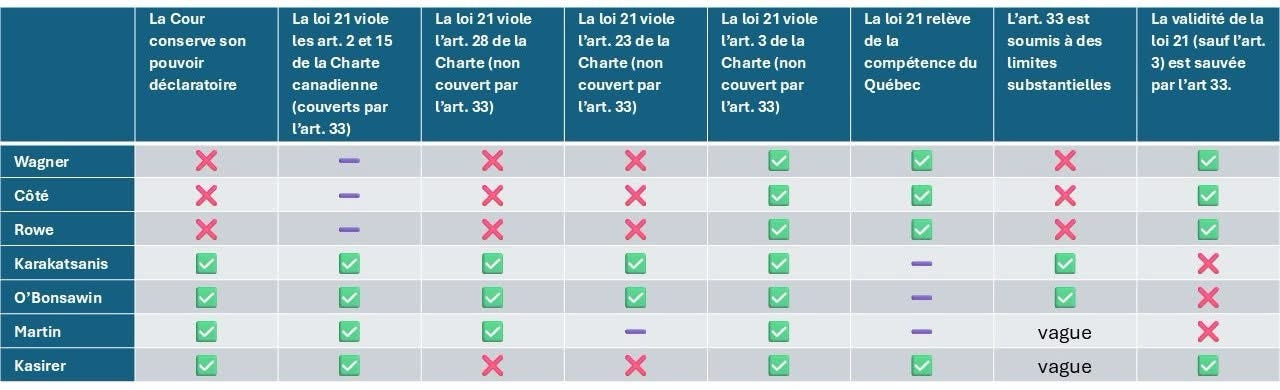
Three judges held that they did not need to decide whether Bill 21 violated most of the Charter rights at issue, since the notwithstanding clause made the question moot.
But the other four judges decided to do so. All four found that Bill 21 violates section 2 (freedom of religion) and section 15 (equality before the law) of the Charter.
That’s 100% of the judges who expressed an opinion on this aspect of Bill 21.
Except that one of those judges, along with the three who did not weigh in on Bill 21’s constitutionality, found that section 33 of the Canadian Charter, the notwithstanding clause, shields the law. Hence the Quebec government’s “victory.”
The headline we should have seen everywhere, but didn’t, was that a majority of Supreme Court judges found Bill 21 violates the Canadian Charter, even though the law is ultimately saved by the notwithstanding clause. One reason we didn’t see that headline appears to have been an error in the briefing notes prepared for the media, according to a lawyer who argued the case.
All seven judges also considered whether Bill 21 violates rights that fall outside the scope of section 33.
Three judges found that Bill 21 violates section 28 of the Charter, which guarantees equality between the sexes. Four disagreed.
The judges also unanimously found that Bill 21 violates section 3, which guarantees every citizen the right to hold elected office.
Finally, a four-to-three majority also held that the Supreme Court can explicitly rule on the constitutionality of a law protected by the notwithstanding clause. That part is especially important.
Because, as we saw above, they did rule on it. Which means they can do so whenever a government, here or elsewhere in the country, wants to limit the rights guaranteed by the Canadian Charter by invoking the notwithstanding clause or renewing its use.
It looks roughly like this, with thanks to Jérôme Lussier for untangling it all. I swiped his table, too.
+++++++
It’s this power to issue declaratory judgments that has put Paul St-Pierre Plamondon in a bad mood (again) over the Supreme Court’s ruling. At least until Quebec becomes a country.
Because the elected officials and legal experts who support Bill 21 know full well that it tramples on freedoms and is discriminatory, even if they won’t admit it. And they fear how public opinion would react to rulings highlighting repeated violations of Quebecers’ fundamental rights.
That is precisely why those behind Bill 21 (and Bill 96, and Bill 9, and Bill 94…) felt the need to invoke the Canadian Charter’s notwithstanding clause.
It’s also why they decided to amend the preamble to the Quebec Charter and systematically override it in advance.
Not the evil Canadian Charter. Ours. The one that came first, Bourassa’s Charter, the one René Lévesque was so proud of too.
Lévesque was a statesman, and his words bear repeating:
“In 1975, the people of Quebec adopted a Charter of Human Rights and Freedoms that remains, to this day, one of the most comprehensive in the world. Such a charter is the foremost means of affirming a people’s values. It expresses both their most fundamental convictions and the sometimes difficult choices and trade-offs that every society must make.”
And above all, this:
“It guarantees every person the minimum conditions for exercising their freedoms.”
Because this is no longer about secularism. It’s about freedom. We tend to forget that.
As Jacques Parizeau reminded us during the 2013 debate over the charter of values, the question of the Quebec state’s “secularism” had been settled since the 1960s. Parizeau, lest we forget, opposed the PQ’s proposed ban on teachers wearing religious symbols, which the CAQ would eventually adopt.
In an interview well worth watching again, “Monsieur” rejects every specious argument used to defend this secular fundamentalism, from completing the Quiet Revolution to preserving Quebec’s identity.
After pointing out that modern Quebec had never banned any expression of faith by Catholics or Jews, Parizeau asked the only question that matters:
“Regardless of which government was in power, we have never banned anything religious through a law or regulation. So we have to ask ourselves: why now, and why Muslim women?”
I got a pretty good idea of the answer today on Facebook, in an enlightened comment on this question of fundamental rights:
“All she has to do is take off her f…ing dishcloth.”
Others say it more politely, or put it differently, but that pretty much sums up how one of our most fundamental freedoms is understood by politicians and the public in 2026.
In the immediate aftermath of the cataclysm of the Second World War, freedom of religion was enshrined in the 1948 Universal Declaration of Human Rights as one of the pillars of our modern democracies, alongside freedom of expression, freedom of the press, and freedom of opinion.
In Quebec, our Charter expressed it this way in sections 3 and 10:
“3. Every person is the possessor of the fundamental freedoms, including freedom of conscience, freedom of religion, freedom of opinion, freedom of expression, freedom of peaceful assembly and freedom of association.”
“10. Every person has a right to full and equal recognition and exercise of his human rights and freedoms, without distinction, exclusion or preference based on race, colour, sex, civil status, religion, political convictions, language, ethnic or national origin or social condition.
Discrimination exists where such a distinction, exclusion or preference has the effect of nullifying or impairing such right.”
I have deliberately kept the original 1975 wording. The language was absolute, with no qualifications. For the founder of the Parti Québécois, these were the “minimum conditions” for exercising our freedoms.
That “minimum” has taken quite a beating since.
The first salvo targeted a minority within a minority. In 2008, to soothe our collective anxieties, we proposed treating a religious tradition more visible than others like a contagious disease.
We lumped the hijab in with the kippah and the Catholic cross, but Muslim women in Quebec were the real targets.
To ease our consciences, we contemplated restricting the fundamental rights of only those who wield the state’s coercive power, telling ourselves it would stop there: police officers, judges, prosecutors, and prison guards. What slippery slope?
The ban proposed in the Bouchard-Taylor report was almost entirely theoretical. How many judges in Quebec wore religious symbols? How many police officers? Prosecutors? Prison guards?
So we all accepted it.
Even though no one has ever been able to establish a causal link between wearing a religious symbol and proselytizing. Even though the most radical and militant believers, often men, don’t wear them. Even though other countries, as well as most of our own country, have shown that coexistence and tolerance are entirely possible. Even though a judge or a policewoman in a hijab has never caused any more problems than one without it.
Bouchard and Taylor’s original proposal, later disavowed by Taylor, seemed like a compromise with broad support at the time. Jean Charest’s Liberals shelved it before the ink on the report had even dried.
But the door had been opened.
Then came Pauline Marois’s government and the charter of values. We went from “coercive power” to “authority figures.” And we decided that a teacher was an authority figure, so her fundamental rights had to be restricted.
Go ask teachers whether they feel like authority figures…
But it would stop there. Cross our hearts and hope to die.
The charter of values went down with the PQ in 2014, but all the groundwork had been laid for the CAQ, which passed Bill 21 in 2019.
Once again, that was supposed to settle the debate. It didn’t.
Last year, educators in school daycare programs were next. We all understand that they have to maintain some discipline, but we’re getting pretty far from judges and police officers…
And, just to be on the safe side, every adult who comes into contact with students was lumped in too, from library and cafeteria staff to volunteers at a corn roast.
Nobody had asked for that. Are they authority figures too? “Clean your plate, or else…”
Last spring, educators and other staff at CPEs, Quebec’s early childhood centres, were added to the list. Nobody had asked for that either. The government did it anyway.
There’s no longer any attempt to hide it or justify it: the underlying and generally accepted message is that a hijab is radioactive.
During the election campaign, every party leader except Ruba Ghazal struggled to say they had no problem with people wearing the hijab in public. In public! Why risk defending principles if it might cost a few votes?
It didn’t stop when the Parti Québécois was elected. Quebec’s identity nationalists now have their sights set on the tiny minority of Quebec children who wear a religious symbol.
Paediatricians and an association of school principals explained that a ban was more likely to do harm than good.
The new Minister of National Education (yes, they added that) said it was “non-negotiable.”
We’ve gone from people wielding the state’s coercive power to little girls. This is no longer a slippery slope. It’s a free fall.
In its final days, the CAQ had tried to push through a constitution that would have put our fundamental rights in a straitjacket. Apparently, inventing the pre-emptive suspension of those rights wasn’t enough.
For more than 40 years, successive Quebec governments took pride in guaranteeing our rights and freedoms through compromises forged in debate. The governing party always made it a rule to reach agreement with the opposition, because balancing our most sacred rights calls for more than a simple majority, especially when that majority represents a minority of Quebecers, as has usually been the case over the past 60 years.
The CAQ took a chainsaw to our rights and freedoms anyway, using closure to cut debate short, with the complicity of the PQ, which now intends to go after children.
Remember, this was supposed to stop with authority figures.
You may honestly have believed that. But for the zealots of secularism, it was just a Trojan horse.
There is another battle underway, and it is now targeting our institutions more broadly. The saga over the oath to the King offered a glimpse of it.
Everything gives way to identity nationalism.
+++++++
I live on an island named after the son of the Christian God, in Quebec’s third-largest city, itself named in honour of the first bishop of New France.
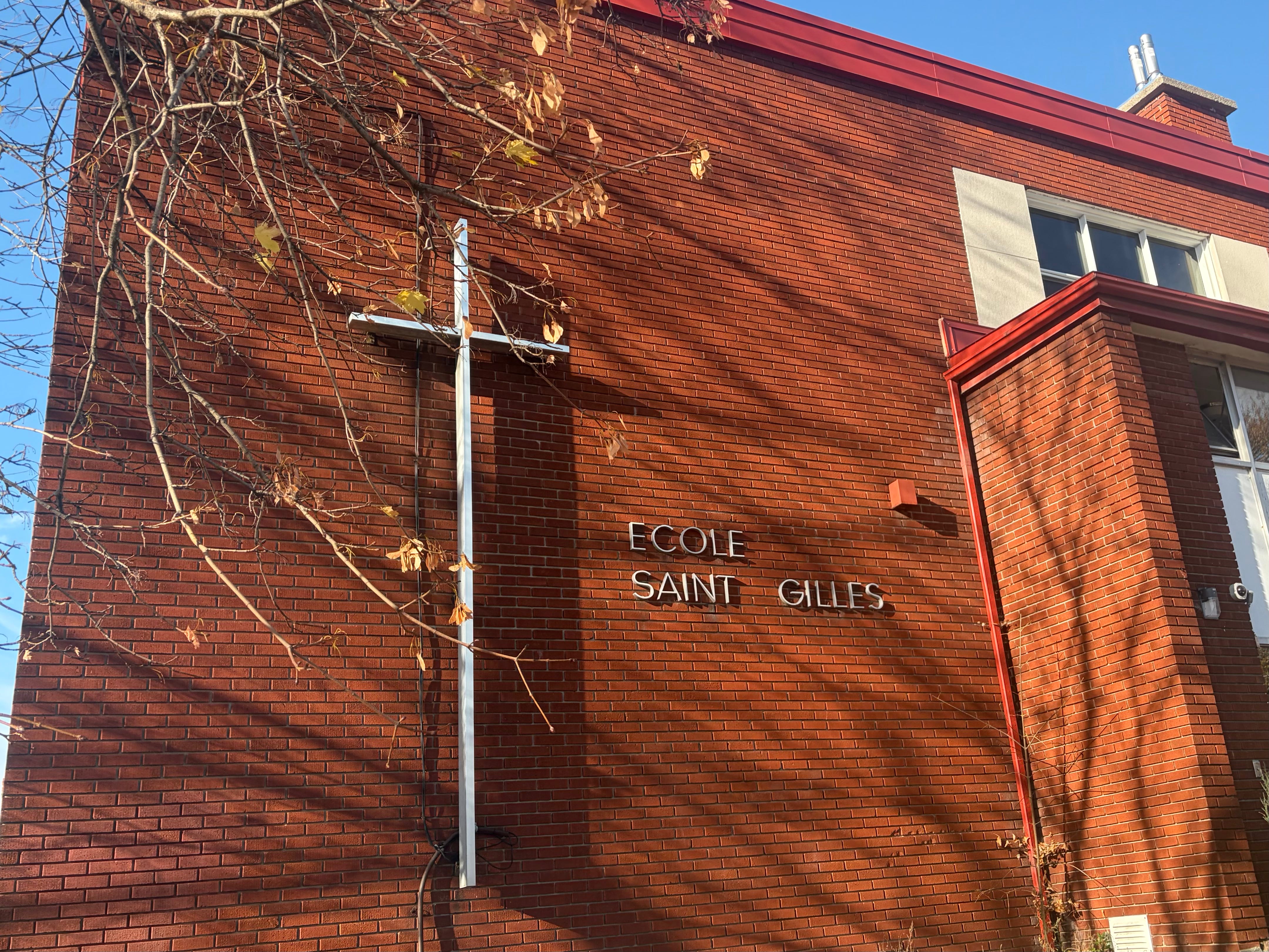
The neighbourhood school is named after a saint whose name appears on the façade, right beside a cross at least ten feet tall.
Catholicism is written all over Quebec, in the names of thousands of cities, villages, lakes, rivers, and streets, with wayside crosses, cemeteries, and churches lining the roads. We all enjoy paid holidays at Christmas and Easter, our national holiday is named after another saint, and Christian sacraments mark the births, marriages, and deaths of tens of thousands of Quebecers.
If this were about “secularism,” we would have cleaned house long ago.
At the very least, we’d have renamed a couple of schools and holidays.
-30-
My name is Patrick Déry. I’m a French-speaking Québécois who writes for a living, and I’m trying something different here. If you enjoyed reading this article, you can support me by buying me a coffee. You can also subscribe to this publication (free or paid, your choice).
Comments, shares, and “likes” are always appreciated. They also help the Substack algorithm notice me, so don’t be shy!