


(Texte français disponible ici)
The first one-on-one meeting between Quebec’s new premier and Canada’s prime minister will take place in Cambodia this week.
It has been surprisingly complicated to arrange.
It began as an olive branch from Mark Carney to Paul St-Pierre Plamondon after the latter snubbed the summit between Canada and the European Union in Montreal.
Mr. Carney had proposed November 9 in Ottawa or Gatineau, or November 10 in Montreal. Failing that, November 20 in the National Capital Region. Mr. St-Pierre Plamondon, for his part, insisted that the first meeting take place in Quebec City.
Even Mr. Carney’s schedule became a news story, as though Canada’s prime minister, between the trade war with the United States, discussions with Europe, and his regular duties, had to prove that he was busy and wasn’t planning a detour through Quebec City in the next few days.
(For anyone interested, in the space of just over a week, Mr. Carney will have travelled to the Caribbean for the Commonwealth summit, returned briefly to Ottawa for the budget, flown to Winnipeg, returned to Ottawa for Remembrance Day, and left the country for Cambodia, where the Francophonie summit is being held. During that same period, I have four hockey practices and a game for my youngest, and that’s plenty.)
PSPP invoked the law on Quebec’s national capital to justify his demands.
Every media outlet in Quebec took the talking point at face value and regurgitated it. But no one thought to check what the law actually says.
Passed in 2016 by the Couillard government, the law states that “Quebec City is the national capital of Quebec.” In Quebec parlance, that’s mostly a reminder that the capital isn’t Montreal.
Many MNAs represent ridings in Greater Montreal. Between the Island of Montreal, Laval, and the northern and southern suburbs, Greater Montreal accounts for 63 of Quebec’s 127 ridings, or half. As a result, many elected officials live and work in Montreal when the National Assembly isn’t sitting.
Several ministries also have offices in Montreal as well as Quebec City: International Relations, Higher Education, Education, Culture, Health, Economic Development, Family and Youth, and the Executive Council, the premier’s own ministry.
The same is true of several government agencies and other arms of the state: Hydro-Québec, Loto-Québec, the SAQ, the Office québécois de la langue française, the Régie de l’énergie, and SODEC, among others. The Caisse de dépôt and the Autorité des marchés financiers have their head offices in Quebec City, but most of their employees work in Montreal.
La Loi sur la capitale nationale is thus meant to counterbalance demographic reality. It makes Quebec City the “ideal and preferred setting” for “diplomatic meetings and government summits,” as well as for “welcoming foreign dignitaries to Quebec.” (Some PQ supporters no doubt have Mark Carney in mind when they read that last part. I’m not kidding.)
The law sets out a policy direction, one I agree with, but not an obligation. Hence the words “ideal and preferred.”
Anything else would be needlessly restrictive. And unworkable. Just imagine what would happen if the federal government or other provincial governments rigidly applied a similar rule. Does my law trump yours?
For the Parti Québécois, though, it was Quebec City or nowhere. So nowhere it was.
The first in-person meeting between Quebec’s new premier and Canada’s prime minister could have taken place on October 26 in Ottawa, at the summit with First Nations; it could have taken place on October 29 in Montreal, at the summit with the European Union; it could have taken place on November 10, again in Montreal, which, last I checked, is still part of Quebec.
Instead, that first meeting will take place sometime between November 14 and 16 in Phnom Penh, twelve time zones and 13,500 kilometres from Quebec City.
Here’s another way to look at it. There are a thousand things for Quebec and Ottawa to discuss or disagree on, and good relations at the top can help get negotiations moving one level down. Of course, that assumes the government in office wants to achieve things with Ottawa without worrying that success might undermine its narrative about the evil federal government plotting Quebec’s decline.
The Francophonie summit could have been the fourth meeting at the highest level between Quebec and Ottawa early in the new government’s term.
Instead, it will be the first, after three missed opportunities, because our stubborn premier is more interested in brandishing symbols than in advancing Quebec’s interests within Canada.
This has nothing to do with being a federalist or a sovereigntist. It’s just basic professional judgment and goodwill. As long as Quebec is part of the federation, it is in every Quebecer’s interest for the federal and provincial governments to find ways to work together. As former Bloc Québécois leader Gilles Duceppe put it: “Making things worse is the worst policy of all.” (“La politique du pire est la pire des politiques.”)
The same goes for the other provinces.
Which reminds me: on Friday, PSPP met with Ontario’s premier. The meeting took place in Toronto.
Oddly enough, no one mentioned the law on Quebec’s national capital to Doug Ford.
🤷♂️
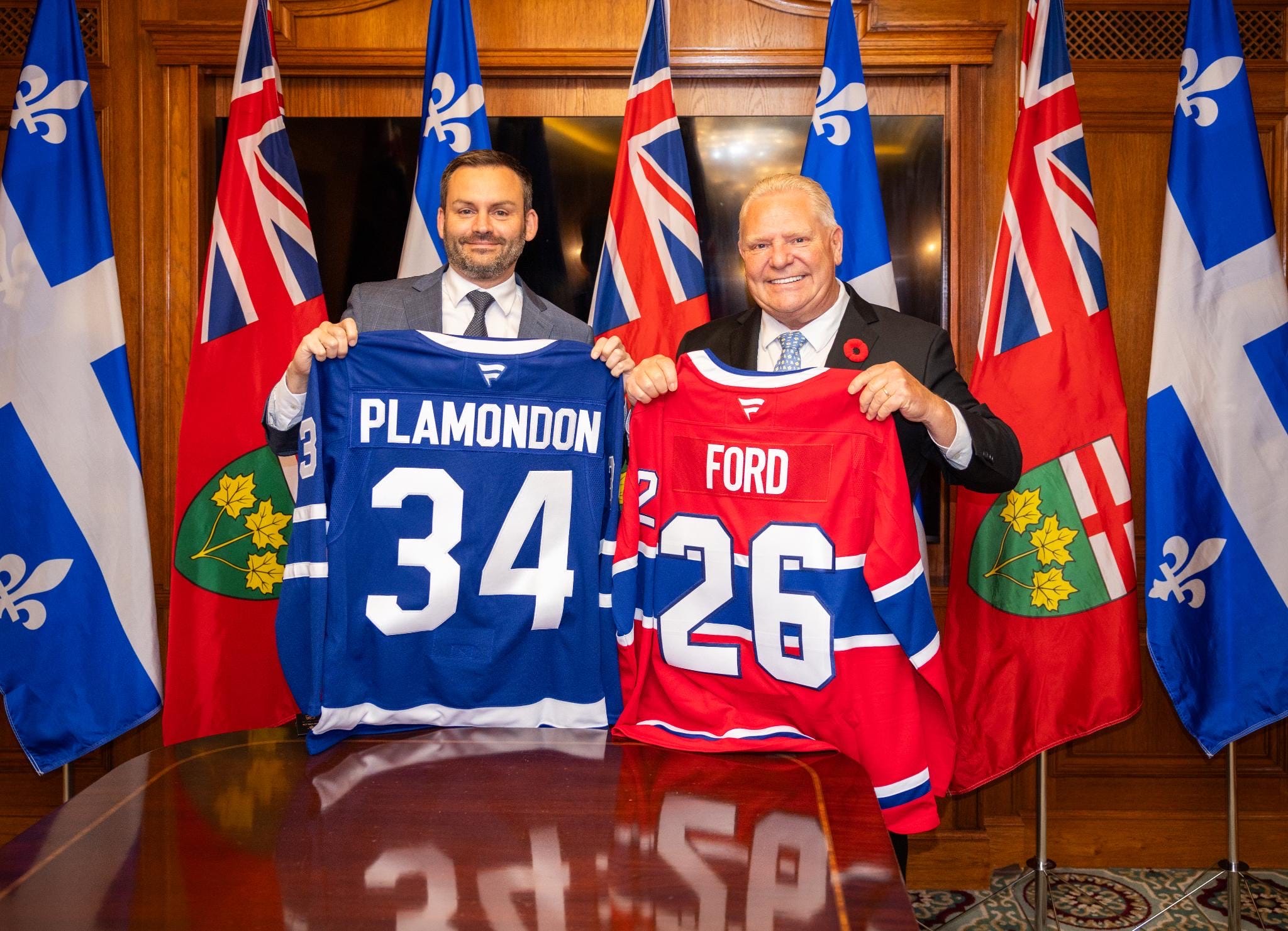
Quebec’s premier on his first trip abroad.
On October 5, when he became premier, PSPP told Mark Carney that “when he stands up for Quebec’s interests, he will find in me a partner for dialogue and cooperation.”
I laughed. Not because I disagreed with the idea, but because I knew it wasn’t true and that PSPP doesn’t think that way.
And really, none of this should come as a surprise.
Back in January, the Parti Québécois leader spoke for about twenty minutes at the close of his party’s convention. The speech followed an uproar over Mark Carney’s clumsy remarks about what the Battle of the Plains of Abraham meant for Quebec and Canada. But PSPP still laid it on a little thicker than necessary.
The particularly spicy prose offers a window into the mind of a PQ activist in 2026. I transcribed the speech for posterity and added some historical context, because the whole thing was particularly unhinged. You can read it in full here, if you’d like to treat yourself.
If you want the shorter version, I’ve pulled out a few choice excerpts below. There’s a recurring theme. I’ll let you guess what it is.
Feel free to read them in an angry, high-pitched voice.
“[The federalist camp] is therefore turning to a lie that has very often been used throughout our history and is central to how British colonialism works. That lie is that Canada is a respectful partnership that benefits Quebec.”
(…)
“I think Mark Carney is an intelligent man who is part of a long line of colonialists applying the techniques of British colonialism point by point.”
(…)
“[Mark Carney] has maintained a very British tradition of falsifying facts and history, of keeping us constantly mired in lies through federal institutions to make us believe that being subordinated and dominated is to our advantage.”
(…)
“Canada is founded on lies, and the problem with passively accepting this climate of colonial lies is that it leads to our decline. It leads to our erasure.”
(…)
“Quebec has survived as a distinct society with its own character, despite Canada. It has survived and achieved great things despite Canada, despite all the attempts at sabotage and assimilation. And these attempts are not confined to our distant past. They are recent. They are happening right now.”
(…)
“there is no partnership, because no people needs to be made a vassal. You cannot have one people dominated by another and then talk about cooperation. It’s the opposite. This domination is unhealthy, and it must end.”
(…)
“we will break with British colonialism and create our own country.”
(…)
“we have to recognize that the immigration, cultural, and language policies, and all the encroachments on our jurisdiction, that the federal government has imposed on us in recent years are what this is about: planned decline (…)”
(…)
“I am therefore offering Quebecers a difficult truth, while Mark Carney will offer them a comforting lie.”
I’ll remind you that this is just a sample. The speech contained a whole litany of wild claims that I documented and commented on here, notably about Gandhi and Mandela. Don’t say I didn’t warned you,.
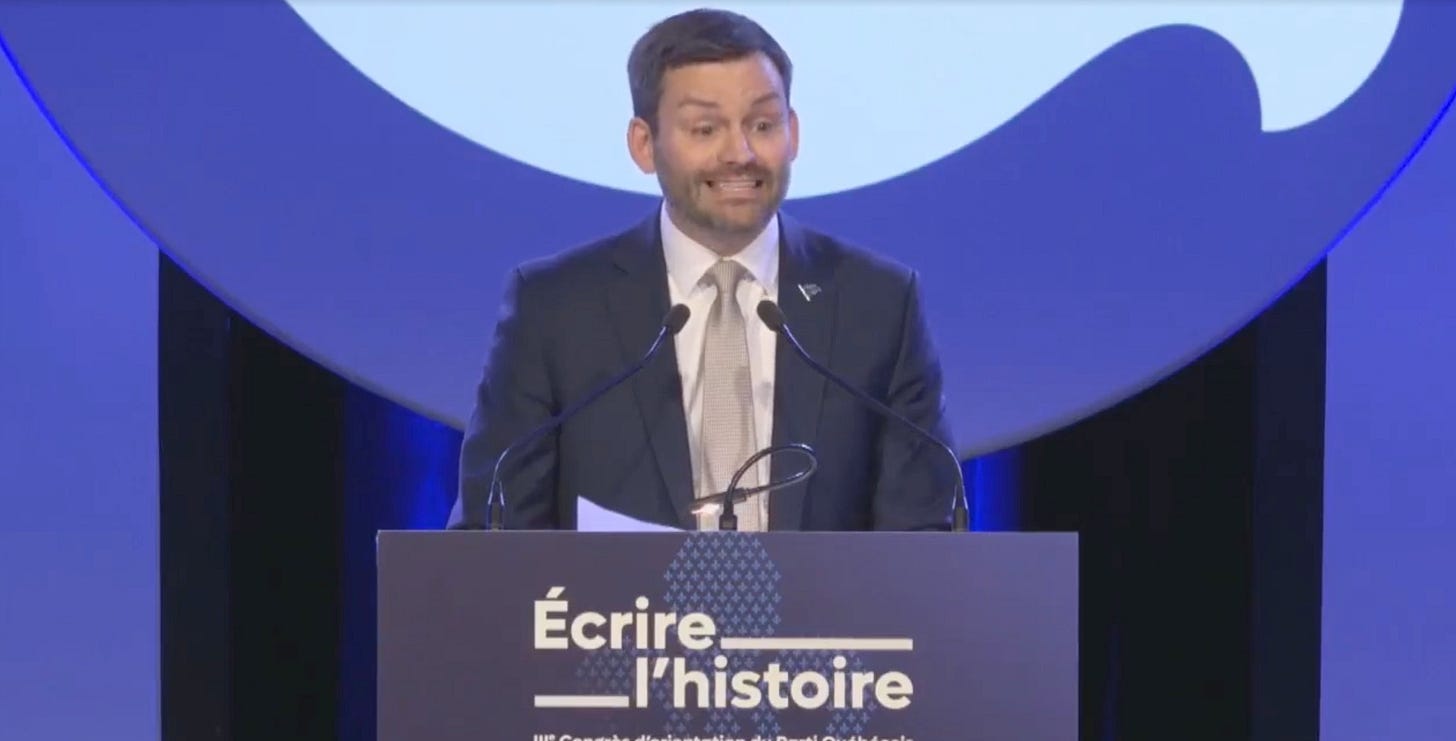
Quebec’s then future premier warning us about British colonialism.
So Mark Carney is a colonizer and a liar who imposes British colonial rule on Quebecers to plan our decline.
Now, you can agree with that, and some Quebecers do. But it’s hard to reconcile with a “partnership” built on “dialogue” and “cooperation.”
Because this wasn’t just a passing bit of partisan posturing. It’s the game plan. Whenever it can, the PQ blasts the federal government through every available channel. The leader and the MNAs do it; even the PQ’s communications director lets loose on social media.
That was the game plan before the election. It hasn’t changed. After being denied a chance to speak at the summit with the European Union, PSPP went off on a tirade about “water carriers” and “financial elites,” and invoked Le Temps des bouffons, a polemical film shot in the mid-1980s.
For the majority of Quebecers, who never knew that bygone era, this is, at the very least, a rather twisted and unhealthy form of nostalgia.
But those nostalgic for a fight to the death between Quebec and Ottawa are precisely the people the Parti Québécois and its leader are talking to.
The PQ also has media foot soldiers fuelled by the same resentment. The headline of this Richard Martineau column, published this week, perfectly captures that mindset.
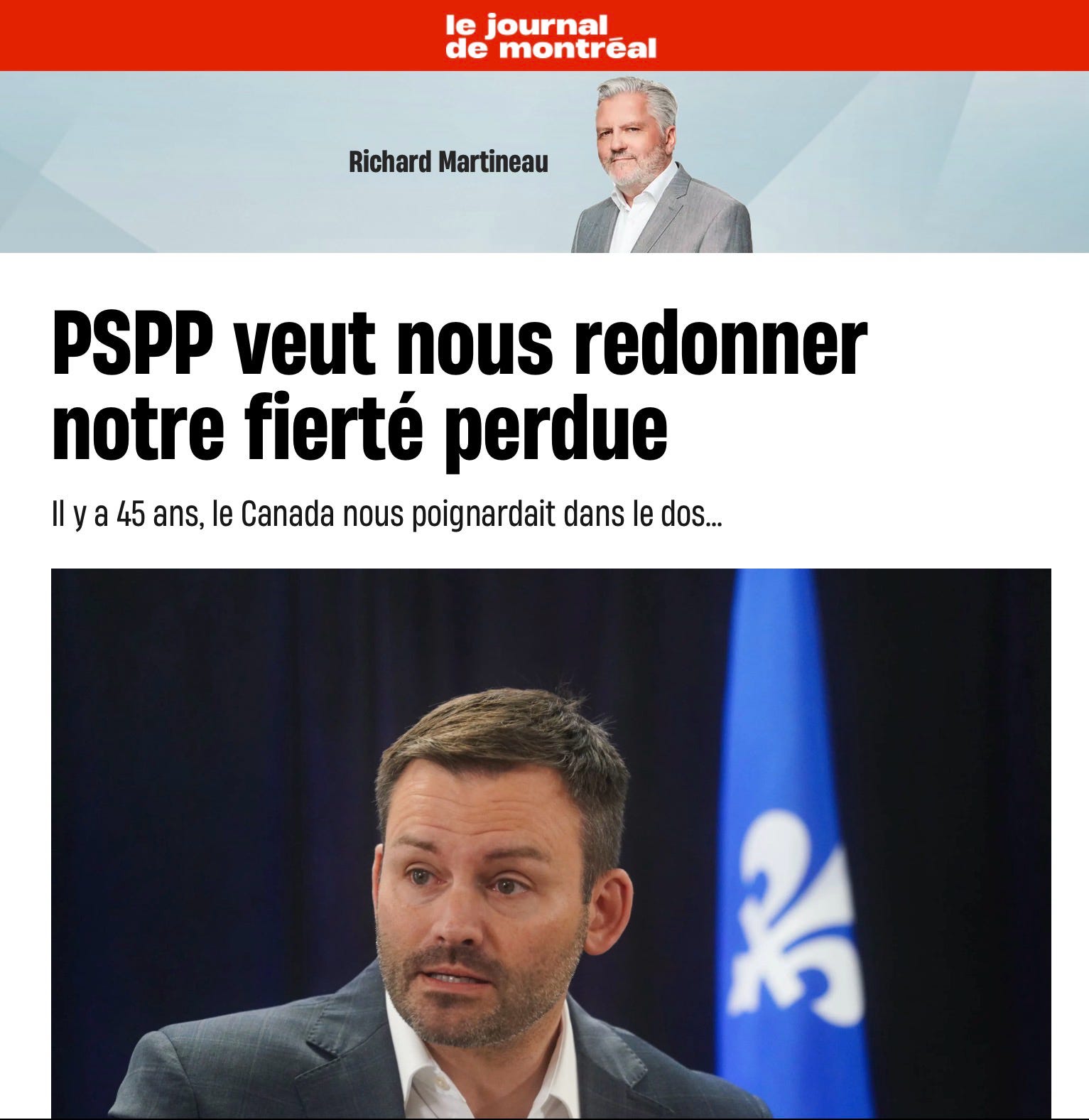
“PSPP wants to restore our lost pride.”
“Forty-five years ago, Canada stabbed us in the back.”
Martineau’s column is here, if you want to read it. I won’t go through all his arguments, because I often do that in my own columns, and also because it would take at least another 1,000 words that I don’t want to inflict on you.
But this remains the 2026 Parti Québécois’s stock-in-trade: an enduring, irreparable affront and wounded pride. An entire industry of commentators is paid (mostly by Quebecor) to feed this defeatist narrative.
Even among French-speaking Quebecers, this is very much a minority view. There is no lost pride to recover. There’s simply a Canadian federation that will always have room for improvement.
This summer, pollster Léger asked Quebecers whether they were proud to be Canadian.
Among Quebecers, 81% said yes. The Canadian average is 84%.
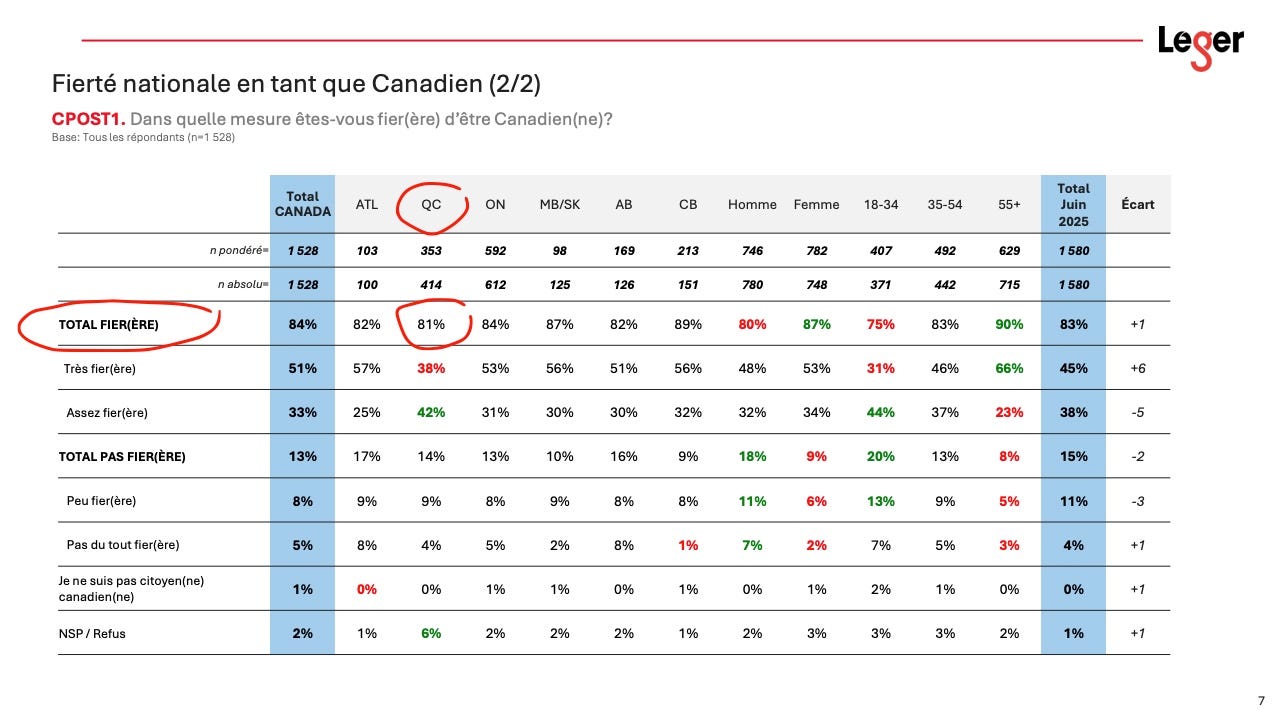
Even among Bloc Québécois voters, 64% said yes.
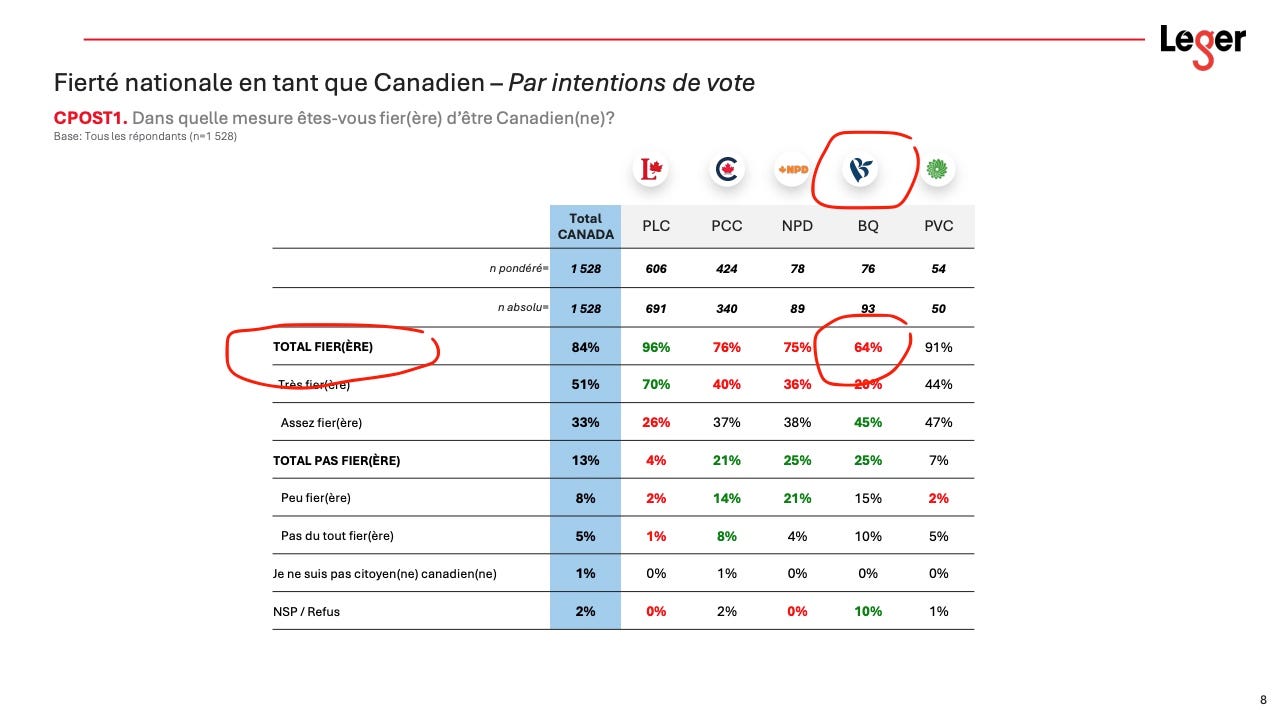
The vast majority of Quebecers no longer buy into the narrative of victimhood. But it’s the story the PQ has been selling, especially over the past two years, and the story it won the last election with.
Not “thanks to it,” because the PQ would probably have won a majority with a more moderate PSPP, every bit as articulate and talented, but with broader appeal.
But “with it,” because that’s the strategic choice the PQ made, because that’s the persona PSPP decided to adopt, and to inhabit. Now he’s stuck with it.
More than ever, the PQ has become the party of rehashing wrongs committed by a regime that ended 160 years ago, of the (fictional) decline of French, of pessimistic nostalgia steeped in insecurity, of fighting the Conquest all over again, of a diminished, vengeful, feverish nationalism with one foot in the 1970s and the other in the nineteenth century. It may seem completely surreal, and it is, because it speaks for only a shrinking minority of Quebecers.
Except that today’s PQ has never tried to represent all Quebecers.
It only had to bring together enough Quebec voters riled up about Ottawa to form a government, and it worked. The PQ found 28% of voters. It wasn’t much, but it was enough.
The result creates a gulf between Quebec as it really is and the Quebec the PQ presents to Canada and the world.
But that is how we will have to understand Quebec politics for the next few years.
-30-
My name is Patrick Déry. I’m a French-speaking Québécois who writes for a living, and I’m trying something different here. If you enjoyed reading this article, you can support me by buying me a coffee. You can also subscribe to this publication (free or paid, your choice).
Comments, shares, and “likes” are always appreciated. They also help the Substack algorithm notice me, so don’t be shy!
Seems like a Québécois Pierre Poilievre.
Ironic that Premier 28% emphasizes "lies" & "colonialism. "
The PQ big lie (à la Trump) is that French is in decline in spite of all evidence to the contrary. (Greater numbers and % of people speaking French) This allows the victim hood of immature "leaders " who try to justify an erasure of English and other languages, all the while campaigning on Montréal being an international city. With so many positives of Quebec’s location, achievements, culture, overall openness and opportunities as part of Canada and its adult in the room PM, PSPP is playing a childish game, like Farage played in the UK. Hopefully Quebec will be smart enough not to go through a Brexit-like folly.