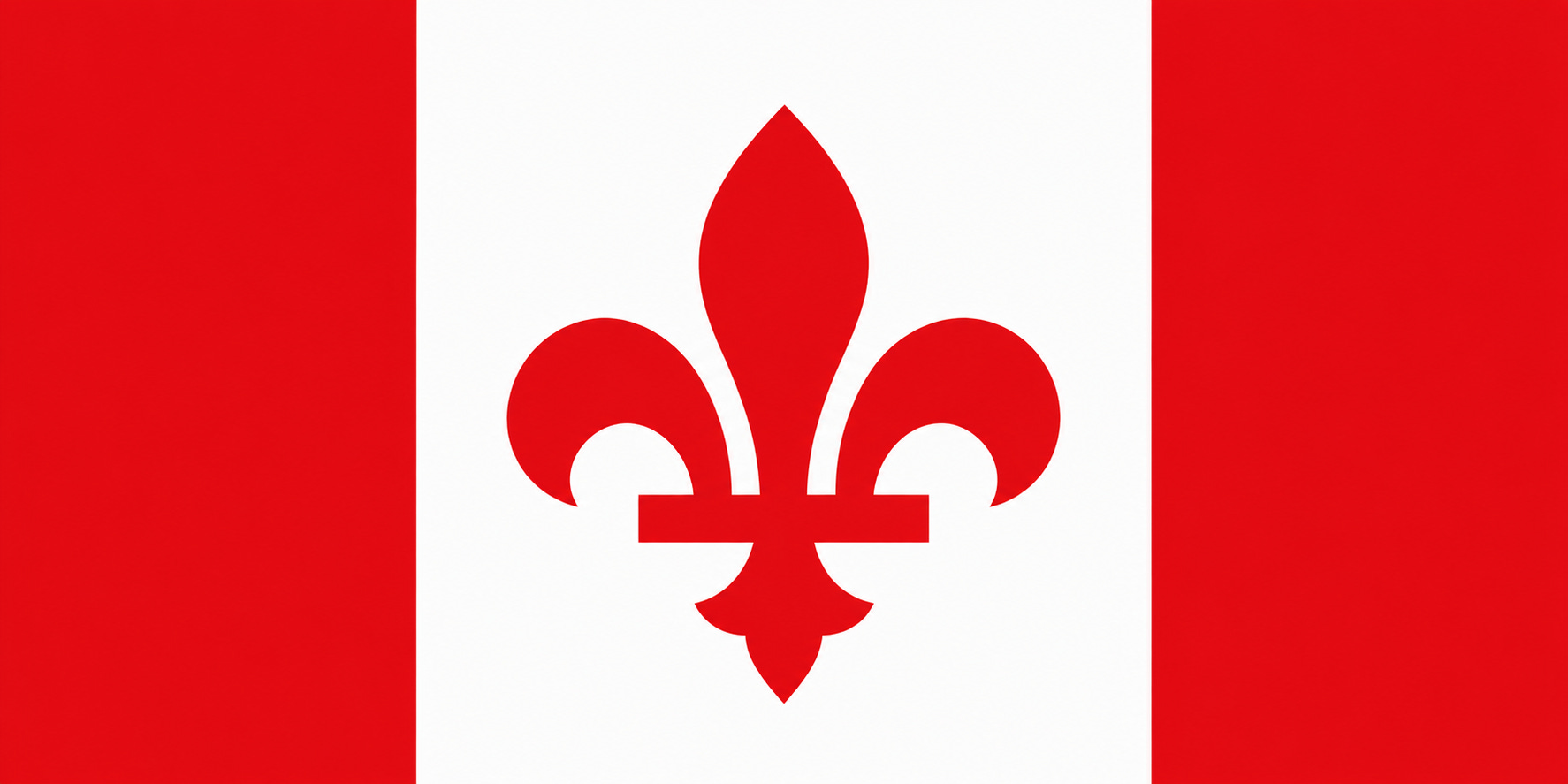
Are you celebrating Canada? Say thanks to Quebec!
If you like what Canada has become, there’s a good chance it’s thanks to... separatist politicians.
(Texte français disponible ici.)
I won’t be celebrating Canada Day. I’ve never celebrated it, and I’m not about to start today.
Nor have I ever celebrated Saint-Jean-Baptiste Day. Waving flags while everything that holds our society together is falling apart isn’t my thing. Or, in the case of July 1st, while a former UN Special Envoy on Climate Action and Finance is throwing the principles he sold us in his book straight into the trash.
Displays of national pride—whether in Quebec City, Ottawa, Washington, or elsewhere—all too often resemble massive distraction campaigns by politicians trying to make us forget their incompetence or their most indefensible maneuvers.
And then, I have this damned habit of always calculating, quantifying, and measuring. Canada’s relative standard of living has been declining for decades; the dysfunction of certain branches of the federal government is legendary; our military, once that of a credible middle power, has become insignificant; more than 150 years after Confederation, we have failed to agree on free trade among the provinces…
Let’s just say that the “fleurons glorieux” and the “true north strong and free” have looked better.
Even though I don’t have a maple leaf tattooed on my heart, I feel no particular animosity toward the Canadian flag and what it represents. Like most of my fellow Quebecers, I even feel a certain pride in the idea of being Canadian. And even more so when it allows me to say, while travelling, that I’m not American.
This isn’t unusual. Recent polls show that between 72 and 80% of Quebecers say they are “proud” or “very proud” to be Canadian.
(Since 32% of Quebecers currently support independence, that means up to a third of separatists would also be proud to be Canadian. Why, you ask? It’s complicated.)
There are also several reasons to prefer that Quebec remain a Canadian province rather than become a country.
I mean, aside from the fact that this is what two thirds of us want. An argument from majority is no more valid than the argument from authority, and the majority isn’t always right.
It’s obvious that having full control over one’s destiny has its advantages, no matter what some federalists may say. It’s just as obvious that there would be significant financial repercussions that could affect our standard of living and our public services, no matter what some sovereigntists claim. And besides, creating a country on the thinnest of margins isn’t a winning formula.
But we’ve been debating these arguments for 50 years without really listening to one another, and that’s not what I want to talk about today.
I’d like to point out that, on this Canada Day, Canadians A mari usque ad mare should celebrate Quebec. And that Quebecers should also feel a bit proud of having improved this country that was initially imposed on them.
Because just about everything Canadians love that comes from the federal government was most likely first a Quebec initiative. Because the social conscience of this rather conservative country—which sometimes claims to be progressive—is us.
Tommy Douglas and Saskatchewan gave Canada universal health insurance.
Everything else comes from Quebec.
Of course, it’s a bit embarrassing that it took so long to grant Quebec women the right to vote—in 1940, two decades after the federal government and most provinces—but you’ll see that we made up for it afterward, and then some.
The first law ensuring that women earn the same pay as men for doing the same work was passed by us in 1996. It took the federal government another 25 years to reach the same conclusion. RCMP officers, military personnel, and federal public servants are still waiting.
We were the first to establish a network of subsidized daycare centres back in 1997. It’s imperfect and incomplete, but better than anywhere else in the country. Here, too, the federal government needed another quarter-century to catch up.
Unsurprisingly, Quebec is the province with the highest employment rate for women aged 25 to 44, who are better able to balance motherhood with their personal aspirations than anywhere else in the country. Other Canadian women are beginning to benefit from this as well.
We were also the first to introduce a universal drug insurance plan, back in 1997. The other provinces followed suit.
The first same-sex civil union took place in Montreal in 2002, thanks to a Quebec law that preceded federal legislation by three years.
The first true parental leave program, including exclusive leave for fathers, was introduced here in 2006. Quebec remains a model in this regard.
These firsts aren’t just Canadian—they’re North American.
We were also the first to legalize assisted dying in 2015, and that sparked a debate that reached all the way to the Rockies and beyond.
And there are others, less fundamental but still noteworthy.
Quebec has strictly prohibited advertising aimed at children for nearly 50 years. The rest of Canada is still considering it.
It was also in Quebec that the first public no-fault auto insurance system for bodily injury claims was implemented in 1978, replacing legal proceedings that were as inaccessible as they were uncertain.
As for the right to abortion, we can once again say thanks to a Montreal doctor who made it his cause. This led the Quebec government to announce that it would no longer bring criminal charges for abortions performed in clinics. That was in 1976, twelve years before the landmark Supreme Court decision that decriminalized abortion across the country.
In addition to social progress, Quebec has also pioneered significant democratic advances that have since spread to other jurisdictions.
Quebec was the first province to limit political donations from individuals and to lower the cap on those contributions. That was in 1977. Here, too, the federal government took a few more decades to follow suit.
If you feel that Canada isn’t evolving quickly enough, consider that things could have been much worse without Quebec’s tendency to take its inspiration from continental Europe rather than England or the United States, as most of Canada tends to do.
The most frustrating thing for the Rest of Canada is that most of these advances took place under a government of the Parti Québécois.
Just imagine: if Canada has become what it is today—especially in terms of social policies—it’s largely thanks to the separatists!
+++++++
The same argument applies to Quebecers who dream of independence. Not a big fan of Canada? You might like even less what it would have become without us.
Without Quebec, Canada would have had more Conservative governments, and those Conservative governments would have been quite a bit more conservative. But Quebec prevents that, if only because the parties vying to govern in Ottawa need us.
Whether it’s social policies, environmental policies, or policies regarding the rights of Francophones in other provinces, Quebec’s mere presence in the Canadian federation pulls it toward progressive policies, in the truest sense of the word: those that bring about progress.
All of this is then reflected in Canada’s foreign policy, which is also that of a country where the second-largest province is predominantly Francophone. Abroad, Stephen Harper usually began his speeches in French.
Put another way, being part of Canada may not always be ideal, and the Rest of Canada can be a bit annoying, but a Canada without Quebec would be a far more unpleasant neighbour.
Without Quebec in the last election, Pierre Poilievre would be firmly in control of a majority government. Trump on one side, Poilievre on the other. Does that sound appealing?
In short, Quebec makes Canada better.
Even if it’s not entirely on purpose on the part of Quebec—or of the rest of this strange country—it might be worth giving it some thought on this 159th anniversary of Confederation.
-30-
My name is Patrick Déry. I’m a French-speaking Québécois writing for a living, and trying something different here. If you enjoyed reading this text, you can support me by buying me a coffee. Comments, shares, and “likes” are always appreciated.
You can also subscribe to this media (free or paid, your choice).


