(Texte français disponible ici)
I’ve decided to make my life easier. Since the CAQ is unlikely to win a single seat next Monday, I’ve decided to stop covering its announcements. They’re increasingly smack of improvisation and desperation anyway.
One fewer party = 20% less work keeping tabs on everyone. That’s something, at least.
But if Ms. Fréchette or anyone else at the CAQ comes out with a real gem, I promise to tell you about it. We’re here to have some fun, after all.
OK, let’s dive in!
Simon Jolin-Barrette’s idea of consensus
Well, that didn’t take as long as I thought. I stumbled over another CAQ announcement from the weekend. The party promised to make its proposed Quebec constitution “Bill 1.”
I’m confused.
The CAQ had a large majority this spring. In theory, it had the power to ram its proposed constitution down the opposition MNAs’ throats, but it ultimately dropped it because just about everyone thought it made no damn sense, albeit for different reasons.
Why bring it back now?
Simon Jolin-Barrette, the outgoing minister of Legislative Rigidity Justice, said there was a “consensus” on his bill.
Oh? So everyone agrees now? Have I been living under a rock for three months?
“The opposition parties didn’t want Quebec to have a constitution at this point, for purely partisan reasons. They put partisan interests ahead of the nation’s interests, which is unfortunate,” Mr. Jolin-Barrette added.
So there’s no consensus at all?
A journalist asked Ms. Fréchette what she thought.
Her answer was that support from just one other party would be enough to pass the CAQ’s proposed constitution.
So the “consensus” is so strong that the CAQ would settle for support from just one of the four other parties represented in the National Assembly.
I’m even more confused.
What was Mr. Jolin-Barrette saying this spring? He blamed the proposal’s failure on “partisanship.”
“There’s nothing in the text, absolutely nothing, that’s problematic, especially after the consultations,” he said.
OK. Everything was fine, nothing was problematic, but the QLP, the PQ and QS were all against the proposal in its current form, along with a host of organizations, including the Barreau du Québec. That’s 100% of the people who will have to interpret the constitution, argue cases under it, and rule on it.
And Mr. Jolin-Barrette is still telling us everything’s fine, move along, nothing to see here?
It reminds me of that scene in Star Wars where Obi-Wan Kenobi manipulates stormtroopers into believing C-3PO and R2-D2 aren’t the droids they’re looking for.

Clearly, Simon Jolin-Barrette is no Jedi.
I really do admire people who can play you for a fool while keeping a straight face and sounding sincere.
But I prefer them as comedians rather than politicians.
Truth and reconciliation, in moderation
It had started out so well.
Early Wednesday, to mark the National Day for Truth and Reconciliation, Paul St-Pierre Plamondon posted a long message addressed to Indigenous communities, reiterating the importance of dialogue and proposing, among other things, to develop courses in Indigenous languages and cultures. An excerpt:
“The Quebec nation, First Nations, and Inuit share the same desire to protect and promote their rights, languages, and cultures. The commitments we are making today will foster the mutual understanding and co-construction [yes, that’s the word he used, Ed.] needed for a relationship with First Nations and Inuit based on respect.”
How lovely.
Mr. Plamondon even made an effort not to get angry about a federal holiday.
Later, someone asked whether adopting a provisional Quebec constitution would require Indigenous nations’ consent.
Well, no, said Mr. Plamondon. There are limits to understanding and co-construction, after all.
On Tuesday, PSPP had told the lieutenant-governor to get lost. She happens to be a member of the Mi’kmaq Nation of Gespeg.
Head in the clouds
Let me take two minutes to tell you about the kook QCP candidate of the day, because about a dozen of them are expected to enter the National Assembly soon.
Tarek Henoud is the QCP candidate in Arthabaska-L’Érable.
Mr. Henoud holds a degree in business administration, has 25 years of experience in management, business development, and entrepreneurship, has deep roots in his community, and is a father of three. He also has perfect teeth.
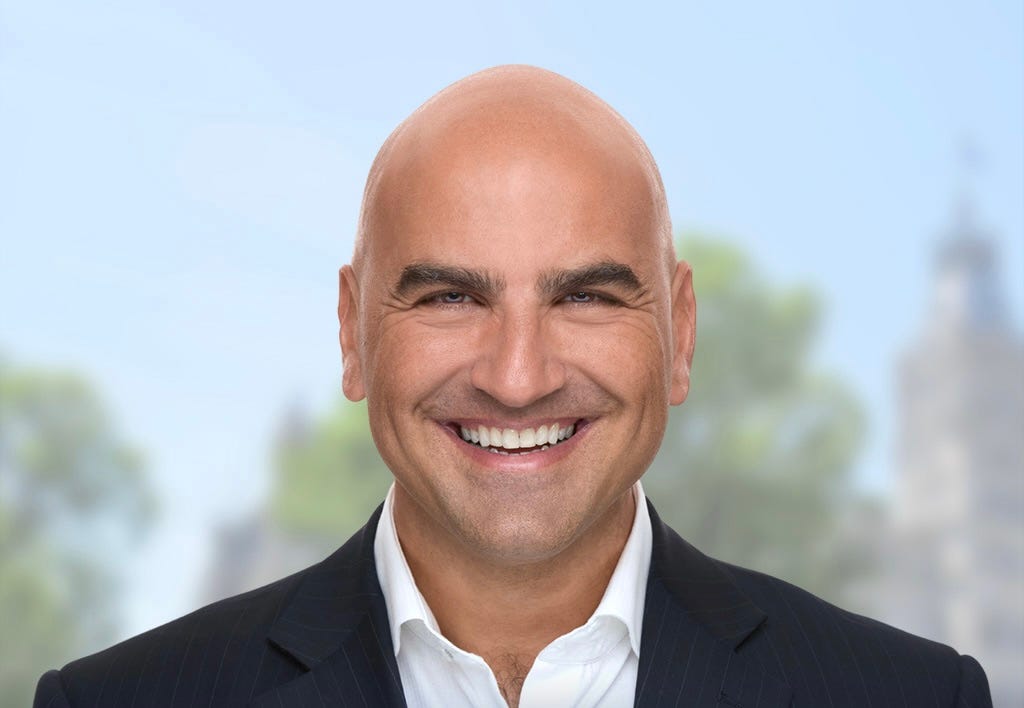
Source: Quebec Conservative Party
I’m sure Mr. Henoud is also a terrific neighbour, but that has nothing to do with being an MNA.
Anyway, when you and I look at planes in the sky, we see trails of water vapour condensing in the cold, thin air high in the atmosphere.
Mr. Henoud sees a bioweapon.

Facebook photo via Le Journal de Montréal
Mr. Henoud subscribes to other conspiracy theories, notably about the COVID-19 pandemic.
He’s also a fan of Christine Anderson, a member of the European Parliament for the AfD, a far-right party that, among other things, downplays Nazi crimes.

Source: Tarek Henoud’s Facebook page
Mr. Henoud has a good chance of being elected next Monday.
Roughly 15 to 22% of Quebecers believe in conspiracy theories. They tend to vote conservative.
Éric Duhaime has won
Last week, Éric Duhaime was promising to cut services for asylum seekers, including by cutting social assistance by 25%. In Quebec, the basic social assistance benefit is $845 a month. We wouldn’t gain much by making life more miserable for people who have left everything behind while they look for work (often in the health care system, by the way).
What’s more, the number of asylum seekers applying for social assistance fell by 60% between 2024 and 2025, as arrivals also declined. In other words, those who stay generally end up working. Duh.
Never mind. What matters is looking tough on foreigners.
But why stop there when you can score populist points by going after other easy targets?
Éric Duhaime supports the “user-pay” principle. In public policy, the goal is to align usage and incentives through price signals. Typical examples are gas taxes and tolls on roads and bridges: the former to curb consumption, the latter to fund maintenance.
Mr. Duhaime, who loves talking economic theory when it comes to health care and education, is far less enthusiastic about the principle when it comes to the third link and gas taxes.
Funny, isn’t it?
And what’s the connection, anyway?
On Tuesday, the QCP leader proposed making criminals pay part of the cost of their court proceedings and incarceration. That could be 20 or 30% of the costs.
Three things.
One, crime rates have fallen sharply over the past 30 years in Quebec and across the country, and so has the Crime Severity Index. We’re living in increasingly safe societies.
Two, the proposal is completely absurd, outlandish, and unworkable on its face, not least because many criminals have no declared income. And do we really need to explain the potential effects of saddling inmates with debt before releasing them from prison?
Three, the QCP won’t form the government, but it doesn’t give a damn. It’s becoming strong enough to scare the other parties, which keep helping themselves to its bag of populist, reactionary ideas.
The real winner of this election, over the next four years, will be Éric Duhaime.
And what the campaign reveals is that, as it gains ground, the QCP is moving from relatively vanilla economic populism, such as tax cuts, toward a vindictive, reactionary conservatism that plays on resentment and singles out groups to blame and punish.
With a gang of conspiracy theorists, anti-vaxxers, and other cranks, Éric Duhaime will have done more than anyone else in 30 years to shift the boundaries of what is acceptable in public policy.
The CAQ is in trouble even on its own Facebook page
A digital communications consultant decided to have some fun by tallying the reactions visitors left on the political parties’ Facebook pages.
Jonathan Thibeault measured reactions between September 27 and 30, after the last debate, but also after the spy novel parody the CAQ served up.
The CAQ’s Facebook page is a textbook example of “losing the room.” The most common reaction is “Haha,” accounting for 44.4% of the total.
😬
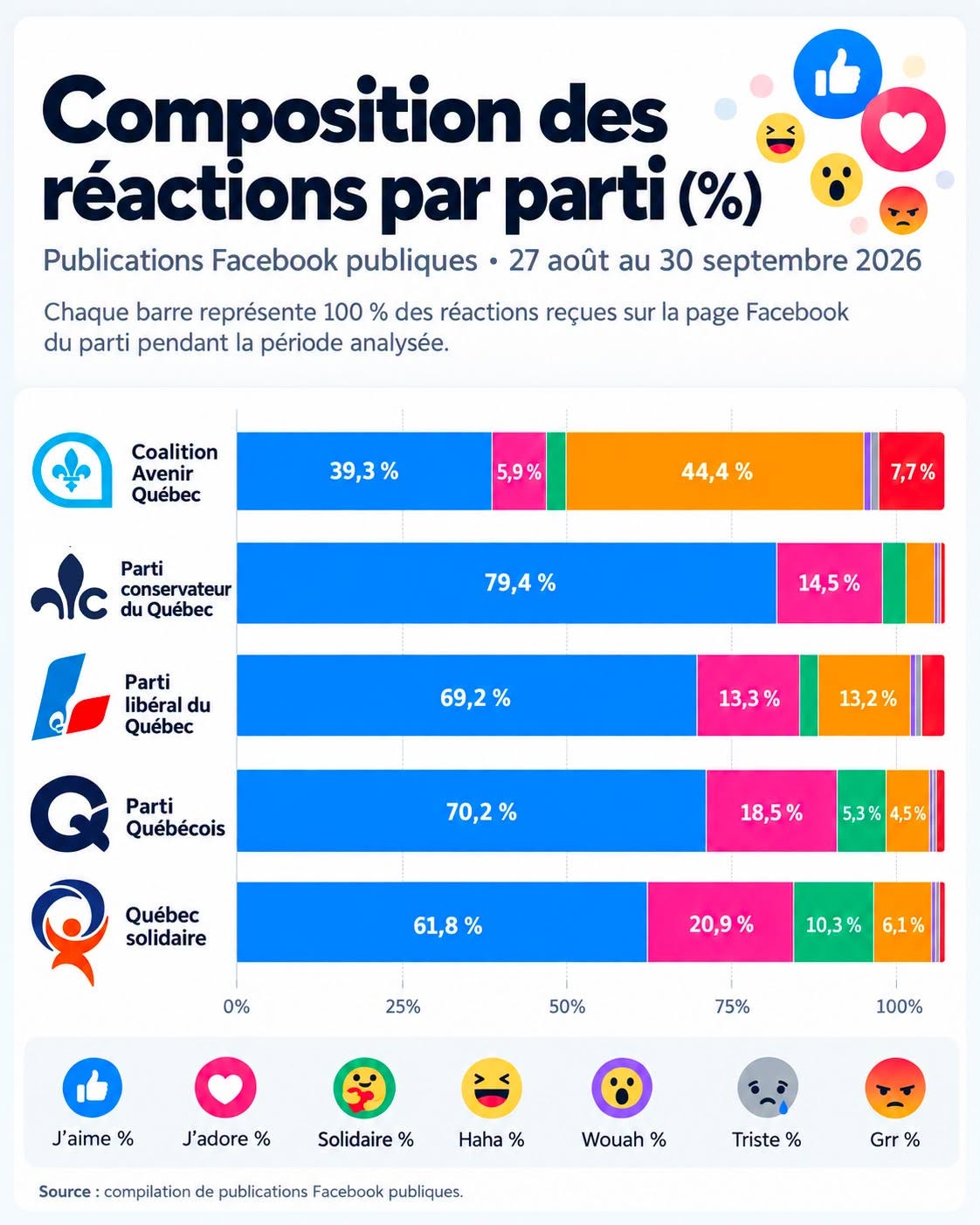
Source: Jonathan Thibeault’s Facebook page
Fewer than half the reactions on the CAQ’s page are favourable (“Like,” “Love,” or “Care”).
For the other parties, the share ranges from roughly 85% for the QLP to 93% or more for QS, the PQ, and the QCP, which enjoys almost unanimous approval among its cult its supporters.
Naturally, Quebec solidaire’s page has the highest proportion of “Care” reactions: solidaire in French.
🥁
Charles Milliard’s principles
Yesterday, I showed the contrast between Charles Milliard’s stated principles and his campaign promises.
I found another example in an interview Mr. Milliard gave to Urbania journalist Hugo Meunier shortly after becoming QLP leader.
Mr. Milliard: “(…) Bill 9, on daycare centres and street prayers, we’re going to vote against that. I think it goes too far. When I hear Bernard Drainville say, ‘Well, the people who lost their jobs brought it on themselves,’ honestly, it disgusts me… (…)”
Host: “(…) the street prayer thing is a bit overblown…”
Mr. Milliard: “That’s a manufactured political issue. I’m uncomfortable with street prayers, whatever the religion, but municipalities have all the tools they need to regulate that. Once again, we don’t need this charade. But, you know, people who follow the news and have five minutes to spare see that and [think], OK, they’re dealing with secularism, but how, and to what end? It makes me uncomfortable.”
(…)
“I know it appeals to a lot of people, but when you go into politics, you also need convictions. So I say, sometimes I take positions that may not appeal to the majority, but at least people will know where I stand.”
It’s all there. Stated clearly, with no hedging. Some bills are unjust and discriminate against Quebec women for no reason, or encourage intolerance by targeting communities to score political points. We won’t go there.
When it came time to walk the talk, those principles got lost along the way.
“(…) sometimes I take positions that may not appeal to the majority, but at least people will know where I stand.”
I’m looking for a single position Mr. Milliard has taken in this campaign that doesn’t “appeal to the majority,” and I’m struggling to find one.
On the contrary, I’ve repeatedly found him gravitating toward the most broadly popular, motherhood-and-apple-pie positions he could find.
On the third link, Mr. Milliard flipped his party’s position yet again to line up with the most popular position in the Quebec City region.
On Bill 96, Mr. Milliard has changed his mind a few times and has generally been at odds with his party’s position, shifting the focus from fundamental rights to red tape for businesses. That’s hardly controversial.
On the secularism legislation, Bills 21, 94, and 9, Mr. Milliard put his principles front and centre during the leadership race and before the campaign, but has recently hit the brakes. Once again, he’s staying on safe ground: a majority of Quebecers support the CAQ’s legislation on identity.
Even on immigration, the QLP has remained very cautious, setting a range of 45,000 to 70,000 permanent immigrants a year. The low end is exactly the CAQ’s target: 45,000 a year. As though the party were determined to keep every option open and appeal to everyone at once.
When you ask economists, though, the numbers are more in the range of 60,000 to 70,000 a year, or even 90,000 for a few years, long enough to grant permanent status to temporary workers and graduates who are already established here.
Since the start of the campaign, mayors across Quebec’s regions have been saying until they’re blue in the face that local businesses need workers. This week, 570 doctors signed an open letter whose headline says it all.

Source: La Presse
“Without immigration, the health care system collapses.”
You look at all this and think there was no shortage of opportunities to campaign on principles and convictions.
Maybe what was missing was the will.
-30-
My name is Patrick Déry. I’m a French-speaking Québécois who writes for a living, and I’m trying something different here. If you enjoyed reading this article, you can support me by buying me a coffee. You can also subscribe to this publication (free or paid, your choice).
Comments, shares, and “likes” are always appreciated. They also help the Substack algorithm notice me, so don’t be shy!