


Did you watch the leaders’ debate that wasn’t really a debate? I was busy writing this, hoping not to finish at 3 a.m. yet again—and, more importantly, to get this newsletter to you at a halfway reasonable hour.
(I was still surprised by how many people read the newsletter within the first hour after it was published. I hope the Substack notification didn’t wake you up!)
Earlier in the day, Christine Fréchette seized on the tariff threat to try to get people to call her “Captain Quebec.” I imagine her strategists were worried she might become “Captain Canada” in spite of herself.
Before this turns into a fight, I have a costume for everyone.

Once again, I have to thank everyone who has made the leap to a paid subscription. More of you join every day, and it’s wonderful.
Let me reiterate my not-so-secret ambition: I want to make this publication a viable project. There is still a long way to go, and you can help. Right this way:
OK, let’s dive in!
Duhaime loses control of the message (and his temper)
On Wednesday, the Conservative Party released its fiscal framework. Its significant tax cuts for individuals and businesses would be financed by eliminating most government subsidies and developing shale gas. Public services would not be affected.
We may never find out. Anyway the Conservative leader was mostly questioned about his star-studded team, whose ranks grow every week. Duhaime, usually affable, eventually lost patience and told reporters, “I don’t like your questions.”
LOL
There’s a very simple solution, Éric: stop recruiting clowns.
The two newest world champions are, respectively, an anti-abortion pastor who supports conversion therapy for gay people, and a former mayor who compared Justin Trudeau to a Nazi. The first withdrew, presumably at Duhaime’s request. The second is still there. For now.
Despite the many cranks in the QCP’s ranks, including anti-vaxxers, conspiracy theorists, 51st-state supporters, and assorted boors, this is, unless I’m mistaken, the first Conservative candidate to be forced out.
By comparison, the QLP is already up to eigth, albeit including withdrawals. In this case, perhaps the problem lies more with the QCP than with the QLP.
The (contradictory) quote of the day
“There is a great deal of money [for infrastructure]. Our approach is to say: let’s focus more on maintenance and put an end to ribbon-cutting syndrome.”
– Adrien Pouliot, former Conservative Party leader, now a candidate and highly hypothetical future finance minister
I couldn’t agree more. That reminds me: since we’re talking about putting an end to ribbon-cutting syndrome, what would happen to the QCP’s promise to build a third link at a cost of $3 billion?
Fréchette agrees that people should pay for access to ministers
Two years ago, François Legault looked bad when it emerged that the CAQ was selling access to ministers through fundraising cocktails. The scheme was so blatant that a tally showed that half of Quebec’s mayors and prefects had felt compelled to donate to the party between 2021 and 2023.
Seventeen employees from the same construction firm had also attended a cocktail featuring Pierre Fitzgibbon, the former minister of everything. Perhaps they had all gone to school with him.
Mr. Legault eventually stopped accepting individual donations for a year. He also stopped having ministers attend fundraising cocktails.
Ms. Fréchette thinks it would be a good idea to start again.
As the CAQ slogan says, Avançons!
The Parti Québécois wants to drive home prices even higher
Well, that’s probably not what the PQ wants, but that’s what will happen if it wins the election and follows through on its latest promise.
The PQ actually wants to help first-time buyers by refunding the QST on the purchase of a new home, up to $45,000. It also wants to double the first-time home buyers’ tax credit, increasing it from $1,400 to $3,000.
How do you explain this to a politician… Where is Uncle George when you need him?
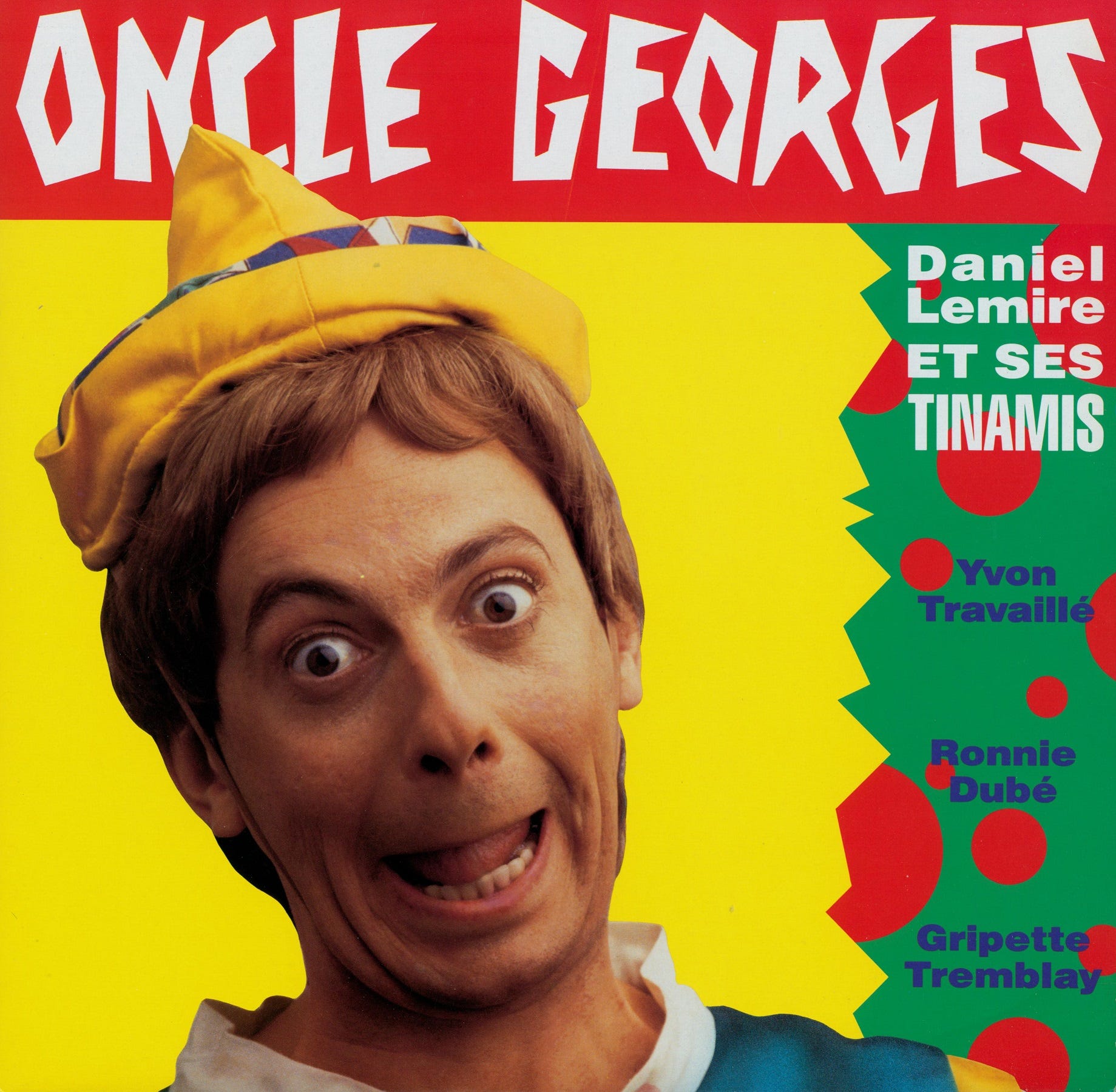
Paul wants to buy a house. Christine, Charles, Éric, and Ruba want to buy the same house because there are no other relatively affordable ones in the friendly neighbourhood.
Paul, Christine, Charles, Éric, and Ruba will scrape together every last dollar and borrow from their parents if they can, because their choice is this house or several more months in an apartment. They don’t want that.
Except that for Paul and Christine, it would be their first home. All else being equal, they would therefore have another $45,000 to offer.
And that, my dear little friends, is how home prices end up rising, because governments AL-WAYS throw money at demand without doing anything about supply.
Think of the FHSA, the epitome of a tax-policy contraption, which offers the advantages of both the TFSA and the RRSP without the respective drawbacks of either. Not to mention that the people who can afford to invest in one are already better off to begin with.
(Uncle George would have been funnier, but I hope that was clear.)
+++++++
Most politicians probably understand this. At least, I hope they do.
What most politicians understand above all, however, is that if they give money to targeted groups, it can turn into votes, even when doing so is harmful to society as a whole.
The phenomenon is so deeply embedded in government decision-making that it was developed into an economic theory, public choice theory, in the 1960s. Its originator eventually received a Nobel Prize in 1986.
Perhaps the Nobel Foundation should consider offering a special prize to whoever figures out how to stop politicians from promising nonsense.
Why does PSPP avoid criticizing Donald Trump?
On Monday, Paul St-Pierre Plamondon said of Donald Trump’s threats against Bombardier that “it’s just a tweet.”
In Tuesday’s newsletter, I explained that it might be worth taking seriously, since Donald Trump’s executive decisions often begin with a social media post.
I am convinced that Paul St-Pierre Plamondon, an intelligent man, knows all of this. There is clearly a strategy behind the Parti Québécois’s approach to Donald Trump. I’ll come back to that shortly.
In the meantime, here is the front page of the Wichita Eagle, a Kansas newspaper, this Wednesday.
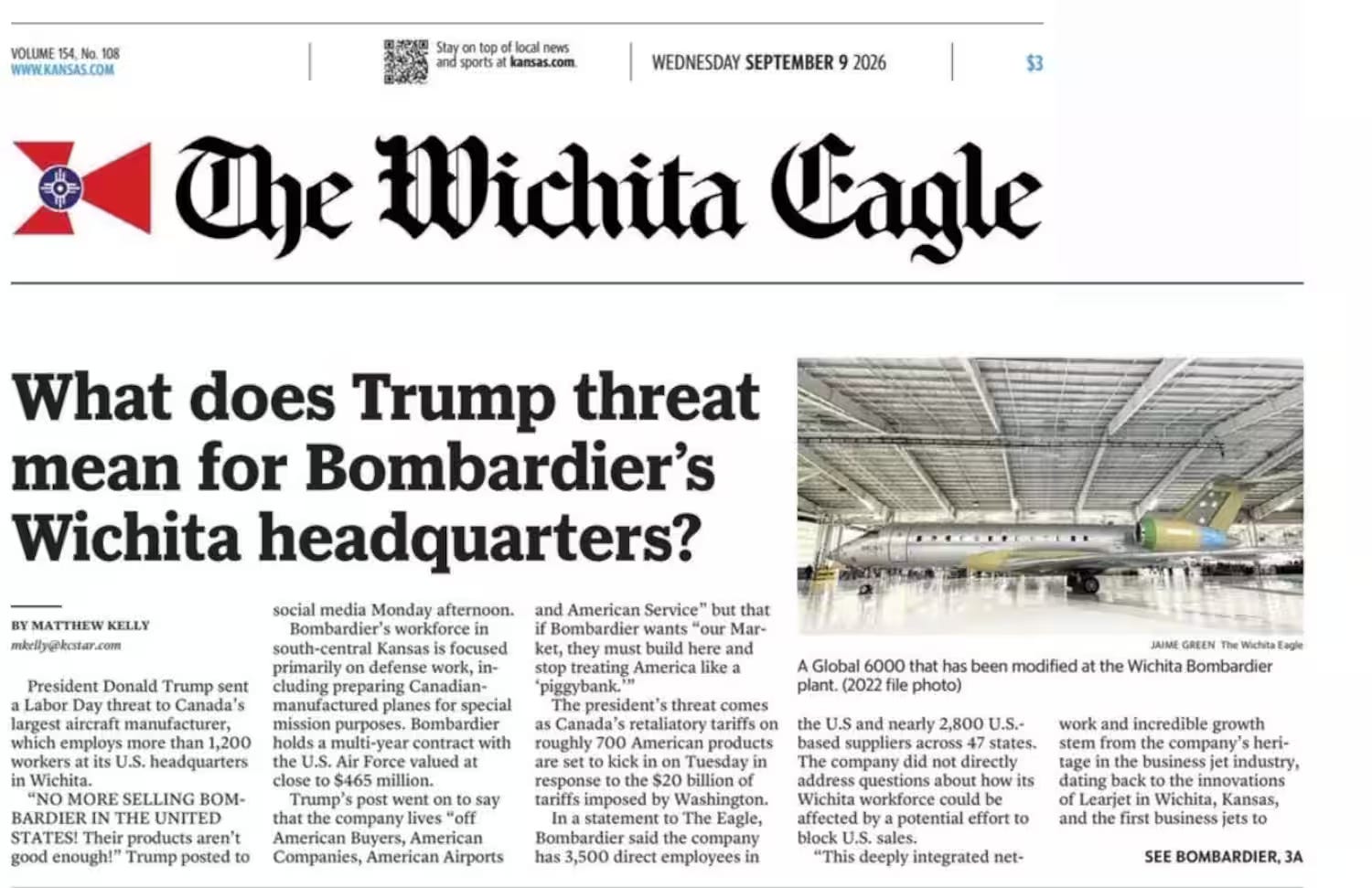
Image via Le Journal de Montréal.
Trump’s threat was also covered by the following media outlets: the New York Post, The Wall Street Journal, MarketWatch, The Hill, Business Insider, the Financial Times, The Guardian, El País, Folha de S.Paulo, The Times of India, Al Jazeera, the Associated Press, and Reuters.
Even Fox News, a mouthpiece for Donald Trump and the Republican Party, covered it.
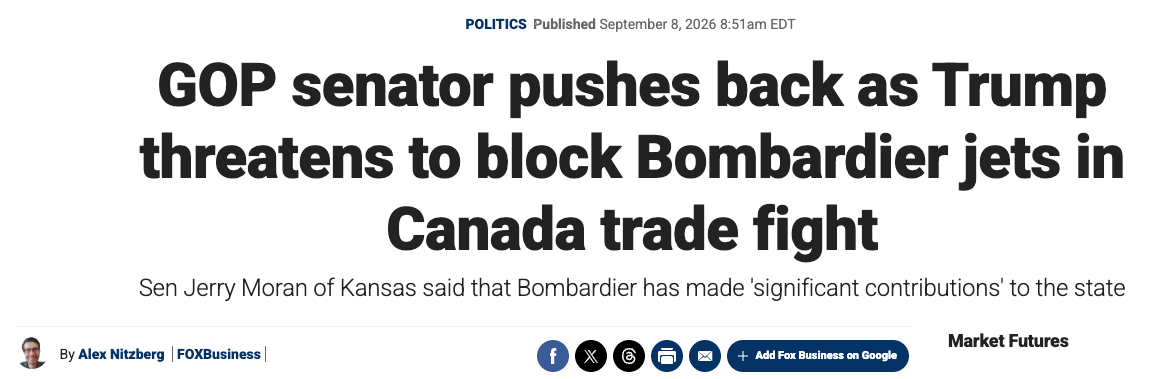
It may be “just a tweet,” but just about everyone concluded that it could go further.
Which brings us to the next point.
If you’re under the impression that the Parti Québécois, and its leader in particular, have been going easy on Donald Trump in recent months, you’re not imagining things. I discuss it in greater detail here.
In fact, PSPP clarified today that he prefers the term “trade conflict” to “tariff war.”
The softwood lumber dispute between Canada and the United States is a “trade conflict.” What we are living through, with repeated threats and attacks intended to make us cave, against the backdrop of repeated annexation threats, is indeed a “war.”
Radio-Canada, Le Journal de Montréal, La Presse, and Le Devoir all use “guerre commerciale” (trade war) almost systematically in their headlines.
English-language media in Canada generally call it a “trade war,” not a “trade dispute” or “trade conflict.” So do American media.
Le Monde, Le Figaro, the BBC, The Guardian, Al Jazeera, El País, and the Frankfurter Allgemeine Zeitung all speak of a “trade war” or use its Spanish or German equivalent.
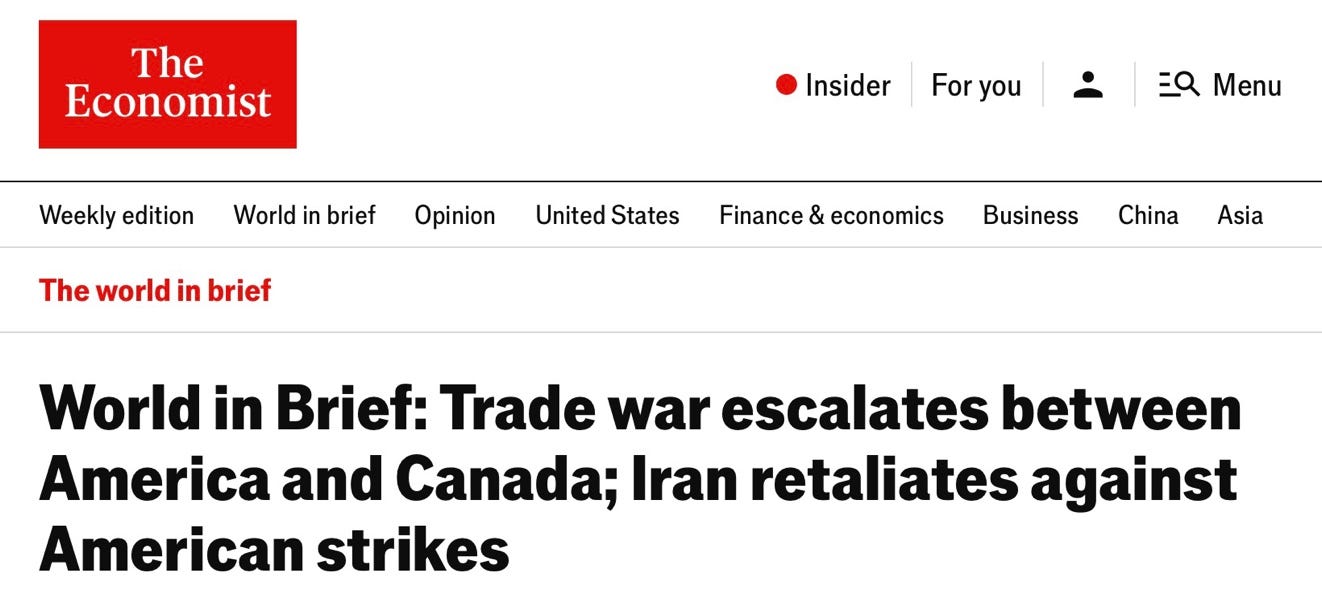
So does the prestigious weekly The Economist.
Why does PSPP resist using the term? I’ll venture an explanation.
There are 18 ridings in the greater Quebec City region, including the South Shore.
The Conservative Party is the clear favourite there, in part because it benefits from propaganda support favourable coverage from local talk radio. If the election were held today, it could win 10 seats.
They are shown in black below. The map comes from the indispensable Qc125.com.
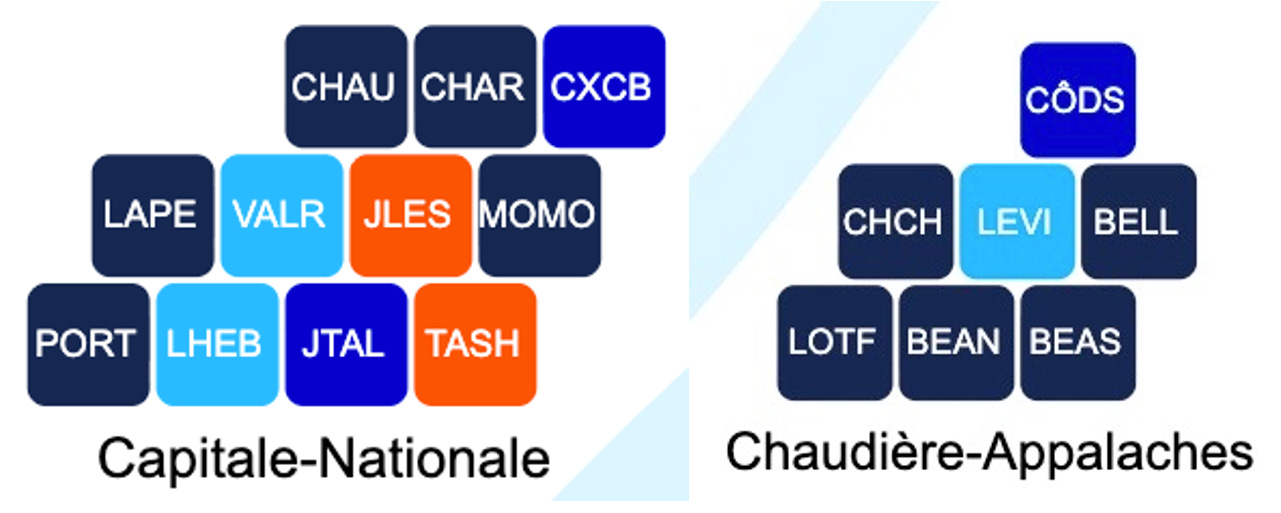
Current projections give the PQ 54 seats. The threshold for a majority in the National Assembly is 64 seats.
The majority PSPP covets may lie in Conservative territory.
The QCP is weaker outside the Quebec City region, but it still draws 16% support outside the major urban centres, and 10% in Greater Montreal. In close races, peeling even a few points away from the QCP could make the difference.
It so happens that Conservative supporters are generally more favourable toward Donald Trump (and far more likely to believe conspiracy theories, particularly those concerning the integrity of Quebec elections).
The Parti Québécois has taken note. It is no accident that it recruited Radio X host François Gariépy, who would be more at home in the Conservative Party. And it is probably no accident that PSPP goes easy on Donald Trump while concentrating his attacks on Ottawa and Christine Fréchette.
He does not want to alienate the Conservative supporters whose votes he also hopes to win. I don’t know whether that is a winning strategy. Perhaps it is.
It also reveals a rather flexible set of moral principles when dealing with a liar and a bully.
The (very naïve) quote of the day
“We can’t always keep responding to counter-tariffs with more counter-tariffs. We’re going to have to sit down with the U.S. administration and see where each side can make gains.”
– Charles Milliard, leader of the Quebec Liberal Party, who wants to “negotiate” with the United States. Mr. Milliard also wants to put himself, “with empathy,” in the U.S. government’s shoes.
Good grief. Where do I begin?
Dear Mr. Milliard,
What do you think the Canadian government has been trying, as best it can, to do for the past year?
How do you think anyone can negotiate with a narcissistic sociopath who lies compulsively, feeds on attention and flattery, prefers dictators to democrats, courts his enemies, and repeatedly vilifies his allies, sometimes threatening to invade them? And, also, a man who built a business empire through intimidation, wrote published a book about the art of swindling his business partners, and surrounded himself with people who think like him?
Allow me to quote Mr. Trump’s chief of staff, who described his delightful view of international relations:
“We live in a world, in the real world (…) that is governed by strength, that is governed by force, that is governed by power.”
“These are the iron laws of the world.”
And also:
“We are a superpower. And under President Trump, we are going to conduct ourselves as a superpower.”
Try “negotiating” “with empathy” with that.
Or, as Winston Churchill said:
“You cannot reason with a tiger when your head is in its mouth.”
Best regards to you and your communications team, and good luck with what comes next,
Patrick
+++++++
A few times over the course of this election newsletter, I have criticized the Liberal team for their leader’s lack of visibility.
I must correct myself. Mr. Milliard has indeed been much more visible and much more present in the public debate over the past few days.
I’m not sure it is doing him any favours.
-30-
Comments, shares, and “likes” are always appreciated. It also helps the Substack algorithm notice me, so don’t be shy!
My name is Patrick Déry. I write for a living, and I am trying something different here. If you enjoyed reading this piece, you can support me by buying me a coffee. You can also subscribe to this publication (for free or as a paid subscriber; the choice is yours).