



(Texte français disponible ici.)
The PQ’s promise to lower gas prices takes up almost all the space today because it’s the kind of pork-barrel promise that royally gets on my nerves.
Basically, I’m a victim of Brandolini’s law, also known as the bullshit asymmetry principle: it takes less time to say something stupid than to debunk it.
There are numbers, but I promise I’ve kept things simple. I did the math. All you have to do is read as I methodically carve up the (political) pork, one slice at a time.
And because you’re such wonderful readers, I also have a few treats for you, courtesy of the QCP, which has once again found a way to push the envelope.
Let’s dive in!
The PQ Wants to Save You $1.40 a Week
If his party forms the next government, Paul St-Pierre Plamondon is promising to cut the Quebec sales tax on gasoline in half and eliminate the double taxation of gasoline (Quebec’s fuel tax is itself taxable).
Basically, he would reduce the QST on gasoline from 10% (9.975% if you want to be very precise) to 5%, plus eliminate the effect of the tax-on-tax. The net result would be a discount of about seven cents per litre.
So far, so good. I mean, it’s pork-barrel politics (see the next section), but at least the math checks out.
That’s where the wheels come off.
“In concrete terms, for someone who fills a vehicle with 60 litres of gas every week, that represents savings of $220 a year,” Mr. St-Pierre Plamondon said.
In concrete terms, the PQ leader is way off base because his example is nowhere near representative of average gasoline consumption.
+++++++
In Quebec, a car travels an average of 12,435 kilometres a year, according to the most recent data, from 2022. Average fuel consumption is 8.1 litres per 100 kilometres.
That works out to 1,007.2 litres a year, or 20 litres a week.
That’s one-third of Mr. St-Pierre Plamondon’s dishonest misleading figure of 60 litres a week.
Twenty litres a week, with a discount of seven cents per litre, works out to savings of $1.40 a week. Or $73 a year.
Seventy-three dollars. A year.
For context, the median after-tax family income in Quebec for a couple with two or more children is about $130,000.
To quote Mr. St-Pierre Plamondon at length:
“As a father of three, I understand what it’s like to try to juggle a budget when food costs more, rent or mortgage payments cost more, cars and transportation cost more, and then there’s clothing and gasoline,” Paul St-Pierre Plamondon said in front of a gas station displaying a price of $1.89 per litre.

Break out the tissues.
Why did the Parti Québécois choose a consumption figure of 60 litres a week when it bears no resemblance to reality?
There are several possibilities, and they are not mutually exclusive.
Because someone plucked a number out of thin air without checking it;
Because someone did check it and decided that $73 a year would look insignificant, especially compared with the cost to the public treasury;
Because the party is targeting voters who like bigger engines;
Because the party is targeting voters who can’t count.
Because we know it pays politically to get people worked up about gas prices.
I could stop here. But there’s more.
The increase in gas prices that we spend so much time decrying doesn’t exist. That’s because the real price of gasoline has been the same for 20 years.
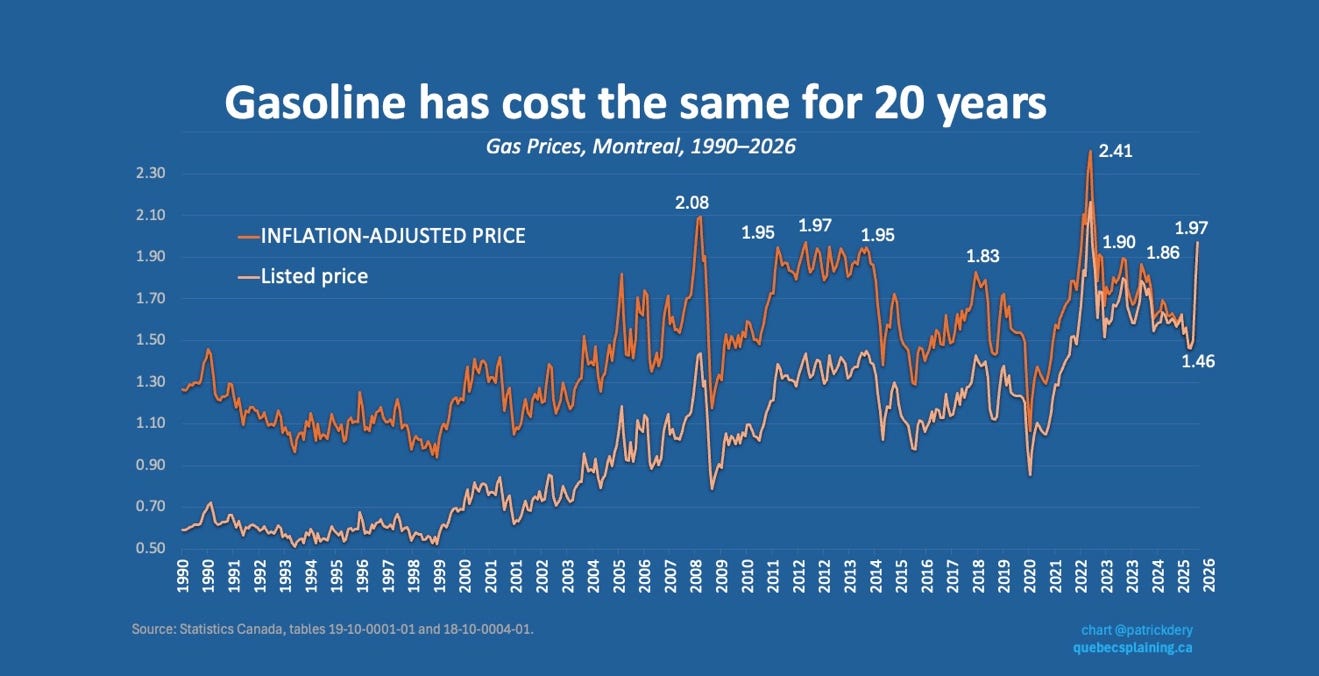
The pale line shows the average posted price at gas stations. The orange line shows the price adjusted for inflation. There was an increase between the late 1990s and the mid-2000s. Since then, it has been broadly stable. There was an increase this year, but it followed a decline.
Since 2006, the price of a litre of our daily addiction has fluctuated between $1.50 and $2.00, most often hovering between $1.70 and $1.90. You can read the detailed explanation here.
How much did gasoline cost in Montreal this summer?
Between $1.70 and $1.90, according to the Régie de l’énergie. The same damn range as for the past 20 years.
Let’s read a few excerpts from the PQ news release together.
“In response to a significant increase in gasoline prices in recent years.”
(…)
“I completely understand Quebecers who feel that everything costs more than it did before the pandemic: food, rent, mortgages, cars, clothing, and especially gasoline.”
(…)
“Especially since, over the past eight years, the price of a litre of gasoline has jumped from $1.29 to more than $2.”
There’s an awful lot of misrepresentation and cherry-picking packed into those statements.
Claim No. 1: “Everything costs more than it did before the pandemic (…) especially gasoline.”
That’s true… except for gasoline. As for everything else, our incomes have generally risen even faster. As a result, we are, on average, financially better off than we were before the pandemic.
Allow me to quote the Université de Sherbrooke’s Research Chair in Taxation and Public Finance, which I previously mentioned here when discussing the proposal to eliminate sales tax on used goods.
“The overall picture from 2019 to 2026 shows an improvement in the real financial situation of every type of household.”
Clear enough? The PQ is hardly alone here. All the parties, along with the media, are playing along.
Back to gasoline.
Claim No. 2: “In response to a significant increase in gasoline prices in recent years.”
We’ve just seen that this isn’t true.
Claim No. 3: “Over the past eight years, the price of a litre of gasoline has jumped from $1.29 to more than $2.”
It isn’t true that the real price of gasoline has “jumped.” It has fluctuated, both up and down;
The September 2018 price of $1.29 would be equivalent to about $1.80 today. By comparison, the average price of gasoline in 2026, from January through the end of August, was $1.73;
“More than $2.” Not true either. Province-wide, the weekly average price of gasoline has never exceeded $2. The peak was $1.97 in May;
In Montreal and Laval, the weekly average edged slightly above $2 on three occasions (in May, peaking at $2.02), and another in Montreal in August, barely (2.005). That’s it. Everywhere else in Quebec, the weekly average never reached $2, except in Nord-du-Québec.
The PQ even goes out of its way to mention Radisson in its news release, where the price per litre briefly reached $2.37.
Do you know where Radisson is?

If I had to bet, I’d wager that gasoline isn’t the only thing that costs more there. Ice cream and Corn Flakes probably do, too.
I could stop here as well. But there’s more.
Average vehicle fuel consumption fell by about 11% over the same period. That means that, for the same number of kilometres driven, our inflation-adjusted fuel costs have also fallen by about 11%. Keep in mind that we’re still talking about 2022. With the growing number of hybrid models, the decline is probably even greater in 2026.
And average mileage per vehicle is trending downward. I’d bet at least $1.40 a week that remote work has something to do with it.
So, the savings announced by the PQ are misleading, gasoline doesn’t cost more, and we tend to use less of it.
In other words, all the public, political, and media fuss over gas prices is rooted in distorted perceptions, especially the gap between the posted price and the real price once inflation is taken into account. The same is generally true of the cost of living.
You won’t hear a politician tell you that. It’s easier to say that everything is going badly and blame the party in power for your problems.
The worst part is that the other half of the Parti Québécois proposal is perfectly defensible: giving $125 a year to Quebecers earning less than $40,000. All the effort should go into increasing that amount, while leaving the gasoline tax alone.
Finally, if you want driving to cost less, tell governments to let more Chinese electric vehicles into the country.
After Godwin’s Law, the Pork-Barrel Rule
Godwin’s law holds that any online discussion that drags on long enough will inevitably include a comparison involving Hitler or the Nazis.
In Quebec politics, any discussion that drags on long enough will eventually conclude that the gasoline tax needs to be cut. This is nothing new. Jacques Parizeau reached that conclusion when he was a minister in René Lévesque’s second government more than 40 years ago. Mr. Parizeau eventually acknowledged that it had been a mistake.
Because it costs the public treasury a fortune without making any real difference in people’s wallets. Because oil companies always pocket a good share of the tax cut. Because fuel taxes help pay for our pothole-riddled roads. And, today, because we’re trying to reduce greenhouse gas emissions.
Forty years after Parizeau’s mistake, public debate in Quebec still invariably ends with the conclusion that the gasoline tax needs to be cut.
The QCP promised to do it because its political business model essentially consists of promising voters whatever they want to hear. Populism 101.
We might have expected better from the Parti Québécois. In another era, when the PQ still had principles, it would have appealed to reason, explained why it didn’t want to go down that road, and left the populism to the QCP.
But when I see how collectively unhinged we can become whenever gas prices come up, I almost understand the politicians.
Today’s Absolutely Terrific Quote
“No one of any calibre will be able to run for office anymore. We’ll end up with nothing but people whose lives are so boring, who are so beige, so neutral, and so empty.”
Éric Duhaime, QCP leader and martyr, whose idea of a candidate with “calibre” includes conspiracy theorists, anti-vaxxers, 51st-state supporters, people who lie under oath, and other perfectly reasonable individuals who compare their political opponents to Nazis.
The quote comes from an episode of the series Lambert en campagne that will air shortly.
(I do have a question, though. I understand the need to frame the shot, but was it really necessary to seat the host quite so close to his guest? It looks as though Mr. Duhaime is trying to escape.)

For two days in a row, Mr. Duhaime has complained that people are asking him about his candidates’ antics instead of his proposals.
Today, things reached another level. Judge for yourselves.

Allow me to translate :
Quebec Conservative Candidate Lied in Court After Vandalizing a Sugar Bush Owned by a Couple in Their 70s
A Superior Court judge described Jimmy Gagnon’s testimony as “fanciful” and entirely lacking in credibility
It looks like a parody. It isn’t.
I’d be tempted to say there’s nothing to add, but that would mean passing up a golden opportunity to understand the kind of rabid anti-everything cranks who make up part of the QCP’s base and candidate roster.
In short, following a dispute over the boundary between two properties, Conservative candidate Jimmy Gagnon decided to help himself to part of his neighbours’ land, even though a land surveyor had determined that he was in the wrong. Mr. Gagnon then cut the water and electricity lines, ripped out the maple sap lines, and blocked his 77- and 79-year-old neighbours from accessing their own property.
Once in court, Mr. Gagnon lied and changed his story several times. The judge described his testimony as “fanciful.”
When asked about it, Jimmy Gagnon replied that “it was a civil boundary dispute between two businessmen.” Of course.
Éric Duhaime, meanwhile, dismissed the situation as a “dispute between neighbours.” Of course. As though both sides shared the blame.
On Friday, Mr. Duhaime was asked whether lying in court should disqualify someone from becoming an MNA. The QCP leader said that we would need to “know the context in which it happened.”
The “context,” dear Éric, was sworn testimony before a judge. I don’t think that helps your candidate.
At least there’s still karma.
The QCP has a few serious candidates (hi, Adrien!), but it also made a deliberate choice to scrape the bottom of the barrel by recruiting clowns whose sole qualification was their ability to mobilize an electorate that is largely anti-establishment, conspiracy-minded, or both, and fuelled by misinformation.
Today, Éric Duhaime is partly reaping what he sowed, even if he will soon be rewarded with a handful of seats. That could be entertaining.
Which brings us to…
Today’s Other Absolutely Terrific Quote
“If people who lie weren’t allowed to sit in the National Assembly, I can tell you right now that we wouldn’t have 125 MNAs as we speak.”
Éric Duhaime, who knows a thing or two about lies himself.
I have to give him that one. It’s sad, but it’s true.
For those who are interested, I’ve documented blatant lies by François Legault (in French), Jean-François Roberge, and Christine Fréchette on this platform.
I could make a full-time job of it and still not keep up.
-30-
Comments, shares, and “likes” are always appreciated. It also helps the Substack algorithm notice me, so don’t be shy!
My name is Patrick Déry. I write for a living, and I am trying something different here. If you enjoyed reading this piece, you can support me by buying me a coffee. You can also subscribe to this publication (for free or as a paid subscriber; the choice is yours).