


Manitoba will not set its clocks back on November 1. It will be the fourth province to remain on daylight time year-round, after Saskatchewan, Alberta, and British Columbia.
I wanted to write about it Saturday, but my piece was already long.
I wanted to mention the public consultation held two years ago, which found that 91% of Quebecers want us to stop fiddling with the clocks twice a year. Nearly 80% of businesses want the same thing. Studies have also found a significant increase in car accidents and medical errors on the day after the clocks go back. And the practice, introduced to save energy during the First World War, no longer serves any purpose.
I was going to write that, on November 1, we will all wake up a little happier after getting an extra hour of sleep. Especially parents who have to be at the arena at 7:30 on Sunday morning.
I was going to say that every fall and every spring, we talk about it and hope this will be the last time. Then again, we spent 35 years arguing over the colour of margarine…
I was going to write that it said a lot about our politicians that they were still incapable of taking a clear position on such a thoroughly documented, motherhood-and-apple-pie issue, when the conclusion was both clear and inevitable. The only thing left to decide was how many more pointless turns of the clock hands we would have to put up with.
I was going to write that, as of Monday morning, none of the five parties had expressed a particularly firm preference on the time change. They were all generally in favour, but not too much. They wanted to study the issue further and act “in a coordinated way” with neighbouring provinces and states. (Why? We trade with New Brunswick, Europe, and China, and we manage just fine.) As though the issue carried any political risk whatsoever.
(Sigh.)
The CAQ even specified that “more in-depth analyses of the economic and health impacts are still underway. We’re not at the announcement stage yet.”
That was Monday morning.
I would have told you not to hold your breath. Again, it took us 35 years to settle the margarine question.
And then, a dramatic turn of events!
Early Monday afternoon, Christine Fréchette made a “firm commitment” to abolish the time change.
(Apparently, those “more in-depth analyses of the economic and health impacts” took half a day. Maybe they asked ChatGPT.)
What happened?
A little political manoeuvring. CAQ strategists saw an opportunity to get out ahead of the other parties on a popular issue and make an announcement.
The other parties’ strategists saw the risk of letting the CAQ have a popular issue all to itself.
And we vote in two weeks.
All right, let’s dive in!
When a fact-checker fact-checks La Vérif
Last Wednesday, Christine Fréchette claimed that the CAQ had hired 100,000 teachers during its two terms in office. That was quite the whopper, since Quebec’s public school system employs about 100,000 teachers altogether.
On Monday, Radio-Canada fact-checked the premier and correctly concluded that the CAQ could not have hired 100,000 teachers during those two terms. In the process, however, the public broadcaster claimed that Quebec employs 131,000 teachers at the preschool, elementary, and secondary levels.
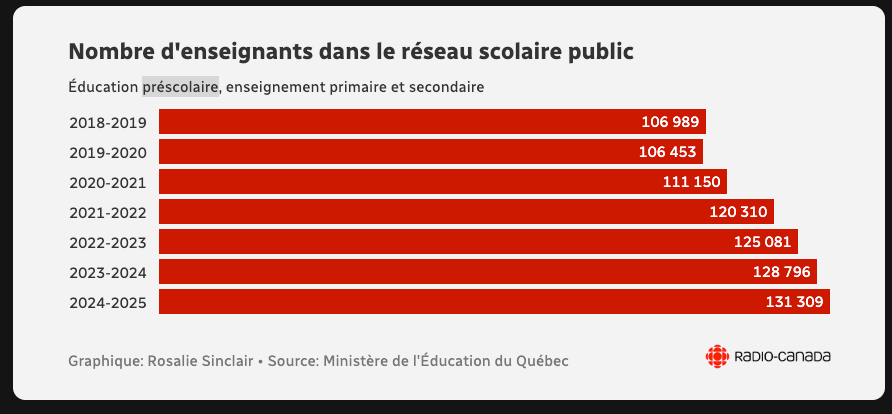
Source: Radio-Canada
That is not the right number.
The total of 131,000 includes not only teachers, but also support staff, such as special education technicians and educators, as well as professionals, including remedial teachers, psychoeducators, guidance counsellors, speech-language pathologists, and psychologists.
For teachers, the figure is 91,732 positions, minus however many remained unfilled as of mid-September.
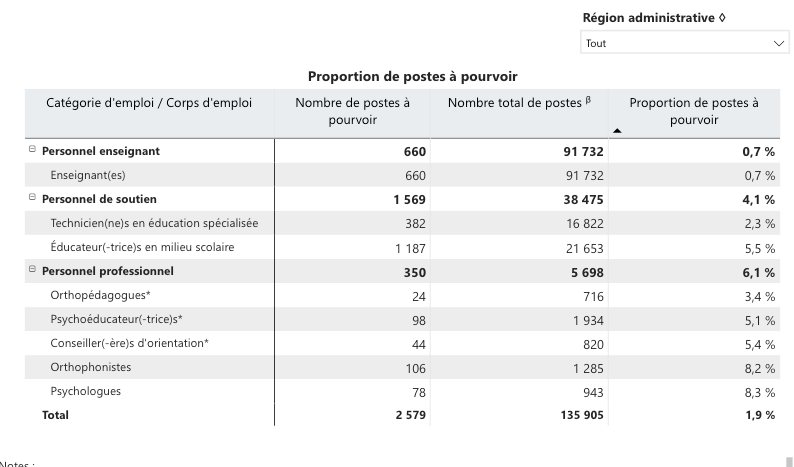
Source: Quebec Ministry of Education dashboard.
If even the fact-checkers cannot get their numbers straight, we can hardly blame voters for being confused.
One useful poll and one useless poll
Let’s start with the useless one.
There are too many polls, which means we have to talk about them too often, if only to ensure they are interpreted properly. But that is not what makes this one useless.
Radio-Canada conducted a large-scale election survey last week involving more than 5,000 respondents.
In theory, that provides greater precision than a standard survey of 1,000 respondents, particularly within subgroups such as gender, age, and region. For a typical poll, the margin of error is generally around 3% for the overall results. For Radio-Canada’s survey, it was generally 1.3%.
That is useful. In a close election, it makes a difference. Is the PQ really six points ahead of the CAQ and QLP? Two points? Or are we looking at a statistical tie? Are the CAQ and QLP tied too? Does the CAQ instead have a five-point lead over the QLP? Or is it the other way around?
Radio-Canada’s survey produced the following results:
- PQ: 29%
- CAQ: 22%
- QLP: 19%
- QCP: 18%
- QS: 12%
The QCP only three points behind the CAQ and one point behind the Liberals? Interesting.
Except that… those numbers are now worthless. Most of the fieldwork was completed BEFORE last week’s two debates, which went disastrously for Ms. Fréchette. (I have numbers on that too, further down.)
Maybe the cement has set and nothing has changed. Maybe the tectonic plates have shifted. This survey can no longer tell us, despite everything Radio-Canada put into it.
There is never a perfect time to poll voters during a campaign. Everything moves quickly, and plenty of surprises can occur. Debates, however, are not surprises. The survey should have been conducted entirely before them or entirely after them.
You can read it here if you are interested.
And the useful poll?
That would be Pallas’s, which was conducted after the debate and should therefore, in principle, capture its effects.
The numbers broadly resemble the recent trend:
- PQ: 28%
- QLP: 22%
- CAQ: 22%
- QCP: 16%
- QS: 11%
So the debate apparently had no effect. Except that…
There was movement beneath the surface. Christine Fréchette’s approval rating, to put it bluntly, took a beating. Ms. Fréchette is now seen as only the third-best choice for premier.
Last week, PSPP and Christine Fréchette were tied at 23%. This week, PSPP is alone in first place at 29%. Ms. Fréchette has fallen to 16%, barely ahead of Éric Duhaime and Ruba Ghazal. Charles Milliard is now second at 19%.
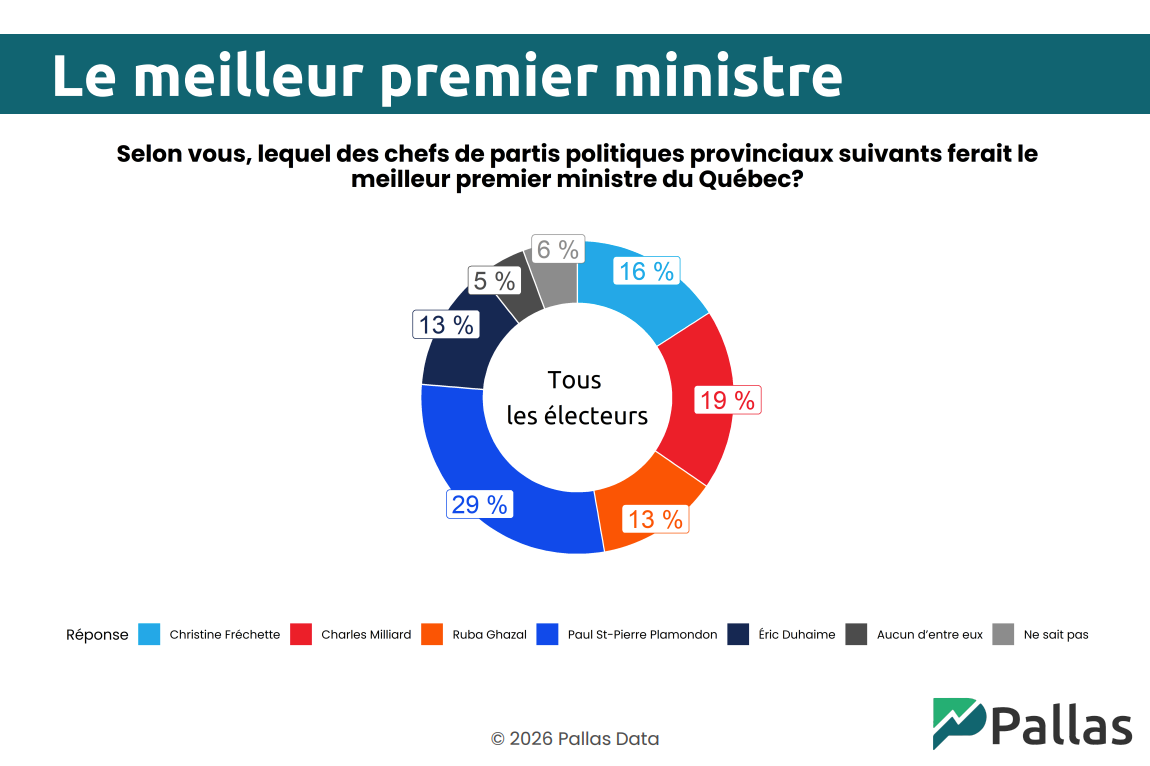
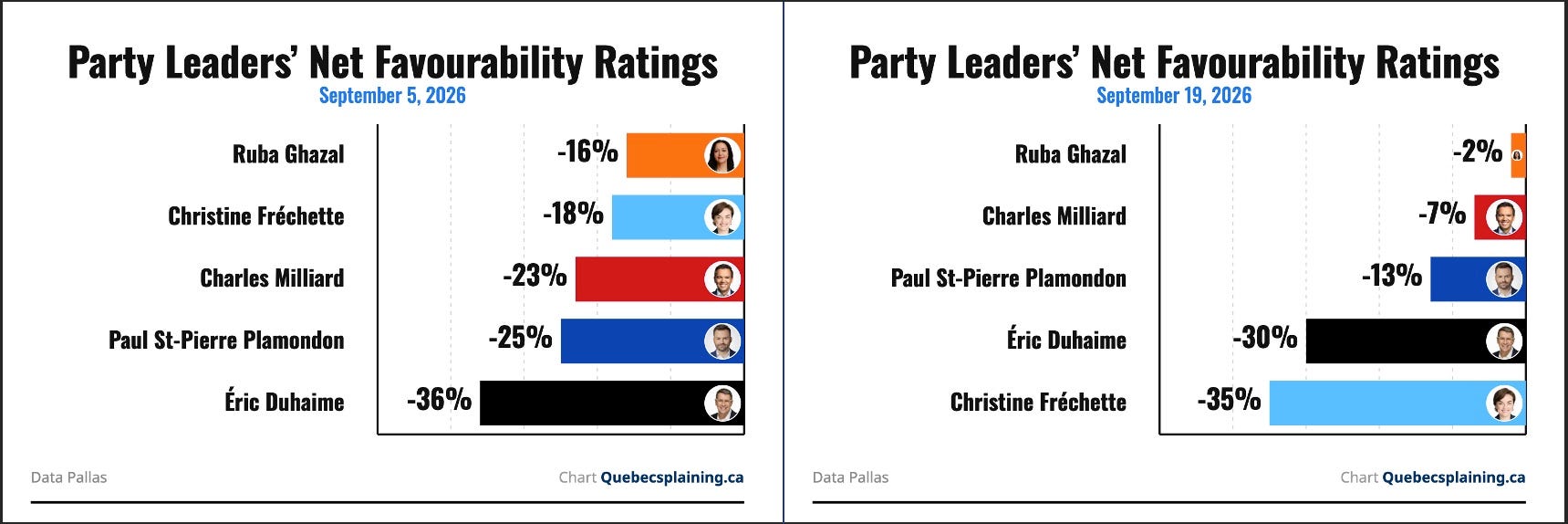
Things look even worse for Ms. Fréchette when we examine the leaders’ net favourability ratings.
Everyone’s rating has improved over the past two weeks except that of the leader of Team Christine Fréchette. In other words, everyone gained ground at Ms. Fréchette’s expense.
Two weeks ago, Ms. Fréchette was in second place. She is now dead last, even trailing Éric Duhaime, who until recently was Quebec’s political bogeyman of choice.
On the left, the leaders’ favourability ratings two weeks ago. On the right, their ratings now.
A few takeaways:
· Ms. Fréchette took quite a tumble, dropping 17 points;
· Meanwhile, all her opponents gained ground: PSPP gained 13 points, Ghazal 14, and Milliard 16;
· Even Éric Duhaime managed to gain six points;
· In other words, Christine Fréchette lost 23 points relative to Éric Duhaime, 29 relative to PSPP, 31 relative to Ruba Ghazal, and 33 relative to Charles Milliard;
· Ouch.
Another, rather depressing, takeaway: not one of the party leaders has a positive net favourability rating.
Ruba Ghazal comes closest, at −2%.

As I noted Friday, Québec solidaire still has a reservoir of goodwill to draw on, and therefore room to grow. What it needs are policies that are a little more grounded in reality. (Dear QS, there are two weeks left.)
For the CAQ, Ms. Fréchette’s slide is bad news. A party’s support usually ends up following its leader’s trajectory.
There is another debate this week. Ms. Fréchette might want to come up with a good excuse to skip it.
The Pallas poll is available here.
The PQ thinks there are too many children—and offers $350 starting with baby No. 3
Parti Québécois Leader Paul St-Pierre Plamondon has been playing fast and loose with the facts as he denounces the strain that immigration supposedly places on public services, particularly daycares and schools, as well as housing.
So we have too many children.
On Sunday, the PQ unveiled its plan to “stem the decline in the birth rate.”
So we want more children.
I’m confused.
Among other things, the PQ proposes enhancing the Quebec Parental Insurance Plan (QPIP) by raising both the minimum benefit and the amount paid, and making the program even more flexible. It also wants to cover second and third in vitro fertilization cycles.
The PQ would provide an annual allowance of $350 for a third child and another $350 for a fourth.
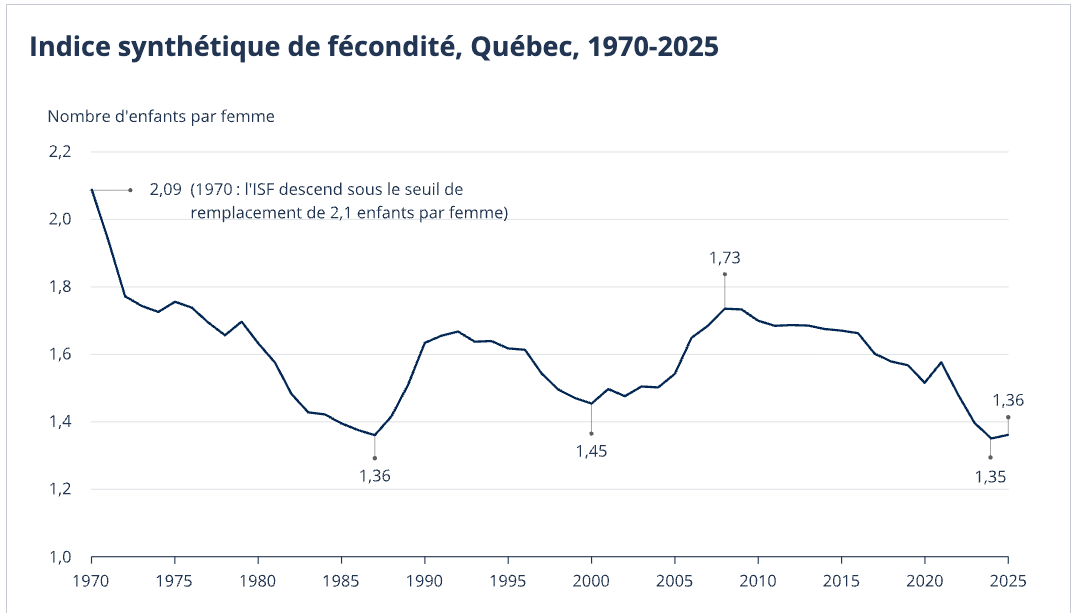
Unlike the supposed decline of our culture or the French language, the decline in our fertility rate is real, although the PQ does make a small error.

The current rate is indeed 1.36, not 1.33. It was also this low in the late 1980s.
Here is what it looks like over 55 years.
Source: Institut de la statistique du Québec
We can speculate about why the PQ did not include the Institut de la statistique’s chart showing the evolution of the fertility rate in its news release. Your explanation is as good as mine.
Mine is that, when telling a fish story, it helps to make the fish as big as possible, even if that means mixing up centimetres and inches.
+++++++
Pronatalist policies generally do not work, as I explained when the CAQ announced its $1,000 babies, unless governments spend enough to all but eliminate the financial consequences of having children.
We can decide to improve our family policies for reasons of fairness, which is entirely legitimate, but doing so will probably have very little effect on the fertility rate.
QPIP did produce a temporary bump in the mid-2000s, but it probably brought births forward rather than creating more of them. The rate eventually returned to the same level and then fell even lower than it had been before the program was created. The effect of subsidized child care is even harder to discern.
These two programs, the most generous of their kind in North America, have failed to reverse the worldwide decline in fertility rates.
Does anyone at the PQ really believe that $350 a year will make a difference in someone’s decision to have another child?
I sincerely hope not, because at this point, incompetence would worry me even more than intellectual dishonesty. (The bar is low, I know.)
For the sake of argument, let’s nevertheless assume that an allowance equivalent to $7 a week would persuade parents to have another child, along with the rest of the policies intended to “stem the decline in the birth rate.”
If we follow PSPP’s logic, we are shopping for a whole aisle of trouble, because daycares and schools will not be ready to accommodate the Quebecers we will have created. If there is no room for immigrants’ children, why would there be room for the children of old-stock Quebecers?
Housing will not fare any better. If families grow larger, demand for bigger apartments and houses will increase.
Have I missed something?
And what about the fifth child? If the goal is to increase the number of births, why stop at four? Why not reward couples who decide to have five, six, or seven children?
By that logic, the QCP’s proposed weekly allowance of $100, or $5,000 a year, is potentially more effective, even if it is misguided, since it would represent a more substantial net gain for mothers who have already decided to stay home.
Could there be a simpler explanation?
Could this be, once again, another fine slice of political baloney? Bargain-bin baloney, cheaper than eliminating the sales tax on used goods or gasoline, but baloney nonetheless: an individual benefit and a tangible effect that are both close to zero, at a cost to the government amounting to millions that could be better spent elsewhere. ($5 million, if you are wondering. I know community organizations that wouldn’t turn up their noses at that.)
So why did the Parti Québécois put this not-so-subtle bit of baloney this measure in its platform?
Because it also gives the party an opportunity to sound a populist dog whistle, as it does with regressive tax cuts that are easy to sell. And with immigration.
Someone we know well rode that strategy to the White House twice.
France is headed that way too.
-30-
My name is Patrick Déry. I’m a French-speaking Québécois writing for a living, and trying something different here. If you enjoyed reading this text, you can support me by buying me a coffee. You can also subscribe to this media (free or paid, your choice).
Comments, shares, and “likes” are always appreciated. It also helps the Substack algorithm notice me, so don’t be shy!