


Just a quick note before we get started: the Churchill Falls agreement with Newfoundland has been approved by our neighbours’ legislature. I mention it because it is just about the only good news for Christine Fréchette in what has been a fairly disastrous week. The next poll could hurt and mark a turning point for the CAQ.
Also, a 63-year-old woman has been stuck in hospital for more than a year because there is no room for her in a suitable residence able to take her. She has even brought plants into her room. To add insult to injury, she was reportedly offered a transfer to palliative care even though she is not dying.
I don’t know whether that part is true, but I do know that the number of Quebecers aged 75 and older will climb by roughly 40% by 2034, and that we are nowhere near ready for it.
Mom, keep snowshoeing and eating your vegetables, okay?
OK, let’s dive in!
Numbers and women candidates
Elections Quebec released some election statistics this week.
Some 908 candidates were accepted in Quebec’s 127 ridings, an average of just over seven per riding.
Verdun has the largest field, with 13 candidates. Across Quebec, 19 independent candidates are trying their luck.
By party, ranked by number of candidates, here is what that looks like:
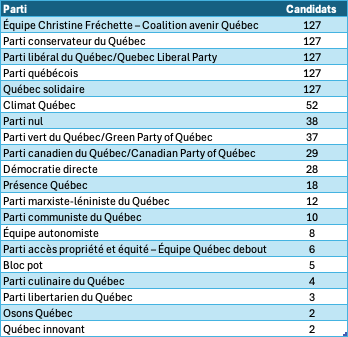
A few observations:
Climat Québec, led by Martine Ouellet, is the largest of the minor parties, with 52 candidates;
The Parti nul is ahead of the Green Party. That is not reassuring;
Three parties registered bilingual names: the Quebec Liberal Party, the Green Party of Quebec, and the Canadian Party of Quebec;
The CAQ is not the only party with a name long enough to need a hinge. There is also the Parti accès propriété et équité – Équipe Québec debout;
After more than 100 years of bickering over ideological purity, the Communist Party and the Marxist-Leninist Party still have not managed to reconcile their differences.
And the women? Here they are:
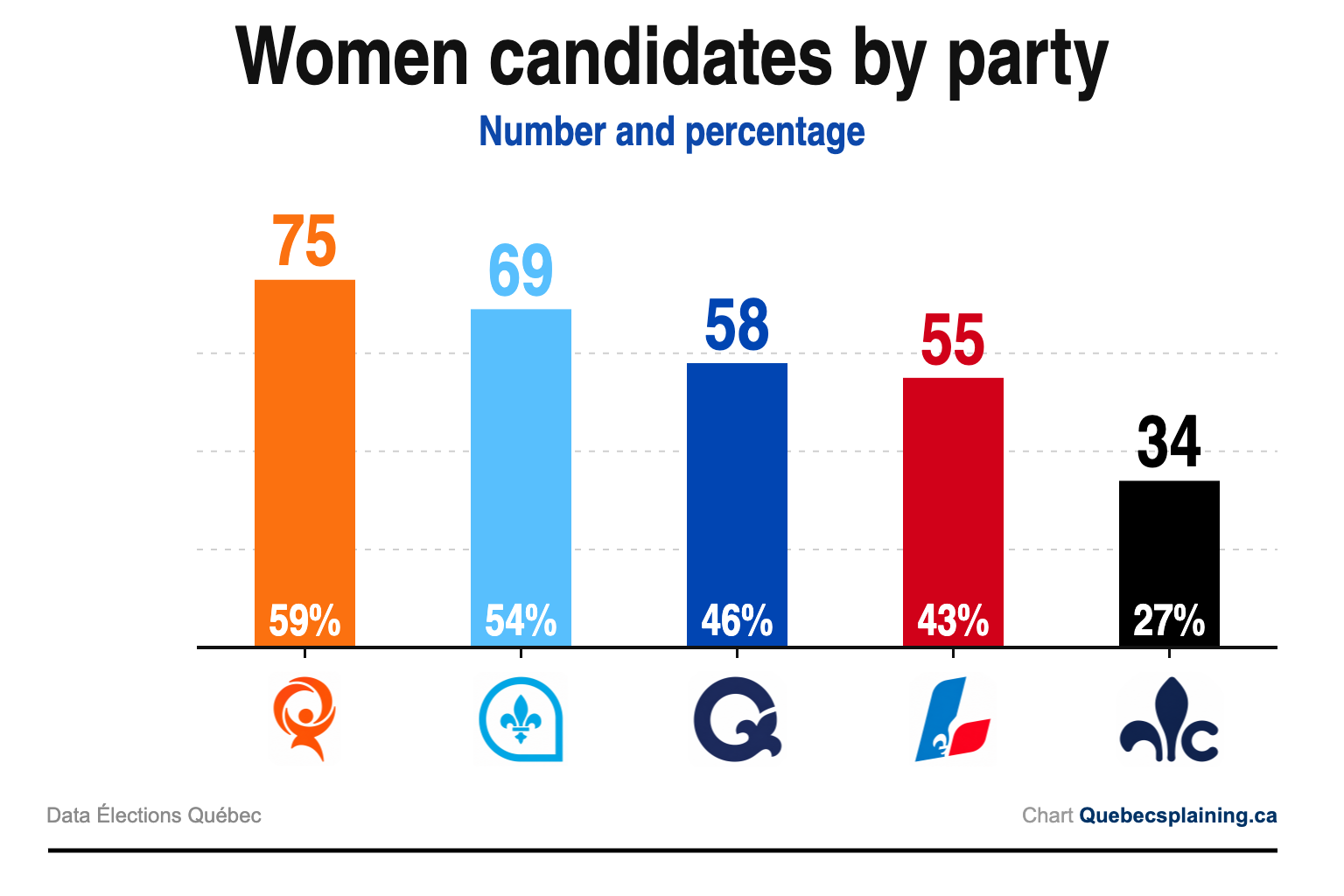
QS, the CAQ, the PQ, and the QLP are in roughly the same range as in 2022, when they fielded 69, 69, 54, and 53 women candidates, respectively.
The parity zone is generally considered to fall between 40% and 60% women candidates. (Personally, I think we could make a little more of an effort and aim for 50%. There are, after all, more than three million Quebec women old enough to run for office.)
The Conservative Party managed the remarkable feat of reducing its share of women candidates, fielding 47 in 2022 but only 34 in 2026, even though the number of ridings grew slightly, from 125 to 127.
Which raises a question…
Why does the Conservative Party attract fewer women?
It would be tempting to make an inappropriate joke and say it is because potential candidates are at home waiting for the $100 a week promised by the QCP.
Even leaving aside the spectacular bad faith that would require on my part, however, the theory does not hold up.
Because it is not just about the candidates.
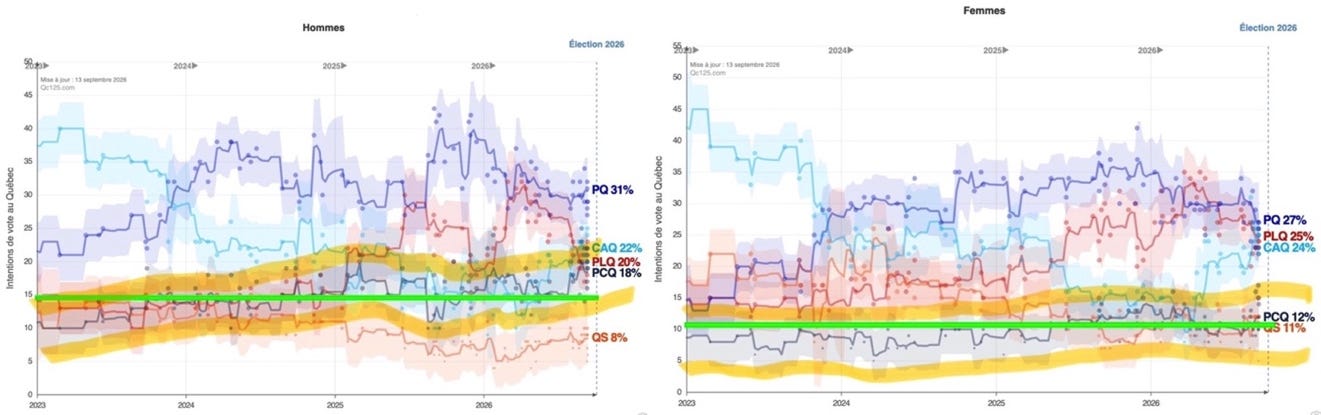
Since the beginning of 2023, Conservative voting intentions have generally trended upward, rising from around 10% to an average of roughly 15%.
But the average human being also has one breast and one testicle, which illustrates the limits of averages, in anatomy as in politics.
Among men, shown on the left below, Conservative support has generally remained around 15% or higher.
Among women, shown on the right, it has generally remained below 10%. (I had to fiddle with the image sizes a little to make the scales line up.)
Source: Qc125.com
The margin of error is substantial, at six percentage points. But the gap is consistent throughout the entire period, which suggests it is probably real.
Some will point out, correctly, that other parties also have gender gaps. The Parti Québécois attracts slightly more support from men, while the QLP attracts slightly more from women. But a five-point gender gap for a party polling at 20% or 27% is much less striking than a five-point gap from a base of 10%.
Support for the QCP is 50% higher among men than among women. That is enormous.
With Québec solidaire, the reverse is true, although the gap is somewhat smaller.
I will close this section by reminding everyone that men are generally the ones who cause the problems, and women the ones who fix them.
The parties don’t care about Montreal
If you think the Third Link, gas taxes, and other populist measures are taking up a little too much room in this campaign, you are not wrong.
And if you think no one is talking much about Montreal, your instincts are right there too. The two are connected, as we are about to see.
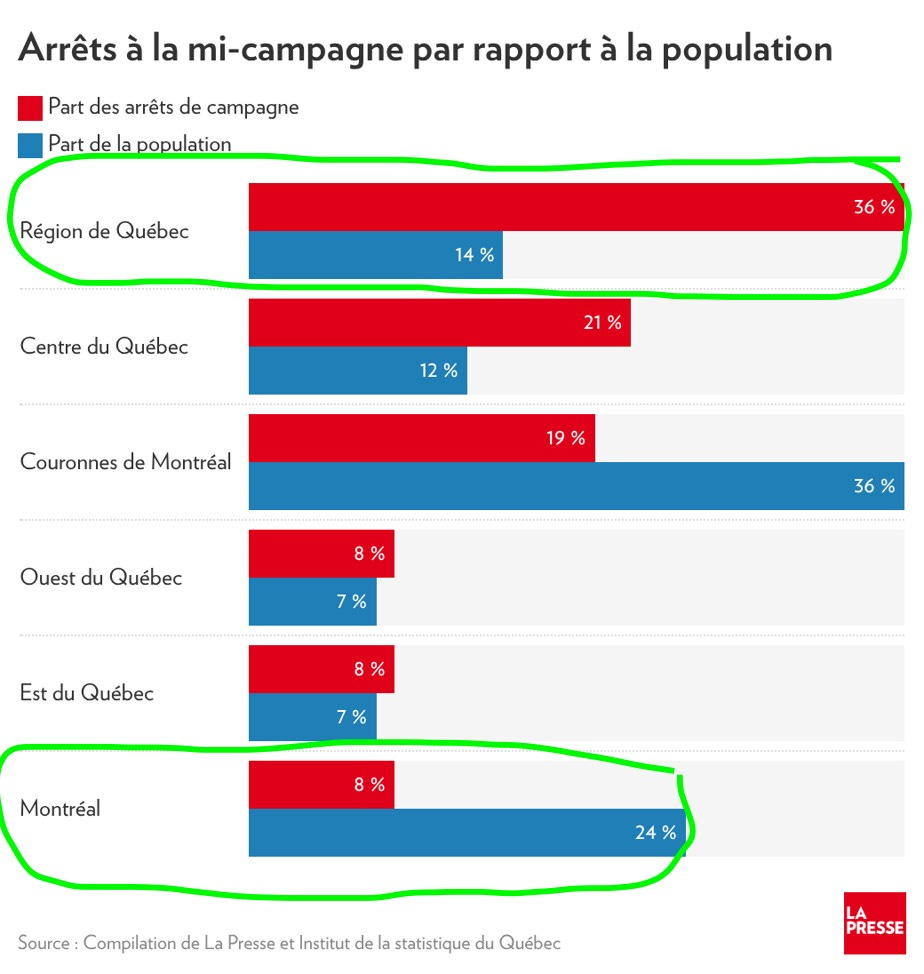
The Island of Montreal accounts for 24% of Quebec’s population, or slightly more than two million Quebecers. Party leaders have made only 8% of their campaign stops there.
By contrast, the greater Quebec City region, including its South Shore, has received 36% of all visits despite accounting for only 14% of the population.
In the first case, Montreal received roughly one-third the attention its demographic weight would suggest. In the second, Quebec City received nearly three times as much.
Adjusted for population, Quebec City therefore received nine times as much attention as Montreal from the leaders, and thus from the parties.
Source: La Presse
Montreal’s surrounding suburbs, meaning the South Shore, Laval, and the North Shore, have not received much attention either: 19% of the visits, despite representing 36% of the population.
The PQ’s path to a majority may run through Quebec City. The CAQ’s shrinking hopes of forming the Official Opposition rest there. And for the QCP, Quebec City holds the balance of power.
In short, this year’s electoral battleground is Quebec City, and the political target is its conservative electorate.
Québec solidaire and the “clunkers”
To encourage people to give up their cars, a Québec solidaire government would offer $1,000 and a one-year public transit or car-sharing pass in exchange for scrapping a gas-powered vehicle more than 15 years old.
That sounds as though it was designed by people who do not own a car and do not need one. Which, incidentally, is almost a perfect description of the ridings QS currently holds: downtown Montreal and downtown Quebec City, with Sherbrooke as the lone exception. (And that will not last much longer.)
Very few people buy a car, much less two, on a whim. If public transit were genuinely practical, people would use it without a second thought. Even in Montreal, driving is often faster.
Without adequate public transit, people will not give up their cars. With adequate service, no financial incentive would be necessary.
It is the Field of Dreams principle: build it, and they will come.

(At first glance, it looks like a horror movie, but don’t be fooled. It is about a guy who wanted to play baseball with his father and another guy who did not wear shoes. Yes, it has been a long time since I saw it.)
Back to Québec solidaire. The inadequacy of public transit is not the main problem with its proposal.
How can I put this? If people are lining up to sell 15-year-old cars for $1,000 and a year of public transit, I am opening a used-car dealership, doing this for two or three years, and then retiring.
Go take a look at AutoTrader and see what a 15-year-old Civic or Corolla is worth. You will quickly understand. If it is an SUV, the absurdity of the proposal becomes even more obvious.
I realize that QS activists and candidates are more likely to ride a bike than drive, but I would bet they have internet access.
Assuming they do, why did absolutely no one think to check whether the proposal was roadworthy, so to speak, before putting it in the party platform and boasting about it?
Because in Québec solidaire’s certainty-soaked world, a 15-year-old car is an “old clunker.” That would be the name of the program.

Source: Québec solidaire’s climate plan
We have two cars at home. We put off getting the second one for as long as we could. But eventually, for a family of four, it just did not work anymore. I know that can be hard to imagine from the Plateau, but that is life. Communauto is hit-and-miss where I live, and there is no way I am biking to the arena three times a week.
The Honda is 13 years old. And we are not getting rid of it in two years. Not for $1,000, $2,000, or $5,000.
It is always the same problem with QS. The good intentions are there, but you are left with the impression that its activists do not live in the real world, and that some of its proposals came straight out of a CEGEP philosophy club, drafted by people who have never owned a car, never owned a home, and never held a job.
There are social democratic models that manage to be both highly egalitarian and highly effective, and the Nordic countries are pretty good examples. They outperform us both economically and socially.
Yesterday, I explained that Québec solidaire should reconsider its goals: influencing public policy without necessarily trying to form government, much as the QCP has managed to do under Éric Duhaime.
It might also be a good idea to test public policy proposals outside the party’s echo chamber before they make it into the platform. Or the news.
Christine Fréchette and the multiplication of teachers
I have already written about the superpower of the outgoing premier, who will soon simply be out: claiming to know things she does not, and stating as fact things she knows are not true.
Ms. Fréchette has another power: multiplication. Jesus multiplied the loaves; Christine multiplies teachers.
I missed one hell of a lie.
On Wednesday, during an exchange with Paul St-Pierre Plamondon, Ms. Fréchette touted the CAQ’s record on education, casually claiming that the CAQ government had hired 100,000 teachers. Just like that. In passing. Bam.
Here it is.
Let me take a brief detour.
There are roughly 3,000 schools in Quebec. I know that figure by heart because, when you spend enough time looking at education, you keep tripping over it.
So Ms. Fréchette hired more than 30 teachers per school? That seems like a lot.
Especially when you know there are roughly 100,000 teachers in Quebec. That is another figure I know, and it is what I would say in a debate if my team had not prepared me. And I am not running to be premier.
The exact figure, after checking, is 91,732 teaching positions in Quebec schools, according to the Education Department’s dashboard.
In an ideal world, candidates for the most important job in Quebec would know a number of basic facts and useful benchmarks about our society: the number of schools and hospitals; the size of the government’s expenditure budget and those of a few key departments; the number of doctors, nurses, and teachers; the number of people experiencing homelessness; the proportion of Quebecers aged 65 and older; and the number of Stanley Cups Henri Richard won.
That would be true in an ideal world. But in our less-than-ideal one, I do not expect politicians to have every one of those figures at their fingertips whenever they are asked a question.
When Ms. Fréchette throws out a number to try to trip up a political opponent in front of hundreds of thousands of potential voters, however, I do expect her not to make up enormous numbers just to look good. She did that at least once more on Wednesday, when homelessness came up.
Did she knowingly make it up, or was she misled by her advisers? It is hard to say. Either way, it leaves two possibilities: a problem with honesty, or with competence.
+++++++
I am taking a break this Saturday and giving myself two days off for the first time since the campaign began.
I also want to thank you once again for the invaluable support that a growing number of you are giving me. Paid subscriptions continue to rise, which gives me hope that my slightly crazy goal of making this independent outlet sustainable might actually be possible.
If you would like to help this improbable adventure along, this is the place. A free subscription helps too!
-30-
My name is Patrick Déry. I’m a French-speaking Québécois writing for a living, and trying something different here. If you enjoyed reading this text, you can support me by buying me a coffee. You can also subscribe to this media (free or paid, your choice).
Comments, shares, and “likes” are always appreciated. It also helps the Substack algorithm notice me, so don’t be shy!