


How was your three-day weekend? Mine lasted a day and a half, thanks to the election campaign. There was more teenage soccer tonight, hence the late delivery.
We’re entering that phase of the campaign when the daily din of overlapping announcements starts to blend into a vague roar. Five hundred million more on the left, a billion less on the right, with counter-counter-tariffs thrown into the mix. With five parties, it’s easy to lose the plot. So I’m left with two choices: take a step back and pick the best bits, or hit you with 8,000 words every night.
I briefly considered the 8,000-words-a-day option, but my girlfriend threatened to unsubscribe from my Substack. So I chose to take a step back. Maybe.
What happened on Saturday and Sunday?
Let’s try this: I’ll summarize each announcement and respond to it in one sentence so we can move on to the rest more quickly.
— Québec solidaire wants to raise the minimum wage to $20 (increase refundable tax credits instead; it will be more effective and less inflationary);
— The QCP wants to require a secret ballot for union certification votes (I don’t understand why that hasn’t been the rule for the past 50 years);
— The PQ wants to invest an additional $1.3 billion over four years in home care and subsidize the conversion of homes into multigenerational dwellings (YES! But I still have the same question: where are we going to find the caregivers? Here’s an idea: why not rely on immigration?);
— The QLP promises to expand Cité-de-la-Santé Hospital in Laval, the only hospital serving a city of more than 460,000 people (I live in Laval and I’m biased, so YES! We also have only one Costco. Could the QLP do something about that?);
— The leaders of three of the four opposition parties grudgingly agree to meet with Christine Fréchette about the U.S. tariffs (which lets everyone engage in some bad political theatre: Charles Milliard says he is “not at all reassured,” PSPP says he learned nothing, and Éric Duhaime congratulates himself for not taking part).
Now that we’ve covered that, let’s get to everything else.
But first, a word about subscriptions, which have continued to climb over the past few days.
I’m trying to build a sustainable, independent, unsubsidized media outlet. It isn’t easy, but many of you are answering the call.
Thank you again. Even a free subscription helps if you’d like to try before you buy. You can sign up here:
By the way, my Substack climbed as high as No. 29 in “Rising in News,” among thousands of publications. And that’s thanks to you. :-)
With that out of the way, let’s dive in!
Has the electoral Jell-O set?
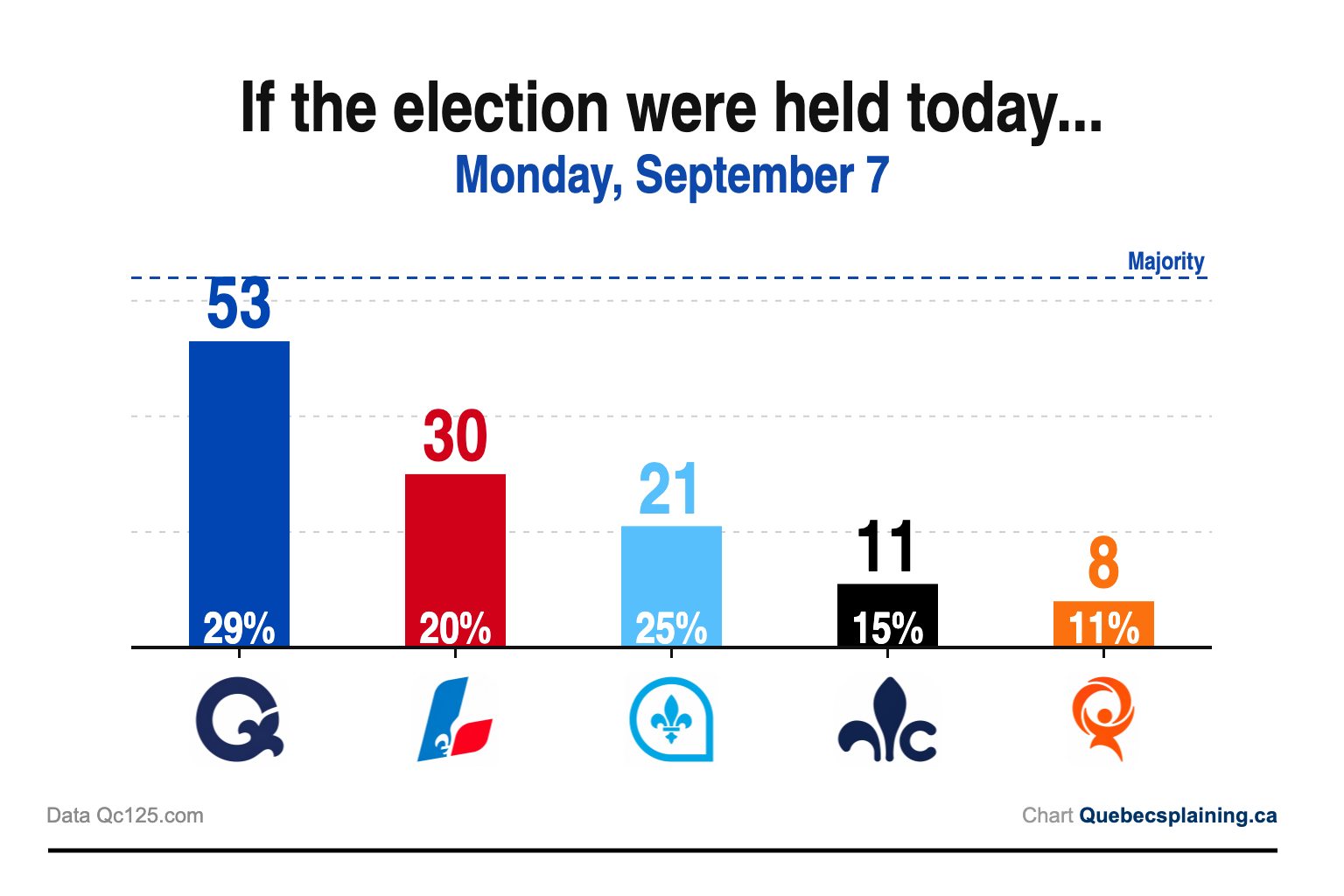
A new Pallas poll shows that voting intentions have not moved much. Factoring the poll into the latest projections would produce the following seat totals if an election were held today. (Each party’s share of the vote appears inside its bar.)
A few quick observations:
The PQ would still win far more seats (53) than it would under a perfectly proportional system (36), but it would remain well short of a majority;
The QLP holds on to second place because its support is geographically concentrated, but its position is fragile: if just one percentage point of QLP support shifted to the CAQ, the two parties would trade places (I checked);
With support similar to its 2022 result (13% then, compared with 15% now), the QCP could elect 11 MNAs instead of none;
Both the QCP and QS would elect more MNAs under proportional representation than under the current projection (19 instead of 11 for the QCP, and 14 instead of eight for QS). That would make a difference in the balance of power and the checks and balances within the National Assembly;
The result above, if an election were held today, would nevertheless give us the most balanced Parliament since 2012, when the PQ formed a minority government with 32% of the vote and 54 seats;
In theory, the QLP could try to form a government with CAQ support. In practice… see the next section;
Even more theoretically, the CAQ could try to remain in power if it believed it could secure the support of one or more parties on a case-by-case basis. In practice… good luck!
A PQ-QCP coalition would hold 64 seats and control the National Assembly. It’s not as far-fetched as it sounds.
For any of these scenarios to materialize, our politicians would have to behave like adults. Which brings us to…
The QLP Wants Nothing to Do with a Coalition with the Coalition
Given the polls, a reporter eventually asked the QLP leader whether he would agree to form a coalition with the Coalition Avenir Québec Équipe Christine Fréchette. Mr. Milliard wants nothing to do with it, even though their respective parties increasingly resemble each other.
Three things. First, the QLP should stop imagining that Quebecers are simply waiting for the opportunity to flock back to the party. (Yes, some people inside the QLP believe that. Some believed it in 2022, too. We saw what happened.)
Second, Mr. Milliard may not have a choice if he wants to prevent the PQ from holding a referendum.
Third, what our power-hungry politicians of every stripe see as an aberration is perfectly normal almost everywhere governments are not chosen by divine will or at gunpoint.
Across the Western world, the only countries whose electoral systems include no form of proportional representation are the United States, France, England, Australia, and, of course, Canada, including every province.
In other words, apart from Australia, they are the countries we know best. That gives us the impression that our prehistoric voting system is the norm. The opposite is true.
Almost everywhere else, the different parties have to negotiate after an election to determine who can form a coalition. Contrary to popular belief, this produces governments that are nearly as stable as ours, but far more representative and democratic, as well as much greater continuity in public policy.
One day, Quebec politics will grow up, too.

Québec solidaire Makes an Almost Selfless Proposal
Québec solidaire is trying to revive electoral reform, solemnly promised by François Legault in 2018 and subsequently abandoned. Before that, it was promised and abandoned by Jean Charest. And before that, promised and abandoned by René Lévesque.
Are you noticing a pattern?
In 1972, Mr. Lévesque called our voting system “democratically rotten.” You can understand why. With 23% of the vote, his party had won seven of the National Assembly’s 108 seats.
René Lévesque did not change the voting system once he had the chance, either. Neither did Mr. Charest or Mr. Legault.
We’ve tried to bring electoral reform back to life so many times that it’s starting to look like this:

Québec solidaire is once again trying to resurrect the monster. It proposes replacing our first-past-the-post system, introduced in 1791, with mixed-member proportional representation, similar to the systems used in Germany, Scotland, and New Zealand. That is precisely what the CAQ, PQ, and QS had agreed to before François Legault decided in 2022 to keep his promise not to keep his 2018 promise.
The PQ and QCP support it.
The CAQ remains true to itself.
The QLP opposes it because it believes it can regain voters’ trust while still hoping to keep both hands on the wheel and win a “majority” with 40% or even less of the vote. (Actually, the QLP does support replacing the current system with ranked-choice voting because it thinks that would benefit the party. That’s not a good reason. And it’s no longer true.)
Some free advice for the QLP, because it sorely needs it. But first, a reminder: francophone Quebecers don’t trust you. Anglophone Quebecers don’t either, but they feel they don’t really have another choice.
If you want to make a bold move that captures the public imagination, dominates the media narrative, and might even move the needle, promise not only to change the voting system if you win the election, but also to offer cabinet positions to the other parties in proportion to their share of the vote. Then repeat that promise every day until the campaign ends.
I guarantee that reporters will be surprised, that you’ll get a couple of great headlines out of it, that it will spark debate and analysis, that the coverage will be positive overall, and that the premier will take a beating in the debate if Mr. Milliard is even halfway competent.
And perhaps people will believe that the QLP really is changing.
That’s it for the advice. Office hours are over.
Lie of the Day
Early last week, Christine Fréchette claimed that the federal government had “taken [Quebec’s] requests into account and adjusted its approach,” implying that Ottawa had just changed its counter-tariffs in response to new demands from Quebec.
On Monday, we learned that this was false.
The La Presse headline:

(Ottawa contradicts Fréchette)
My correction:

(Fréchette tells a lie)
This was not an honest mistake.
The premier possesses a superpower common to certain politicians: the ability to assert something they don’t know to be true, or know to be false, with the confidence of an extended-warranty salesman.
Ms. Fréchette notably used that superpower last spring during the initial rollout of the Digital Health Record, guaranteeing that it would cause no delays for patients. That was not true. In the National Assembly, she tossed out a word salad (search for “délais prescrits” and “cas urgents” here) that showed she did not understand what she was saying.
In February, Ms. Fréchette also spent a long time explaining something about the Quebec Experience Program (PEQ) for temporary immigrants: namely, that it was “impossible” to provide a grandfather clause for people who already met the requirements but had been prevented from applying. Three days later, she promised the opposite. You can look on the bright side and see this as someone promising to do the “impossible.” Or as someone who was lying.
And then there’s this gem. (I know, I’ve shown it before, but I never get tired of it.)
“At the CAQ, sound management of public funds is in our DNA.” Yeah, right. Northvolt and SAAQClic, anyone?
The media have a certain squeamishness about calling things what they are, and it only encourages politicians to take us for fools. Every lie should be called out, every time. Donald Trump doesn’t care, and the media stopped counting after the 30,573 Trumpian falsehoods of his first term, but less sociopathic politicians might feel embarrassed if they win the award for best liar too often.
That reminds me: the latest tariff retaliation in the U.S. trade war takes effect this Tuesday. Buckle up.
Lie of the Day (2)
On the first day of the election campaign (that is, Day 0, which has since become Day 1), Charles Milliard promised to “continue the studies on the third link,” which is roughly equivalent to beating your horse until it admits it’s a cow.
Every known study of a third highway link between Québec City and the South Shore reaches the same conclusion: it isn’t necessary. Today, Mr. Milliard says he wants “all of the information currently available.”
It is entirely possible that the government has concealed information about the third link. But given how long the CAQ has been trying to sell us its tunnel to nowhere without the slightest shred of solid evidence, it would be truly astonishing if it had deliberately kept secret a study showing that the project is justified.
Mr. Milliard also said he had heard “some analysts say that we wanted to launch a whole series of new studies. That is not the case.”
Yes, “that was indeed the case.”

By the way, Mr. Milliard, they’re called “reporters,” not “analysts,” and all they did was quote you.
I know a word. It starts with “bull” and ends with “shit.”
Had Mr. Milliard not joined the stupid bidding war over the third link, he would be more credible when discussing another promise, this one necessary: widening Highway 50 in the Outaouais.
And the headline on the story about that announcement would not have turned into a story about backtracking, making it look as though Mr. Milliard can say one thing and its opposite on the very same issue.
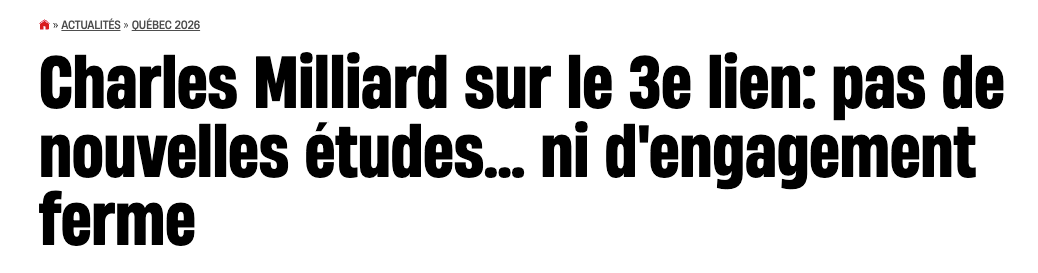
Yes, the article really is about Highway 50. But the Journal de Montréal reporter chose to highlight Mr. Milliard’s contradiction about the third link. Reporters are like that.
The best way to avoid losing control of your message and your announcements is not to treat people like idiots. It’s no guarantee. But it helps.
-30-
My name is Patrick Déry. I write for a living, and I am trying something different here. If you enjoyed reading this piece, you can support me by buying me a coffee. You can also subscribe to this publication (for free or as a paid subscriber; the choice is yours).
Comments, shares, and “likes” are always appreciated. It also helps the Substack algorithm notice me, so don’t be shy!
Hi Patrick,
Can you envision an alliance between the CAQ and the Parti conservateur du Québec? As a PCQ candidate, I certainly hope so. It's hard to ignore that both these parties share similar philosophies.