


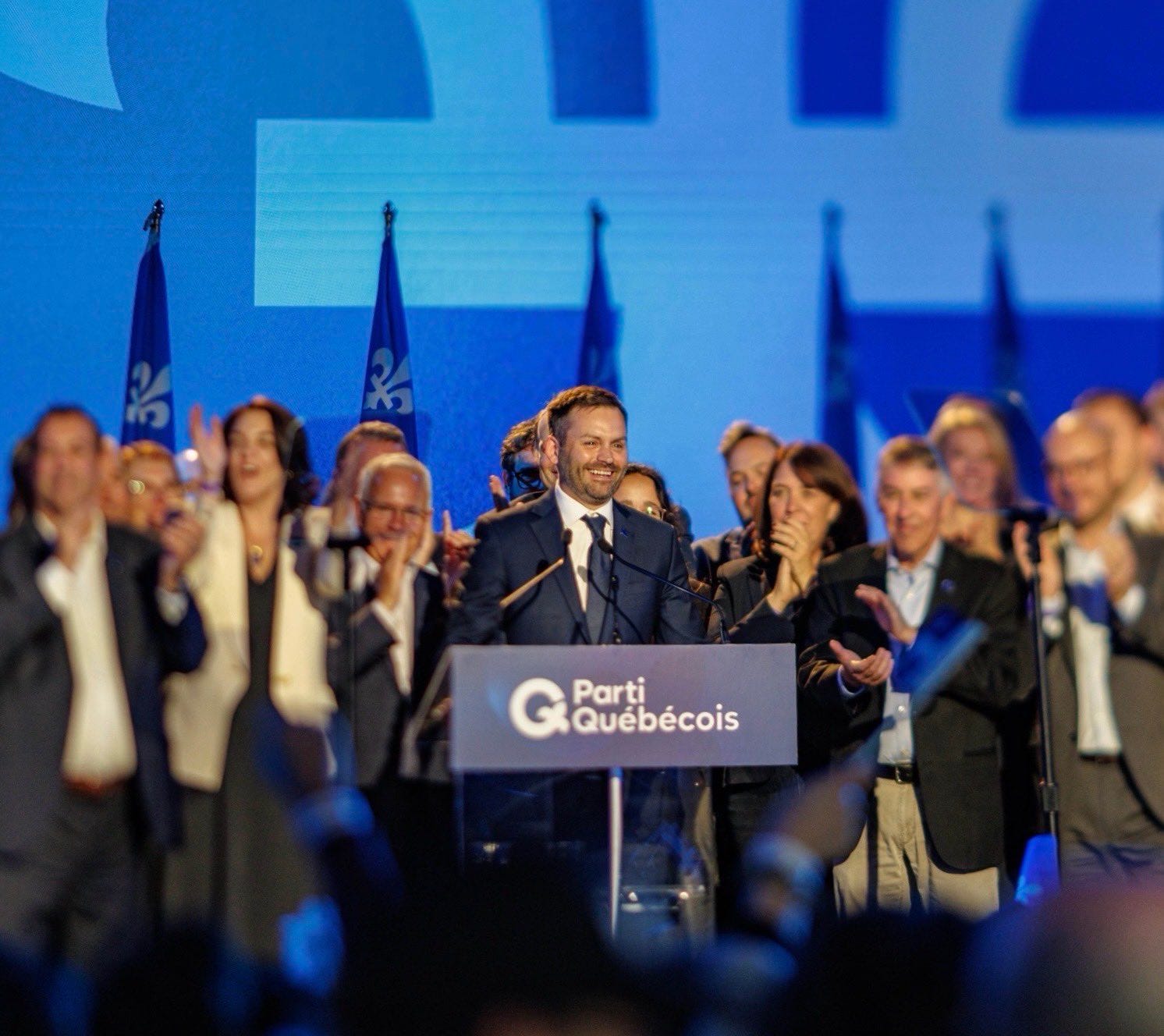
Source: Paul St-Pierre Plamondon’s X account.
(Texte français disponible ici)
Having just won a minority government, Paul St-Pierre Plamondon struck a conciliatory tone.
Quebecers had “elected the Parti Québécois and asked us to work with the other parties,” PSPP said late on the evening of October 5. “I’m reaching out to the other leaders so we can work together.”
On Sunday, he congratulated Mathieu Lévesque, the new interim leader of the Coalition avenir Québec, “wishing him every success in his new role” and “reaching out to him to make progress on the issues Quebecers care about.”
(Working with a party that has no seats shouldn’t be too difficult, but let’s appreciate the spirit of openness all the same.)
All this reaching out is lovely.
And it won’t last.
Throughout the campaign, Paul St-Pierre Plamondon repeatedly asked for a parliamentary majority.
On September 8, when he asked to have “a free hand” rather than his “hands tied,” stressing a majority government’s “much greater ability to act.”
During the September 23 debate, when he said he wanted to form “a stable government” and lamented the “shorter lifespan” of minority governments.
On September 28, when he sought “as much strength and legitimacy as possible.”
On October 1, when he again called for “a strong, stable government.”
Of course, you have to read between the lines. When a politician asks not to have their “hands tied,” they want to be able to ignore dissenting views and do as they please. PSPP made no secret of it when he said that under a minority government, “delivering on promises depends on the other parties.”
I should hope so. It would be beyond absurd if a minority of elected representatives could call the shots for everyone else. But the mind of a sociopath politician doesn’t work that way. For a politician, the prospect of compromise is terribly irritating.
Most of us can accept that a view different from our own is valid.
Most politicians think a view that differs from theirs is wrong and must be opposed. So it’s simpler not to have to debate at all.
You’ll notice that in his calls for a majority, PSPP never asked for the support of a majority of Quebecers. In that respect, he’s no different from Jean Charest, who asked for “both hands on the wheel.” Or from other politicians.
The only majority that counts is the one that lets you do whatever you want.
Whether that majority comes with 42% of the vote (Charest, Couillard), 41% (Lévesque, Legault), or 37% (Legault) doesn’t really matter.
On October 5, if the Parti Québécois had picked up just two more percentage points, bringing it to 30% of the vote, it would almost certainly have formed a majority government.
Do you think our new premier has forgotten that?
+++++++
Over the past two weeks, several political commentators have pointed to the shorter lifespan of minority governments, implying that they could be brought down and concluding that we could have another election in the next 18 months to two years.
That gets it backwards.
Because most of the time, when a minority government falls, it’s because the government itself has decided it’s time.
That was true of the two minority governments Quebec had between the start of the 20th century and this election (the only earlier one was formed in 1878). It’s also true of most minority governments in Ottawa, including three of the last four.
In 2007, after a difficult first term, Jean Charest’s Quebec Liberal Party was caught off guard by the rise of Mario Dumont’s ADQ. Over the next 19 months, the Liberals relied on support from either the ADQ or the PQ, depending on the circumstances.
Quebecers liked what they saw. Unfortunately, they drew the wrong lesson, and the Liberals rose in the polls.
Mr. Charest, ever the tactician, didn’t let the opportunity pass. In November 2008, less than a month after the federal election, he called a provincial election for December, counting on lower turnout, which generally favours the Liberals.
The gambit worked. Jean Charest secured a slim majority in the National Assembly, enough to let him tune everyone out for four years.
Quebecers were less impressed with his third term. In 2012, the Liberals were narrowly voted out.
That brings us to the other recent minority government. In 2012, Pauline Marois’s Parti Québécois formed a minority government with 32% of the vote, three-quarters of a percentage point and four seats ahead of the Liberals.
The PQ then tried to emulate the Liberals of 2007. It used the now-defunct Charter of Values, a precursor to Bill 21, to play on insecurities and resentment over identity.
For a while, the gambit worked. Between the spring of 2013 and late winter 2014, the Parti Québécois enjoyed a surge in the polls that seemed unstoppable.
Then along came Pierre-Karl Péladeau, fist in the air, declaring that he wanted to “make Quebec a country.”
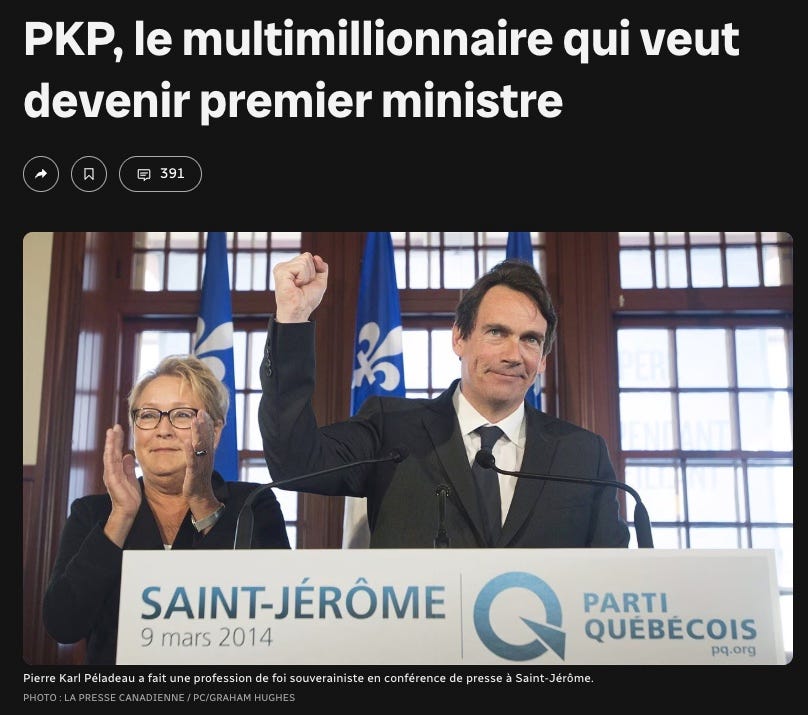
Pauline Marois, applauding the debacle to come. Source: Radio-Canada
And so began a slide the PQ never managed to halt. A few weeks later, Philippe Couillard’s Liberals won a parliamentary majority with just 42% of the vote, then the sixth-lowest vote share ever to produce a majority government in Quebec.
At the federal level, without getting into the details, Stephen Harper in 2008, Justin Trudeau in 2021, and Mark Carney in 2025 all called elections while leading minority governments, judging the circumstances to be favourable. Harper and Trudeau failed to improve their positions, but Carney’s gamble paid off.
Over the past 20 years, Quebec City and Ottawa have seen six minority governments. Only one had its time in office cut short by the opposition parties: Stephen Harper’s in 2011. Ironically, that led to his only majority victory.
Every other minority government brought itself down.
On election night, premiers and prime ministers all strike a conciliatory tone, reach out, and promise to govern “for all Quebecers” or “for all Canadians.”
Maybe they really mean it.
Experience has shown that their promises are, as Plume Latraverse sang, “c’est comme les promesses d’ivrogne: ça se tasse quand la soif te pogne” (“like a drunk’s promises: they go out the window when the thirst hits.”)
The Parti Québécois will have no choice but to compromise if it wants to get legislation passed. The good news is that it can look for allies across a broad ideological spectrum: any one of the opposition parties could hold the balance of power and support it on a particular issue.
PSPP will therefore try to advance his priorities and reap the political rewards of a government that works, just as Mr. Charest did in 2007.
That was the agenda the new premier laid out in his address in the Salon rouge as his caucus members were sworn in: regain control of public finances, clean up the bureaucracy, refocus the state on its core responsibilities, provide health care and education, reduce homelessness, put our house in order, and so on. The referendum will have to wait.
And did you notice that PSPP said nothing about the low level of trust in our democracy and institutions, or how to restore it?
I wouldn’t put much money on electoral reform in the PQ’s first term. Or even in a second term, if a referendum still hasn’t been held.
When will the government fall?
It will come down to a game of chicken that ends when one of the following conditions is met:
1- Favourable polls for the Quebec Liberal Party, the Conservative Party of Quebec (QCP), and Québec solidaire at the same time, allowing them to join forces to bring down the PQ government. That would require a particularly inept PQ government, which would be surprising: PSPP can be faulted for his volatile temperament and his shifting convictions, but not for incompetence.
The government would also have to be doing so badly that all three other parties would want an election, since the PQ needs the support of only one to stay in power. The QCP, in particular, has every reason to retain its leverage over a more right-leaning PQ government. That makes this scenario even less likely.
2- Polls putting the PQ in majority territory, along with other favourable indicators, such as approval ratings for the government or the premier.
Recent political history suggests the Parti Québécois would be unlikely to pass up such an opportunity. So do its leader’s ambitions.
That condition could be met if support for the PQ settled a few points above 30%. The CAQ’s loss of all its seats and a possible decline in its support make that threshold harder to pin down, but the principle remains the same.
The strategy of reaching out will last as long as it has to.
Once this government feels a parliamentary majority is within reach, that outstretched hand may well turn into a raised middle finger.
Rollout of services to speed up cancer diagnoses delayed
The government was supposed to roll out fast-track cancer diagnostic services by 2026. The goal was to help patients get the tests they needed sooner when a doctor or nurse practitioner suspected cancer.
Waiting times for cancer treatment (and everything else) are a problem in Quebec. Every day, patients learn they have cancer too late, have surgery too late, and start treatment too late.
These services are meant to reduce delays that too often prove fatal.
On Monday, we learned that the full rollout will have to wait until 2028 because there aren’t enough staff to run them.
So an aging population drives up demand for care. But that same aging population reduces our ability to provide it.
Things won’t get any better without the drastic action we’re still waiting for, as I explain here.
-30-
My name is Patrick Déry. I’m a French-speaking Québécois who writes for a living, and I’m trying something different here. If you enjoyed reading this article, you can support me by buying me a coffee. You can also subscribe to this publication (free or paid, your choice).
Comments, shares, and “likes” are always appreciated. They also help the Substack algorithm notice me, so don’t be shy!