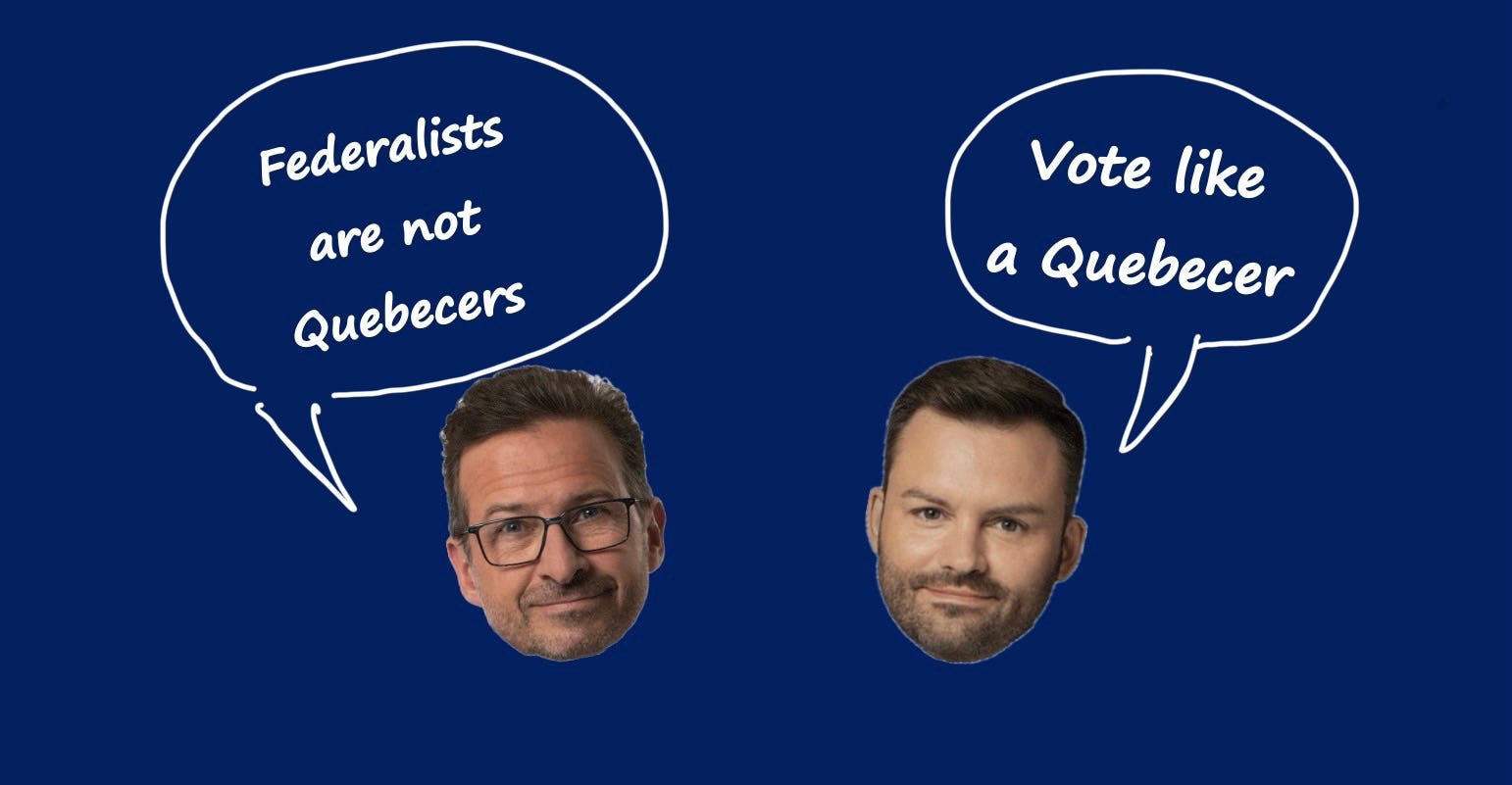
Are federalists Quebecers?
The leaders of the sovereigntist parties don’t think so.
Do you have a maple leaf engraved on your heart? Or, simply put, despite your love for Quebec, do you prefer to remain Canadian? Any one of those shades of red—and all the shades in between—makes you a federalist.
According to Bloc Québécois leader Yves-François Blanchet, that also means you’re not a Quebecer.
Blanchet really did say that in an end-of-year interview with La Presse, published on December 24th. It went relatively unnoticed, quickly buried by Christmas Eve and that we ate, drank and celebrated that evening. The news cycle came to a halt while we were serving tourtière. After the holidays, journalists and political commentators moved on to other topics.
I’ve been thinking what Blanchet said and the resounding silence around it almost every day for the past three months, because it’s so huge, so absurd, but also so revealing of the mindset of certain current sovereigntist leaders.
If a referendum on Quebec’s independence were held today, nearly 70% of us would vote “No.” So, according to Blanchet’s logic, 70% of Quebec’s inhabitants “are not Quebecois”.
Nor are the majority of those who have lived in Quebec for the past half-century.
Sovereigntist leaders from a bygone era—let’s say, pre-charter of values—would never have dared to say such a thing, out of respect for their fellow citizens whom they were trying to convince and whom they aspired to lead in the country they were proposing, but also because it is nonsense. Quebec’s status will be decided amongst Quebecers; those who prefer to remain in Canada are no less Quebecers than those who would vote to leave.
I cannot recall this ever having been called into question by a mainstream politician. The federal government and certain federalist politicians may well have come under fierce attack by sovereigntists. But they never attacked the whole of Quebec federalists.
Similarly, Robert Bourassa or Philippe Couillard never viewed sovereigntists as a subcategory of Quebecers. The federal government has never administered a test to determine whether you were sufficiently federalist to be able to vote or to be elected. A sovereigntist party has thus been sending MPs to Ottawa for over 35 years. It even briefly formed the official opposition.
Today, more and more sovereigntist politicians seem to think that Quebec is not inhabited solely by Quebecers. Since Mr. Blanchet’s statement three months ago, no prominent sovereigntist figure has contradicted him.
Paul St-Pierre Plamondon, the leader of the Parti Québécois, even went a step further recently, asking residents of the Outaouais region to “vote like a Quebecer” in the upcoming elections.
Yes, he actually said that.
One might assume that, for Mr. St-Pierre Plamondon, voting like a Quebecer means voting for the party he leads.
Currently, the Parti Québécois stands at 31% in the polls. So, 31% of us intend to “vote like a Quebecer”. How would the rest of us vote? Like a colonized person? A sell-out? An Anglophone? An immigrant?
Or, worse still, a Canadian?
Yuck!
One might think this trivial. For my part, I believe a significant shift is taking place in Quebec politics. A more accusatory discourse has emerged, perhaps influenced by a general deterioration of the political climate, first in the United States and then in Canada. Political thinking has also evolved in the same direction, and more radical rhetoric—previously on the fringes of the major parties—is now being adopted by their leaders.
In the past, sovereigntist leaders never attempted to draw a line between “real” and “fake” Quebecers. They sought to rally, to convince, to bring people together. Sometimes through criticism, but never through exclusion. Whether sovereigntist or federalist, we were not necessarily so far apart on the essentials; we simply hoped to change people’s minds and believed that dialogue was possible. This was also essential to winning an election, let alone a referendum.
For instance, in his often-quoted “Centaur” speech of 1998, Lucien Bouchard assured English-speaking Quebecers that their institutions, rights and way of life would be protected in an independent Quebec. Bouchard famously said that, “When you go to a hospital and you’re in pain, you may need a blood test; but you certainly don’t need a language test.”
But before Bouchard, René Lévesque had drawn the boundaries of the national debate in a far more explicit manner.
It was in March 1980, two months before the first referendum, during an address to representatives of the English-speaking community. The opening words left little doubt as to Lévesque’s intentions: “Dear Fellow Quebecers.”
This was not mere politeness. In his speech delivered in English, Lévesque sought to clear the air once and for all by addressing what “Québécois” or its English equivalent “Quebecer” meant in the eyes of his party’s members.
“I would like to try to get to the bottom of this rather tired question about who—in our view, supposedly—is entitled to call himself or herself a Quebecer. This very artificial, but also very insistent uncertainty even lies at the bottom of some concerns that have been voiced in several quarters that we would not consider the Anglophone vote valid than the referendum results come in. This is a sort of maximum variation of the notion that has been promoted and particularly in opposition quarters for over three years, according to which, for us, to be a Quebecer, one must be a French Canadian and even also a Catholic, whether practising or not. So, let’s come to grips, if possible, once and for all, with this business of who is a Québécois or a Quebecer.”
“‘Quebecer’ is a name that, to us, unites all those who were born or who live in Québec and it links together their many language, ethnic, cultural, religious, geographic and other differences. It is the mark of belonging to a people and to a land and the use of the word or its French equivalent ‘Québécois’ is in no way the exclusive property of one group and much less of one party.
(…)
Today, the word Quebecer is recognized and whether the term is used in English or in French, Quebecers in English may do things that are more or less intelligent or palatable and Québécois in French may act brilliantly or stupidly, but in no case could their title to their Québec identity possibly be challenged. I hope that’s clear!”
As a reminder, Lévesque was not keen on the name “Parti québécois”, because he felt that the politicization of the term might exclude those with other political preferences. Nearly 60 years after the PQ was founded, Lévesque’s most recent political heir demonstrated this when he called on people to ‘vote like a Quebecer’.”
As with the Bloc leader’s comments about federalists, it seems that no one is considering that PSPP might actually mean what he was saying and, if he does, that it is completely bonkers.
For some sovereigntists, English-speaking Quebecers have often been seen more as an obstacle than as fellow citizens exercising their democratic freedoms. Questioning the authenticity of their ‘Quebec-ness’ was a convenient way of pushing them aside and considering only the ‘real’ Quebecers. Without the “English,” Quebec would already be a country, wouldn’t it?
This mindset still exists today, but it has crept into acceptable discourse, or at least a discourse that has been accepted. Recently, commenting on a poll, a former PQ MNA pointed out that the Francophone vote is “the one that counts.” Sovereignist leaders go even further, encouraged by commentators who are increasingly uninhibited, even hateful, towards those who commit the crime of not sharing their vision of the national question.
It is no longer just the Anglophones who are an obstacle; it is all federalists. And, confusing their own political preferences with what they see as an obvious and inevitable conclusion, sovereigntist politicians have come to assert publicly and without any embarrassment that federalists are not Quebecers, do not vote like Quebecers, forgetting that these “non-Quebecers” represent the majority of the electorate whose support they seek.
It marks the emergence of a voice that has always existed amongst the most militant sovereigntists, but which had never reached the top of the movement. It also reflects radicalization—in the first meaning of the word—or, at the very least, a greater intransigence of the movement as a whole.
This shapes and influences the actions and priorities of pro-independence politicians and their advisers. If only 31% of Quebec’s inhabitants are Quebecois, why worry about what the others think?
+++++++
The more a party represents a broad coalition, the more compromises it must make. When Quebec was dominated by two parties—which was the case for almost our entire political history—virtually everyone wishing to engage in public life gravitated towards these two poles. First, it was the Liberals and the Conservatives, then the Union Nationale, and then the Parti Québécois.
The PQ has historically brought together both impatient and less impatient sovereigntists, as well as those further to the right and others very much on the left. The Liberal Party comprised supporters more enthusiastic towards Ottawa and others that saw themselves more as Quebecers than Canadians.
The fragmentation of our political landscape has multiplied the poles of attraction. Nationalist federalists and disillusioned sovereigntists have turned to the CAQ. Left-leaning sovereigntists, as well as supporters of the QLP, have swelled the ranks of Québec solidaire, which is now more of a left-wing party than a sovereigntist one. The right-wing and anti-establishment electorate, and even a somewhat paranoid fringe, who were previously scattered along the federalist-sovereigntist axis, have found a home with Éric Duhaime’s Conservatives.
Each of these five poles is ideologically ‘purer’ than the PQ or the QLP could ever have been when they each defined nearly half of the Quebec political spectrum.
Discussion within these new, narrower camps is easier. Each party increasingly resembles an echo chamber, almost unanimous within its own ranks, but divorced from the far more diverse conversation that animates the whole of Quebec society.
This ideological purity is also appealing because it can now be rewarded at the ballot box if a critical mass is reached, even if that mass falls well short of a majority.
In 1973, with 30% of the vote, the Parti Québécois won six seats. René Lévesque was defeated in his own constituency. Today, with 31% of the vote, the PQ would have a good chance of forming a majority government.
Why try to win over voters by making compromises if ideological purity is enough? Why adopt a moderate stance if accusatory rhetoric, bordering on paranoia and insults, manages to mobilize a sufficient base?
It’s much simpler. And too bad for the others.
Politicians of all stripes are often so convinced they are right that they can no longer see a legitimate point of view in their opponents. Being a federalist doesn’t necessarily mean you think everything that comes out of Ottawa is brilliant. For most of us, even if the federal government sometimes makes us roll our eyes, it just means that, at the moment, we generally feel we’re better off with Canada than without it.
Outside the political bubble, our day-to-day relationships—with colleagues, friends, family, even as a couple—aren’t determined by the national question. Some are federalists. Some are sovereigntists. Others are somewhere in between. All of this can change. It’s part of who we are. Like many Quebecers, I voted ‘Yes’ in 1995, and I’d vote ‘No’ today.
Daniel Johnson senior used to say that “every Quebecer is a separatist for at least an hour a day.” That sums up the general feeling quite well.
The new sovereigntist discourse sees things in black and white — or rather, in blue and red. Federalists are colonized, or even traitors. At best, they are being manipulated and are incapable of understanding what is good for them.
This can lead to being content to form a government with a third of the electorate. It can also justify holding a referendum when the other two thirds are not interested.
After all, they aren’t really Quebecers.
-30-
This text is 2,004 words long, which is roughly eight pages of a book. The research, writing and amateur artistry took me two days and left me homesick.
My name is Patrick Déry. I write (mostly in French) for a living, and do my best to Quebecsplain in English in this space. If you enjoyed reading this text, you can encourage me by buying me a coffee. Comments, shares, and likes are always appreciated.
You can also subscribe to this media by clicking on the button below.


I’m surprised it didn’t get more press. I’m an individual with multiple personalities: Canadian, federalist, Québécoise (13th generation), Quebecker, Historic Anglo and bilingual. I find it slightly insulting that I’m not considered Québécoise in Mr. Blanchet’s eyes just because I don’t want Quebec to be its own country.
