


(Texte français disponible ici)
A few days before the campaign began, Team Christine Fréchette–Coalition Avenir Québec recruited influencer and businessman Olivier Primeau to party campaign for the party.
I imagine this is the kind of influence they were hoping for:

Source: Instagram
It was already a little awkward. Mr. Primeau holds permits covering 36% of the water authorized for extraction in Quebec. Until August 21, he was also registered as a lobbyist for projects involving the commercial use of water.
Primeau saw “no conflict of interest” in his new role and swore he expected nothing from another CAQ government. He had, however, criticized the party extensively in the past and made his conservative sympathies abundantly clear across his many platforms.
The CAQ had even arranged for him to be described as “a longtime CAQ supporter.” At least, that’s what anonymous sources told Radio-Canada in late August.
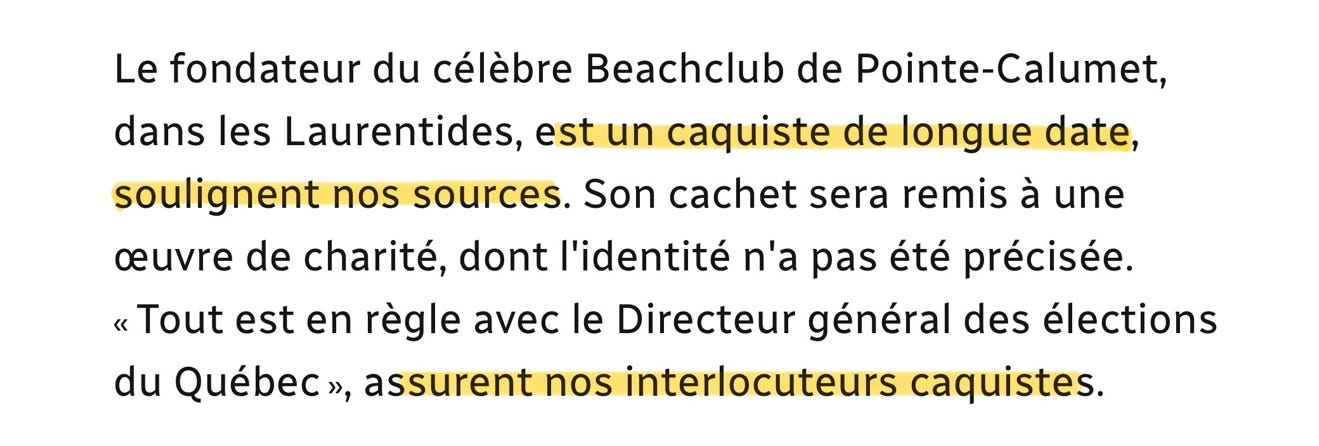
I love it when anonymous sources talk. Sometimes they need protection from real reprisals. Other times, they just want to fill journalists’ ears with nonsense without having to answer for it.
In politics, the second kind is more common. Someone’s baloney detector should have gone off.
Last week, we learned that the “longtime CAQ supporter” had previously asked about the rules for entering the QLP leadership race. He had also said he was “certain” he would make a good premier.
Well, well. Beep-beep. Baloney.
Today, things went up a notch.
Primeau explained that he is “a conservative in a riding where my vote won’t count for anything, and if I don’t want a referendum, I have to vote CAQ.”
🤣
“I’m a conservative in a coalition, and I’m going to vote strategically,” he said, insisting he has been saying so since the beginning of the campaign.
🤣🤣🤣
And we shouldn’t expect him to post pro-CAQ videos on his platforms.
🤣🤣🤣🤣🤣🤣🤣🤣🤣🤣🤣
The CAQ is paying Olivier Primeau $20,000 for his services. He will, in turn, donate the money to charity.
If I were Christine Fréchette, I’d still ask for a refund.
Okay, let’s dive in!
Minister Duranceau gets it wrong. Five times, in fact.
We recently learned that the government ignored an analysis by its own civil servants and outside accounting experts warning that Santé Québec’s finance and procurement information system, known as SIFA, could cost ten times more than originally planned.
Instead of $100 million, it is heading toward $1 billion.
Next to that, SAAQclic looks like a well-managed project. Even if SAAQclic is also going to cost $1 billion, its initial estimate was $638 million. A 50% cost overrun looks almost modest next to a 900% one.

The government didn’t just ignore its experts. It ignored its own rules, which require it to take their advice into account. The savings used to justify SIFA may also have been overstated.
In short, this has the makings of a public inquiry next spring. At this rate, we’ll run out of retired judges and prosecutors.
Here, incidentally, is an analysis of the project’s rising costs prepared by the Ministry of Cybersecurity and Digital Technology and outside firms. The government kept it under wraps for as long as it could.
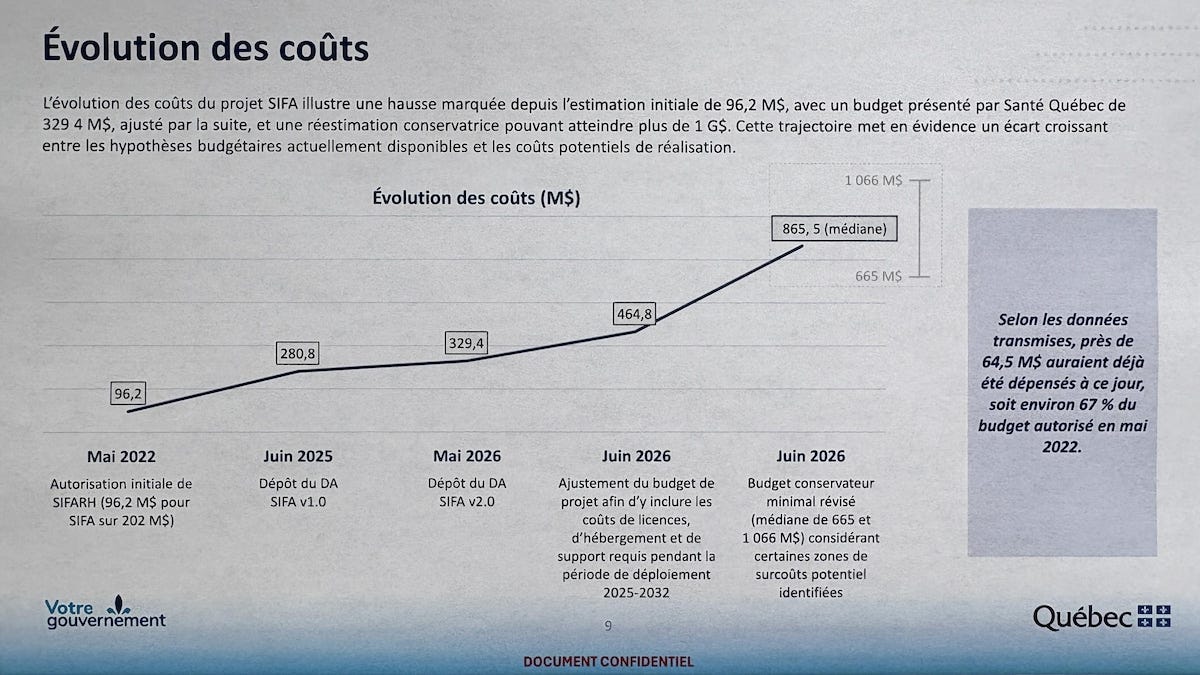
Source: Radio-Canada
(I love the “Your government” logo in the bottom left corner, permanently stamping this document with the seal of political incompetence.)
Last week, Ms. Duranceau, who is also known for suggesting that tenants invest in real estate and for being nicknamed “Cruella” by former premier François Legault, dismissed the warnings as a “doomsday scenario” and “numbers thrown around to scare people.” She called it an “organized” effort to “embarrass the government” ahead of the debate.
It is embarrassing. But is it wrong?
Ace reporter Thomas Gerbet got hold of a document showing that Minister Duranceau appears to have made at least five inaccurate public statements about SIFA.
I’ll summarize them. They offer a fascinating glimpse into the minds of politicians who can tell you things they don’t know to be true, or even things they know are false, while looking you straight in the eye and all but swearing on their mother’s life.
The minister said implementing the project would cost $329 million. The government she still belongs to, as well as Santé Québec, puts the cost at $677 million.
The minister defended $329 million in spending by pointing to $1.2 billion in savings. But she counted only five years of costs against 18 years of savings, which were themselves overstated. Oops.
The minister said software licences would cost $20 million a year instead of $106 million, producing annual savings of $86 million. The main licence supplier was unimpressed. It wrote to the minister to tell her the licences cost no more than $60 million, which would put the savings at $40 million. Over the project’s 18 years, that amounts to an overstatement of more than $800 million. Oops again.
The minister said Santé Québec was the first to sound the alarm. In fact, the Ministry of Health was warned about the problems twice in 2024. Santé Québec, which took over in late 2024, then received three requests to suspend the project in 2025. That makes five warnings before the red light finally went on.
The minister said the $1-billion estimate was exaggerated because it assumed 200,000 users rather than the planned 17,000. In fact, the Ministry of Cybersecurity and Digital Technology and the accounting firms based their analyses on 22,000 users.
It’s possible Thomas Gerbet has it wrong. But given his track record, I know whom I’d bet on at an online sportsbook.
The media back-and-forth is interesting, too. An awkward story breaks at Radio-Canada. Ms. Duranceau goes on Mario Dumont’s show at Québecor to defend herself. Radio-Canada publishes something even more awkward for the minister. She goes back to Québecor to defend herself again, this time with Benoît Dutrizac.
Why am I telling you this? As we’ll see below, things aren’t going very well for the CAQ.
They won’t improve if, every two or three days between now and election day, voters seing news about an IT project going badly off the rails despite repeated warnings, while the government concealed information and/or spread falsehoods.
On this platform, I’ve already documented clear, verifiable, and verified lies by François Legault, Jean-François Roberge, and Christine Fréchette.
Minister Duranceau is a chartered professional accountant, like her former boss, François Legault.
Chartered professional accountants are not allowed to lie.
Le Journal de Montréal changes its polling graphic
Last week, the latest Léger poll produced a chart that was funny for all the wrong reasons: the sheer number of distortions and basic mistakes.
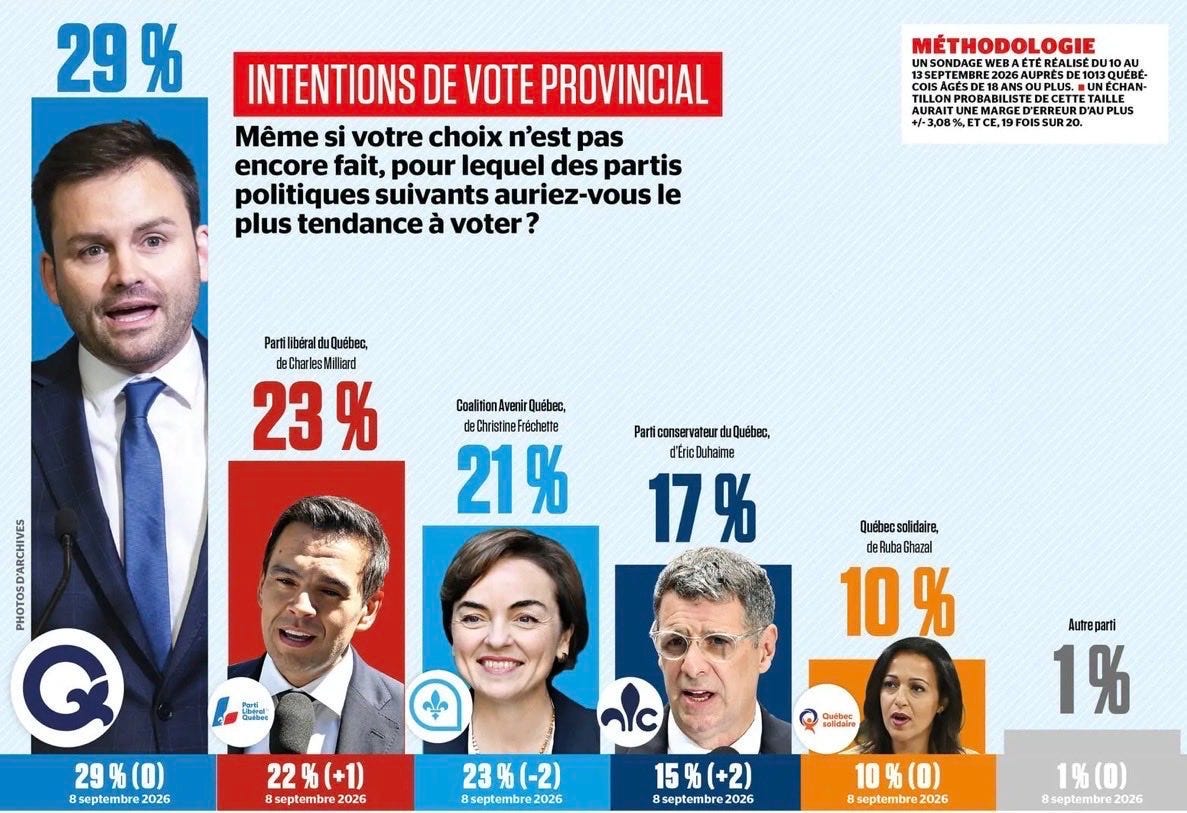
There was the enormous gap between the first bar and the others, bearing no relation to the numbers; the inconsistent gaps among the second, third, and fourth bars; the heads enlarged or shrunk; and the logos of varying sizes and styles. It had everything.
It was so ridiculous that Le Journal redid the chart a few hours later with proportions that were more… proportional.
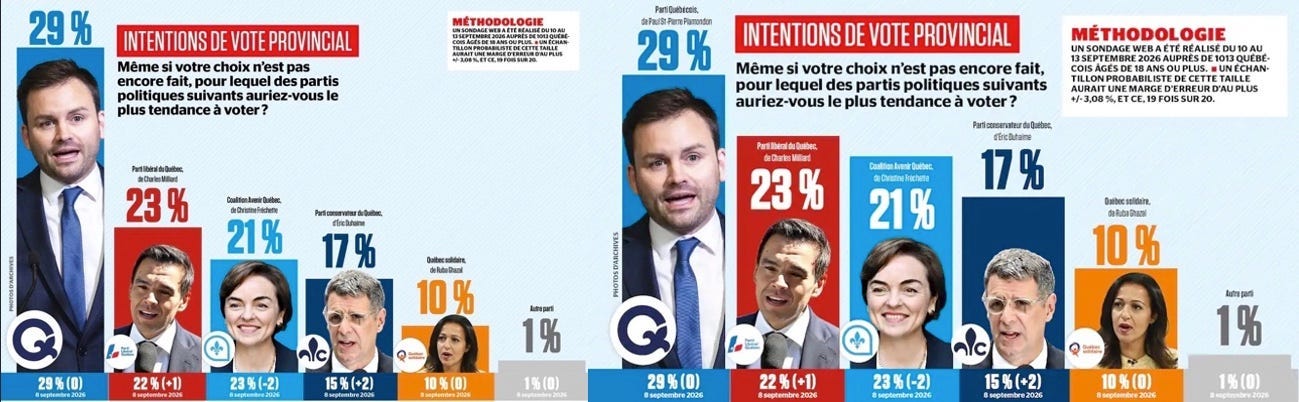
This week, the presentation of the new Léger poll is completely different.
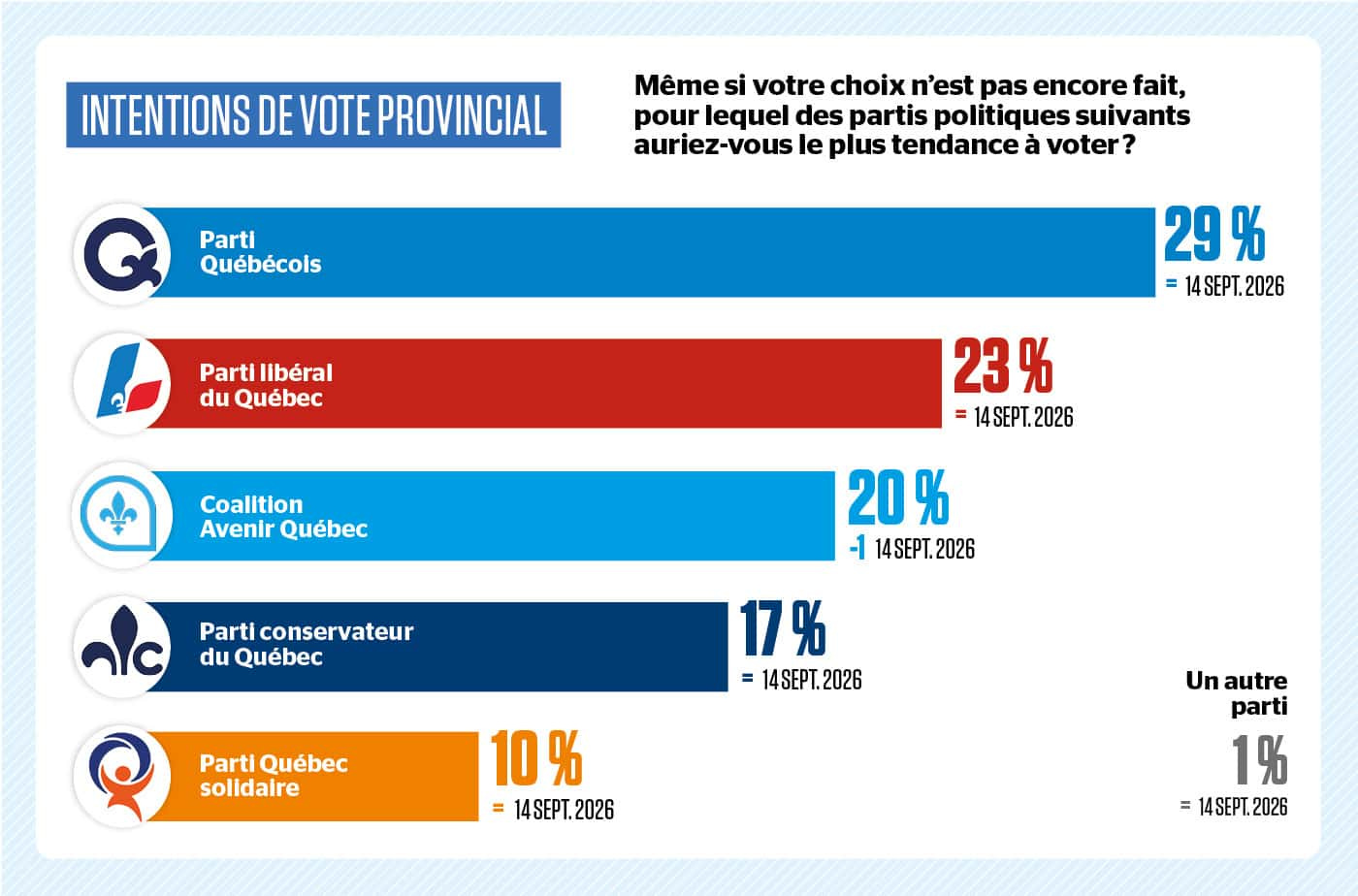
Source: Le Journal de Montréal
The presentation is neutral, the proportions are right, and the logos are roughly the same size.
I mean this without a trace of sarcasm: well done. It shows someone spotted the problem. Credibility remains a news outlet’s most valuable asset.
Still, someone at Le Journal couldn’t resist playing with the candidates’ heads.
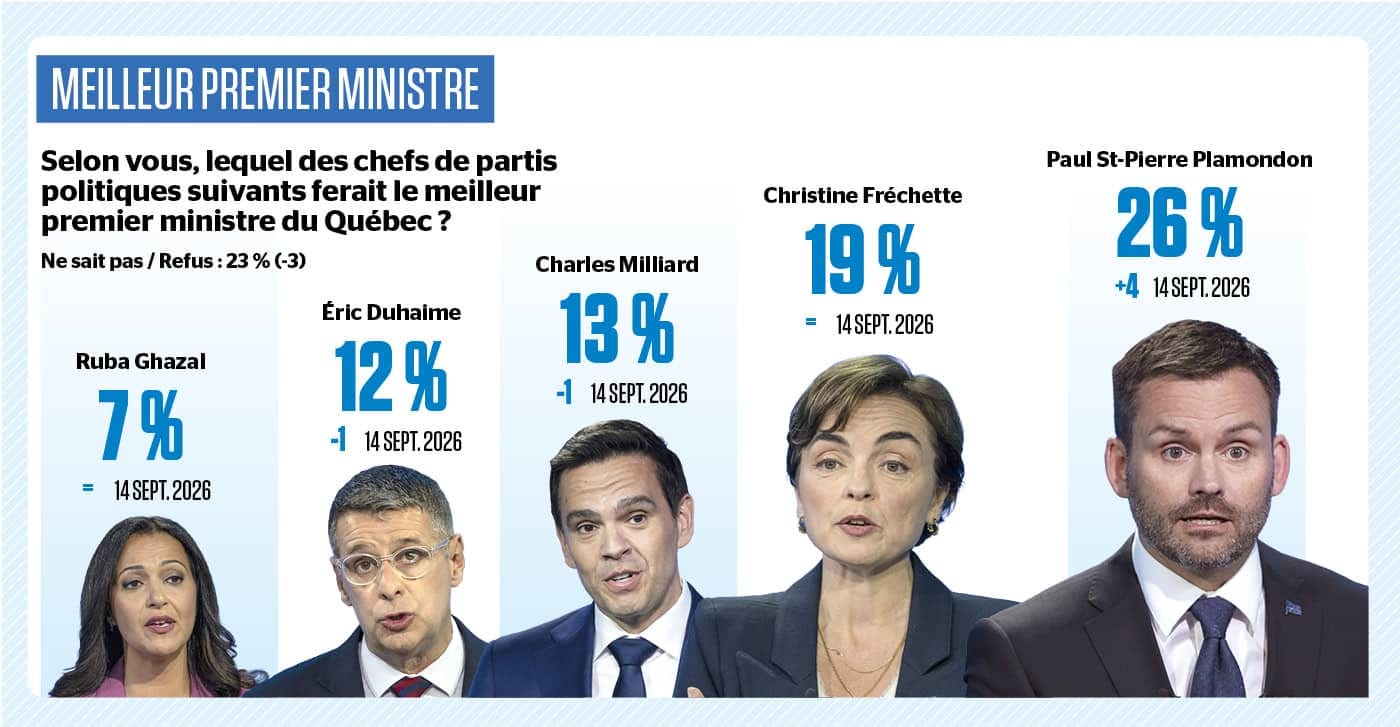
I still say they shouldn’t do that.
Okay, Déry, can we talk about the poll now? Voting intentions haven’t really changed, so the seat projections can’t have changed much either, right?
Buckle up!
Could the CAQ be wiped off the map?
Here are the seat projections and voting intentions as of Monday, September 7, and Thursday, September 17. The change is modest.
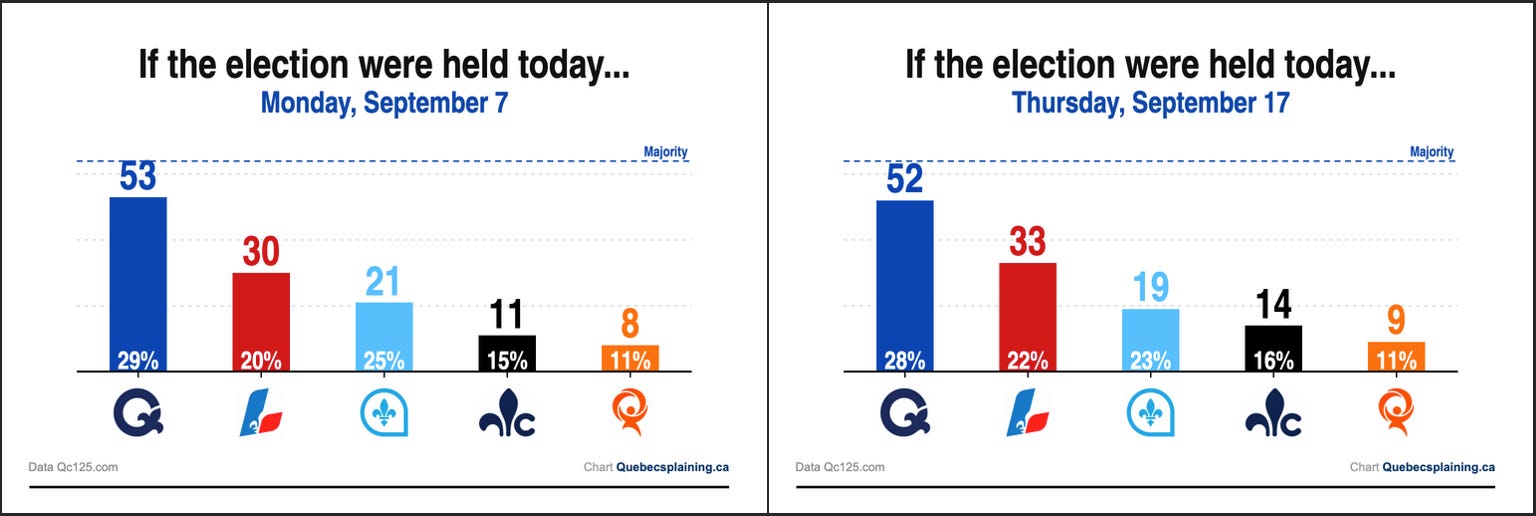
Both polls were conducted before the debates. Even so, we can see the CAQ losing a little ground in voting intentions, from 25% to 23%, and in projected seats, from 21 to 19.
Now we get to watch our utterly disproportional voting system distort the results in almost real time. It’s quite something.
The Léger poll published Tuesday captures the effect of the debates, in which Christine Fréchette gave a performance that came close to disqualifying her.
The CAQ lost another two little points. The PQ gained just one. Support for the QLP, QCP, and QS didn’t move, or at least not enough to show up in the rounded percentages. So less than one point. All told, there’s no more movement than there was between the previous two polls.
And yet those tiny shifts completely change the seat projection on Qc125.com.
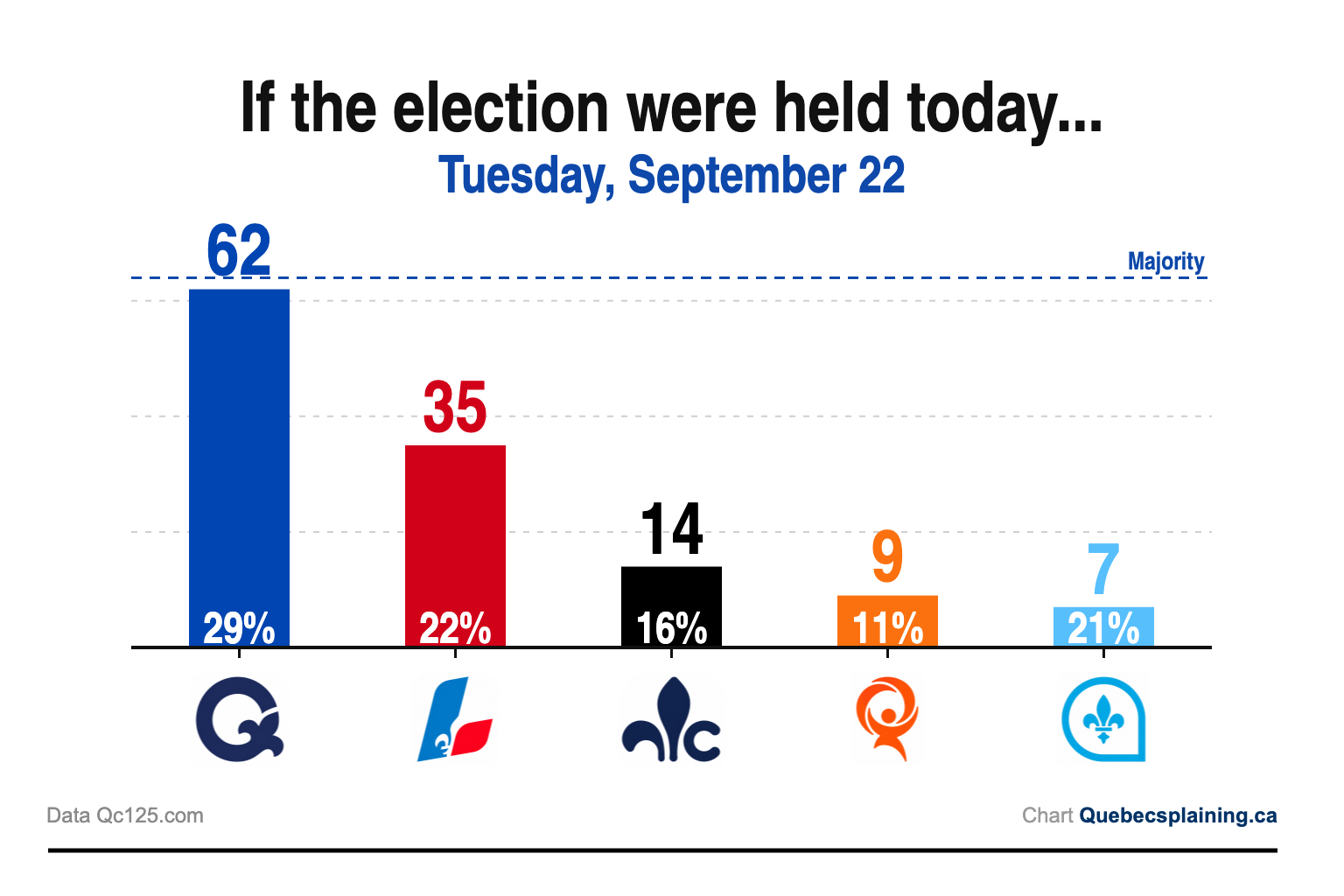
· The PQ gains ten seats with just one additional point of support, putting it only two seats short of a majority.
· The QLP gains no full percentage point, yet its potential seat count rises by three thanks to the CAQ’s decline.
· The QCP gains no vote share or seats, but moves up one place.
· Same for QS.
· The CAQ loses two points but 12 (!) seats, dropping into last place.
What happened? In three-way or even four-way races, a shift of a few points is enough to change the winner.
A party can even gain seats at a rival’s expense without gaining any votes itself. If the third-place party takes a few points from the leader, the party in second can slip through.
I played around with Qc125’s simulator. Take one point away from the PQ, half a point from the QLP, and another half-point from the QCP, then give those two points to the CAQ. The PQ loses about ten seats, the CAQ wins back roughly a dozen, and we’re essentially back where we were before the debates. Wild!
After briefly hoping it might form the official opposition, the CAQ is now in precarious territory.
If it lost another point of support, it could hope for no more than five seats. Lose two points, and it would hang on to only one or two. Lose three, and it could be wiped off the map while still winning close to 20% of the vote.
Coalition Avenir Québec came to power eight years ago by benefiting from our outdated voting system. It stayed in power after breaking its promise to change it.
On October 5, it could be brought down by the very system it refused to reform.
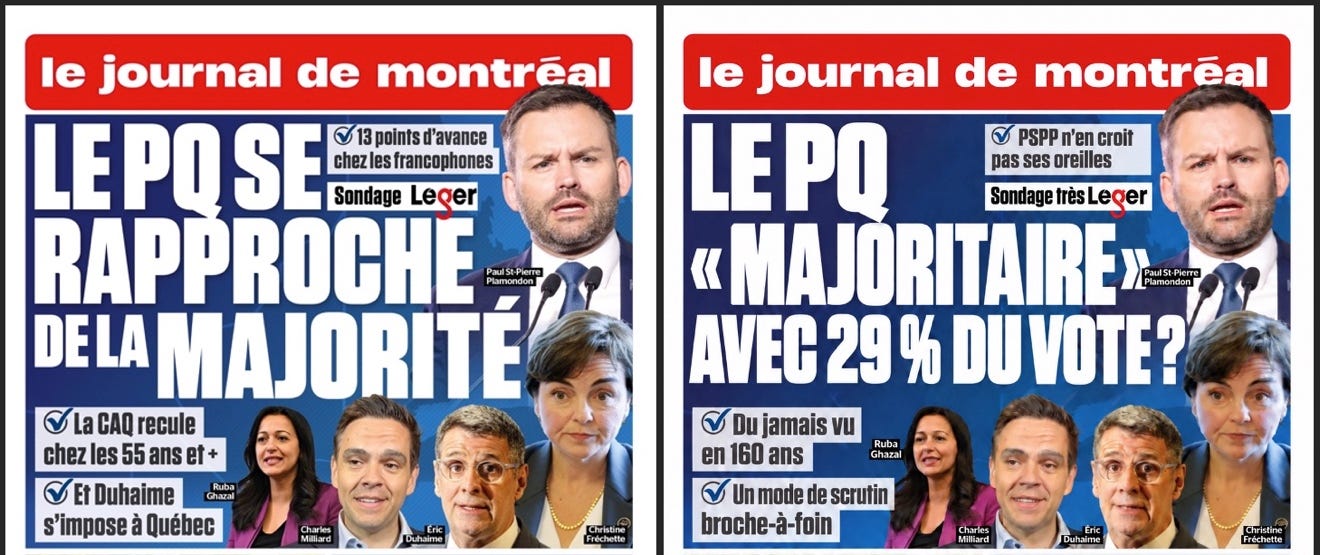
That said, I look forward to the day we stop pretending it’s normal to contemplate a majority government with less than a third of the vote.
So I made a few adjustments to Tuesday’s Journal front page.
Selective conservative outrage
“It’s pretty incredible to talk about a majority when [a party] can’t even get 30% of people behind it.”
— Éric Duhaime, QCP leader, putting his finger on the problem with our broken voting system.
But…
We need to “stop looking at people in terms of their sex, religion, sexual orientation, or gender.”
— Éric Duhaime, when it was pointed out that only 27% of QCP candidates are women.
So democratic representation matters, except when it comes to women? I suppose that if you’re worried women might “dominate” the world, that changes the calculation.
When nobody believes you anymore, keep promising
I missed this one. On Sunday, Christine Fréchette promised that every Quebecer would have a doctor or be registered with a family medicine group within four years.
I can do better: I promise every Quebecer will be registered with a doctor or a family medicine group within ten minutes.
The promise is worthless because there aren’t enough doctors. This spring, hundreds of thousands of Quebecers were registered with the stroke of a magic bureaucratic wand. But there are no more doctors than before, so getting an appointment is no easier.
Take this 98-year-old woman, who has to go to the emergency room or pay for private care. Or this 59-year-old woman, in remission from cancer. Or you, me, and all the other people who end up in the emergency room when they’re in a bind. C’est comme ça qu’on vit au Québec.
The CAQ was elected in 2018 after promising a doctor for every Quebecer.
It was an impossible promise to keep because Quebec has fewer doctors than most developed countries.
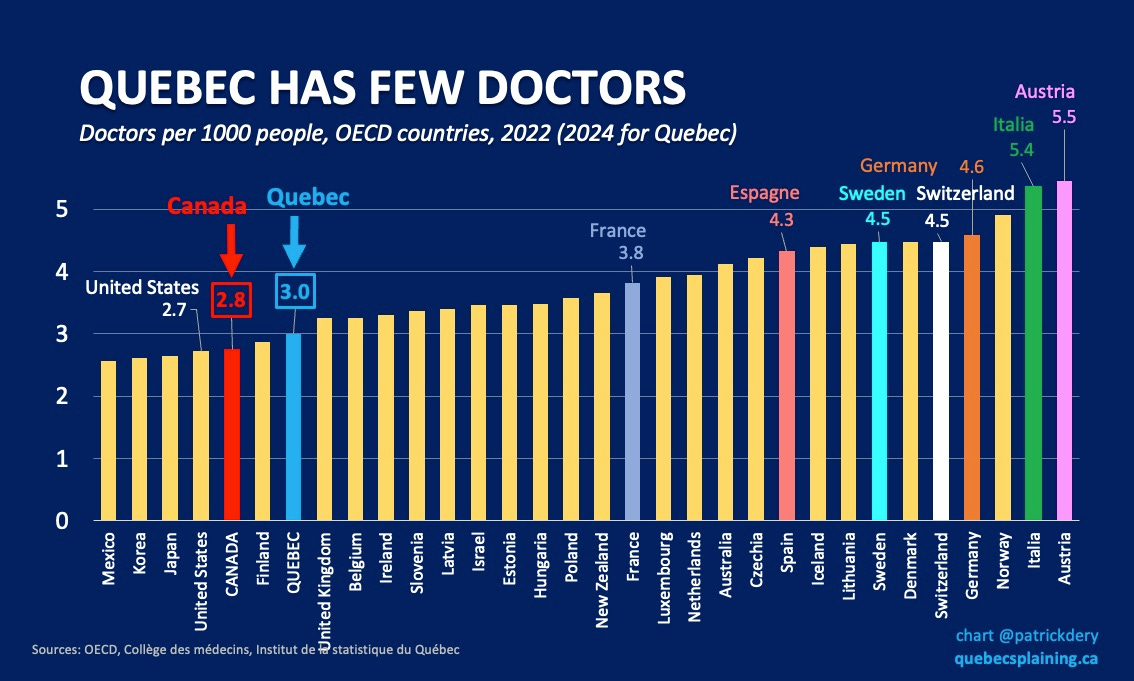
It’s been that way for years. On top of that, we make very poor use of the doctors we have.
I don’t know whether Ms. Fréchette really believes that, within four years, every Quebecer could have a doctor they can actually see. Recent experience suggests she says a lot of things she doesn’t believe.
The only promise anyone can make about health care is that it will remain bad for at least another ten years. It might become a little less bad if we start doing everything that helps right now. (I discuss the solutions here.)
That is essentially what Paul St-Pierre Plamondon said Tuesday.
It’s a bit depressing, but at least it’s honest.
-30-
My name is Patrick Déry. I’m a French-speaking Québécois writing for a living, and trying something different here. If you enjoyed reading this text, you can support me by buying me a coffee. You can also subscribe to this media (free or paid, your choice).
Comments, shares, and “likes” are always appreciated. It also helps the Substack algorithm notice me, so don’t be shy!