


While Céline shines in Paris, Paul St-Pierre Plamondon is lighting up the Quebec election campaign. Try as I might to keep things short, he keeps forcing me to devote a lot of space to him because PQ’s proposals run the gamut from the very best to the very worst.
That’s also because, despite his undeniable talent and political skill, the persona PSPP has boxed himself into often leads him to make the day’s most outrageous statements. Which, let’s face it, is no small feat when he’s competing with Éric Duhaime.
On today’s menu: the big bad federal government, to scrap or not to scrap the QST, the third and fourth links, and PSPP being set straight by regional mayors.
Let’s dive in!
Federaaaaaaal interference
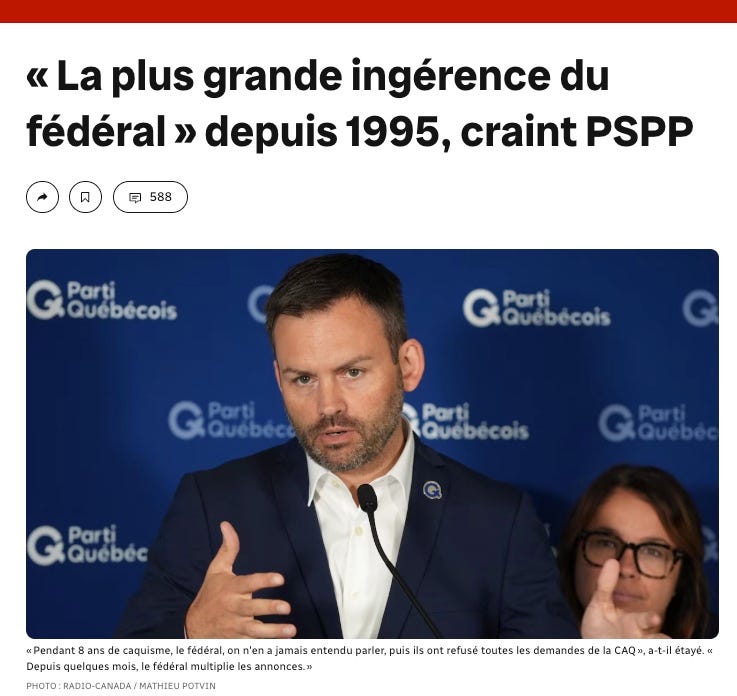
With a grave expression, the leader of the Parti Québécois stepped before reporters to denounce what he called the “worst case of federal interference” since 1995. Take a look.
What are we talking about?
The $3.5 billion Ottawa is investing to facilitate the Churchill Falls agreement between Quebec and Newfoundland and Labrador; the $11-billion contract to build icebreakers at the Davie shipyard in Lévis; and the $4.7-billion contract to build VIA Rail passenger cars in La Pocatière.
Some might see all this as welcome economic activity for Quebec. PSPP sees an Ottawa scheme to influence the election campaign.
I’m confused. And I have a question.
Should the Quebec government refuse every agreement with Ottawa on principle, just to prove that federalism does not work?
That would be incredibly stupid.
At any rate, all this gives the impression that the Parti Québécois is never happy. When the federal government does not spend enough in Quebec, the PQ complains. When it spends too much, the PQ complains about that too.
Gilles Duceppe, the former leader of the Bloc Québécois, was no federalist. Still, he used to say that “the politics of the worst is the worst kind of politics.” So he made sure the Bloc was useful in Ottawa instead of complaining all the time. That made him more credible when he did criticize the federal government. Mr. Duceppe might want to give PSPP a call. Anyway.
The caption accompanying the photo on Radio-Canada’s website also says that “For eight years under the CAQ, we never heard a peep from Ottawa, and they turned down every request the CAQ made.”
Really? Off the top of my head, without even using Google (promise!) I can think of at least two significant occasions when the federal government gave Quebec what it wanted in recent years: compensation equivalent to the funding provided to other provinces under the national affordable child care program, and tighter limits on temporary immigration.
Surely that ought to make PSPP happy, at least!
The PQ wants to reinstate the QST at the grocery store
I need help again.
This spring, the CAQ government scrapped the QST on certain grocery products, including granola bars, pre-cut fruit and vegetables, ice cream, and single-serving puddings, among other things. And toilet paper. Let us not forget the toilet paper.
The annual savings are estimated at $50 for a family with two adults and two children. Start counting your pennies.
But it costs the government $100 million. In other words, it is the perfect example of a pork-barrel designed to get the premier’s photo next to the words “tax cut” in your favourite newspaper while changing absolutely nothing in your daily life. So, a $100-million government ad, and nothing more.
The Parti Québécois wants to reverse the measure, reinstate the QST, and redirect that $100 million to where it matters: food banks, young people, and disadvantaged families.
👏
It makes perfect sense. Economists and tax experts generally recommend targeted assistance instead of spreading money thinly across a large number of people, many of whom do not need it, for a barely noticeable benefit.
Allow me to quote the news release:
“To create the impression that she was tackling the cost of living, Christine Fréchette removed the tax from cut fruit, individual muffins, and salted peanuts. That’s $100 million for a grand total of $1 a week in savings for families. It is hard to imagine a more meaningful token gesture. (…) A Parti Québécois government will offer far more useful and intelligent solutions for Quebecers who are struggling to make ends meet,” said Paul St-Pierre Plamondon.
Wonderful!

But I have a question: why, then, is the Parti Québécois still committed to scrapping the QST on used goods?
Because it is the same kind of pork-barrel promise, only worse. Everyone buys roughly the same amount of granola bars and toilet paper, in the sense that we all eat about the same amount and it all comes out the same way.
When it comes to used goods, wealthier people will get one hell of a tax break on an SUV, while poorer people will save 10% at Value Village.
If you are calling for “far more useful and intelligent solutions for Quebecers who are struggling to make ends meet,” removing the tax from used goods is exactly the kind of policy you do not want. But since the Quebec Conservative Party promised exactly the same thing, we should not be too surprised that the PQ’s proposal is more about pandering than sound policy.
What’s that? PSPP said the measure would save Quebec families “thousands of dollars” every year?
Really?
Let’s do the math. The PQ estimates that the measure will cost the public treasury between $500 million and $700 million a year, potentially saving consumers the same amount. Let’s use $700 million. Quebec has four million households.
That works out to $175 per household per year. The only people who will save “thousands of dollars” are those replacing their cars, and they will not be buying a 15-year-old Hyundai.
To wrap things up, the CAQ, which introduced the other pork-barrel policy by scrapping the QST on certain grocery products, opposes removing the tax from used goods.
Every party gets its own pork.
The number of the day: $3 billion
That is the potential cost of the Quebec Conservative Party’s highly hypothetical third link.
We will never know because the QCP will never be elected and the third link will never be built. I cannot believe we are still talking about this.
Incidentally, Éric Duhaime admits there could be expropriations on picturesque Île d’Orléans. Good luck with that.
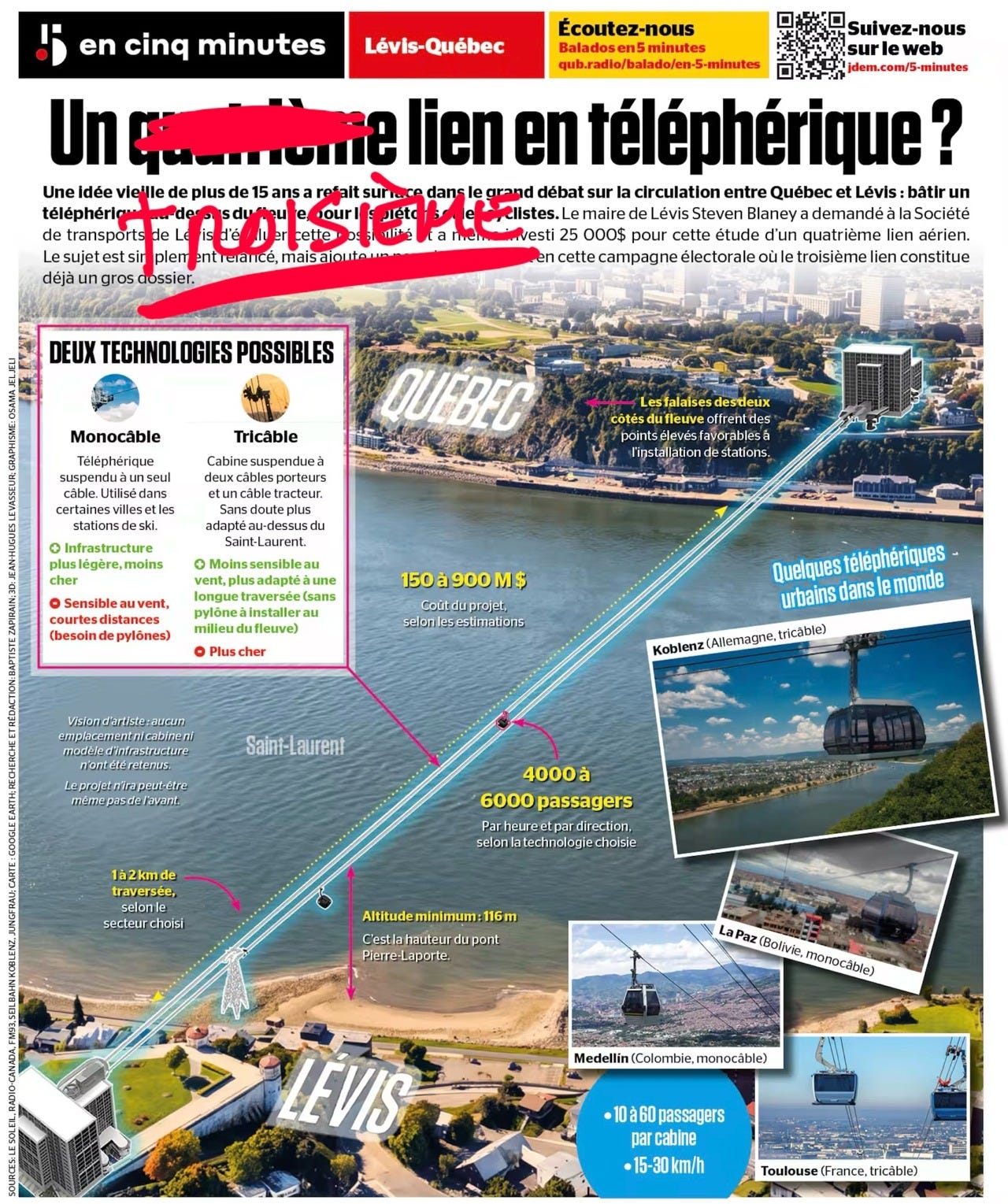
By the way, someone has resurrected the idea of a cable car between Quebec City and Lévis. It makes more sense than a third bridge/tunnel/giant load of baloney for the 160,000 people who live in Lévis. It would round out the network to the west, provide service in both directions, support tourism, business activity, and greater density in downtown Lévis. Do not laugh: with a capacity of 6,000 passengers per hour, there may be something to it.
There is just one mistake in the headline, which I have corrected.
Team Christine Fréchette wants to build more, faster, and at a lower cost
The party-formerly-known-as-the-CAQ is proposing to review safety standards by allowing some flexibility in how their objectives are met. It also wants to streamline the approval process for residential projects. Who could be against that?
Things get trickier in the last two paragraphs of the news release. “Minor renovations” in buildings with eight units or fewer would be deregulated. The construction unions will not like that.
The final sentence, in particular, is potentially explosive, at least if the CAQ manages to squeak back into office: it wants to launch consultations on a review of “the regulatory framework for the entire residential construction sector.” The construction unions will like that even less.
What is at stake? The protected status of what are known as compulsory trades in Quebec’s construction industry.
British Columbia and Ontario have seven. Alberta has 11. Quebec has 25. Quebec is also the only province that requires certification to work as a painter on construction sites, and it is the only one to require certification for several other trades as well.
None of this has anything to do with safety. Buildings do not spontaneously collapse more often elsewhere in the country. It is pure corporatism from another era, rooted in protectionist labour policies. It drags down the industry’s productivity and raises costs for everyone.
The standing joke is that it takes eight trades to renovate a bathroom: a carpenter, a plumber, an electrician, a tile setter, a plasterer, a painter, a sheet-metal worker for the ventilation ducts, and a glazier for the shower.
Meanwhile, your father-in-law does it all by himself.
+++++++
These rules might once have had some twisted logic as a form of job protection for individual workers, but that argument no longer holds up in the face of a structural labour shortage.
You only have to talk to construction workers to understand just how badly a proposal to break down the barriers between trades would go over. Think lead balloon, followed by more than a few choice Quebec swear words.
Quebec’s construction industry is a giant accounting for more than 320,000 jobs. That is one out of every 14 jobs in Quebec, and the industry accounts for roughly the same share of our economy.
But it is a sclerotic giant. Between 2013 and 2025, overall productivity rose by 8% in Quebec. In construction, it fell by nearly 11%.
PS: The CAQ has already introduced a little more flexibility across trades on construction sites, but Quebec still has a long way to go.
The CAQ wants to invest $650 million in gyms and sports infrastructure
I’m all for it. It could be $1 billion or $2 billion. Bring it on. Young people need to move. So do the not-so-young. What’s more, the previous announcement means the projects might even stand a better chance of coming in on budget.
But to borrow the wise words of Michel Chartrand a legendary union leader, a pile of money has never cut down a tree. We can make all the announcements we want, but our enormous infrastructure maintenance backlog means we do not have the capacity to build everything. We will have to make choices and give up on certain things.
I have an idea. It starts with “third” and ends with “link.”
Quote of the day:
“Just let us manage immigration.”
— Jean-Philippe Boutin, mayor of Saint-Félicien, speaking to Paul St-Pierre Plamondon during his visit.
“I have community organizations and volunteers, and we know how many people we can accommodate. Local employers go above and beyond to recruit the best candidates.”
Mayor Boutin also pointed out that his schools have not exceeded their capacity (“our school enrolment is declining”). He was skeptical of the PQ’s promise to cut permanent immigration in half.
Asked about the Quebec Conservative Party’s proposal to manage immigration regionally, the PQ leader admitted that “it’s true we haven’t thought about it on a riding-by-riding basis.”
No shit, Sherlock.
PSPP then added that he had been too busy portraying immigrants as an existential threat to the nation in the hope of peeling votes away from the CAQ to address the issue honestly and rationally. No, I made that part up. Well, almost.
This is the second time in two days that the PQ leader has been schooled on regional immigration. Yesterday, it happened in Abitibi-Témiscamingue.
Photo of the day
How many QCP candidates does it take to spell the French word “trafic” correctly?
I don’t know, but apparently more than five.
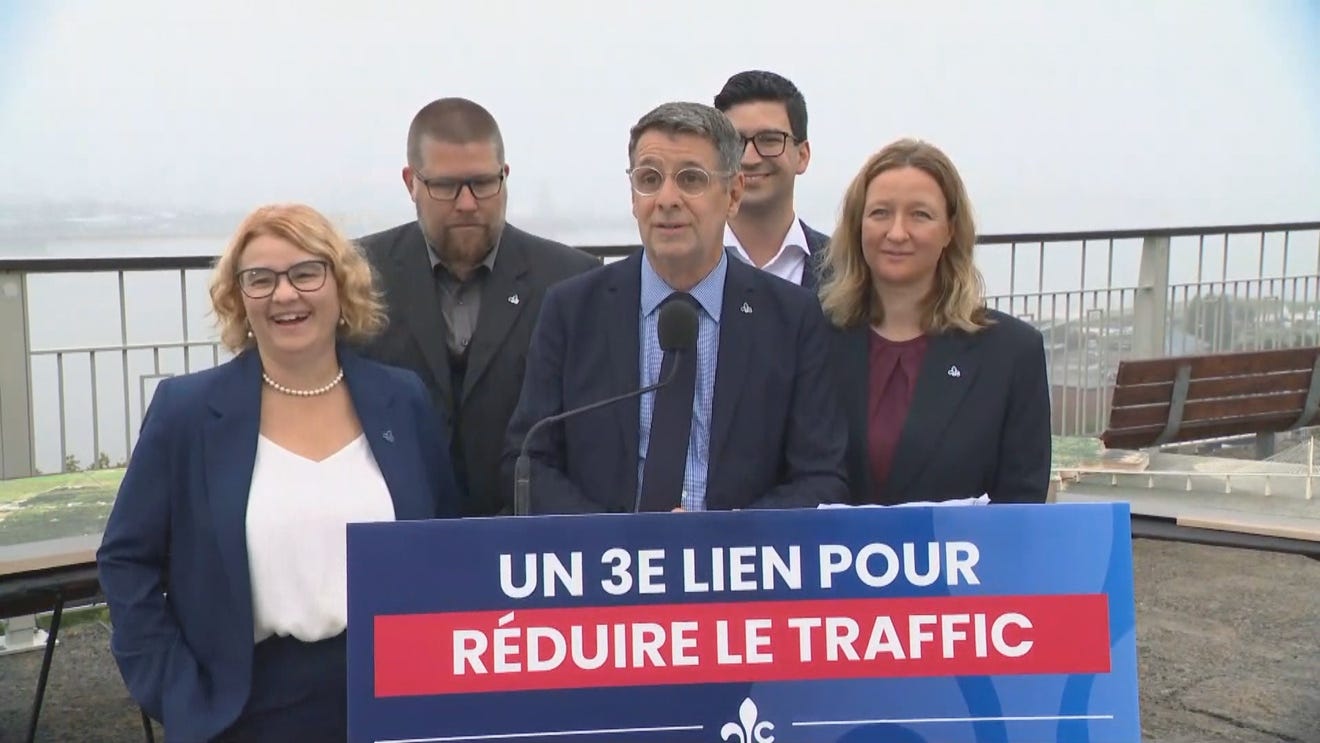
While I’m at it, I have to say that I just love those carefully arranged rows of candidates pretending to have fun next to the leader, regardless of the party. Just look at how beautiful it is.
One of them does not seem to have received the memo. Mind you, he has not had a very good week.
Via Sébastien Bovet on X.
U-turn of the day:
“It won’t take a superhuman effort to change the process and get down to three nanograms.”
— Paul St-Pierre Plamondon, promising during the 2022 campaign to meet the target of three nanograms of arsenic per cubic metre by 2026, while rightly criticizing the CAQ’s handling of the issue and public health officials’ lack of transparency.
As a reminder, the data show that the risks of cancer and lung disease are higher in Rouyn-Noranda than in the rest of Quebec, as is the proportion of babies born with a low birth weight. The community remains torn between economic interests and public health concerns. In 2022, the economy won out. Some politicians took notes, as we’ll see.
Fast-forward to the current campaign.
“A Parti Québécois government’s objective is to protect the public, but also not to sabotage agreements that have just been reached by adding another layer of uncertainty.”
— Paul St-Pierre Plamondon, suddenly comfortable with the fact that the standard is now 15 nanograms, five times his 2022 target, and will not be met until… 2030.
Previously:
-30-
My name is Patrick Déry. I’m a French-speaking Québécois writing for a living, and trying something different here. If you enjoyed reading this text, you can support me by buying me a coffee. You can also subscribe to this media (free or paid, your choice).
Comments, shares, and “likes” are always appreciated. It also helps the Substack algorithm notice me, so don’t be shy!
As an “Anglo” , love your perspective!
Knowledgeable views on Quebec politics and society is sadly lacking in the rest of the country.
Keep it coming; hopefully it will spread.